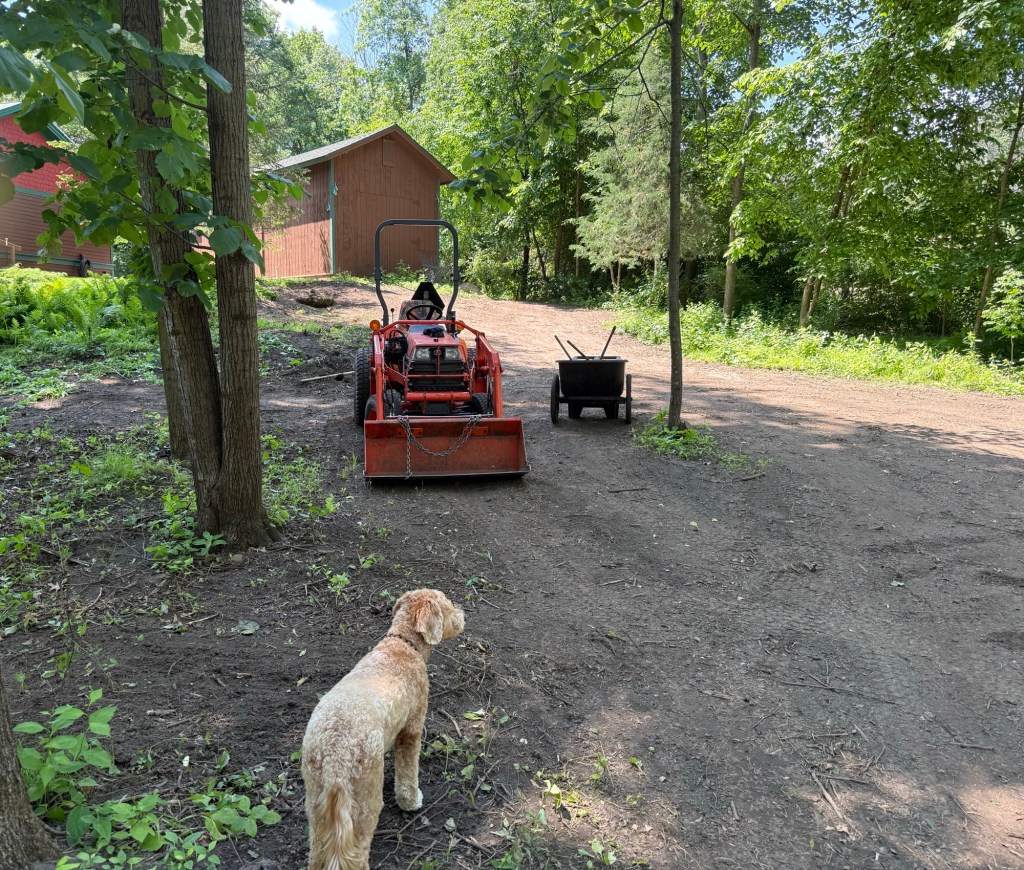
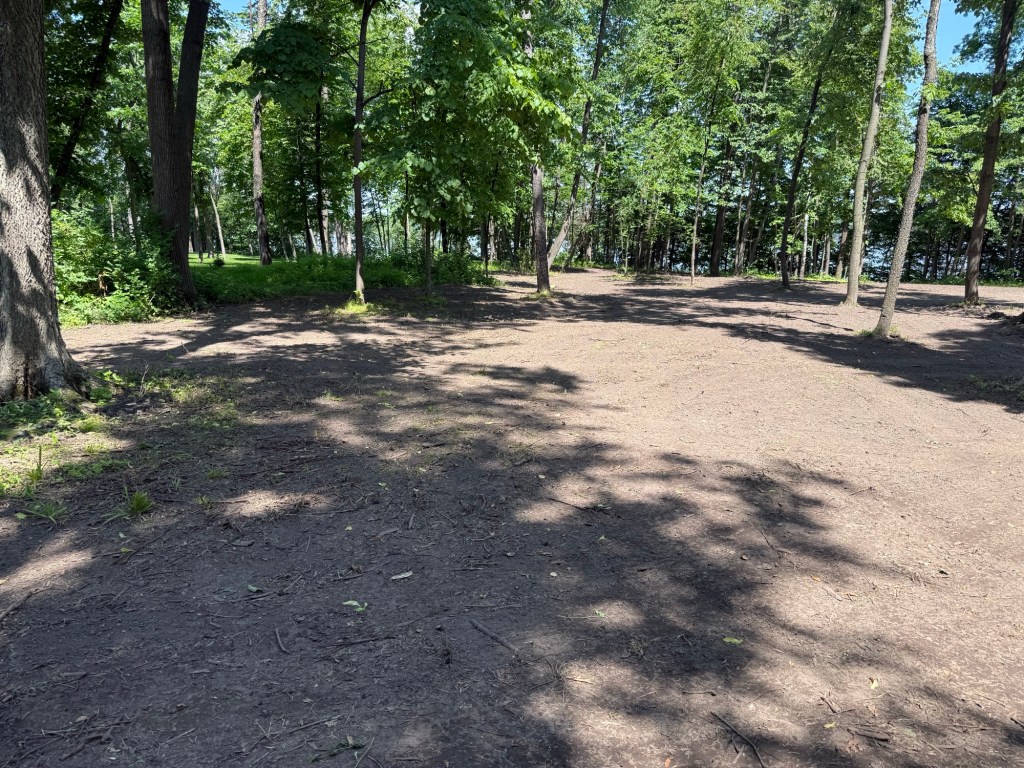
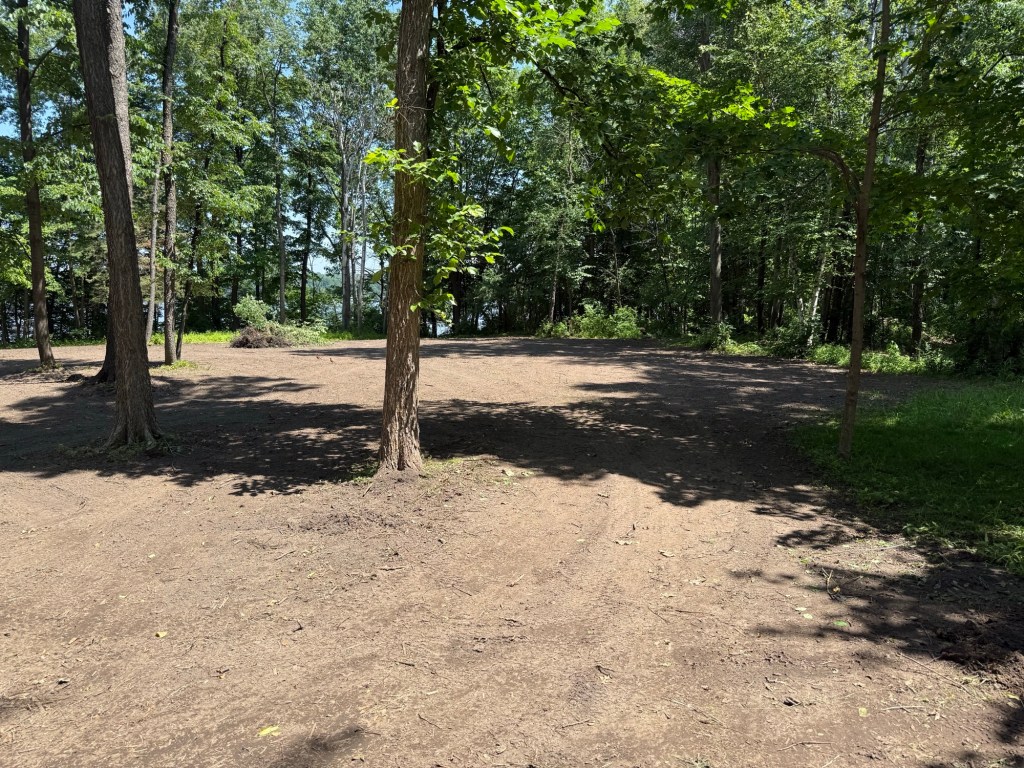
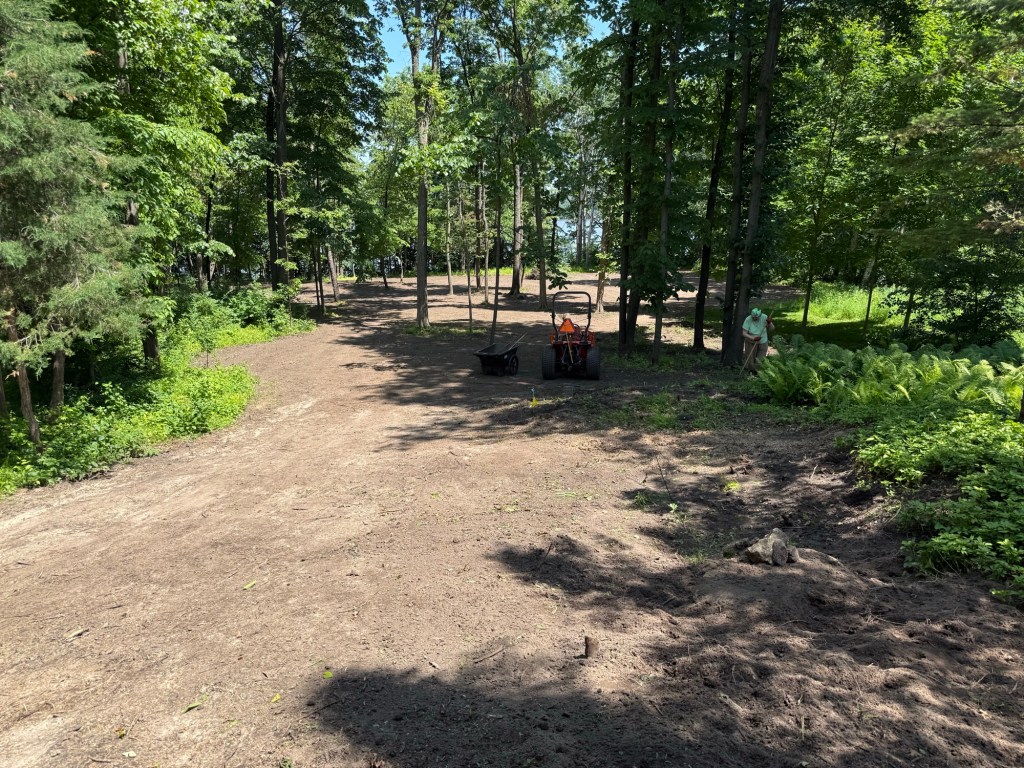
The rye grass we planted in June as a cover crop came up nicely in the “back 40”. It is an annual grass that won’t come back in the next spring.
Our goal was to plant a turf grass that would grow in the mix of sunny and shady areas, be somewhat tolerant of not being watered, and be tolerant of less frequent mowing.
The fellow at the Vermillion Elevator where I have been buying grass seed and fertilizer from in the past suggested three different grass seed mixes which got blended to make the 400 lbs of seed we needed for the “back 40”.
I contacted a fellow with a seeding implement for his tractor and made arrangements with him to come and plant the seed as late as possible before we left for Alabama.
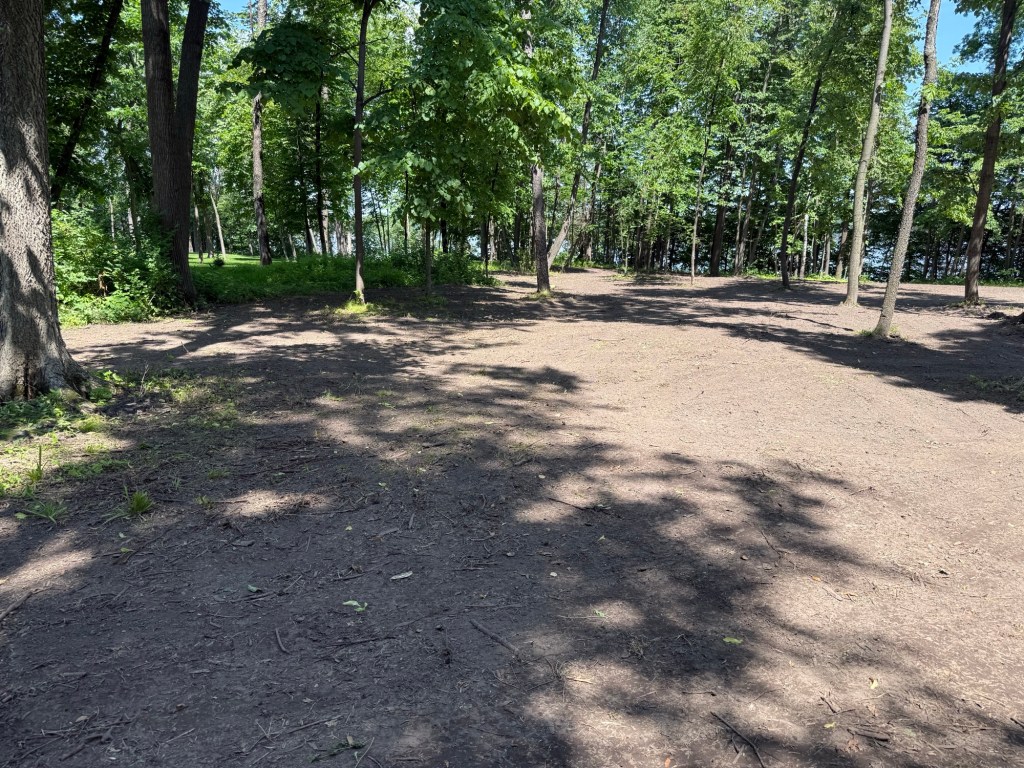
After the rye grass was removed it looked like this.
I spent about three weeks raking up the remains of the rye grass and then loosening up and smoothing the top layer of dirt to get ready to plant the grass seed. After many more passes raking and smoothing, and picking up endless sticks and rocks it was ready.
In early November it was planting day.
We started by spreading a starter fertilizer over approximately 1 acre we were going to seed.
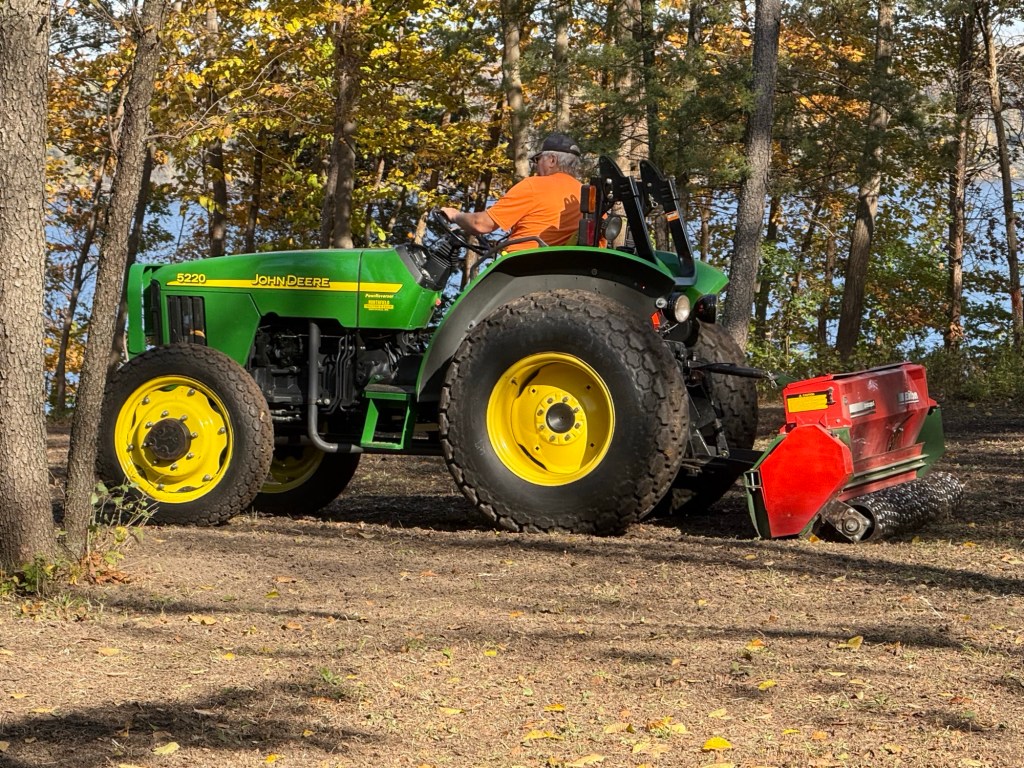
Jeff got his tractor off his trailer and loaded up the grass seed. It held about 100 lbs at a time.
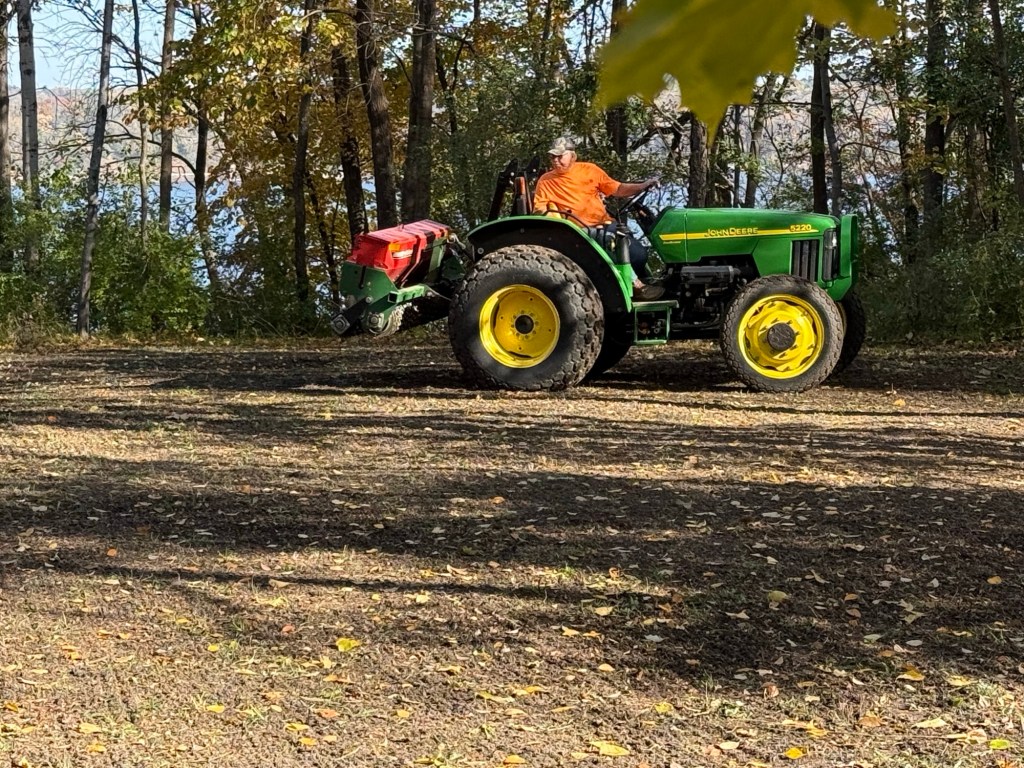
The seeder has a front roller with bumps on it. The pattern it makes looks just like a waffle. The seed is in a container behind the front roller and the rear roller. As he drives forward the seed drops into the waffle pockets. And the rear roller with the same pattern of bumps on it but shifted a bit to the right rolls offer the pockets with seeds. It makes a new pattern of pockets that fills in the seed pockets from the first roller, presses the ground down, and leaves a waffle pattern to catch water.
Jeff went back and forth East and West and then North and South. On the hill behind the barn, we spread a layer of straw to help prevent erosion.
This is called dormant seeding. The fertilizer and seed are put in place just before winter sets in. The ground is too cold for the seeds to germinate. Winter comes, the ground freezes, and it snows. And when spring comes, the snow melts and moistens the ground. The ground gets warm and the seeds germinate. Grass grows.
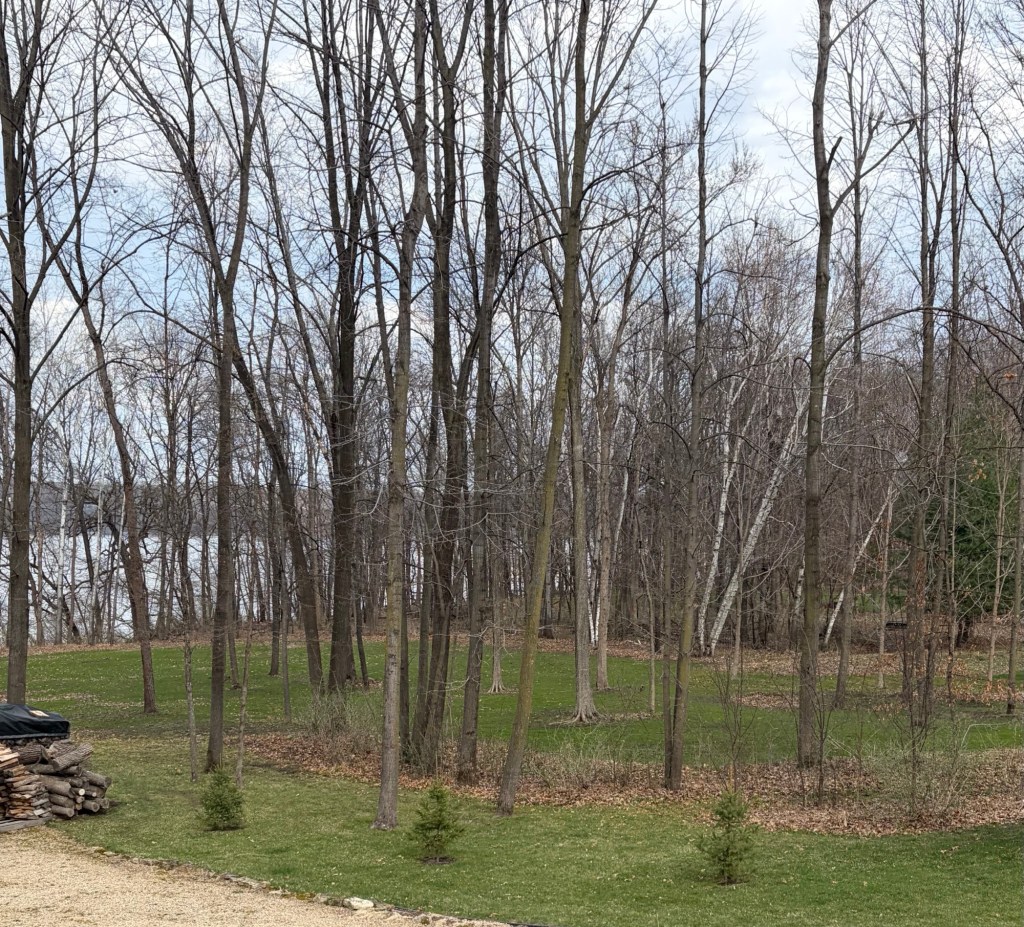
My neighbor, Dan, sent a picture of the “back 40” in early April.
Our new grass is beyond the trees with leaves around their bases. It is green!
So after all of the tree removal and months of work out in the “back 40,” it will look pretty nice. There is just more to mow. And room for Maggie to explore.
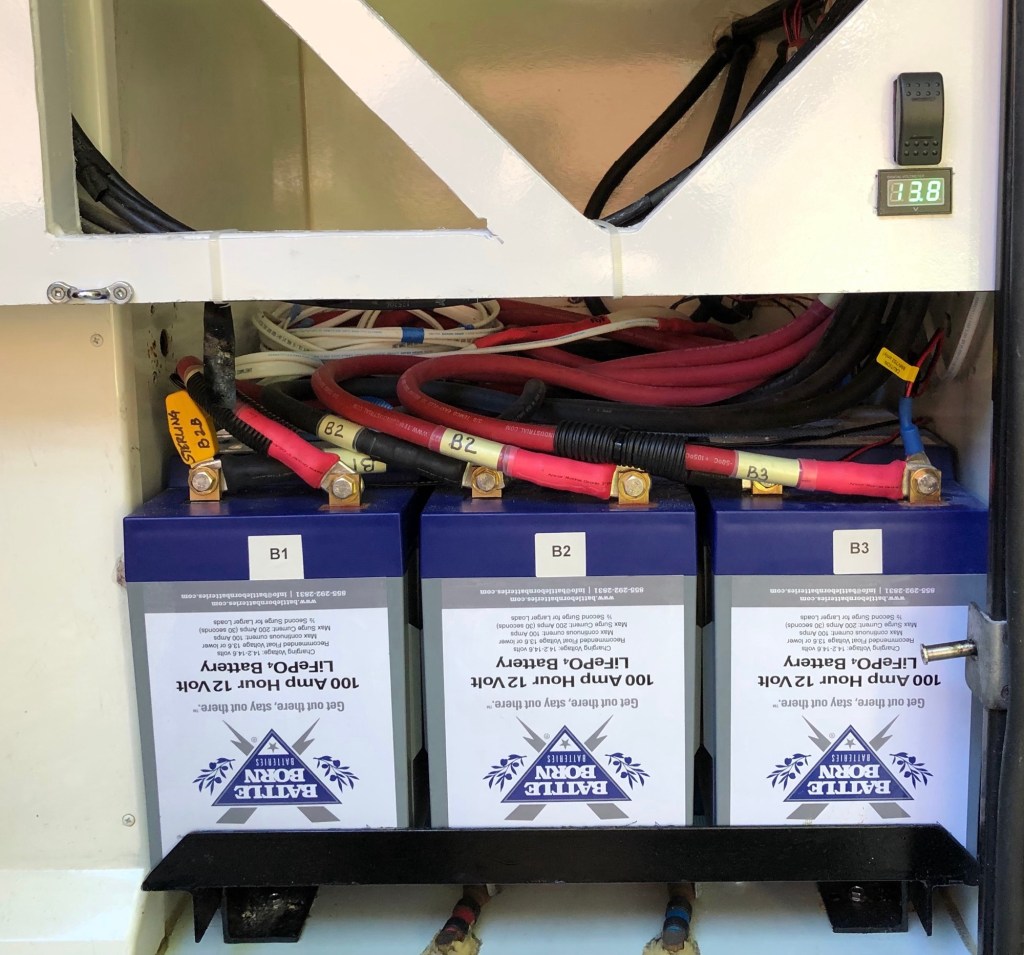
Several years ago we added 1200 watts of solar panels to our coach and 6-100 amphr LiFePO4 Battleborn Batteries. These changes included a Sterling 60-amp battery-to-battery charger, a 120V Sterling 40-amp battery charger, a Victron Multiplus 3000VA inverter/charger, Victron solar charge controllers, and new wiring and controls to improve safety and system management.
The solar chargers and the 40-amp Sterling battery charger are configured to charge both the house batteries and the start batteries.
The battery-to-battery (B2B) charger takes 12-volt power from the engine-driven alternator when the engine is running and charges the lithium batteries with a limited amount of power in a multi-stage charging process. Lithium batteries will generally take all the power that is available when charging and that often overloads the alternator. The B2B chargers manage alternator loads and lithium battery charging rates.
We were fairly early adopters of the lithium battery technology and were amazed at the improvement in available power compared to our then 7-year-old Lifeline AGM batteries. We had essentially doubled the available time we could spend running on just batteries. The solar panels were able to recharge the Lithium batteries for each day’s use on most days.
In 2024 I increased our solar capacity to 1800 watts. I could have gone to as much as 2500 watts if I had replaced all of my existing panels with newer and more powerful panels. But that meant much bigger solar chargers, bigger wiring, new fuse blocks, and combiners. A lot of time and expense.
1800 watts of solar is sufficient to recharge our normal power consumption (about 3800 watts) for about 9 months of the year. In the winter months, the power the panels produce is less (shorter days, lower sun angle) but still enough to put most of what we use in a day back into the batteries. On some days, it will recover all of our usage.
Our off-grid time is mostly in the summer and generally at higher elevations. We have gone as long as eight days with nothing but solar to recharge our batteries. During this time we ended up about 15% short of full recovery for all usage by the time we left. And we had two rainy days in those eight days.
It was an amazing stay.
Lithium battery technology has improved since our original installation and prices have come down by about a factor of four
Vatrer Batteries makes a 300 amp-hour drop-in replacement for 8D AGM batteries. They also make a 460 amphr battery that will fit into the existing Foretravel battery racks with some minor modification. These have steel cases, Bluetooth connection, a more robust management system, and an on/off switch. You can get them with internal heaters for extreme conditions. We have never seen conditions in our battery bay where there has been a need for battery heaters.
I bought two Vatrer 460 amphr batteries in January 2025 and had them delivered to my neighbor at home. I was going to keep my 6 BattleBorn batteries and make a second battery bank using the 2 Vatrers batteries. This was a fairly complicated project. I had to make a new battery rack, wire up new switches, fuses, and electrical bus bars. And make lots of new cables.
I was explaining all of this to someone and they asked why I didn’t just sell my Battleborn batteries to someone and use the Vatrer batteries in the existing battery bank. I didn’t think I would find a buyer for them but as soon as I looked for a buyer, they got sold.
So I ordered a third Vatrer 460 amphr battery and a few more parts I needed to use three Vatrer batteries in my house battery bank.
In August, my friend Dave came to Hastings. His coach is the same year and length as ours. We removed his old AGM batteries, his original battery racks, and the LP tank.
We removed the Battleborn batteries from my coach as well as the panel with the switches, fuses, battery shunt, and bus bars, and the battery rack that held the Battleborn batteries. We also removed the panel with the Sterling battery-to-battery charger.
We reinstalled all of these components in Dave’s coach. It was pretty easy to do, everything just fit in his coach as it had in ours. We made a few new cables for the battery-to-battery charger and installed that in the bay where his big LP tank had been.
This swap doubled his battery capacity compared to what he had, improved his charging capacity while he drove, improved safety, and added much more useful information about his battery state of charge status.
We double checked everything, turned it all on and it was working as expected. We started up the coach’s engine and checked the charging through the Battery to Battery charger, it was about 55 amps. Just what was expected.
So Dave had a new house bank of Lithium batteries for not much more than he would have spent on a new set of Lifeline AGM batteries with about half the capacity of the lithium batteries. And the lithium batteries will last about three times as long as the Lifeline batteries would have.
So, if you need to replace batteries in your RV, lithium batteries provide more capacity, longer life expectancy, and more reliability and safety. And they are much cheaper over time than AGM or GEL batteries. You are very likely to never have to buy batteries again.
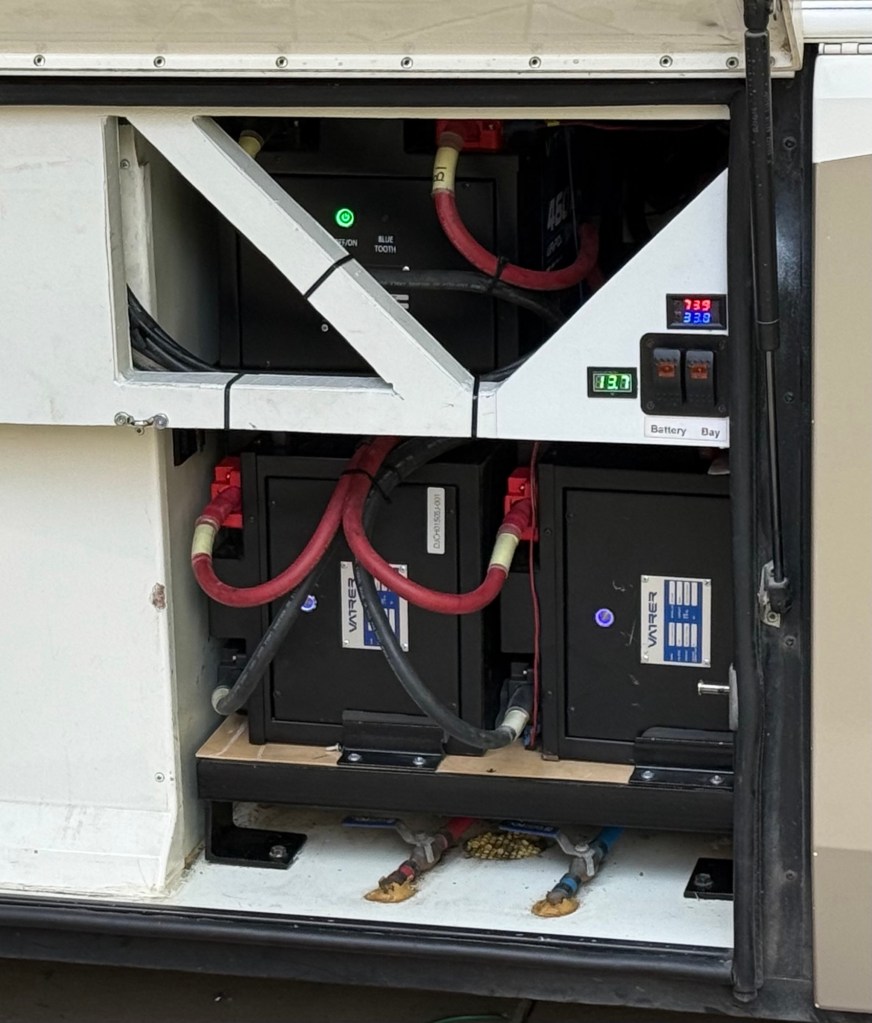
I modified the Foretravel battery rack to fit the Vatrer batteries, I needed an extra half inch in the lower rack to fit the batteries crosswise (side to side) rather than lined up with the length of the coach. This made the battery connections much easier and provided better access to the batteries built-in on/off switch.
The upper battery is mounted with the terminals facing up. The lower batteries are mounted on their sides with the terminals facing the front of the coach.
All of the plus and minus 3/0 battery cables are equal in length within 1/8”. They connect to the plus and minus bus bars. Each bus bar is followed by a disconnect switch. The plus side continues on with a 400 amp fuse and then to the coach common plus distribution point. The negative side continues on through a Victron Smart Shunt and then to the coach’s common negative distribution point.
The green digital meter is the battery voltage. The red digital meter shows the temperature in the battery bay. The blue meter shows the lower temperature at which a temperature controller powers the fans that move warmer air from the AquaHot bay into the battery bay.
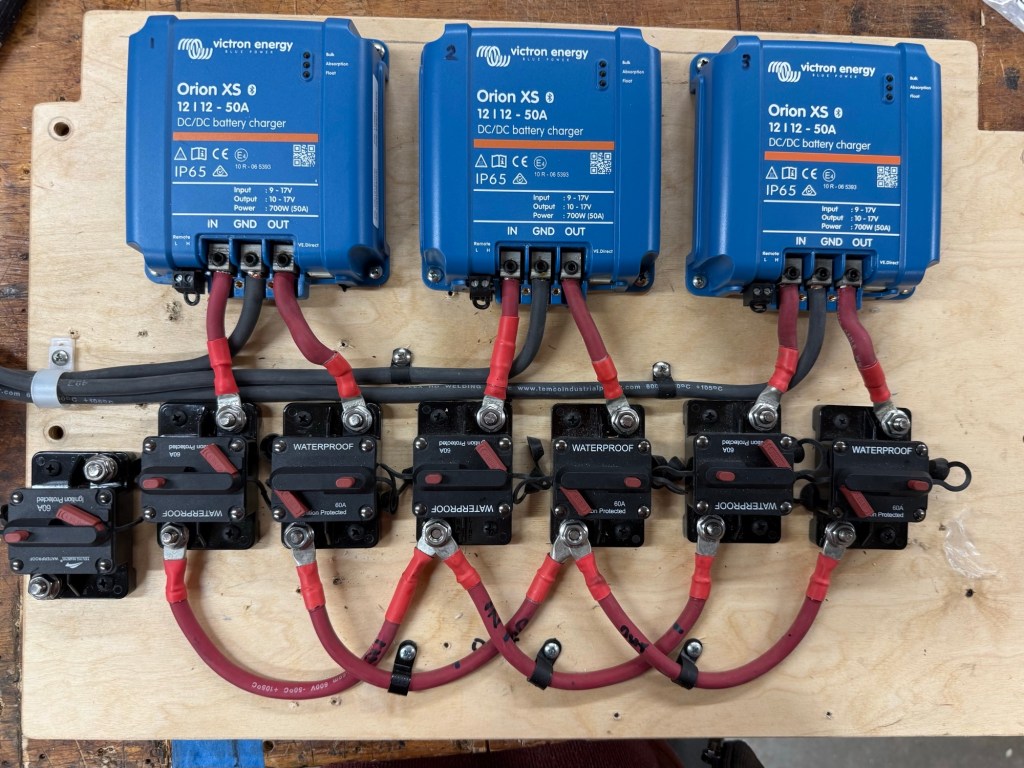
There are three Victron 50-amp battery-to-battery chargers on the back wall of the bay where the original LP tank was located. The B2B chargers were mounted on a panel in the shop. This makes it much easier to install in the coach, just mount the panel and hook up just a few cables.
Once everything was connected connections were tested, the output of each battery to battery chargers was confirmed and the chargers were turned on to bring all of the batteries to 100% charge.
I wanted to run an endurance test. The coach was in the barn so no solar power. The landline connections to the coach were disconnected. The refrigerator was on, the basement freezer was on, the AquaHot heat was on, the lights were on, and the internet electronics were on. The inverter was on supplying 120v power. This is a pretty complete basic load on the batteries.
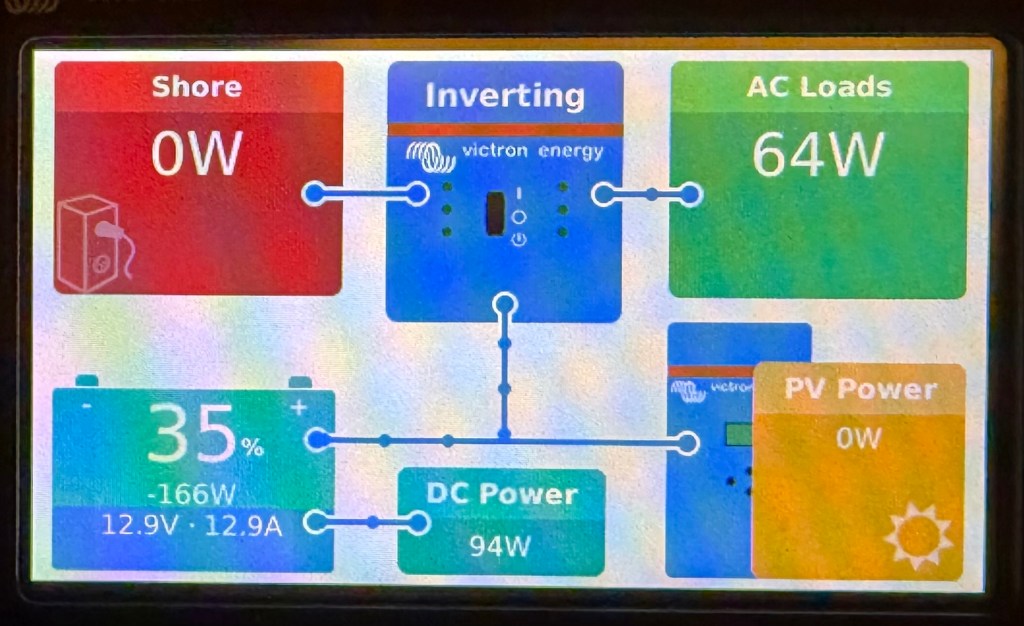
The timer started. 72 hours later the battery bank capacity was at 35%. There was enough left to go another full day and still have about 14% of total capacity remaining.
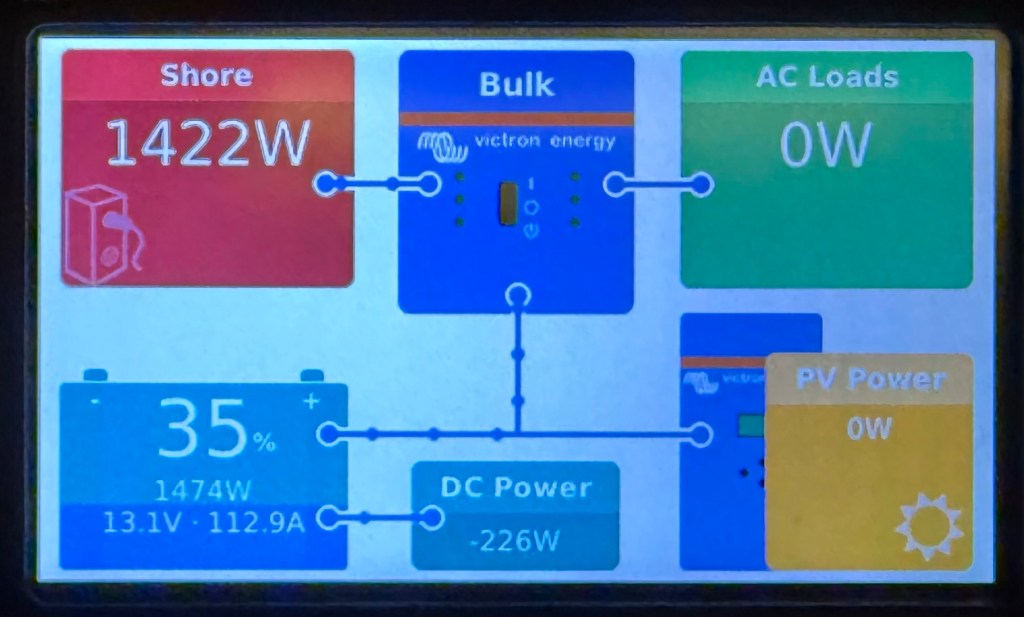
I reconnected the landline. The 120v loads switched to the landline and the inverter quit inverting. The charger started Bulk charging. The 40 amp charger came on as well. The two chargers were adding a net 1474 watts (113 amps) into the house battery bank.
The charging rates and voltages change as the batteries return to full charge.
This was a pretty good test, I was pleased with the performance.
When we left for Alabama in November we stayed at Walmart’s for the first four nights. When we arrived at Walmart each night the batteries were at 100% charge from Solar charging and the Battery to Battery chargers. And then from about 4PM to around 9AM when we left in the morning we would use about 15-18% of battery capacity. We made coffee with the coffee maker, cooked with the induction cooktop, used the microwave, and ran the refrigerator and freezer in the coach and the freezer in the basement of the coach.
Once we started driving the batteries returned to 100% charge usually by noon.
In Orange Beach, all battery charging is being done by the solar panels. And all 12-volt loads are being supplied by the lithium batteries. We use as much as 4% of our battery capacity overnight and that is usually recovered by 10AM.
The Vatrer batteries have an expected life of 5,000 charge cycles. Each cycle is 100% charge to 0% charge and back to 100%. If we used 50% of our capacity every day and recharged to 100%, that would be 1/2 cycle per day. For 5,000 cycles we should get 10,000 days. That is 27 years. We won’t ever have to buy batteries again. And not the next owner either.
Here comes a bit of techno-babble. It is more to document what we did than anything else.
Last fall while we were in Nacogdoches, TX, I took some time to look closely at the 24-year-old exhaust system on the coach. There was one junction between a 5” exhaust pipe and the main muffler where a hanger had completely rusted away and quite a bit of the joining parts were rusted. And I found several small holes as well, almost all were in welded seams.
And the year before, the 5” diameter chrome exhaust pipe tip just fell off after the steel pipe it was connected to rusted through and the hanger failed.
We got an on-the-road fix for the exhaust tip, but not before the hot exhaust melted some wire cover and damaged a tail light.
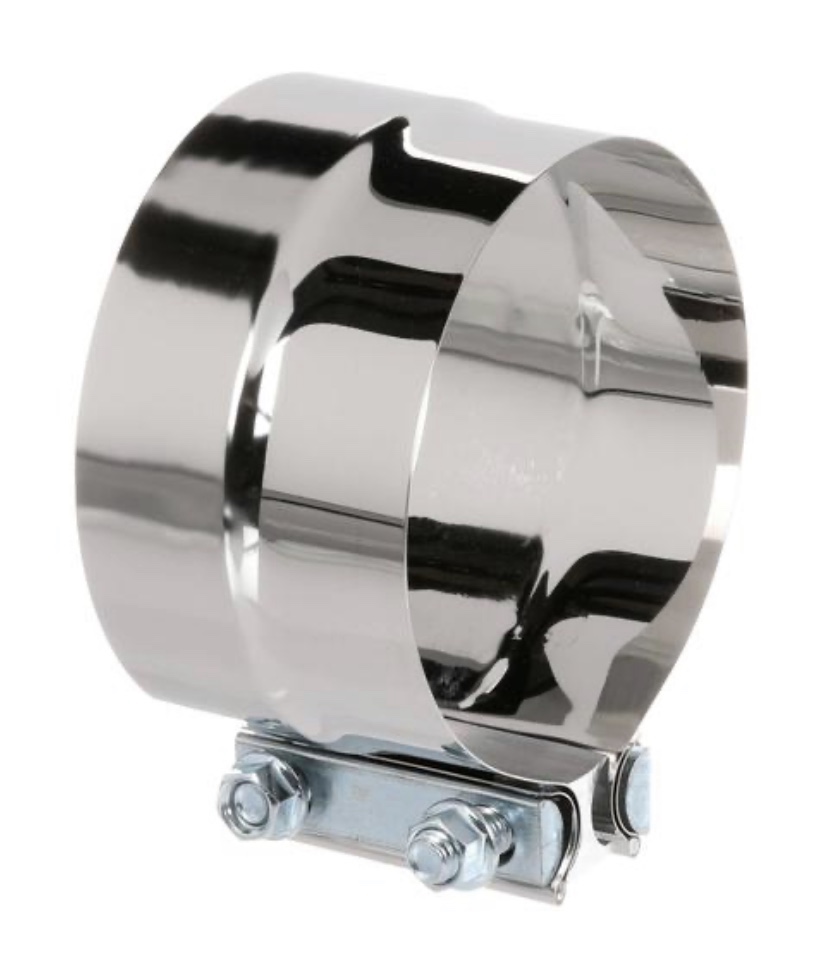
While in Nacogdoches, I removed the rusted hanger and put a 5” band clamp pipe connector over the rusted pipes and a new hanger.
These worked well. I used a generous amount of red high-temperature silicone sealant and the clamp to hold the rusted parts together and give me a place to attach the replacement clamp.
I sealed up the small holes as best I could with sealant and off we went.
So a new muffler was another line item on the summer’s projects list.
The common way to replace the original Foretravel muffler (which is the size of a small trash can) is to route some 5” flex pipe to a resonator and then out through the rear end with a new exhaust tip.
The resonators are mostly about 16 inches long and make the noise level of the exhaust system significantly louder than the original system. I know several people who have gone that way and I didn’t like the extra noise especially when you are starting up and departing a campground.
So I started looking at other options. One might have been to put two short resonators end to end. I found no one who had done that or any reports of noise reduction.
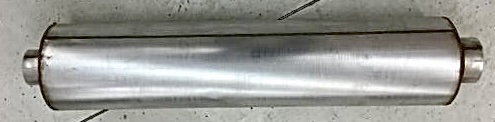
I then found truck mufflers made by Donaldson. They had 5” inlet and outlet pipes. The body of the muffler was about 45 inches long. These came in different materials from steel to stainless steel and different levels of sound attenuation.
I spent quite a bit of time under the rear corner of the coach measuring and visualizing how the exhaust system would work.
I decided it would work so I ordered the stainless steel muffler with the greatest sound attenuation and all of the parts I thought I would need to get this project done.
Once everything was delivered and the weather looked clear for a few days I slipped this project in while still working on the tree clean-up project.
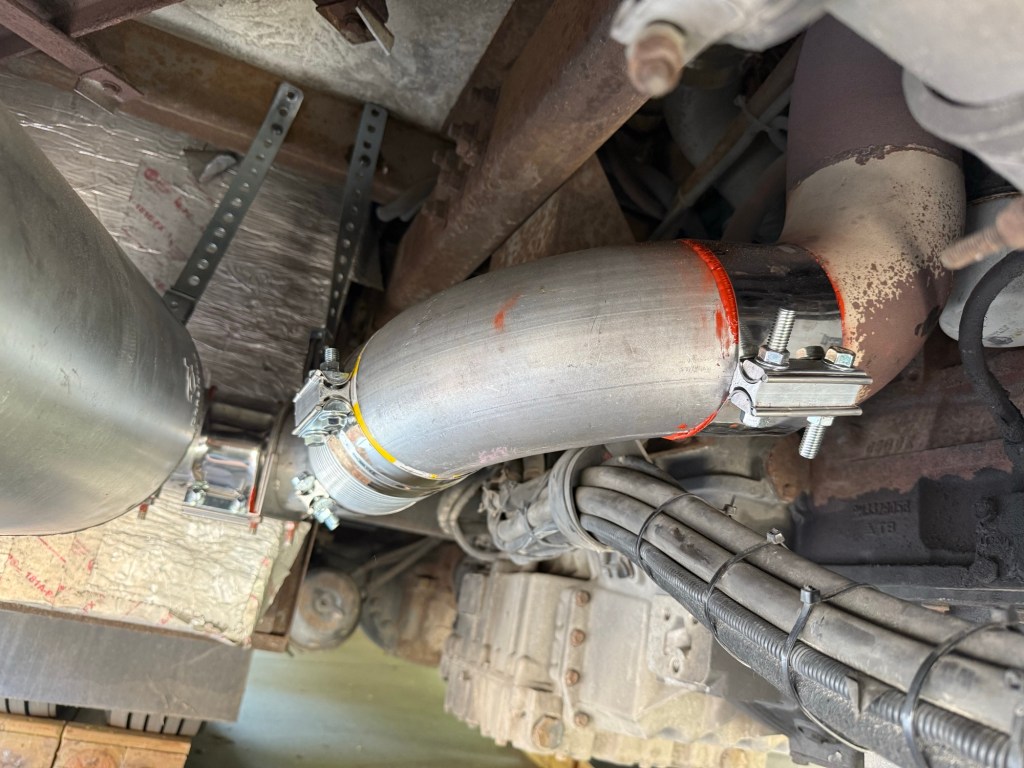
The exhaust from the engine turns the turbocharger which increases the pressure of the air going into the engine. After the turbocharger, the 5-inch exhaust pipe turns 90 degrees and points down, and then another 90 degrees and points towards the side of the coach.
My idea was to add another elbow to turn the exhaust pipe so that it pointed forward and then add a 180-degree U-shaped pipe to turn it back towards the rear.
All the measuring and planning help, but when it comes to actually fitting parts together there is always a lot of trimming and fitting to make it happen the way you want.
I cut off part of the elbow pointing to the side of the coach so that the next elbow pointing forward would be lower. I used a 5-inch pipe to join two pipes of the same size butted up to one another. This was sealed up using a generous amount of red high-temp sealant. When this is all tightened up and the sealant cures it is a rock-solid connection.
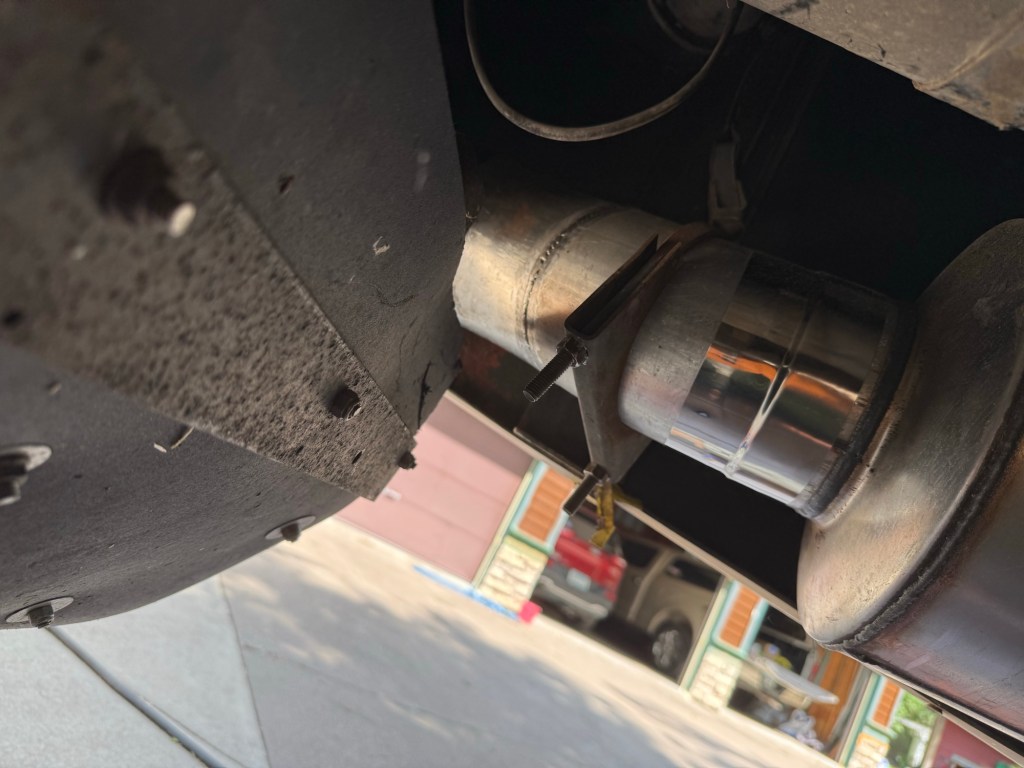
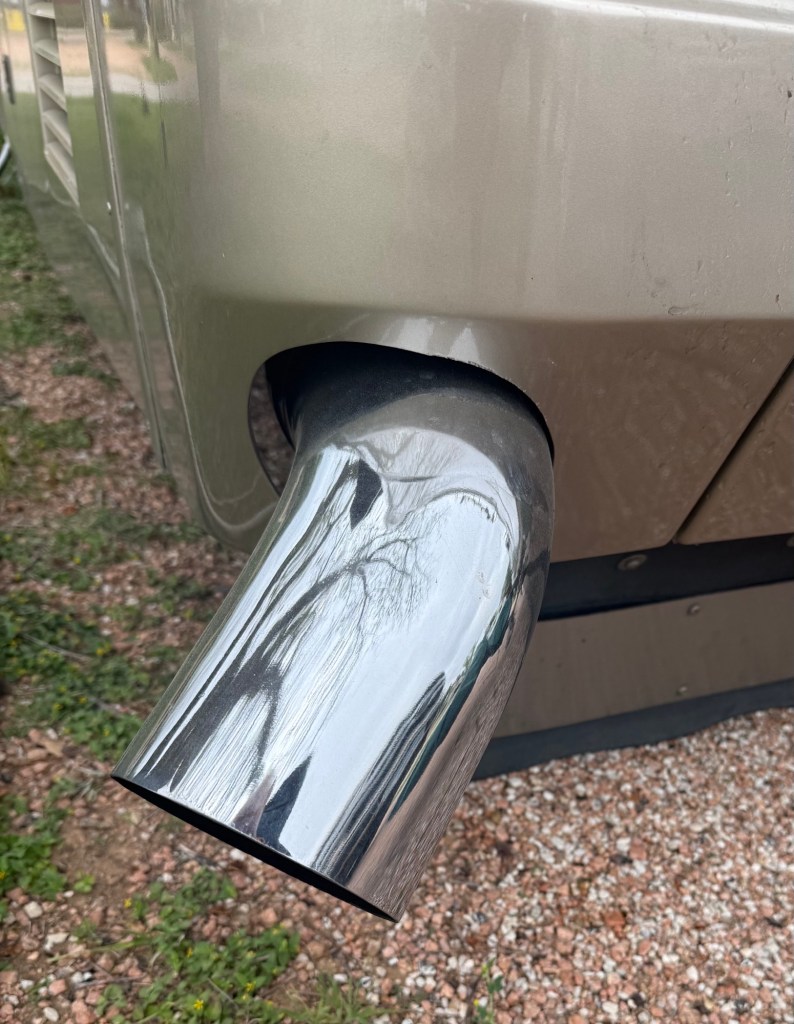
The U-shaped pipe would connect to the front of the muffler. At the rear of the muffler, there needs to be a 5” offset S-shaped pipe that connects to the chrome exhaust tip which goes through a hole in the coach body.
I assembled the U-shaped pipe to the muffler and the S-shaped offset pipe to the other end of the muffler and then propped it up in its approximate position to see how it was going to fit. I needed clearance where the muffler went by the air conditioner cooling fan, it needed to line up with the hole in the back of the coach, and the U-shaped pipe needed to line up with the elbow pointing forward.
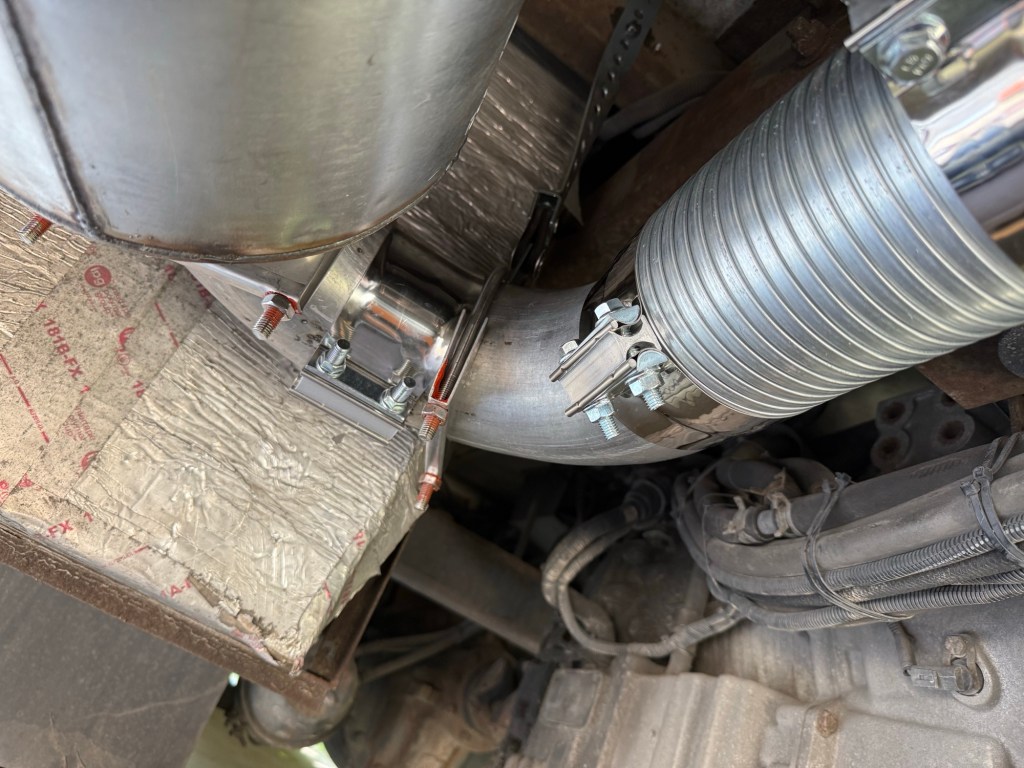
A few adjustments later I had it lined up pretty well and determined I needed to add a section about 8 inches long to make everything fit. That is where a section of stainless steel flex pipe and a couple of additional clamps come in handy.
You can see in the picture above the flex section connected to the U-shaped pipe which is connected to the muffler. The U-shaped piece was made from two ninety-degree sections cut to fit and welded together. I put another connecting clamp and plenty of sealant over the welded joint to make sure it sealed up.
There are a pair of pipe clamps there too which hold one end of the hanger straps to support the front end of the muffler and assembled pipes. The straps are anchored to the coach frame above.
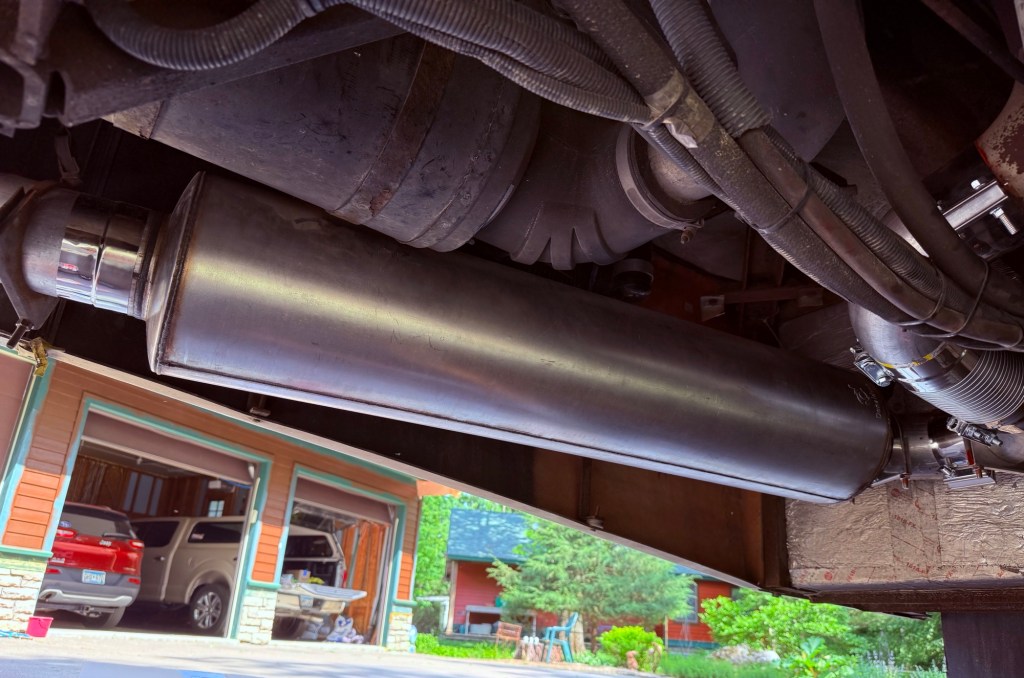
Now you can see the ten-inch diameter muffler heading towards the rear of the coach. The five-inch offset pipe is connected to the rear of the muffler with another pipe band clamp. There are two more hanger brackets attached just to the rear of the band clamp.
This is all pretty close fits. You don’t want anything shaking or loose, nothing too close to anything else that might not do well if it got too hot, and the exhaust tip has to come out through the hole at the rear of the coach with clearance all around.
The exhaust tip is not quite centered in the hole but there is clearance all around. I needed more clearance near the AC fan shroud. An extra quarter inch in the offset pipe would have helped. These are some of the fit issues you just can’t see until you start putting things together.
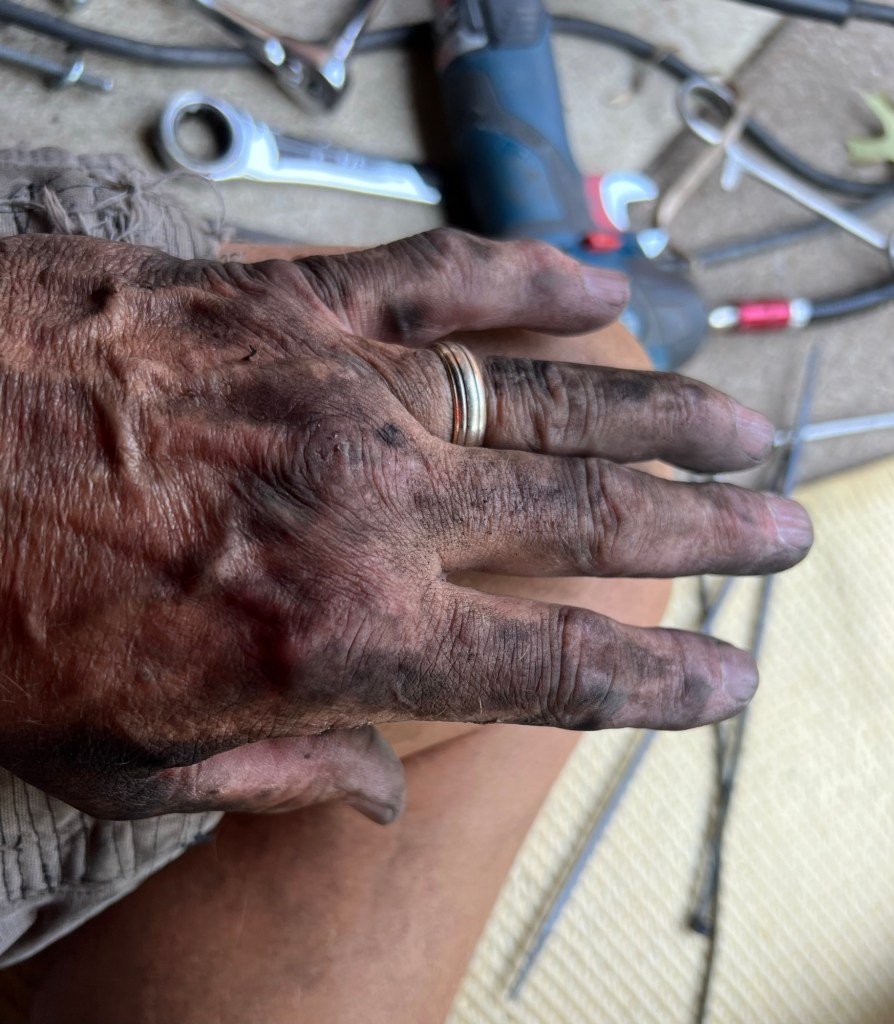
This project took three days to do. I was short a couple of parts and had to order them. The total time was maybe 6 hours. I scraped up a knee, a couple of knuckles, and got dirty. All common results working on under the coach projects.
I double-checked all of the nuts and bolts to make sure they were tight. I drove the coach for about 40 miles to make sure it got warmed up and then tightened everything again. I did the same after a longer drive later in the fall.
Did it work? Nothing fell off and the nuts and bolts are staying tight. It is much quieter than just using a resonator. I think it is about the same noise level as the OEM muffler but that is very subjective. It sounds different from the OEM muffler, I can hear a bit more of a roar going through a tunnel or under a bridge but in normal driving little if any difference.
All of the parts were about $800. I could have saved a hundred bucks or so if I had not used the most expensive muffler. I have several band clamps left over and a hanger clamp. That might be $100 worth of spare parts. Taking the coach to the factory or one of the service places in Nacogdoches to have this done would have been at least $2,000.
Another project checked off the summer list, Bob’s your uncle.
We had to get rid of the stumps before we could do much about getting rid of the sticks and grading everything out.
I had contacted a stump grinder who agreed to come to grind them up. Since we had first started picking up sticks the grass in the woods had started growing up. So I spent several days wandering around marking stumps with spray paint. Lots of the stumps were easy to see, and many I found by tripping over them or stubbing a toe. I marked over two hundred and fifty stumps.
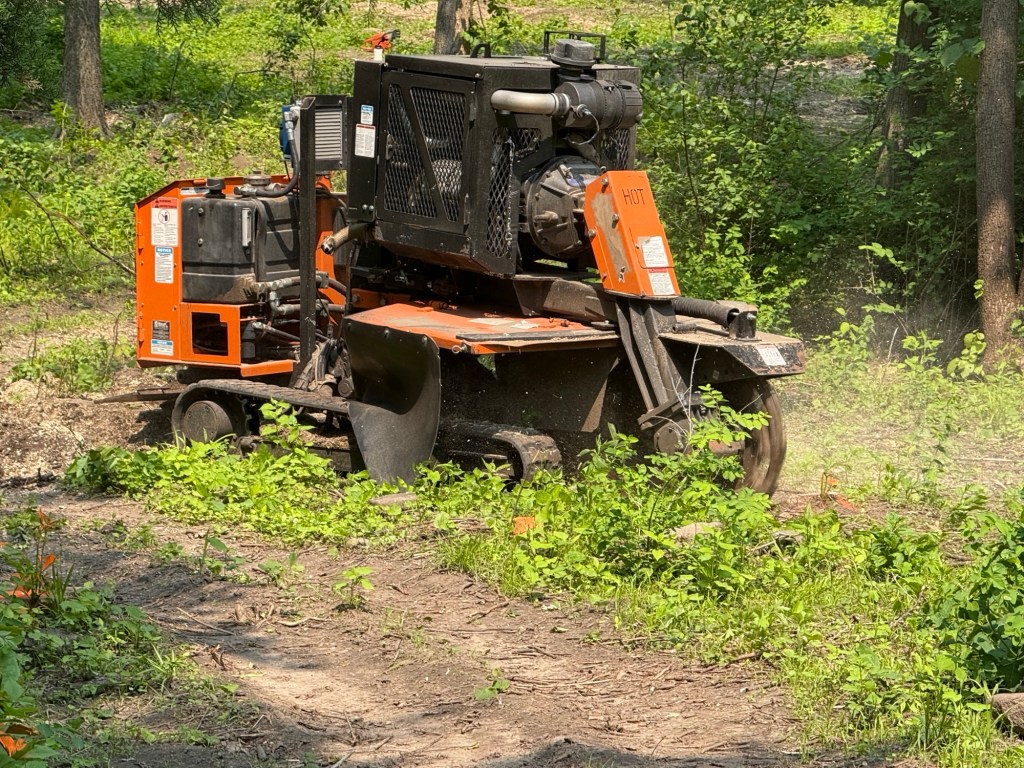
The stump grinder charged $275 per hour. He arrived with his grinder on a trailer. It was about the size of a medium skid steer. It had tracks and a big arm in the front with a grinder wheel. No one rode on it, it was remotely controlled.
The stump grinder/operator had at it. He started behind the barn. He ground down the stumps to about 4” below the surface and left the ground-up bits where they fell.
This was amazing to watch. The machine approached the stump guided by remote control, the big toothed wheel started spinning, the arm lowered and moved back and forth, dropped a bit for a better bite, and back and forth, maybe forward a few inches and the stump was gone. There was a pile of ground-up stump bits that looked like mulch.
No wasted motion, the machine moved on to the next stump and continued feasting on stumps.
There was one old tree stump, maybe 4 ft high and 20 inches in diameter. It was an insignificant challenge to the roaring grinder. Chips flew and the old stump disappeared.
After just over 6 hours the grinder machine and its operator had traversed the whole of the now treeless woodland and up the hill on the east side of the property having its way with every stump it came to. 275 in all. About one and a half minutes per stump, about $6.10 each. What a bargain!
Green grass
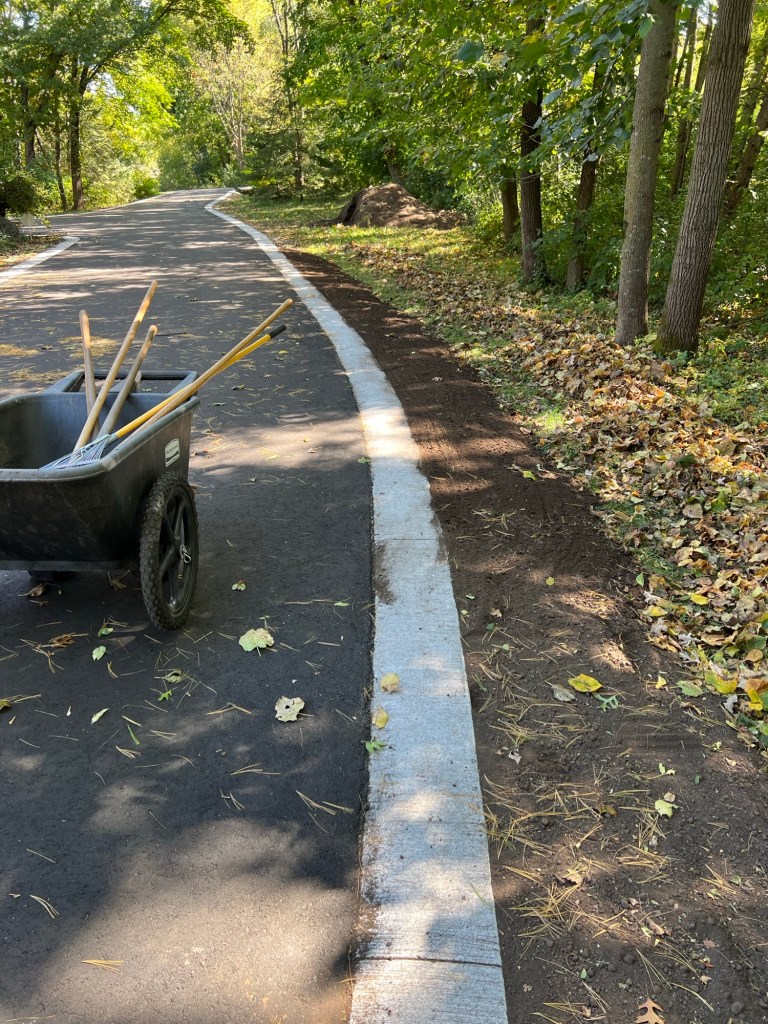
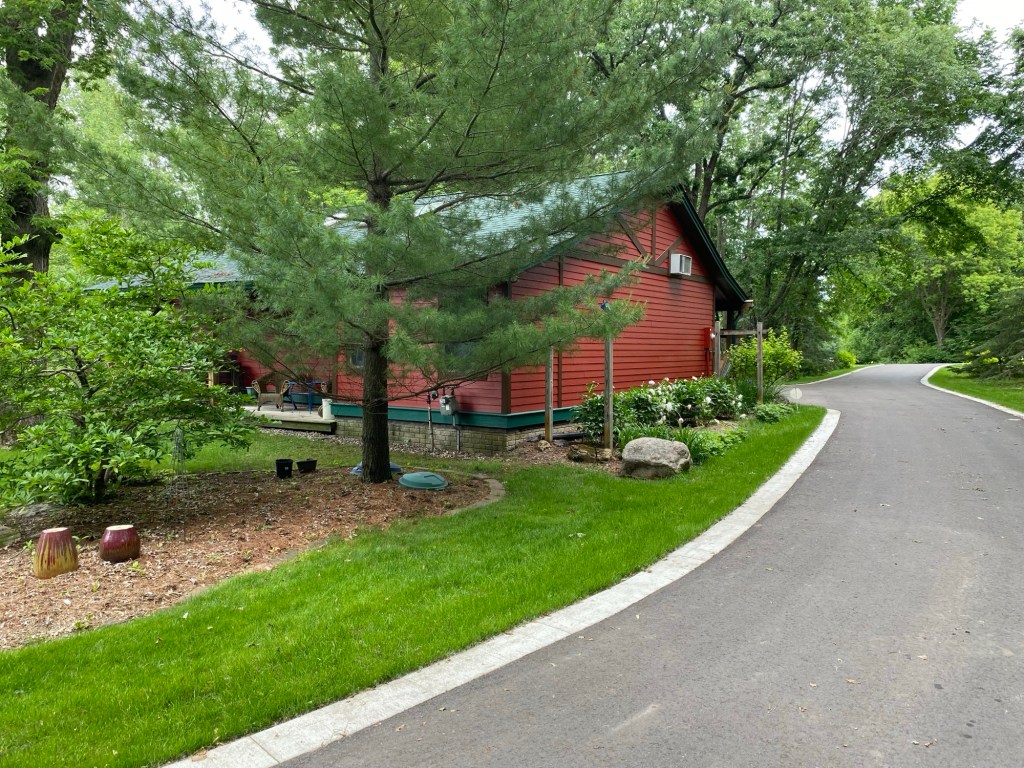
Last fall after we put in our new driveway, we had to adjust the grade from the curbs to the surrounding area.
In the late fall, we spread 10 cubic yards of dirt, raked it out, added starter fertilizer, and grass seed.
And spread a layer of straw to shelter the seed. Maggie inspected to make sure it was perfect. Snow was coming soon, then winter. In the spring the thaw would slowly water the new grass and the warming weather made it grow.
And by May we had green grass!
Sticks
In the back we had to get rid of the sticks and all of the forest refuse before we could do much about grading everything out.
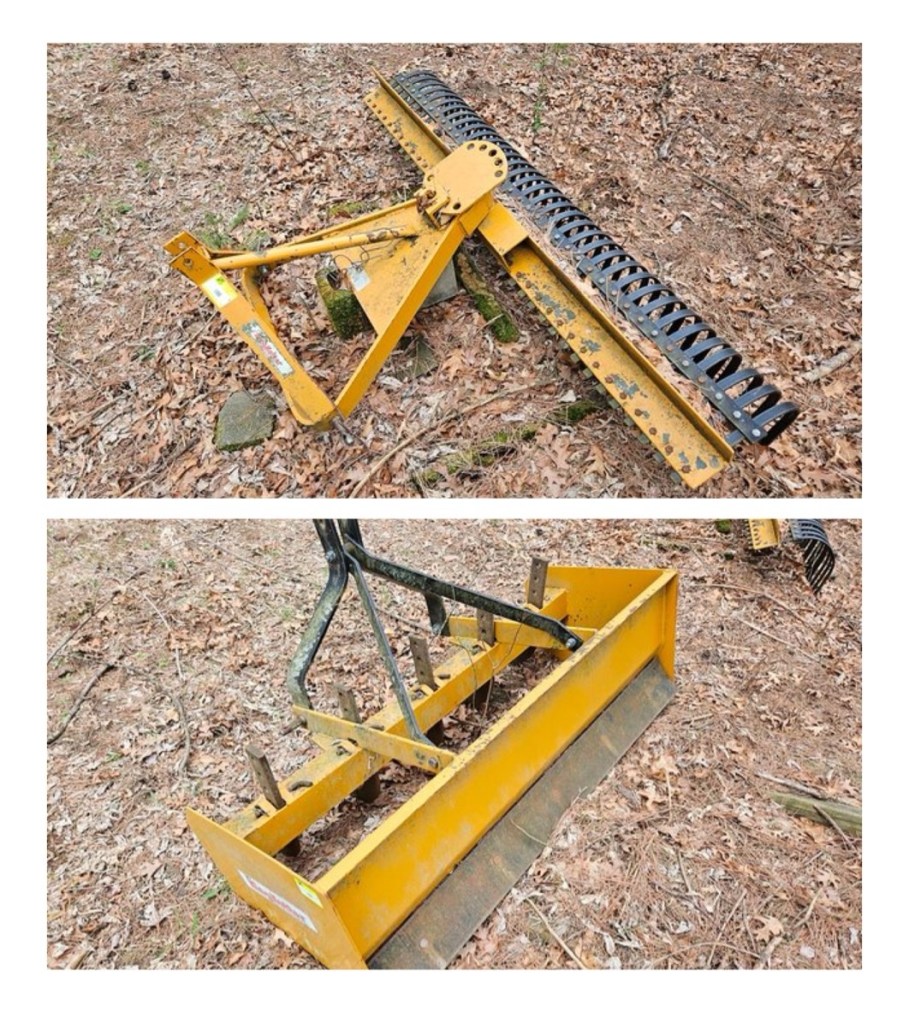
I went on a hunt for a landscape rake and a box grader. Both would attach to the three-point hitch at the rear of the Kubota tractor.
I found these at an online auction. I probably overbid but since the pick up location was more than an hour north of us I wanted to get both or neither. I prevailed.
Susan and I borrowed a neighbor’s trailer and went off to pick up our new implements. We got some help from a friendly fellow to load these onto our trailer. Good thing, the rake weighed a couple of hundred pounds, the box grader was close to 400 pounds.
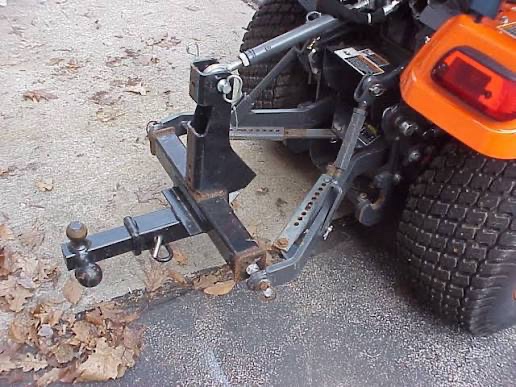
The three points on the rear of the tractor let you hook up a wide variety of implements. There are two lower connections and one upper connection in a triangular arrangement.
The lower arms lift and lower the implement and the upper arm adjusts the alignment of the implement. There are other adjustments to level the implement left to right and to keep it from swaying side to side. What you see in the picture is a great trailer hitch attachment on the three-point hitch. We also have a balast box for the three-point hitch. This gets filled up to help balance the front-end loader when lifting heavier loads.
You back the tractor up to the implement, connect the lower arms with big pins, and then connect the upper arm. Well, after about 20 times doing this, you start to get the hang of it and it almost gets that easy.
A lever on the right side of the driver’s seat on the tractor raises and lowers the hitch and the implement. At some point moving the lever forward, about 1/3 of the way on our tractor, the tines of the rake make contact with the ground. Moving the lever further forward puts downward pressure on the rake. And finally all the way forward lets the implement float up and down as you go over uneven terrain.
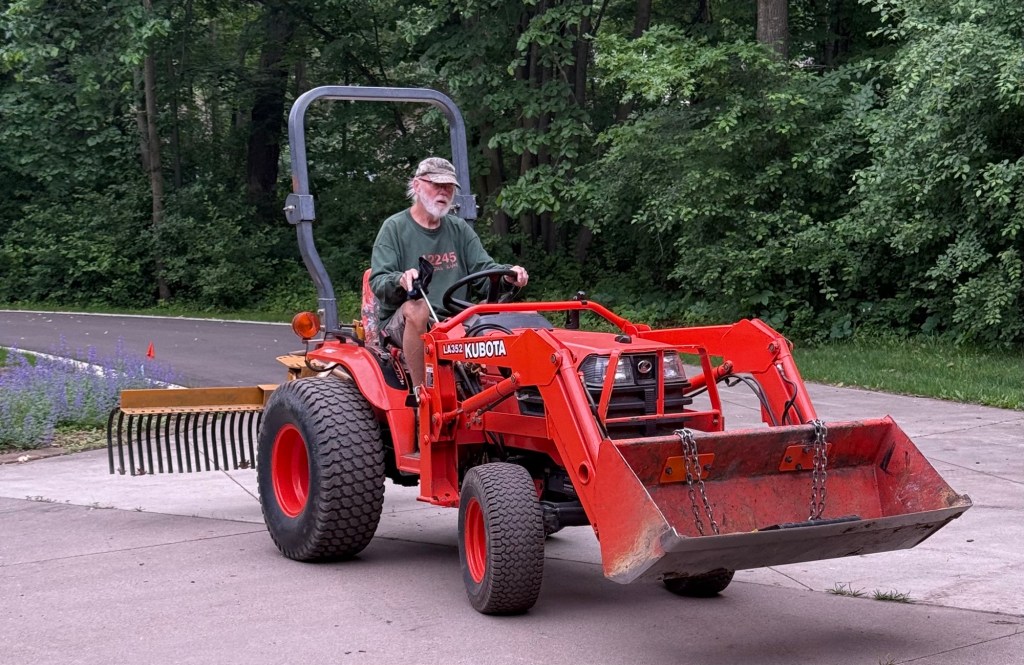
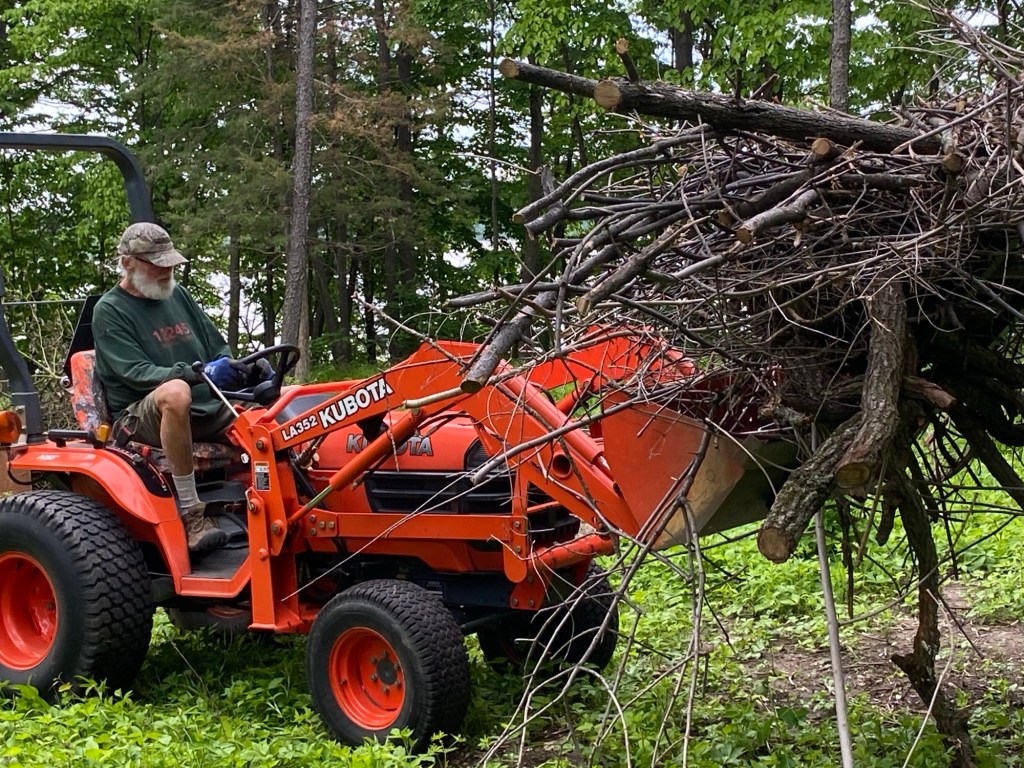
We did most of the raking in the float position. The six-foot-wide rake would collect everything in its way until it could collect no more. We would get over to a place where we were dumping all we collected and raise the rake and most everything would just fall onto the pile. And then more, around and around we went a hundred times, or ten. The pile of stuff kept getting bigger and bigger. We used the bucket to consolidate the pile.
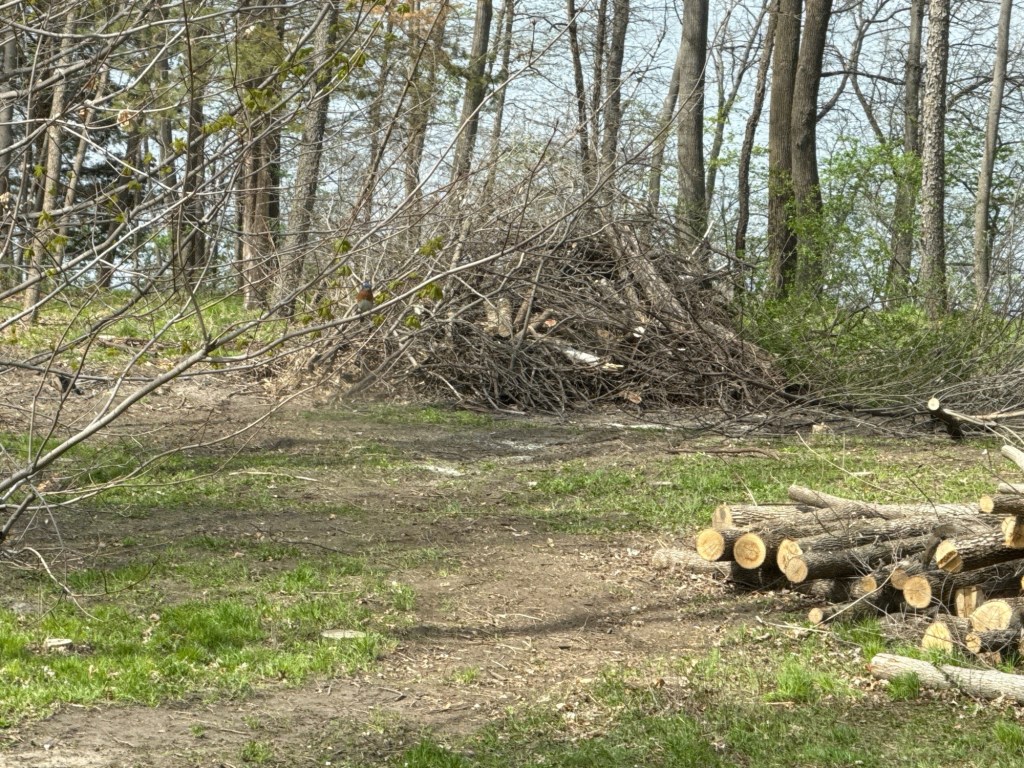
The pile gets big quickly.
The forks on the bucket make moving brush easier.
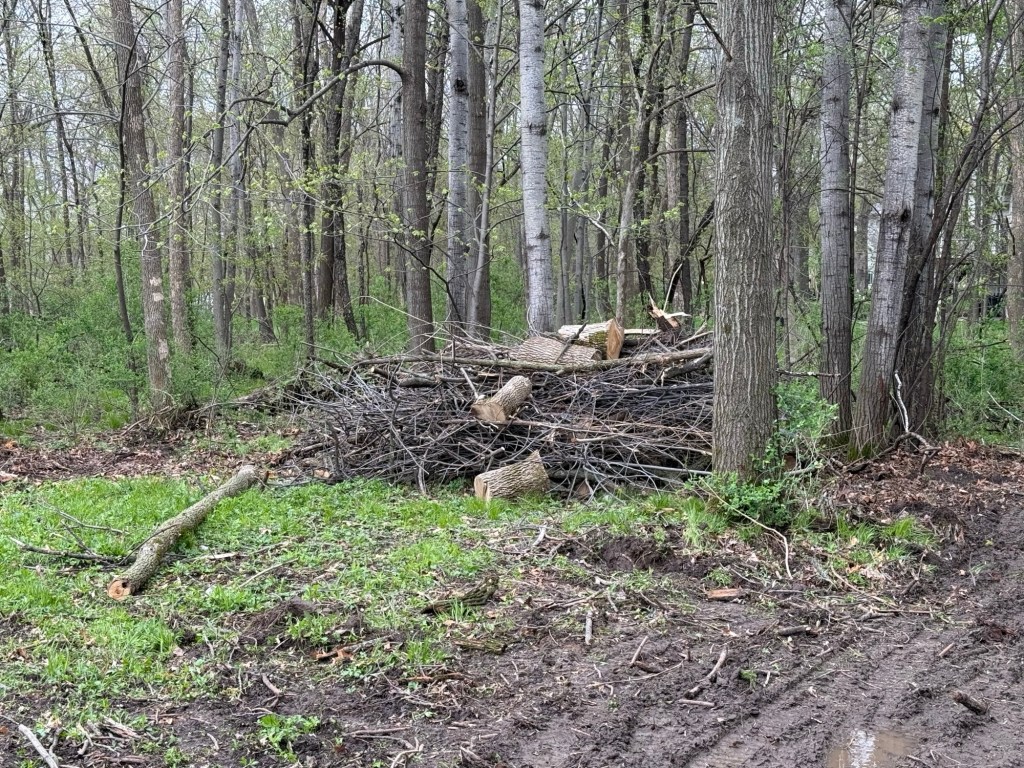
There was plenty of leftovers from the logging operation to pick up too.
Tractor Time
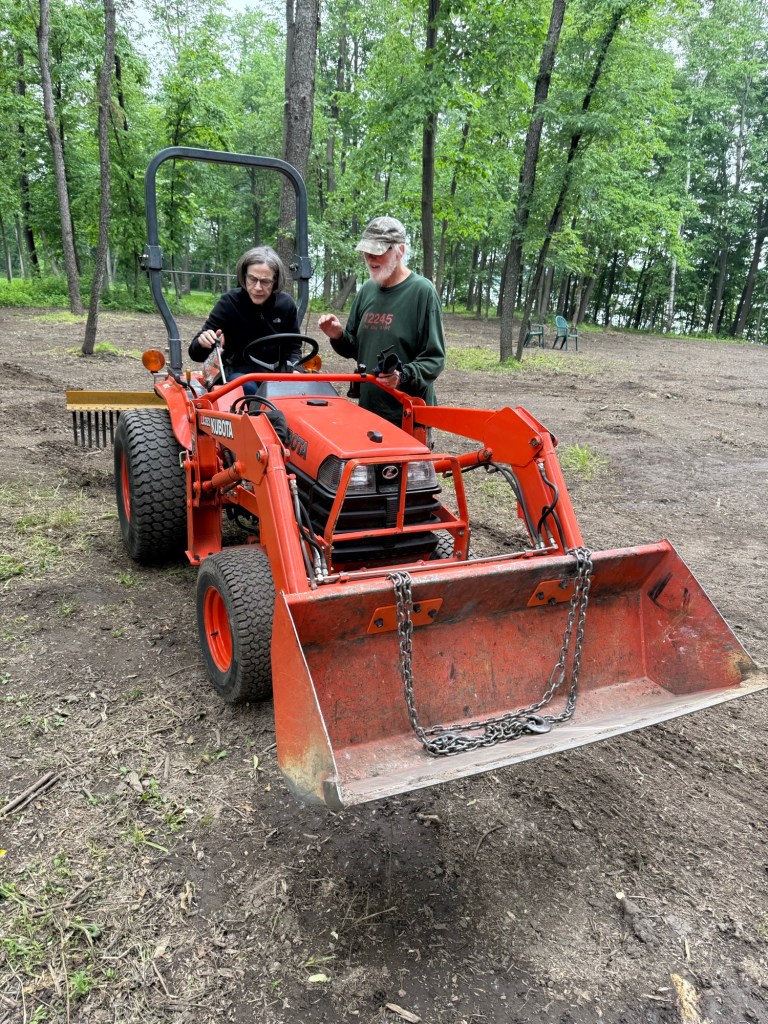
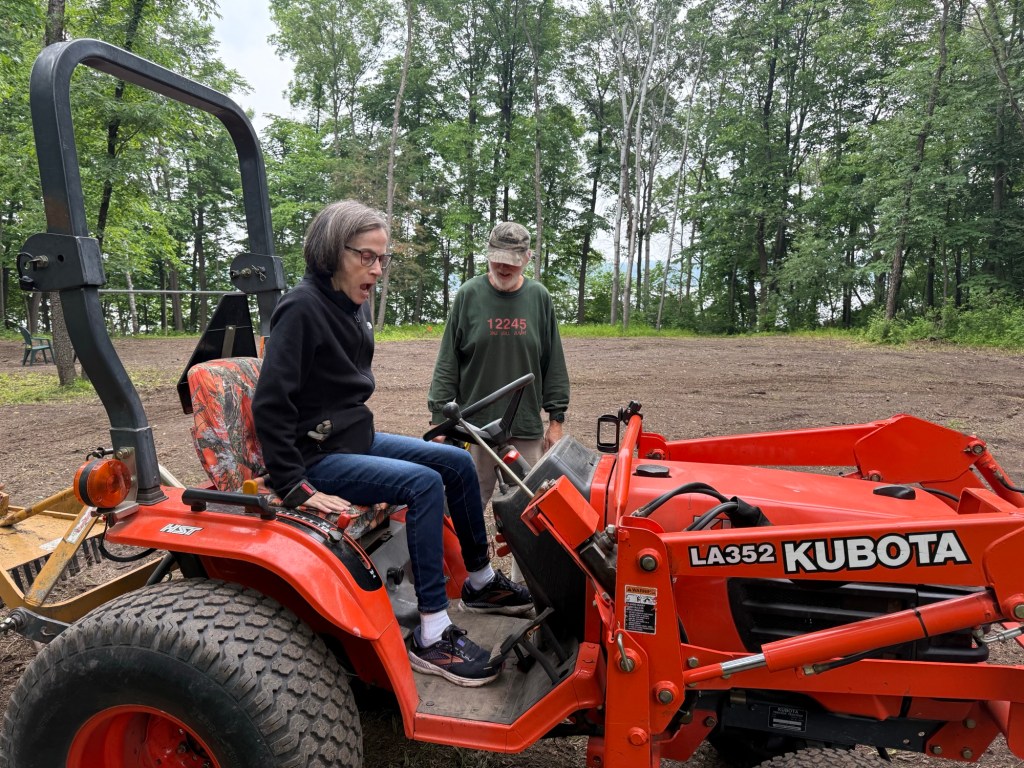
Our friends Ed and Barb came over one day. Barb wanted to try driving a tractor.
She did a good job adding more sticks to the pile.
Every trip around the area picked up more sticks and in many areas turned up lots of rocks.
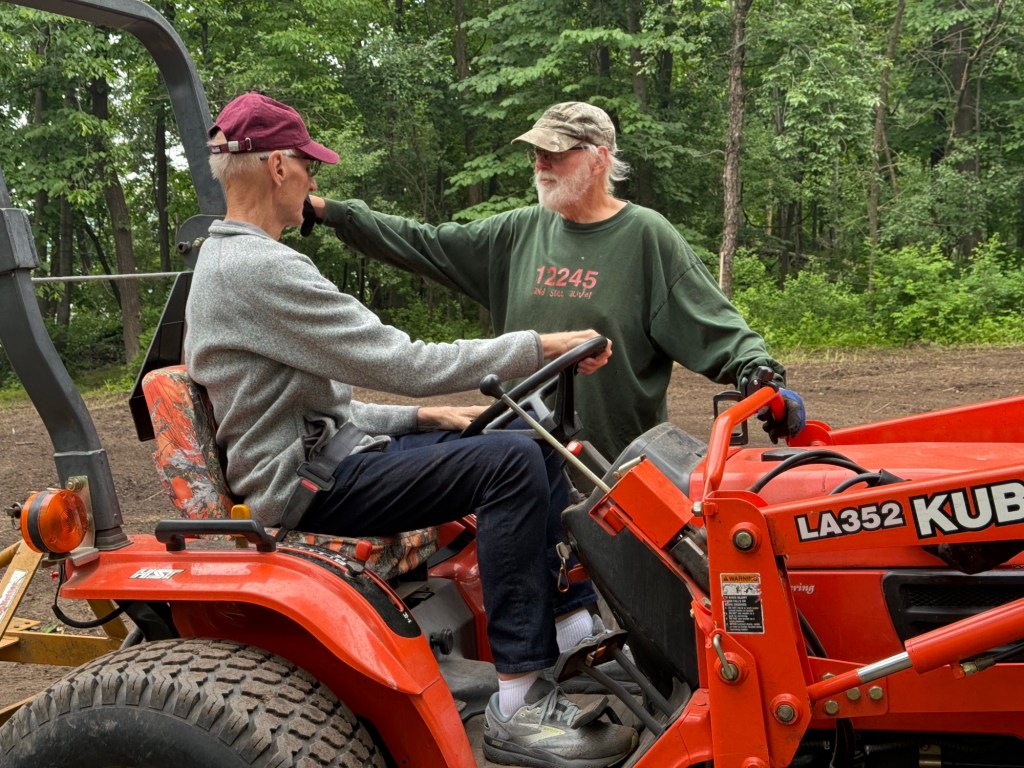
Ed had a go at it as well. It is not really hard to do but there is a learning curve here that takes time and practice.
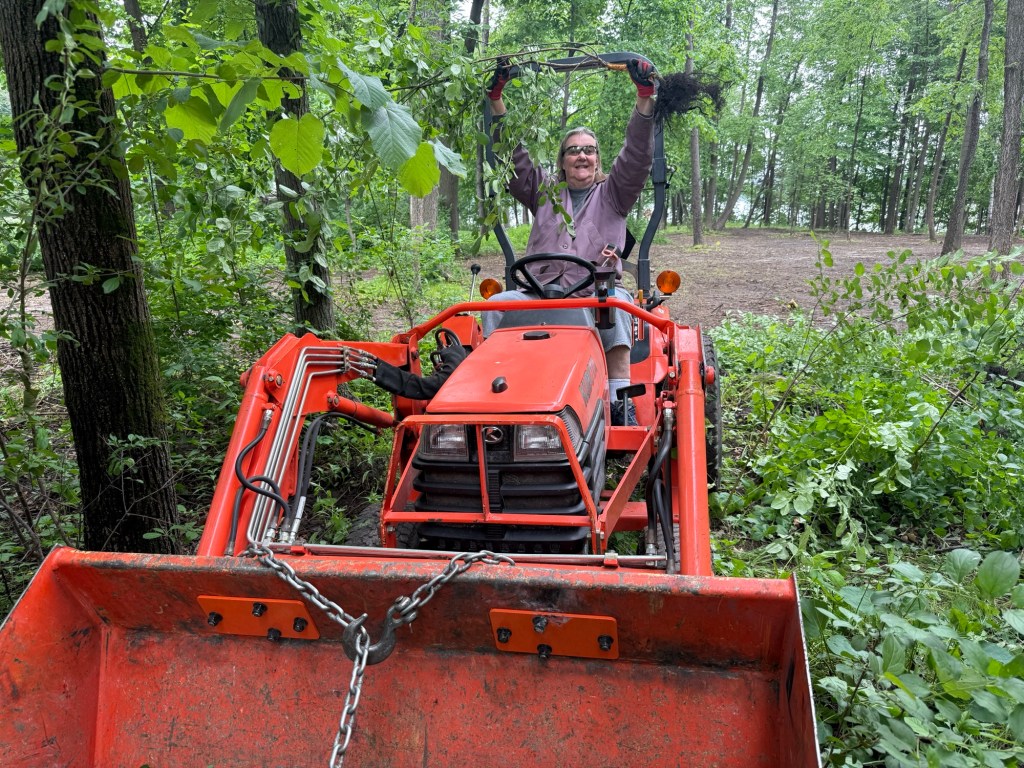
We took a break to show Ed and Barb how we pull buckthorn bushes out.
We wrap a chain around the base of the buckthorn bush and attach it to the tractor bucket. The bucket goes up and the bush comes out. Susan and I do this as a team, she runs the tractor and I do the chain work. Most of what we pull up is bigger than the one shown in the video. It takes us just a few minutes per bush.
It is very satisfying work.
Burn Pile
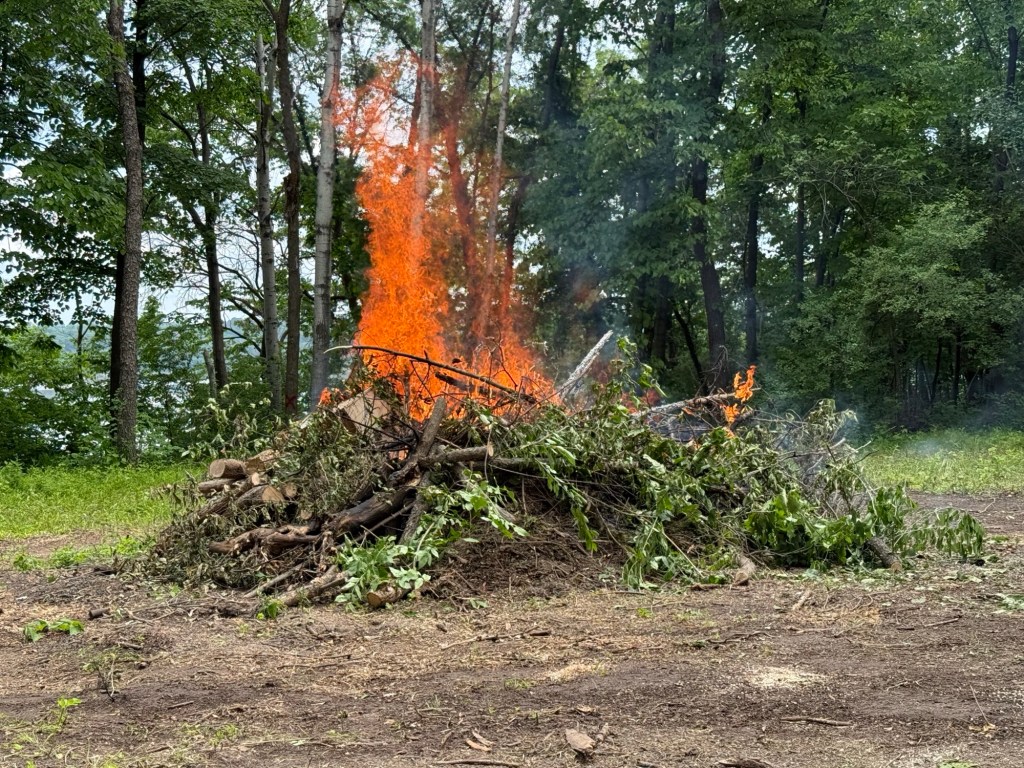
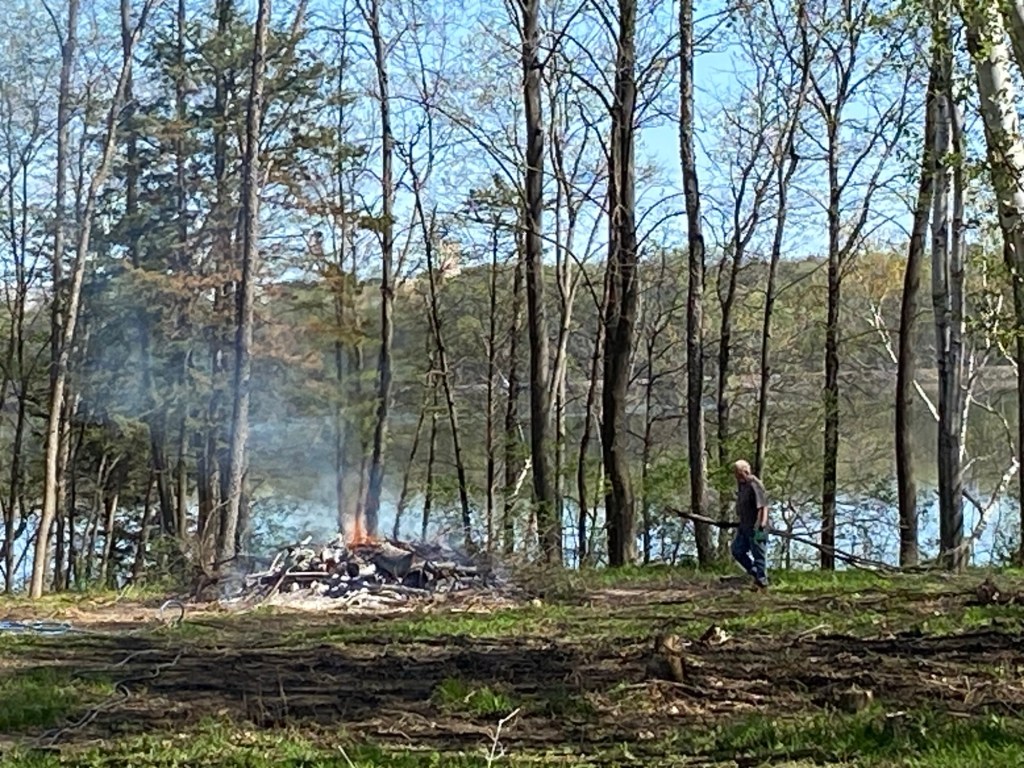
The logging crew did one big burn pile, we did three more.
We had hoses, shovels, and rakes at the ready. These piles would get going and burn hard. The heat is felt a long way away
Burning permit rules said we had to water the pile down by sunset. Usually, the flames had died down but there were some serious hot spots, lots of steam.
I would get up in the morning and stir up the pile and push it in towards the center and it usually started burning again.
We would keep adding to it and burn for a couple of days. And then really water it down until it was out. We would wait at least two days to start scooping up ashes and burnt ends to dump off in the woods.
Grading it out.
We spent almost every day for about two months raking up everything that was loose, cutting more trees, pulling stuff out of the remaining woods, and piling it up to burn. The rocks were collected again and again and added to our growing rock pile
We made two new roads through the woods while we were at it, one was a second loop back to the ravine along the river bluff where we dump a lot of brush. This made access to the tractor much easier. The other was around the east end of the drain field. This kept us off the drain field. This new route saw a lot of use hauling logs up to the driveway.
This was the log pile as we were cutting it up.
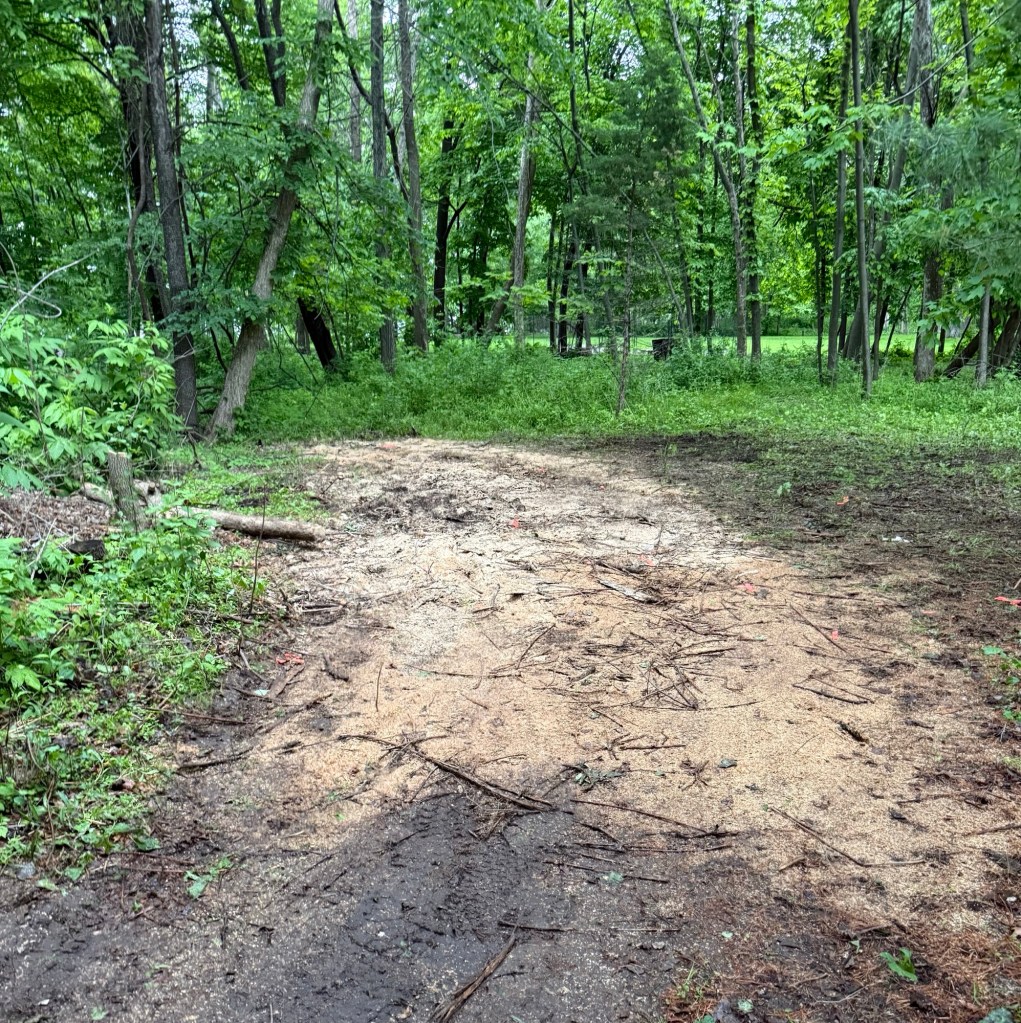
And after it was all gone. It hardly seemed possible that it was all gone, all that remained was sawdust.
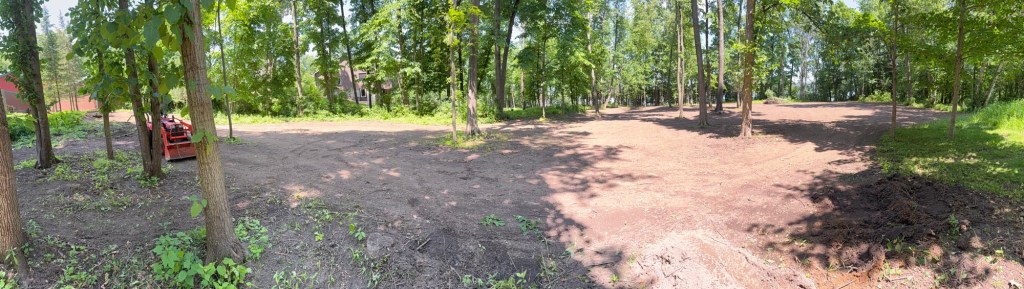
We used a combination of the box grader and the back blade to smooth out the high spots, fill in the low spots, and redistribute everything else. We wanted it smooth enough to mow. We weren’t going for a golf course look, just smooth enough.
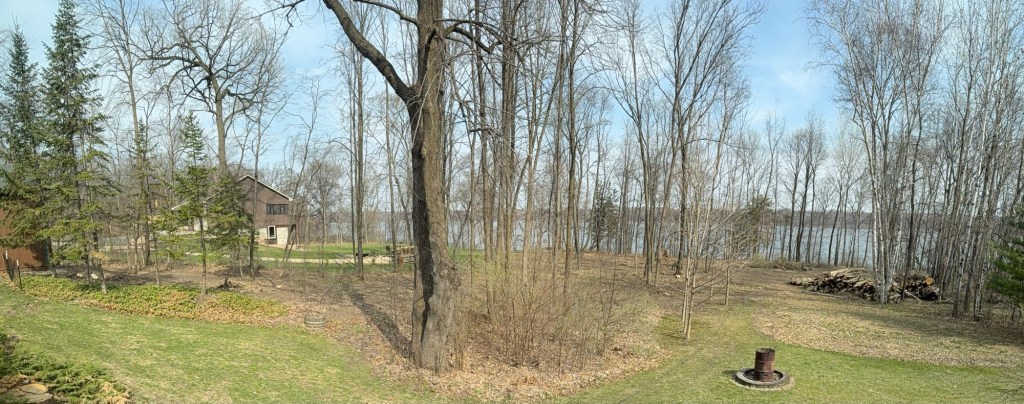
This panoramic view shows just how much space we were dealing with, just over an acre.
Up the hill towards the barn.
Looking North East.
And South East.
Downhill from the barn.
Like raking this meant back and forth again and again. Using the box grader took some time to figure out. We needed to set the hitch height so that the box grader would cut the high spots and dump the collected dirt in the low spots. When we started the ground was pretty rough so that just the tractor going over the ground made the blade go up and down. You just had to pick a height for the box grader and keep going over the same area in different directions. Slowly the high spots were cut down and the low spots were filled in. This took us the better part of a month working at it a few hours every day.
Rye Grass
We roughed up the surface with a dethatching rake and planted about 200 lbs of rye grass as a summer cover. It is like wheat. Sprouts fast, grows to about knee high.
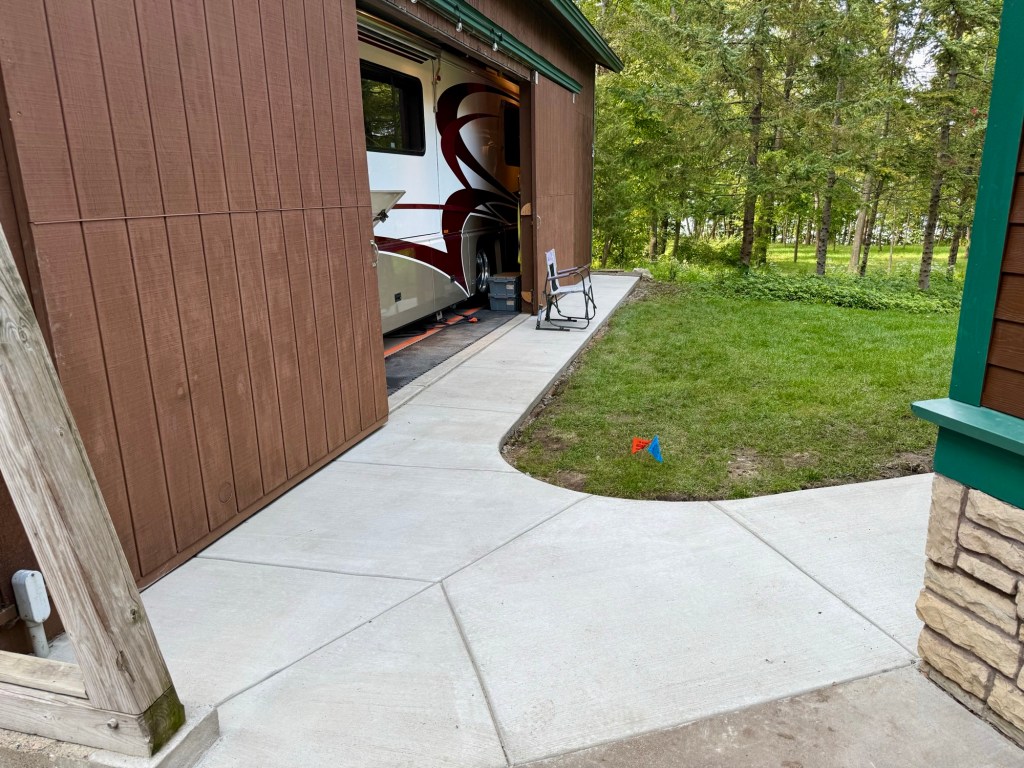
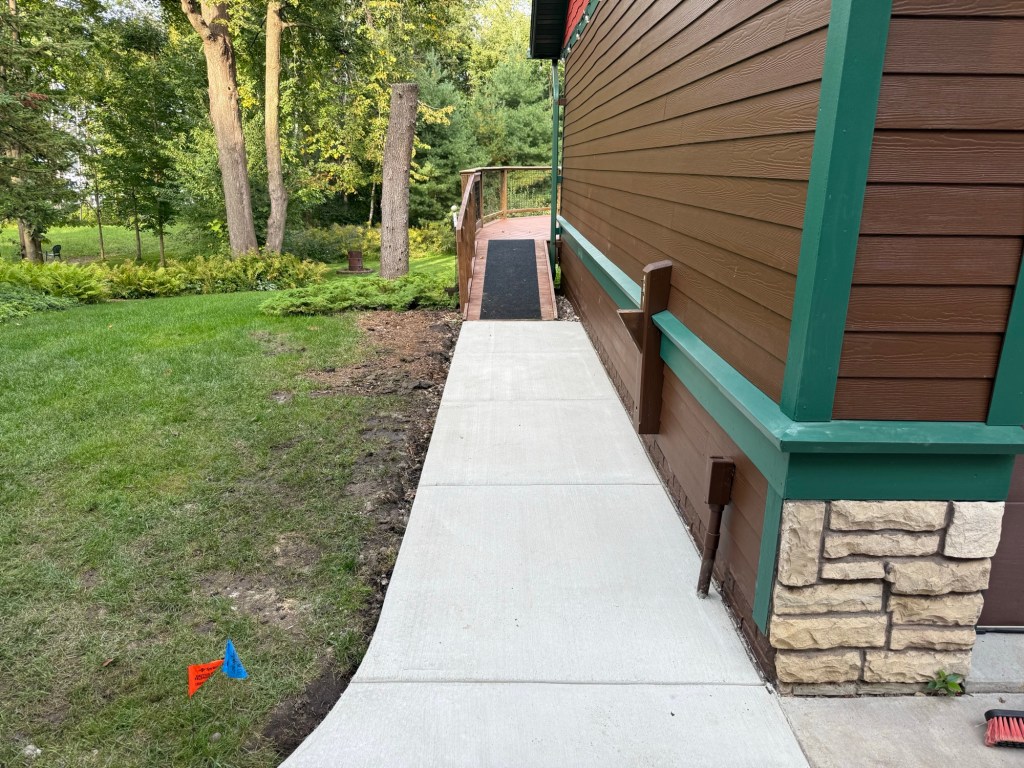
We also put in a new sidewalk along the side of the barn
and along the side of the garage. In the distance, you can see the green of the new grass. And we got a tractor.
Sadly the Emerald Ash Borers finally made it to our area in 2024.
These pesky bugs burrow their way beneath the bark of the Ash trees and their larvae eat their way all over under the bark until they have destroyed the tree’s ability to move water and nutrients up into the tree and all of its branches. They then emerge as the flying beetles that can move on.
It takes a while for the tree to die but it is always fatal. Once the tree dies the bugs move on to the next tasty tree until all of the Ash trees in the forest are dead. And they just keep moving on to the trees in the next area.
In the summer of 2024, we had about 20 dead ash trees and one really big oak tree removed. All were near enough to the house to be a threat if they were to fall in a windstorm. Once we knew what to look for there were obviously many more dead and dying Ash trees.
Over the winter, 2024 into 2025, we had a tree service survey the woods and mark the trees that needed to be removed. They marked about 150 trees.
Our neighbors did the same thing and they had about 100 trees remaining to be removed after having quite a few removed the summer before as we had.
Our neighbors contracted with a tree removal service that we had used before to remove trees from their property in February, 2025. I contacted the company and asked if they could do ours at the same time as long as they were there. They said yes, I told them to remove the branches and brush, and stack the logs thinking I could cut up the logs and deal with getting rid of them.
In March of 2025, the tree removal company started cutting trees and didn’t quit until more than 200 Ash trees had been cut down along with many more that were in the way or not worth saving. All of the branches, and the trees other than the Ash trees were piled up and burned in what must have been a massive burn pile.
By the time we got home the burn pile was a large pile of ashes and remaining chunks. The logs, 8 to 10 ft long, were piled in three not very neat piles. And there was another pile of large chunks of another oak tree that got cut down.
This area was a pretty dense forest woodland. It was shocking to see how many trees were gone and how bare it looked.
The tree cutter came back with a log mover and moved and combined the three piles into a better location. The new pile of almost 400 8 to 10-foot logs was 5 ft high and 45 ft long. It was a daunting task ahead
An even more daunting task was the area that was woods was now a very rough rutted mess from the tracked logging machines working in the March mud, what seemed to be millions of sticks and parts of branches everywhere, and stumps everywhere.
Nothing to do but get started.
I called and got on the stump grinder’s schedule.
I tuned up the chainsaw and put on a new chain, the first of three.
Susan started raking up sticks into piles. I would drive around with the yard tractor and trailer and pick up six or so piles of sticks and add them to the second growing burn pile. This went on for days.
I started cutting up logs first by cutting off the ends of the longer logs to get most of them about the same length. I have to say here that chain sawing is hard work especially for a 76-year-old guy. And it is not just picking the saw and cutting off a chunk of log but then that chunk has to get picked up and moved out of the way, preferably in a fairly organized way. And these logs were all 10 to 18 inches in diameter.
All of my previous chain sawing days were one tank of gas worth of cutting. When the saw was out of gas so was I.
The stack of cut-off chunks was getting pretty large. I mentioned to someone that I needed to figure out how to get rid of them other than hauling them to the county tree refuse place where you have to pay to dump them. They suggested Facebook Marketplace. They might just as well have said the moon. I had no idea what it was or how it worked. But I persevered and figured it out. I put a very simple post on there, Free Firewood, you load it into your car.
It wasn’t even two hours after posting and I was getting messages about free firewood. Several people were coming the next day.
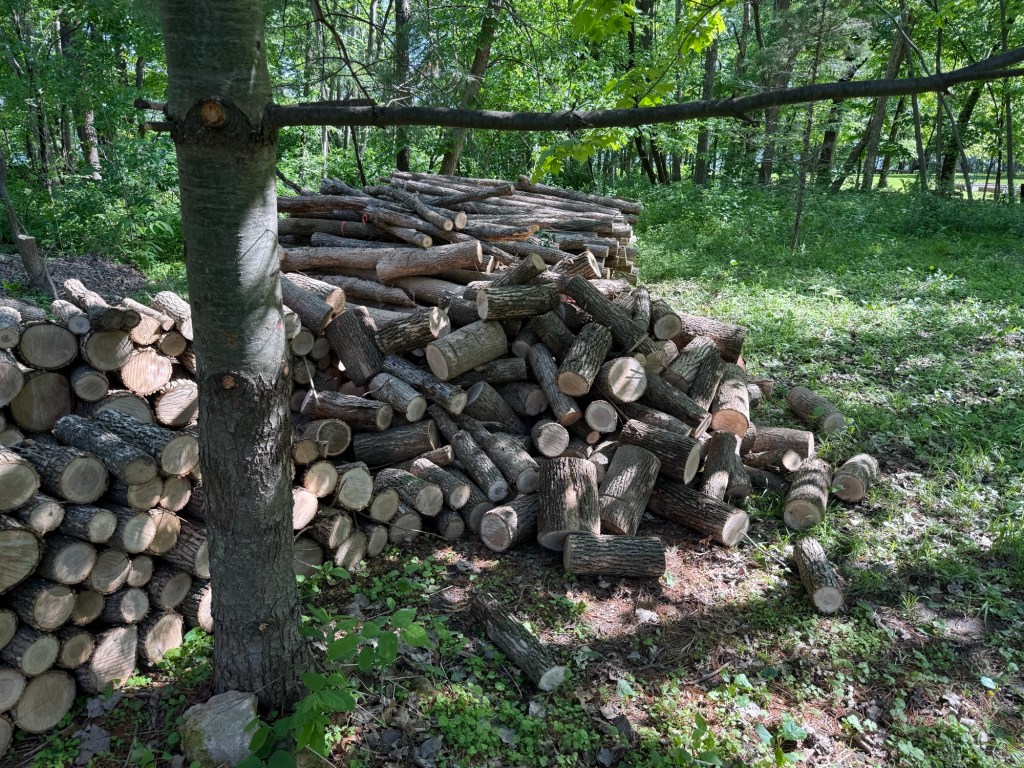
I had to load up logs into the small trailer behind the yard tractor and haul them up the hill to where folks would be loading them into their car. One load after another and then my log pile was getting depleted. So chain sawing commenced, one tank of gas and then two. And then more logs going up the hill.
This went on day after day. Pretty soon I was up to 4 tanks of chainsaw gas. I estimated that I cut more than 700 16” long sections of logs.
And there was still at least half of the pile left.
The log cutting and moving, picking up sticks, ground restoration, and everything else seemed to be an awful lot to do. We checked with a couple of folks we knew who had machines to help. They were busy and expensive. So we started thinking maybe we should get a tractor and some implements to do ourselves.
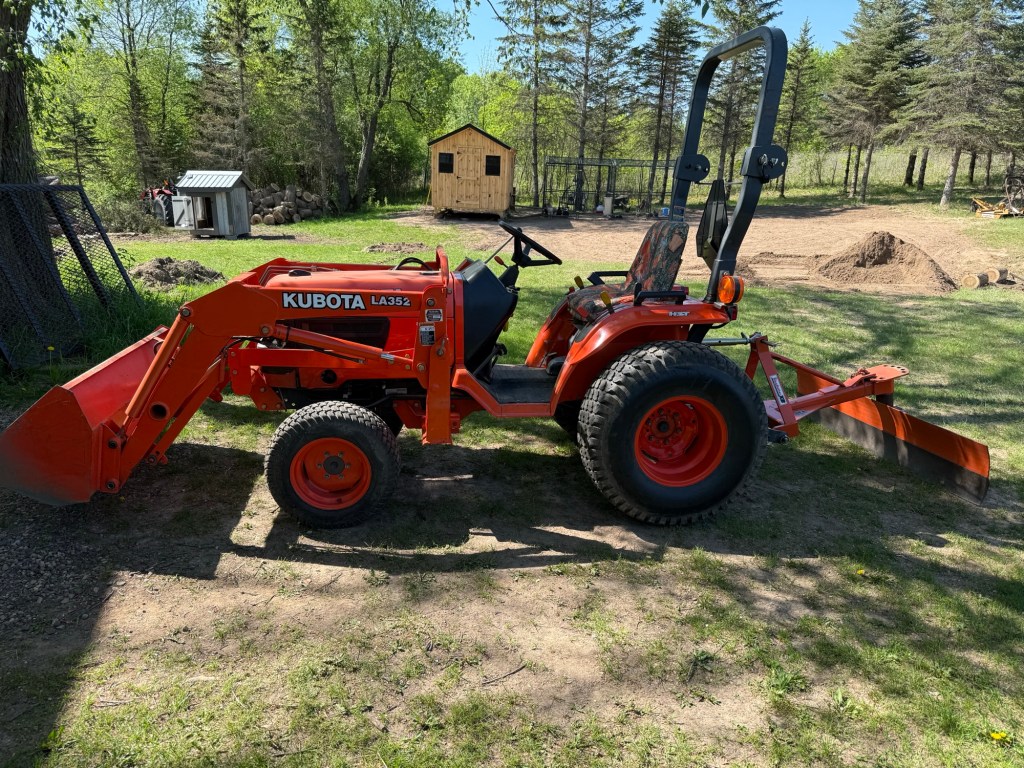
It seemed crazy, newer tractors are expensive. We kept looking and I came across this one.
A nice, clean, low hours, older Kubota, 24 diesel HP. A front loader, forks, and a rear blade over in Wisconsin. The price was right, all was in order, and he would deliver it. We are now tractor people.
I bought a landscape rake and a box grader blade at an auction and we started looking like farmers.
Back at the log pile, a fellow from Wisconsin sent me a note and asked if he could get 8-foot logs. Even with the forks on the tractor there just wasn’t enough room to get 8-foot logs up the hill. I suggested 4 ft logs. He said that would work for him, he was cutting the logs up and splitting firewood anyway. Off I went cutting 4 ft log sections. Much easier for me. He came over with a large dumping trailer and we loaded 4-foot logs onto the tractor forks, drove up the hill, and dumped them into his trailer. Many trips later, his trailer was full and the log pile was significantly smaller.
Another fellow called and said he would take all of the 4-foot logs that were left. I agreed and spent two days cutting the last of the logs. One of those days was a six-tanks in the chainsaw day. I was getting used to it, the weather was perfect, and 4 ft sections are much less work to deal with.
The last fellow came with a really large trailer. He heated his house and shop with wood so this was all going to a worthy purpose.
It took most of the afternoon to haul the 4-foot logs up the hill and dump them into his trailer. He arranged them to get as many in as we could. He took about 250 4 ft sections. His trailer was packed to the top of the side rails and the log pile was gone.
It all took less then three weeks. All that was left was a pretty thick layer of sawdust covering the area where the log pile had been.
On our two page list of things to get done in the summer all of this logging, land restoration, and everything else to do with it was a single line.
By the time we were done with the restoration, it would consume more than three months.
Our original departure date from Orange Beach was March 15, 2025. The plan was to go to the East Coast, specifically to Saint Augustine, FL, and then to Jacksonville, FL. From there we were going to spend 6 days in Savannah, GA. And then 6 more days in Charleston, SC. Then we were going to visit our friends, Ed and Deb, in Central NC, and Hans and Marjet in Western SC. And a few days in Asheville.
That entire part of the trip got canceled because I had an important medical appointment change to April 15. Schedules just didn’t fit so we stayed in Orange Beach until March 22 and headed north towards Lebanon, OH to see our friend Karen and her new puppy Scout.
This part of the trip was always part of the plan. We have known Karen and her husband, Ted for many years and met up with them often on our travels in many places. Ted passed away a couple of years ago and we really wanted to see Karen.
So we went north to just north of Birmingham, AL, and then on up to Mammoth Cave National Park which just happened to be along the way in Kentucky.
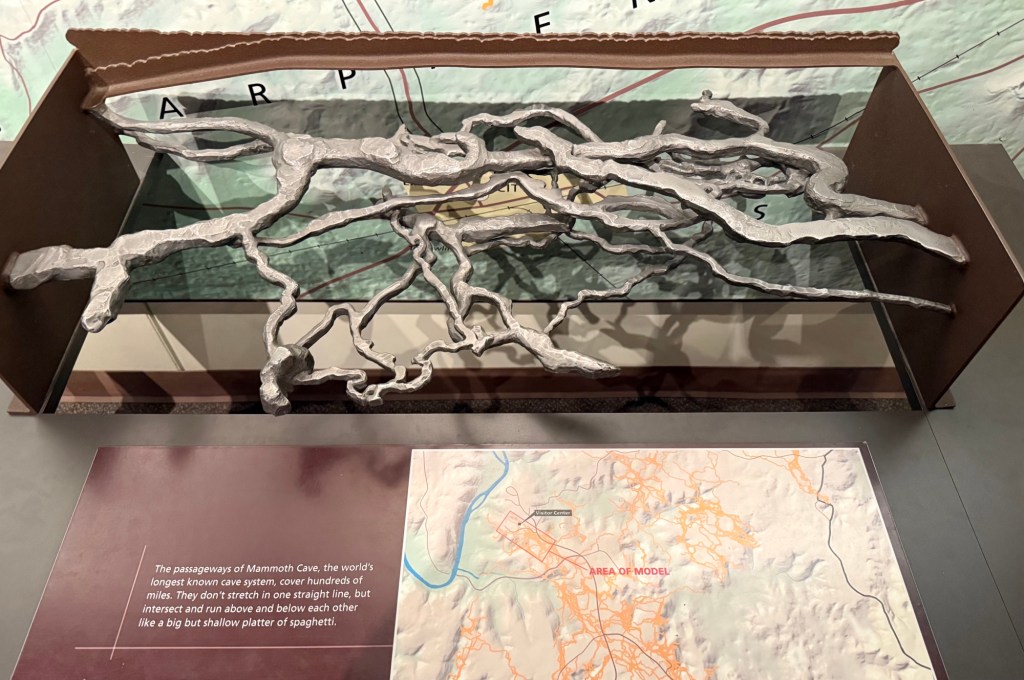
Mammoth Cave is described as a large plate of spaghetti with layers upon layers. More than 400 miles of the cave have been explored and mapped with several miles of newly explored cave added each year. Mammoth Cave is the longest cave in the world.
We didn’t have much time so we went to the Visitor’s Center. There were stories of the early explorers with crude equipment crawling through barely big enough holes. One fellow got stuck and after 7 days of trying to get him out, he died.
Going down into a cave (like Carlsbad Caverns) where you can walk around in big expansive rooms is OK.
There is just no way I would crawl, slither, into a wet rocky hole not knowing what was ahead. No way.
We got to Lebanon, Ohio, and checked into a KOA campground not far from where Karen lived.
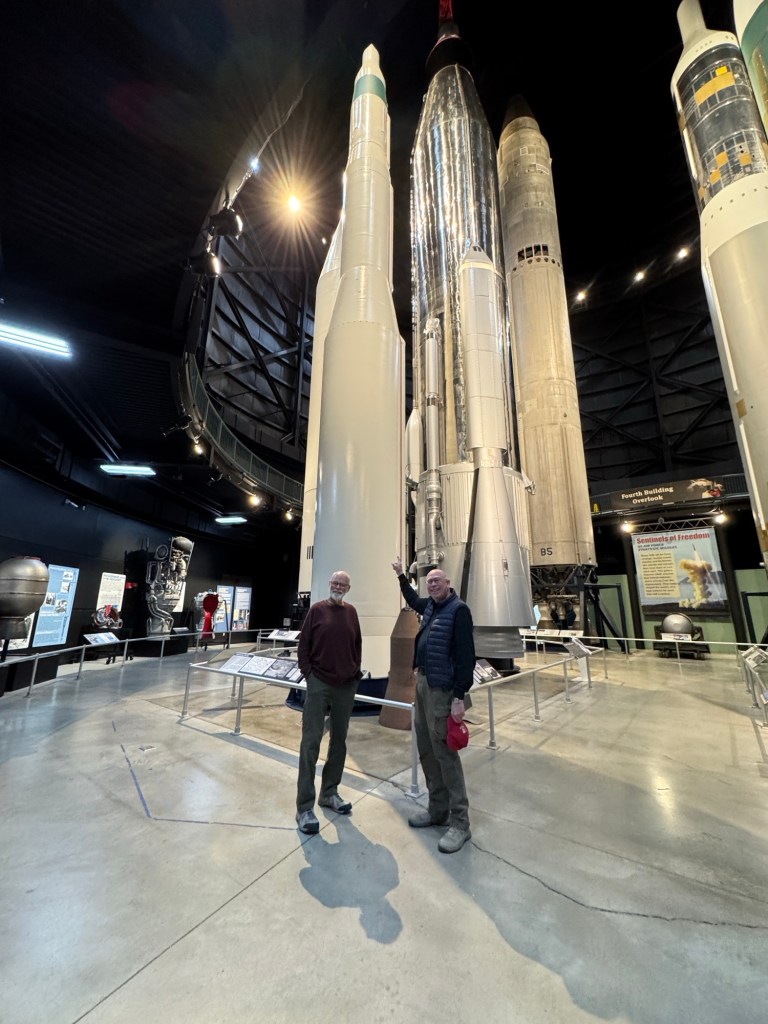
One thing we really wanted to do was to visit the Air Force Museum in Dayton which was only an hour north of Lebanon. Our friends, Rich and Peggy Bowman lived near the museum. They are both retired Air Force officers so who better to act as our guides?
There were big giant rockets.
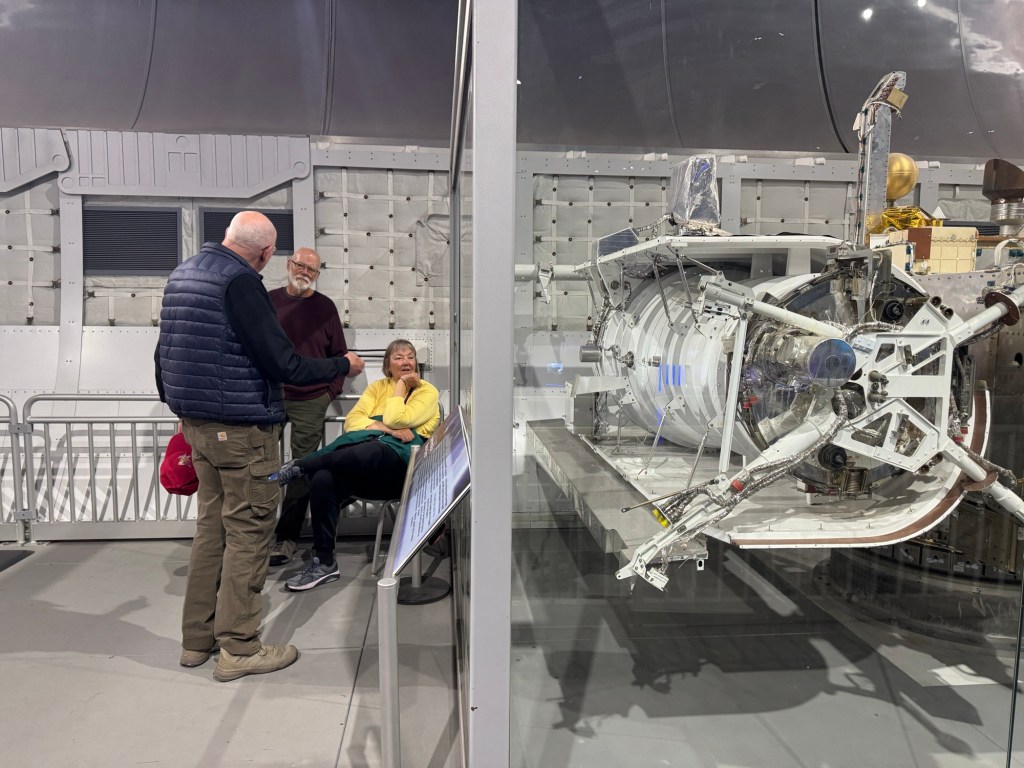
And projects Rich had worked on.
A Lockheed Constellation “Columbine” which was Eisenhower’s presidential plane, the first one called “Air Force One”.
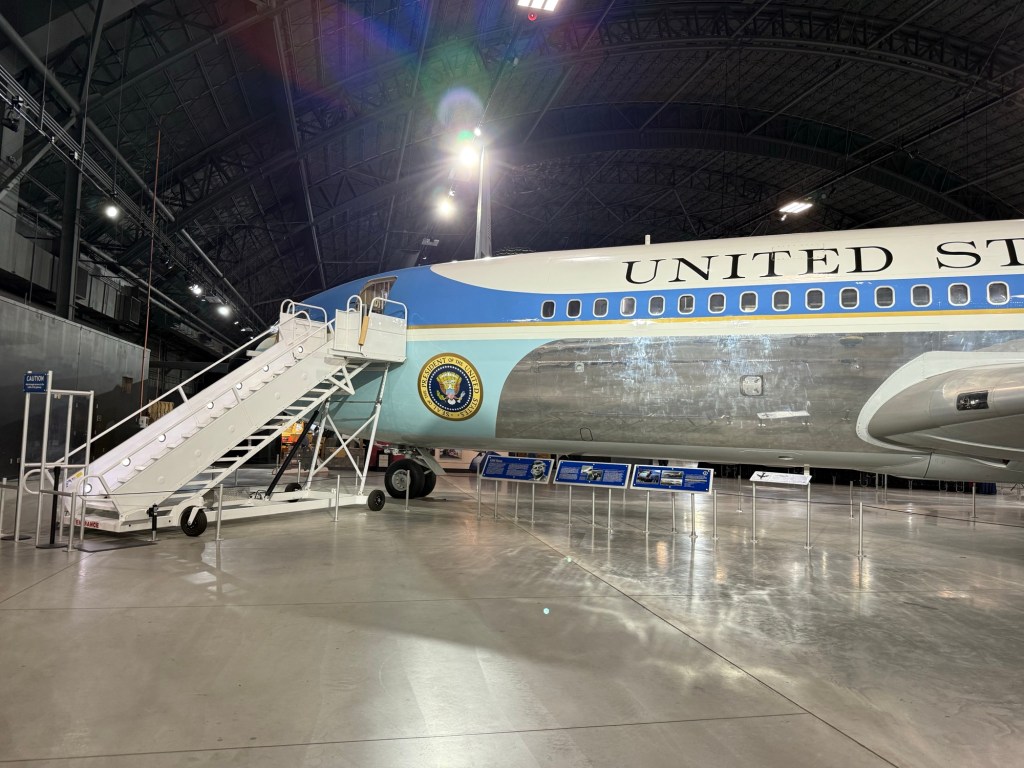
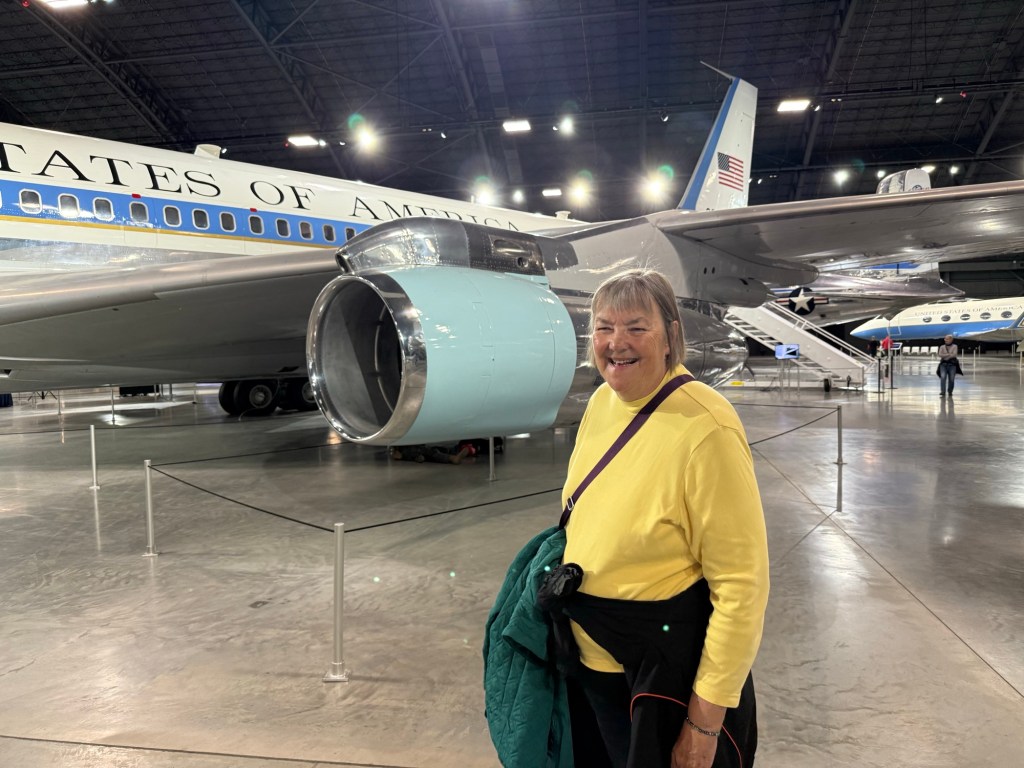
And JFK’s “Air Force One” that we could walk through and see where LBJ was sworn in.
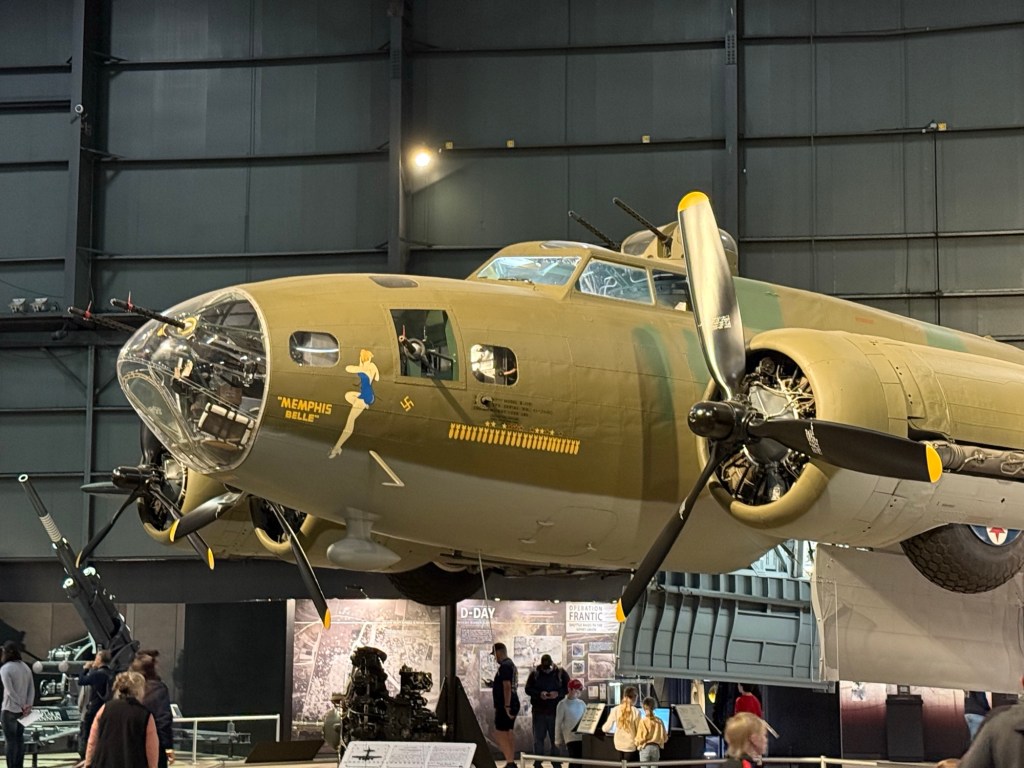
And the Memphis Belle B-17 from World War II.
We were there for several hours, nowhere near enough to see everything. Rich said that going through the entire museum and reading all of the information would probably take a week.
We enjoyed our short visit and lunch with Rich and Peggy. We were grateful for the guided tour.
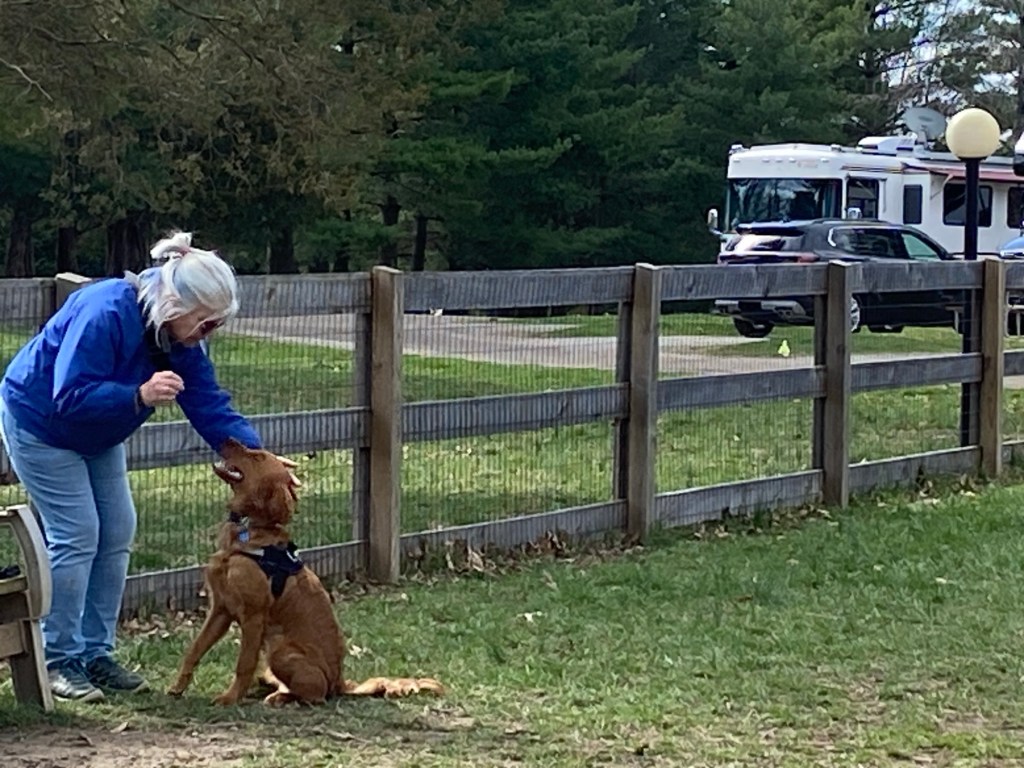
Karen lived not far from the RV park where we stayed. She came to visit with her less than one-year-old puppy, Scout.
Scout was all puppy, full, of energy, ready to play.
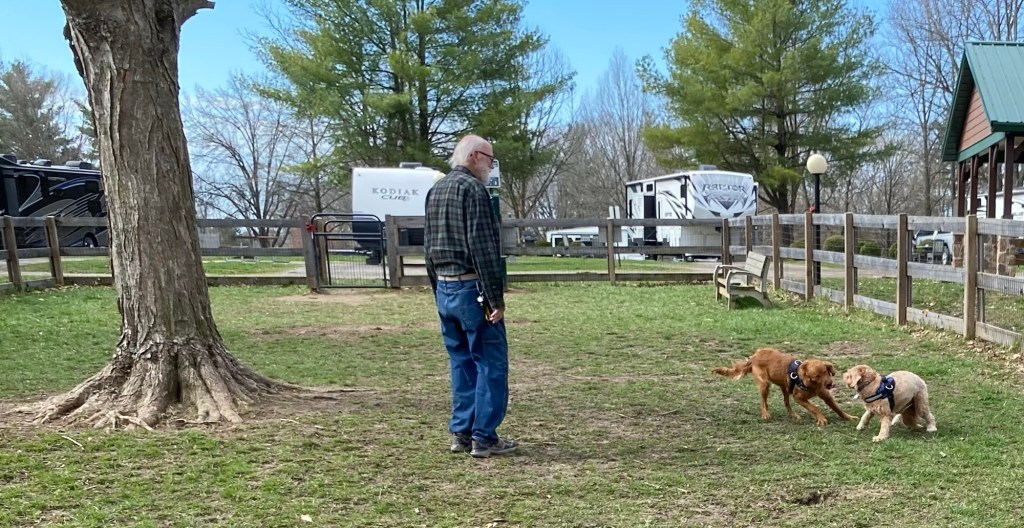
She and Maggie ran and ran and chased a ball until they were worn out, if that is possible.
And then some rest time.
We went out to lunch with Karen to a classy older hotel for lunch and to a pub that she and Ted liked to visit.
We walked through a park where a tree had been planted in Ted’s honor.
It was nice to see Karen and Scout. We will always miss Ted.
We continued towards home through strong winds and almost continuous rain towards Bloomington, IL.
We stayed at a campground on a lake, and the wind was howling all night long.
We headed north from there into Wisconsin and stayed at the only campground open between Bloomington, IL, and home near Portage, WI. It was the Sky High Campground. It was at the top of a ski hill at the end of a winding road. There were quite a few campers there that appeared to live there. No one there in the office, no maps to help us figure out how to get to our site. We just followed the obvious route which of course led us through a low area, wet and muddy. I plowed through and up another hill and around to where we stayed for the night. We crossed this place off the revisit list.
Part of the problem going south in the late fall and north in the early spring through Wisconsin and Illinois is that there are almost no campgrounds open. We are OK with staying in a Walmart overnight but some nights it is nice to have at least an electric hookup.
Going through Iowa and Missouri there are many more options for overnights.
We got home right at the end of March, one of our earliest returns in years.
We backed the coach into the barn, plugged it into power. We went into the house and checked everything out, all was OK. We turned on the water heater, turned up the thermostats, and returned to the coach for supper and a warm last night.
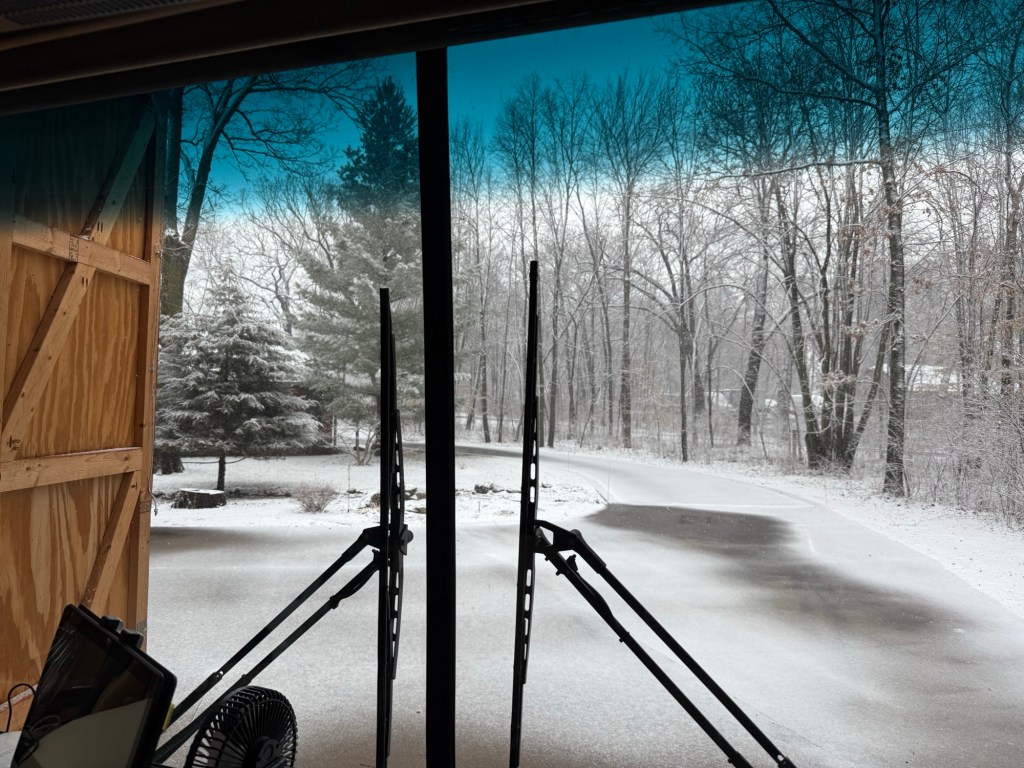
It snowed overnight, not a lot, but enough to remind us that it was Minnesota.
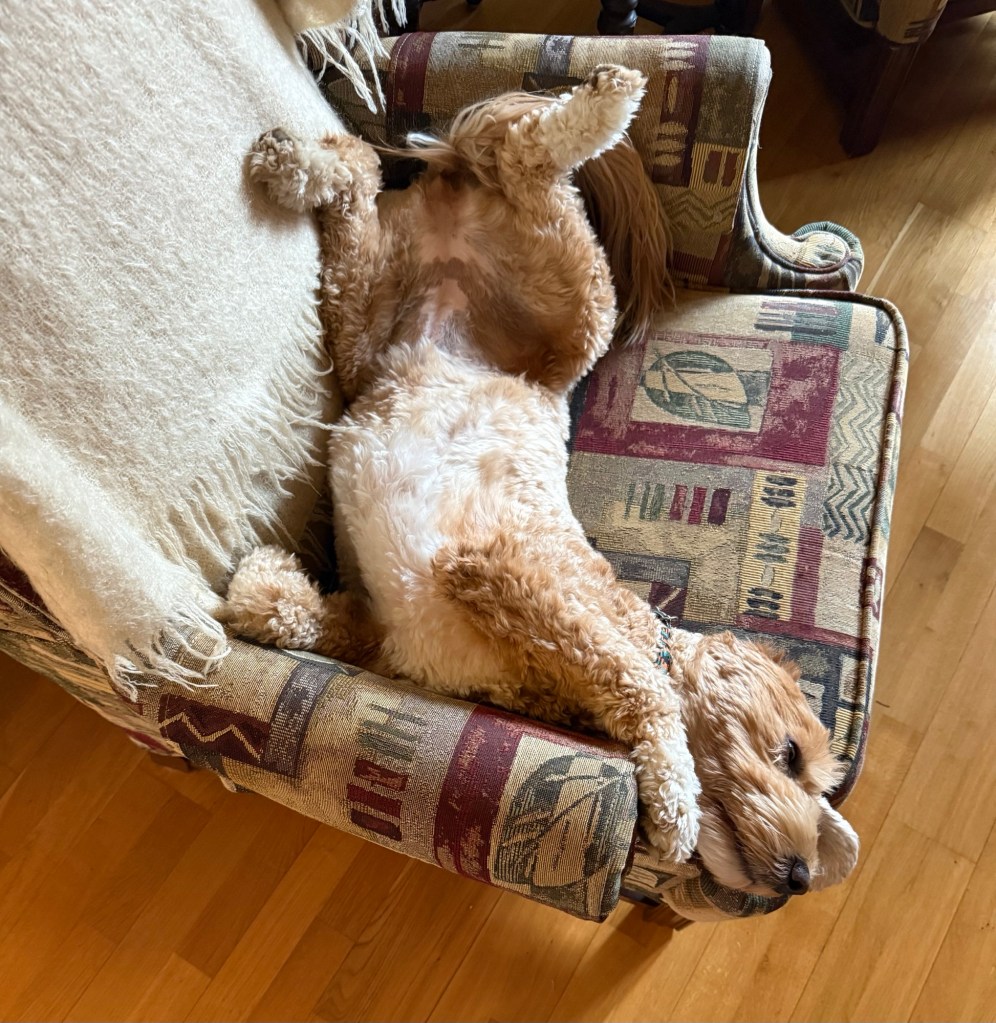
Maggie was happy to be home.
She just crawled into a favorite chair for a nap.
We arrived home with a two-page list of summer projects. Many were just finishing them up sort of things. Some were big projects, bigger than we had envisioned.
After a mixed bag of weather in January, February and March had some of the nicest weather we have had on the Gulf Coast. There were a few cold nights in February but they were followed by warm sunny days. We had one big storm threat that had many in the RV Park nervous but like most of these it went up around Mobile Bay on the west side and over the top of Mobile towards the north and east. There were tornados and severe storms up that way. We were thankful to have only had some rain and gusty winds.
But the rest of the days were generally sunny, almost always a light to moderate breeze, temps in the upper 60s and 70s. And here, the warm sun and mid-60s temperatures feels wonderful.
Maggie and Daisy got together almost every day for some playtime. They too could feel the winter sun and enjoyed the shade provided by the RV next to Sonny and Randi’s.
We met up with John and Sheryl from Minnesota who also spend a couple months in Orange Beach. I work with John on Habitat for Humanity projects with the 3M crew.
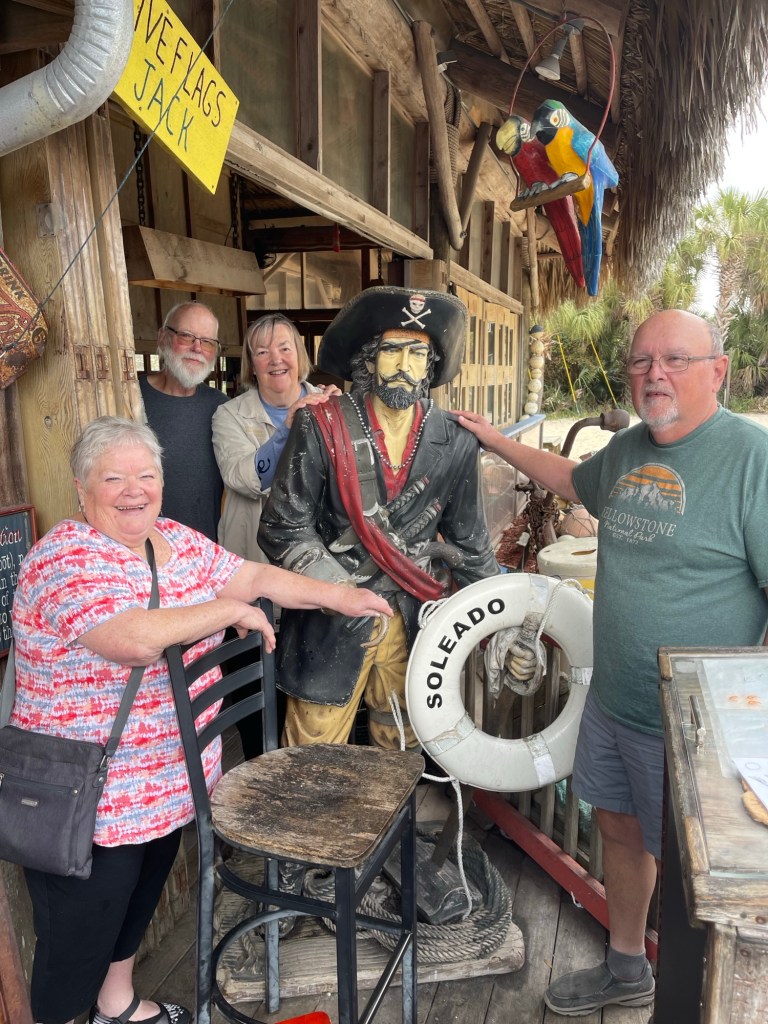
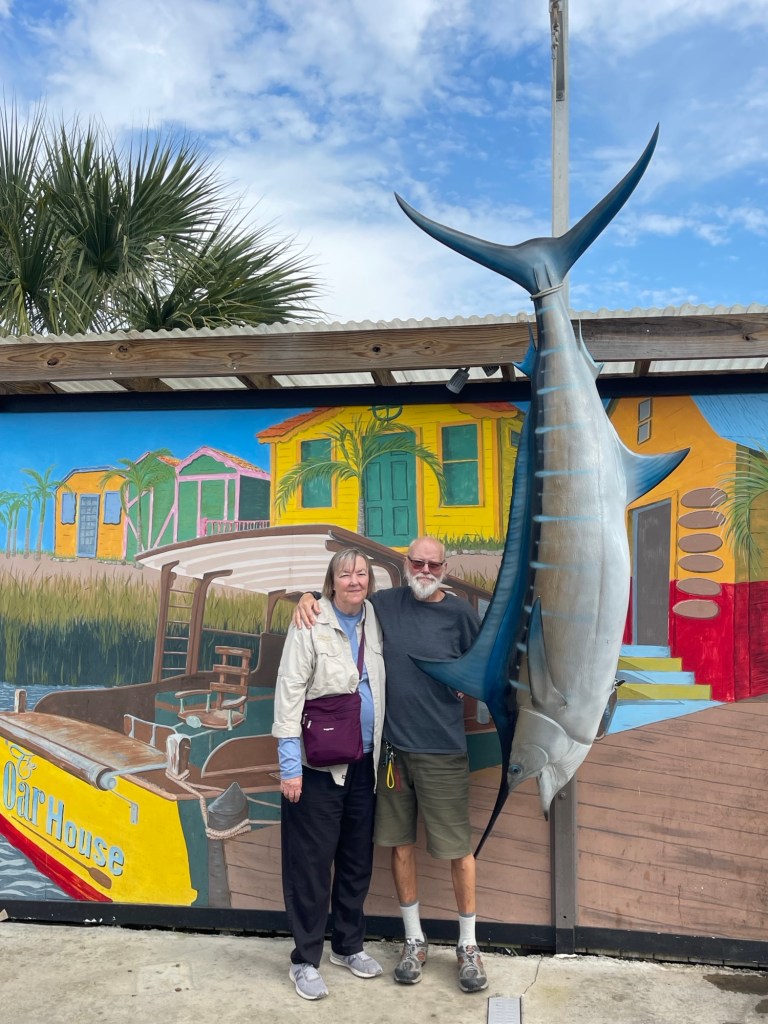
We drove to Pensacola with John, Sheryl, Randi and Sonny to Joe Patti’s Fish Market. We stopped just before we got there at the Oar House for lunch.
We had a nice lunch. The Oar House is on a chanel leading from a harbor area out into the Gulf so there are lots of boats to watch.
At Joe Patti’s we bought lots of Royal Red Shrimp, some got steamed there, some came home raw to marinate and grill for dinner. These are big, sweet Gulf shrimp, easy to cook, and easy to eat.
We also got sea scallops to have for a nice Valentines Day dinner. The scallops were pan seared and served on mashed potatoes with a roasted apple sauce with green beans. Very good.
And by mid-February, the alligators start showing up. They like the warm sun too.
This fellow was in one of the marshy canals that criss-cross the State Park.
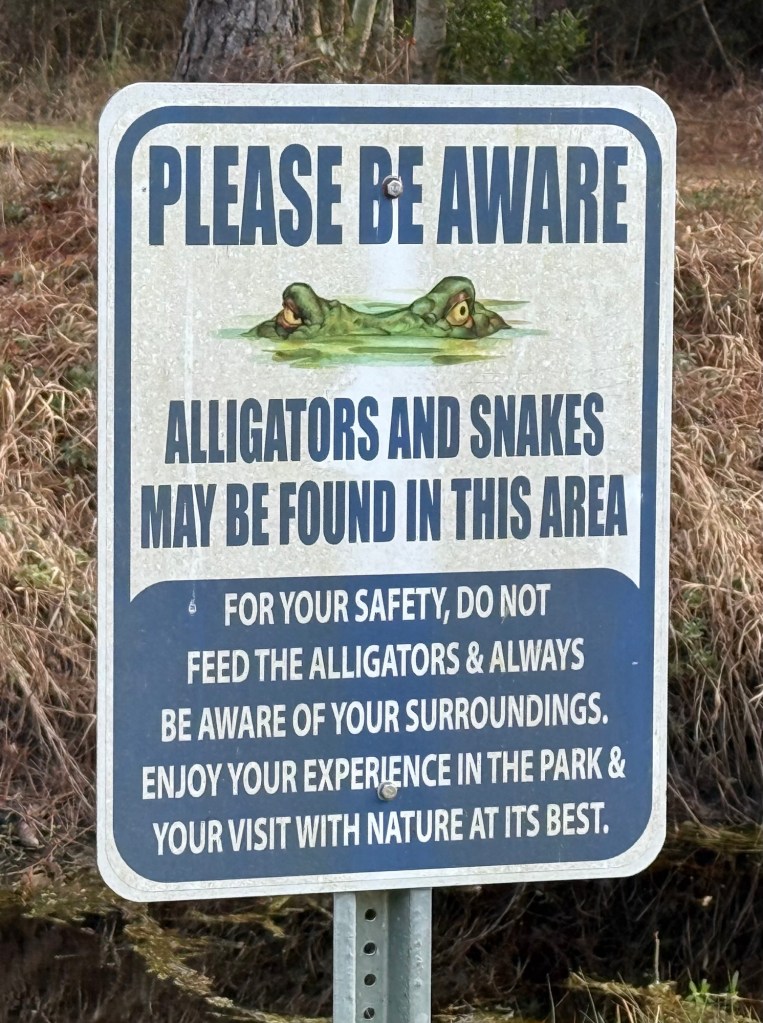
No feeding the alligators? I suppose people will do anything. And snakes! We have never seen one. And I don’t want to.
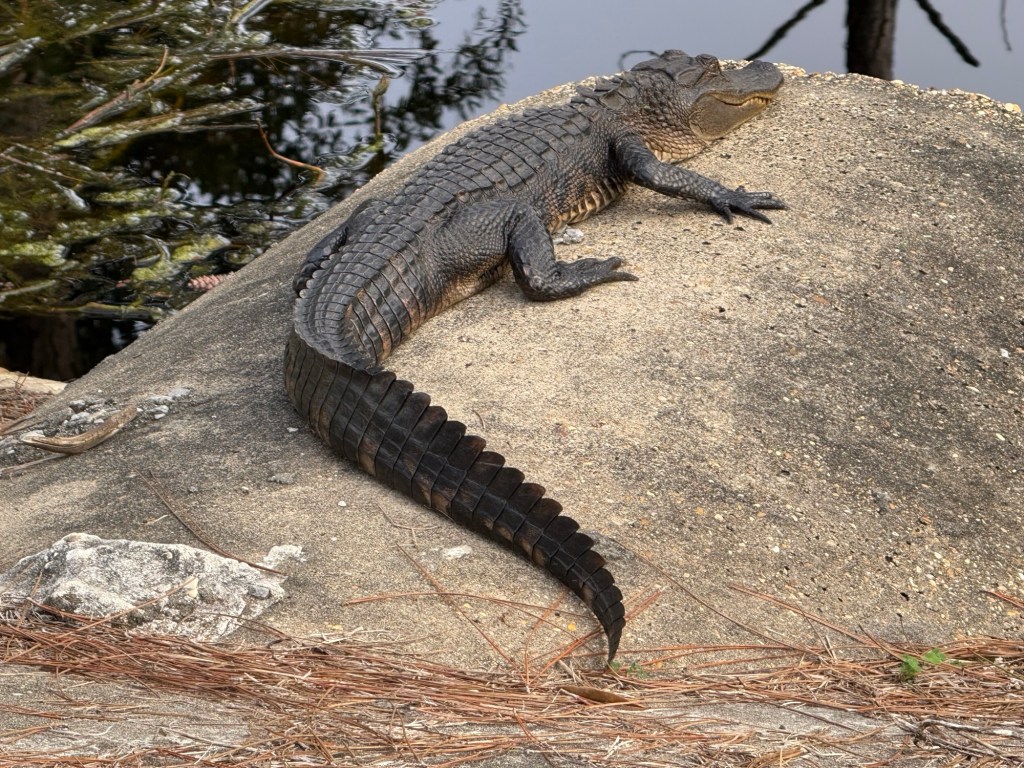
This gator was one of my favorites. We saw him several times in the same location. He just sat there getting warm. He would raise his head up and open his jaws to show his teeth, Yikes! He looks enormous but he was about two feet long, sitting on a drain culvert. Never the less he could have done some damage if your hand looked like dinner.
And just a ways down the ditch were turtles. Some quite big. They too were just looking for a good sun bathing spot. There were usually two or three out of the water and that many in the water waiting their turn in the sun.
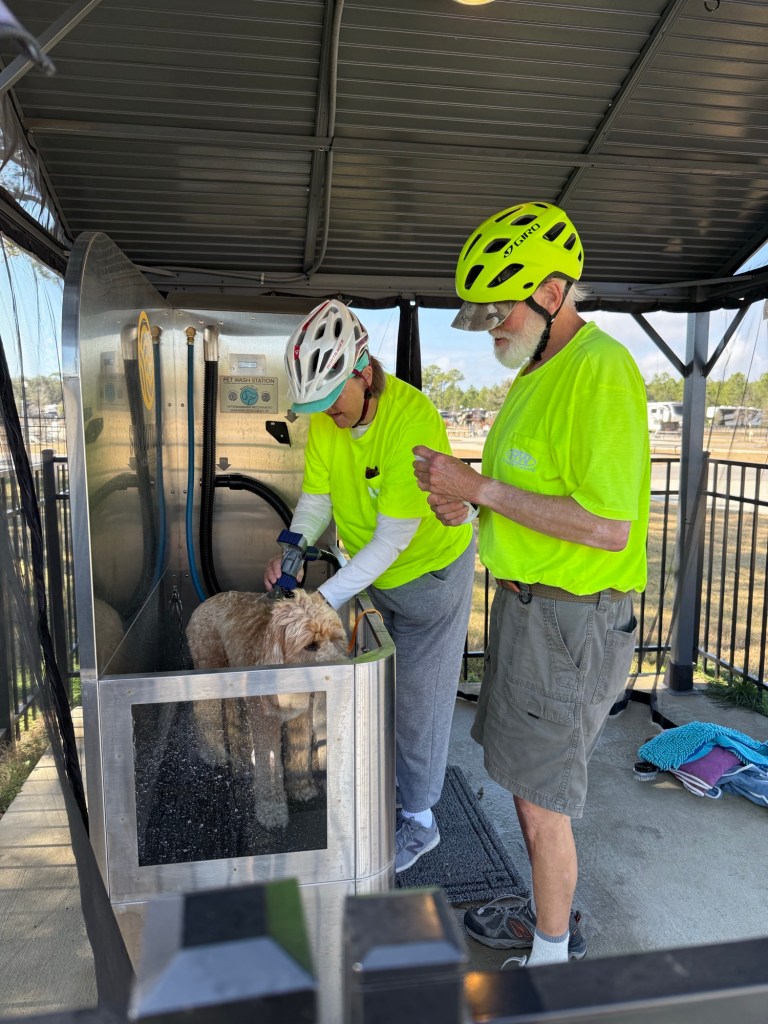
A new feature in the RV park this year is a dog wash station. It features water at the right temperature, shampoo, rinse, and blow dry. We had our own shampoo so we used the water and rinse features. The blow-dry function worked well but Maggie didn’t like it much.
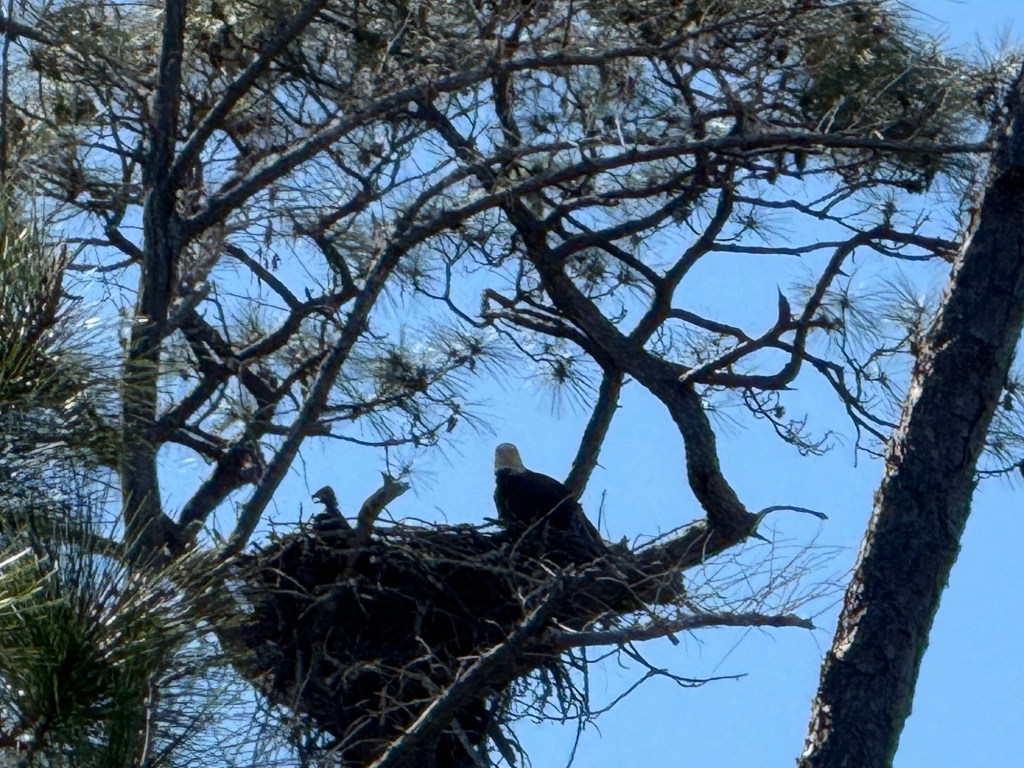
There were three places along the bike trails to see nesting eagles. In this nest, you can see an adult and the little one on the left side of the nest. This was a popular stopping point for many riders. Sometimes a traffic jam with people just stopping in the middle of the trail when there was plenty of room along the side.
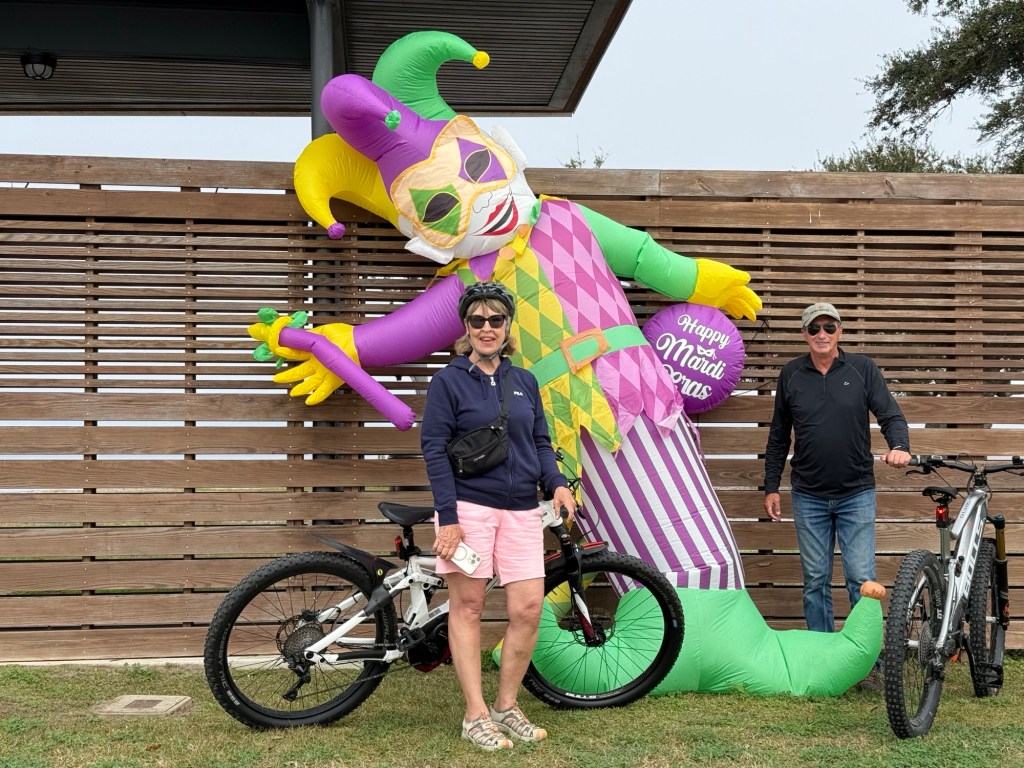
Mobile, AL boasts the origin of Mardi Gras Carnival celebrations in the US. They even have a Carnival Museum dedicated to the history of Mardi Gras celebrations in Mobile.
And most cities have their own parades including Gulf Shores and Orange Beach.
Decorations are everywhere.
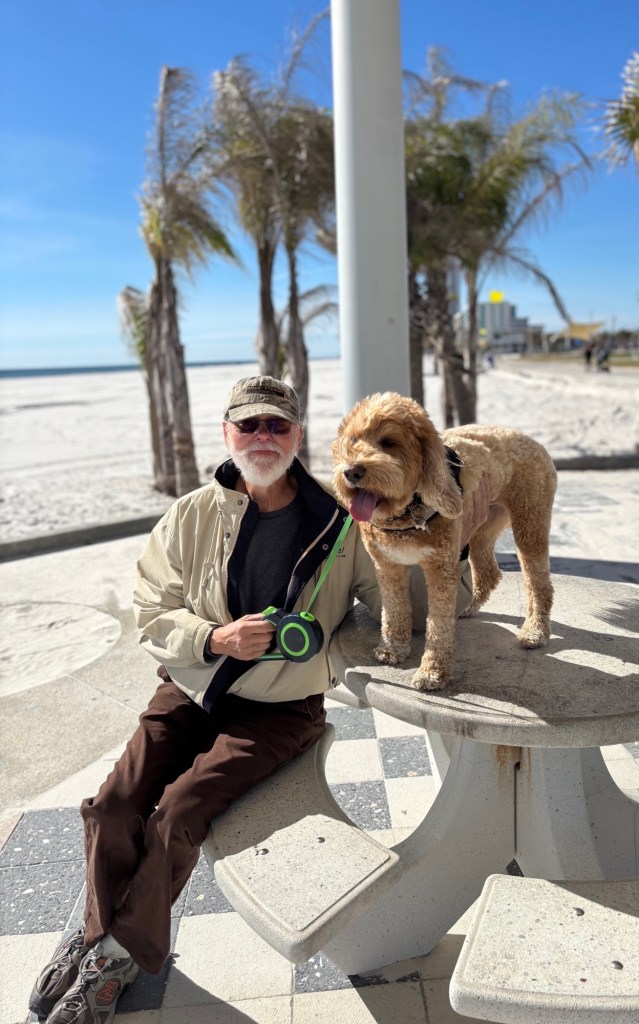
Sonny and Randi were at this one at the beach on Lake Shelby. This is also where the lake side dog park is. The dogs can run right into the lake.
The caution signs were out, I kept an eye out for them. Every dark shadow in the water looked like a 40 ft alligator to me.
I went wading, Maggie waded too and did a bit of swimming. This was the first time she had been in a lake. She seemed to like it.
Lake Shelby is a freshwater lake. At the dog park, it is maybe 200 yards from the ocean, in may places it is closer. It is said to be the closest freshwater lake to the ocean in the world.
Maggie liked the lake but she likes playing in the dirt afterwards just as much. There was another bath for Maggie that afternoon. This one in the shower in the coach. She seems to like them, we turn on the water, open the door and she walks right in.
We were approaching our last week in Alabama.
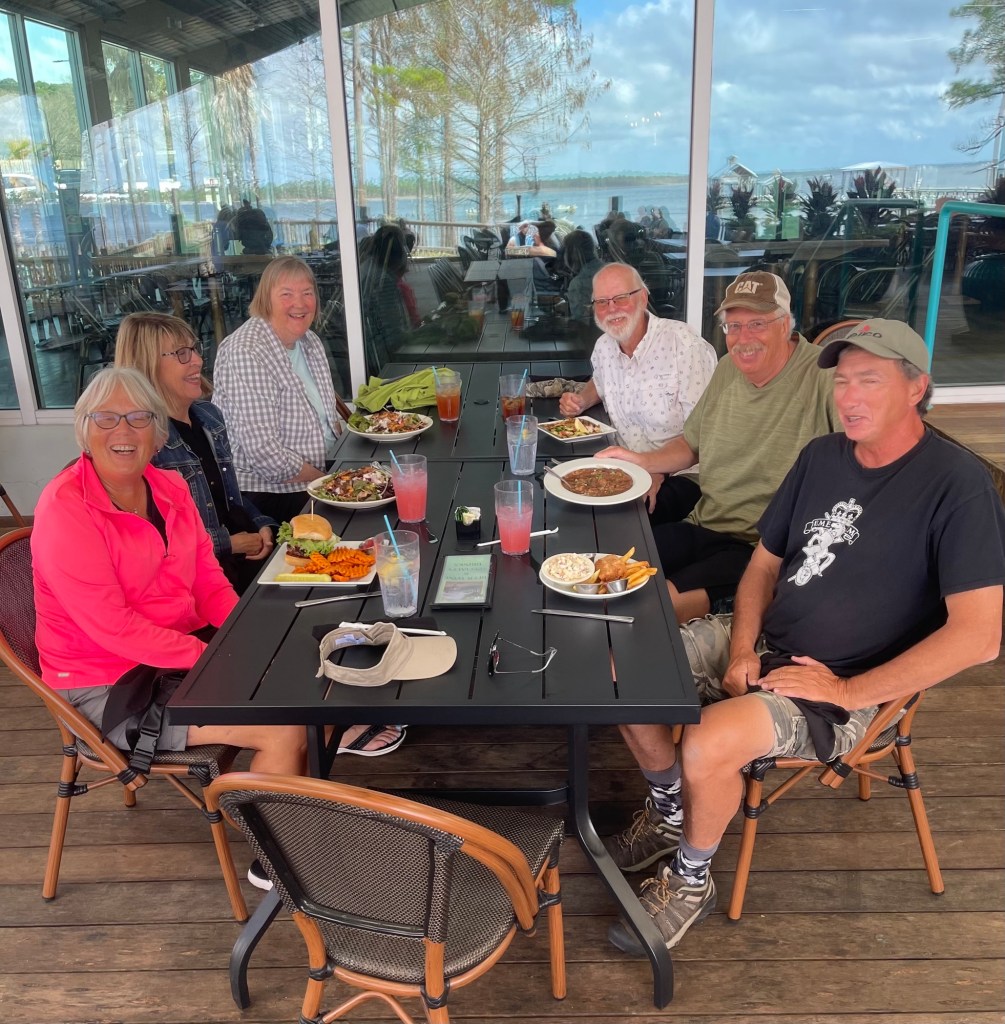
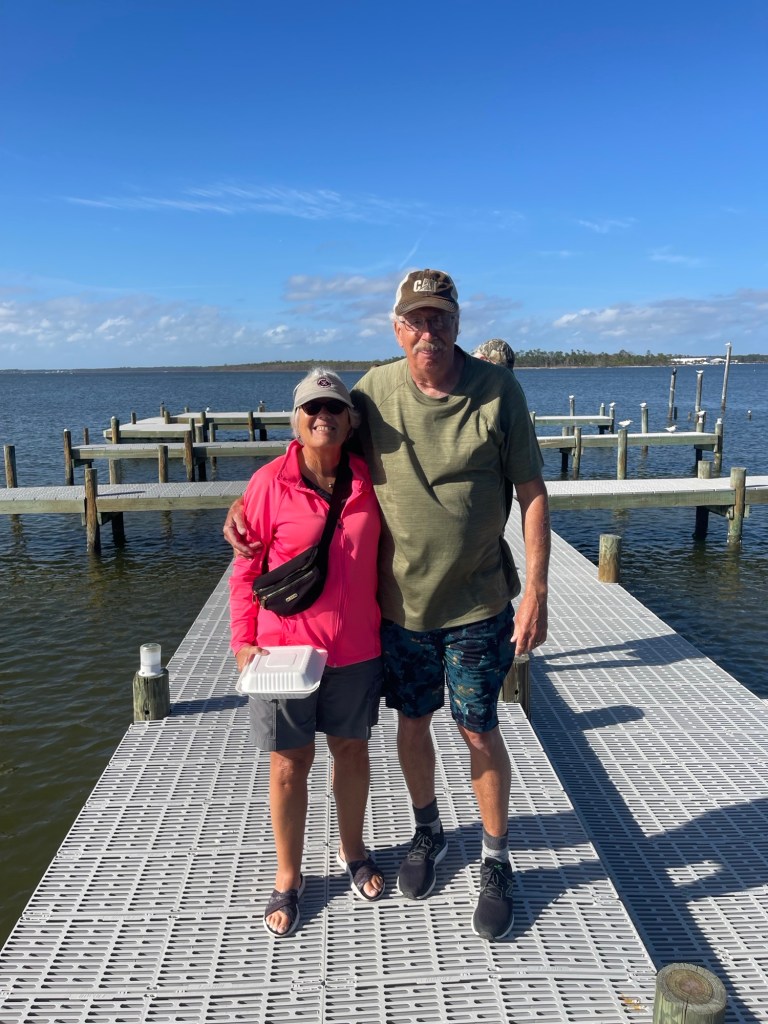
One last lunch out with friends on a sunny, warm March day.
Joe and Rhonda from Illinois were regular biking companions.
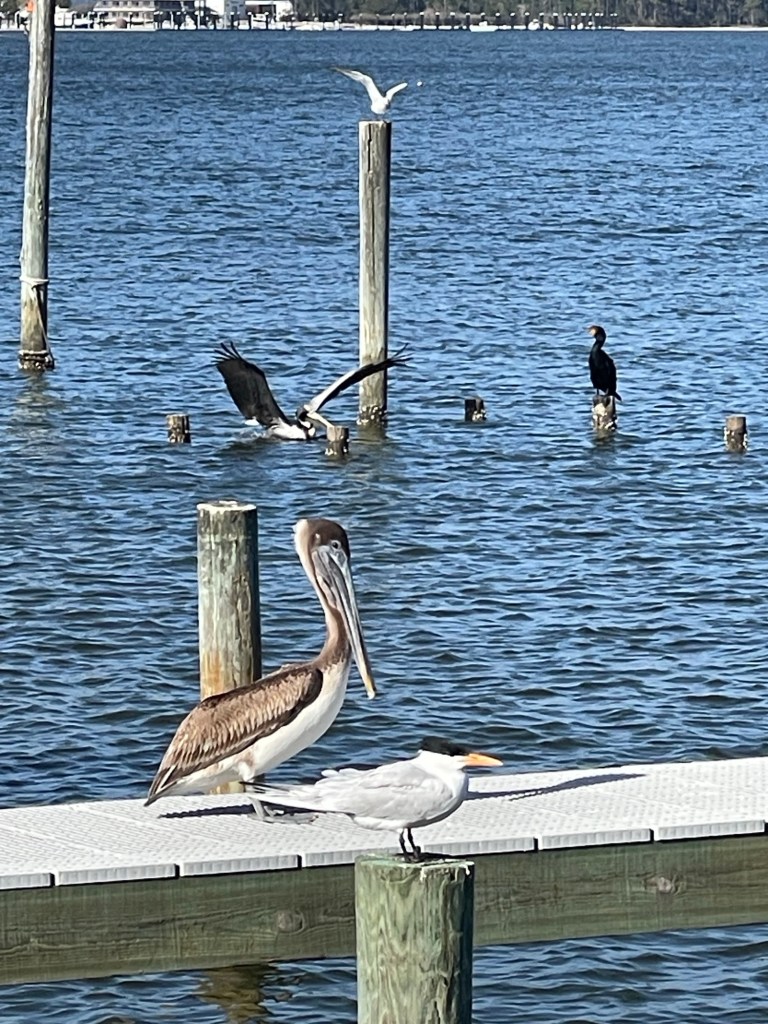
Lots of birds out at the end of the docks. Many of the places we like for lunch have docks where people tie up while going in for lunch.
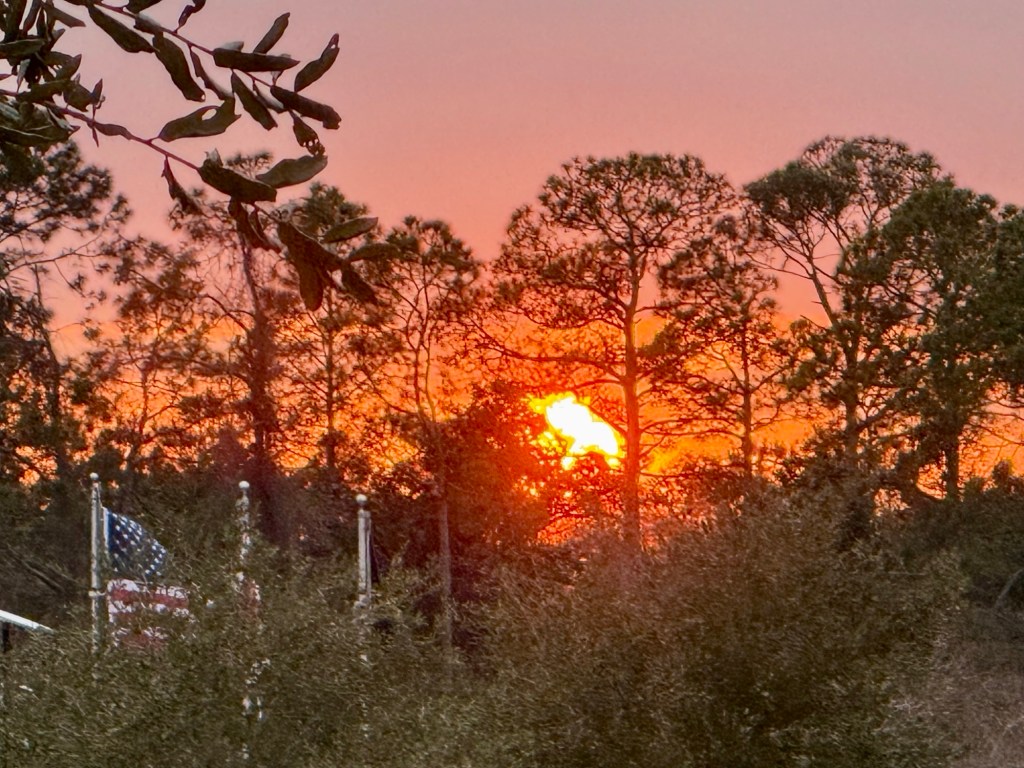
And a good-looking sunset to end the day.
Our neighbors to the north, Mike and Terry from Oklahoma, have two small dogs, Rachel and Roxy. They were pretty wary of Maggie at first but they got to know each other and pretty soon were playmates.
Rachel was more outgoing. She would just come over to see if Maggie could play.
Mike and Terry have been our winter neighbors now for two winters and we are all expecting to be back next winter.
We expect to see Sonny and Randi next winter too. Joe and Rhonda as well. We have gotten to know many on our end of the park, and most will be back. Like most, we have sampled many winter possibilities and settled here.
We have packed up, said our goodbyes, and are ready to go. We are heading north to the Cincinnati area to visit friends. We are watching the weather closely for rain, snow, and storms. It looks good for now so we are going.
We are on the Gulf Coast for the winter. The holidays are done, and the decorations got stowed away for next year. December’s weather was very nice, not much rain, many sunny days, and some 70-degree temperatures. Better than normal. We are waiting for the other shoe to drop.
A look back, A look forward
It is 2025. It seems just a short while ago everyone was worried about Y2K. It was a non-event. I retired in 2017 and really quit working five years later. And Maggie came to live with us. Susan and I shared another anniversary, 49 years together.
We have lived through turmoil and challenges, the loss of friends and family, through a broken leg, 3 broken ribs, several surgeries, and two rounds of cancer. Together, as we always do, we made it through to the next day. And we are always looking forward to life’s adventures, come what may.
There is no way to adequately express our gratitude for the friends and family support we always get, for the opportunities we are able to enjoy, for each other, and for the joy Maggie has brought to our family.
January
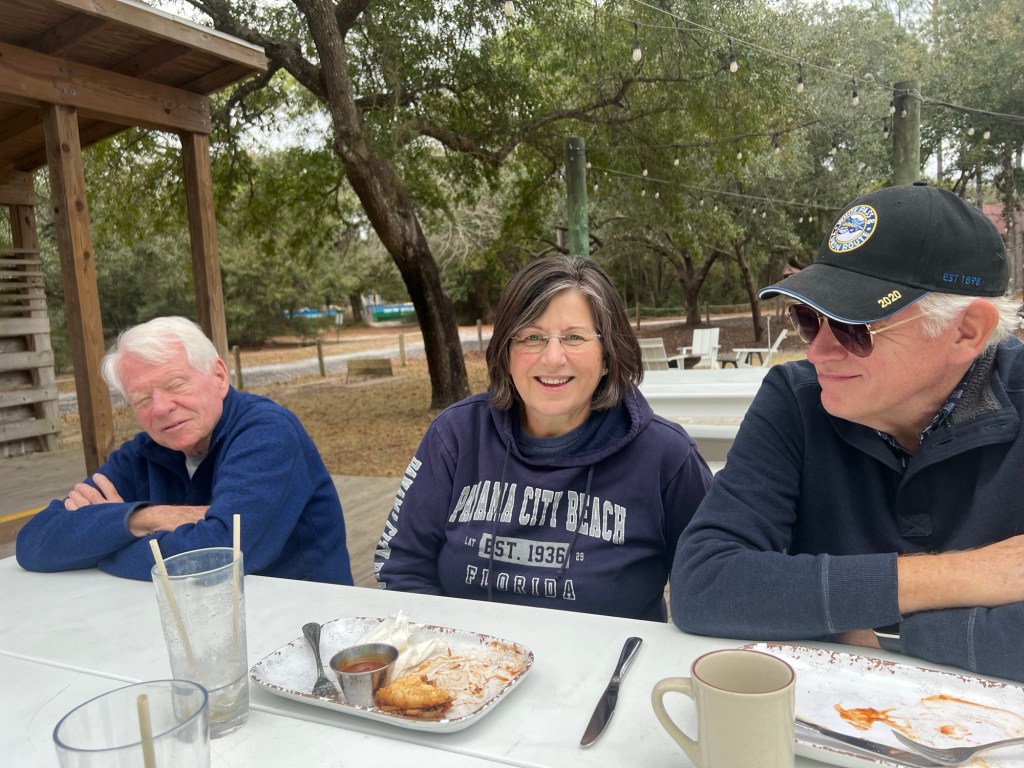
My cousin Sue and her husband Lloyd were in Orange Beach in January. They are staying in a bay-side condo about 4 miles away. So we got to see them frequently. We got together to play Quiddler, a word card game, share some meals, and go to the beach.
December weather was really nice. January had some nice days, a few warm days, and about half of the days when it was just cold (much warmer than Minnesota though)
Sue and Lloyd’s granddaughter, Elyse, and two of her friends came down for a long weekend. They flew into Destin, Florida. Sue and Lloyd picked them up.
The girls were very busy. No sitting around for the youngsters. They rented E-Bikes one day and rode for a few hours, then took a boat tour of one of the bays to see dolphins (they saw a lot), and then we went to Tacky Jacks for Thursday Tacos.
Fish, Shrimp, Chicken or Beef. Grilled or Blackened. Anyway, any filling, just $3 bucks. They were all good, I especially liked the shrimp tacos.
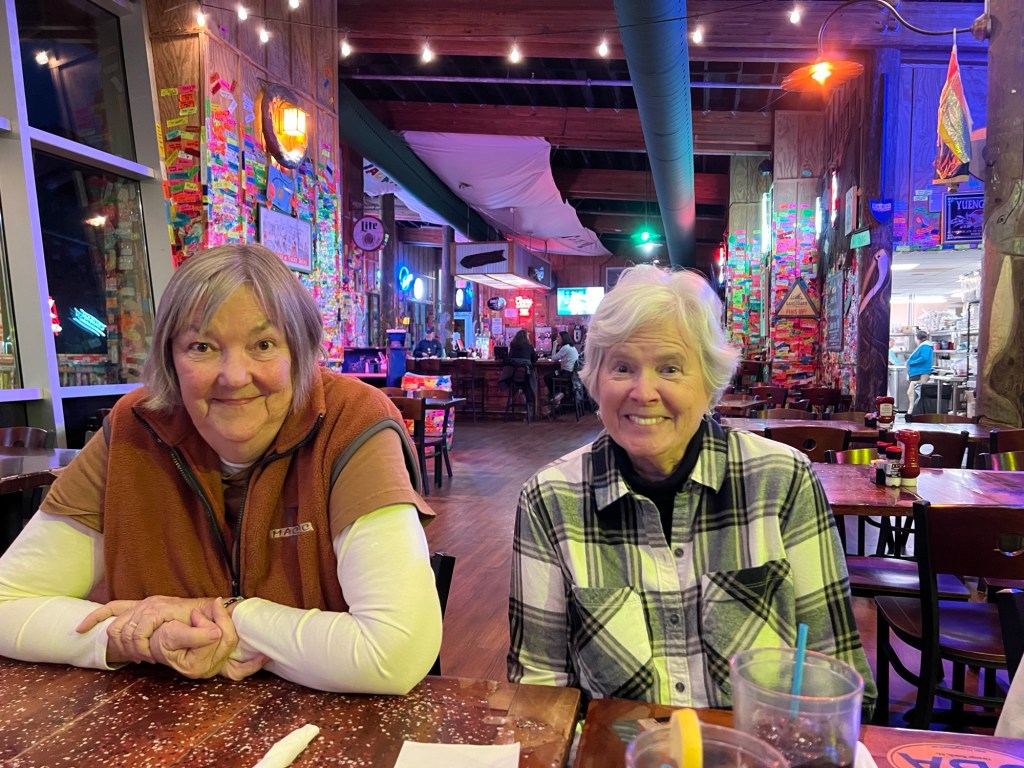
The girls were fun, they were OK with the older folks. Tacky Jacks had strips of every color of Duct Tape all over with messages left by customers.
And they liked Maggie and she liked them.
Susan and Sue
Roger and Lloyd.
There were a few stretches of cold weather so it was a good thing we had a Lee Valley Jigsaw puzzle with us.
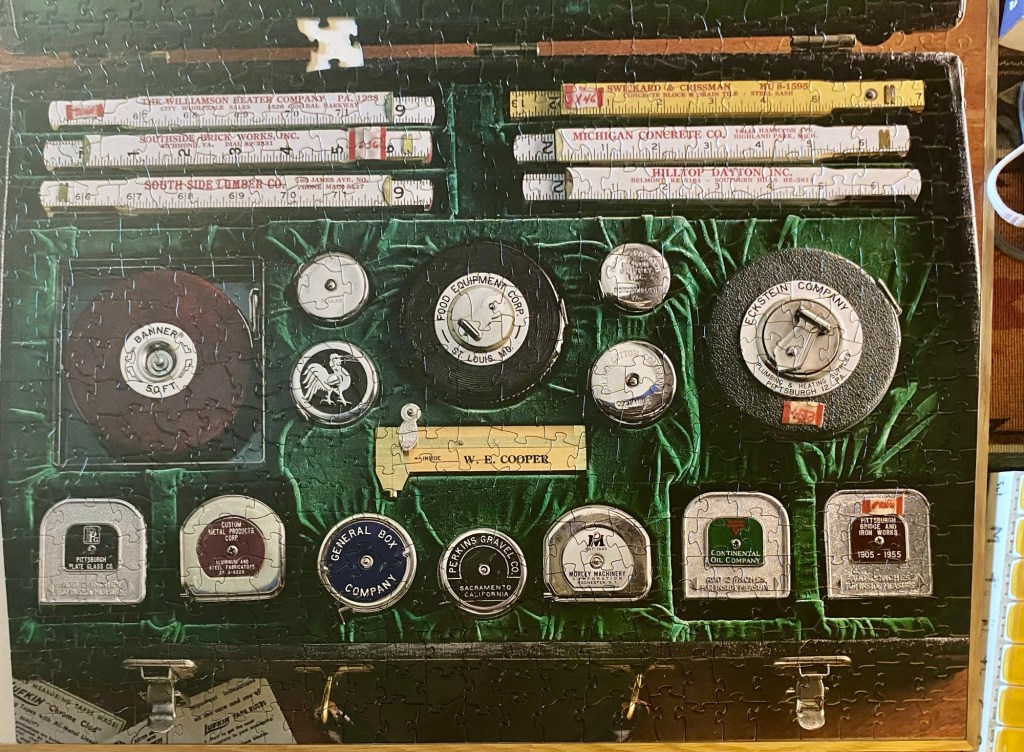
And a second one. They come in sets, one gardens, and one antique tools. This was a collection of old tape measures, one piece left to put in.
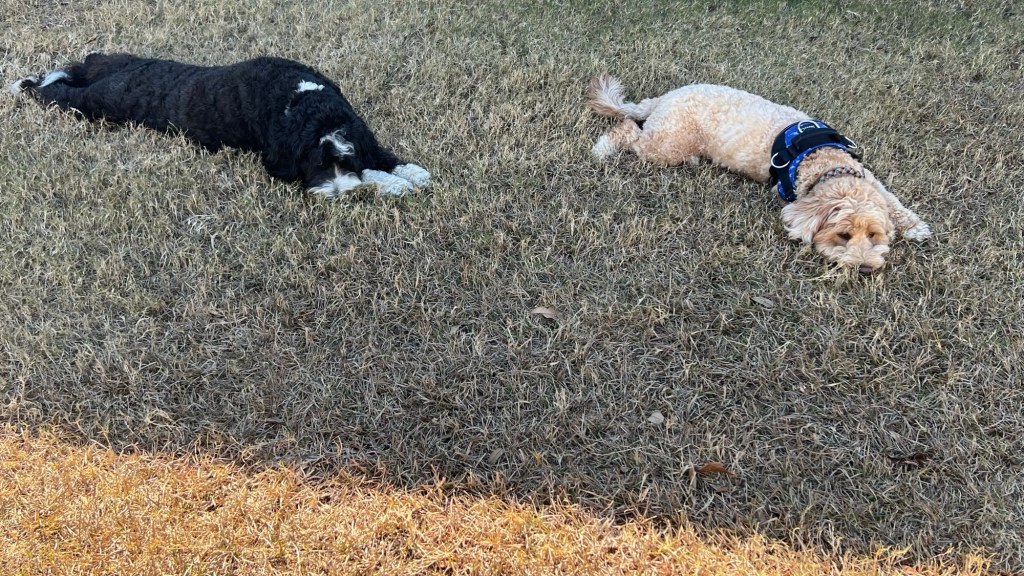
Maggie’s friend, Daisy, would come for visits. Daisy’s owners, Sonny and Randi from Quebec came too. Even though Daisy is twice the size of Maggie they played well together. Maggie would go after Daisy’s ears.
And then some rest in the shade.
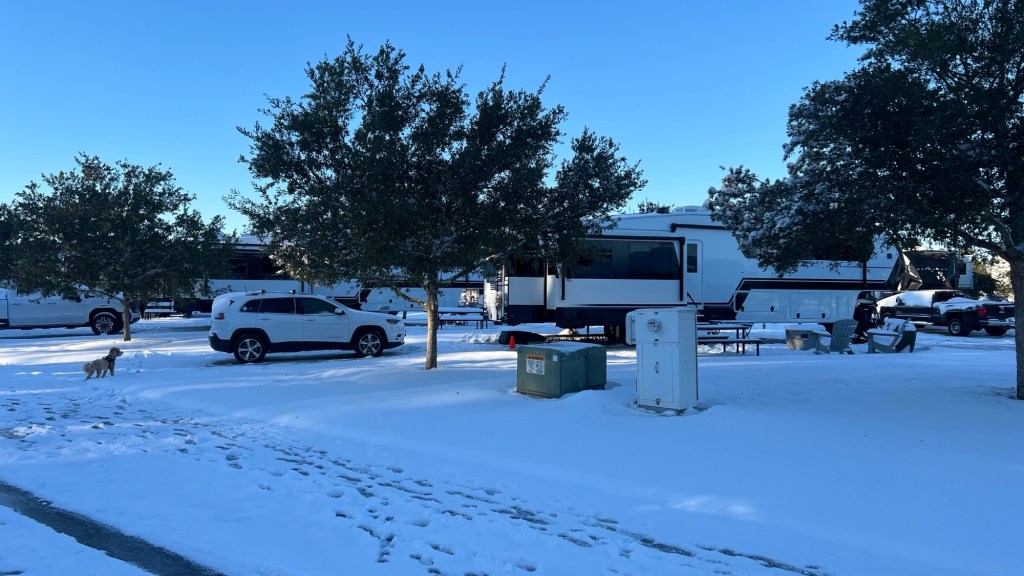
There was a cold snap across most of the country that reached all the way to the Gulf Coast. We got 8.8 inches of snow, an all-time record. It lasted for 2 days and then was gone. But it was exciting to be somewhere where history was made.
Maggie and Daisy had lots of fun in the snow.
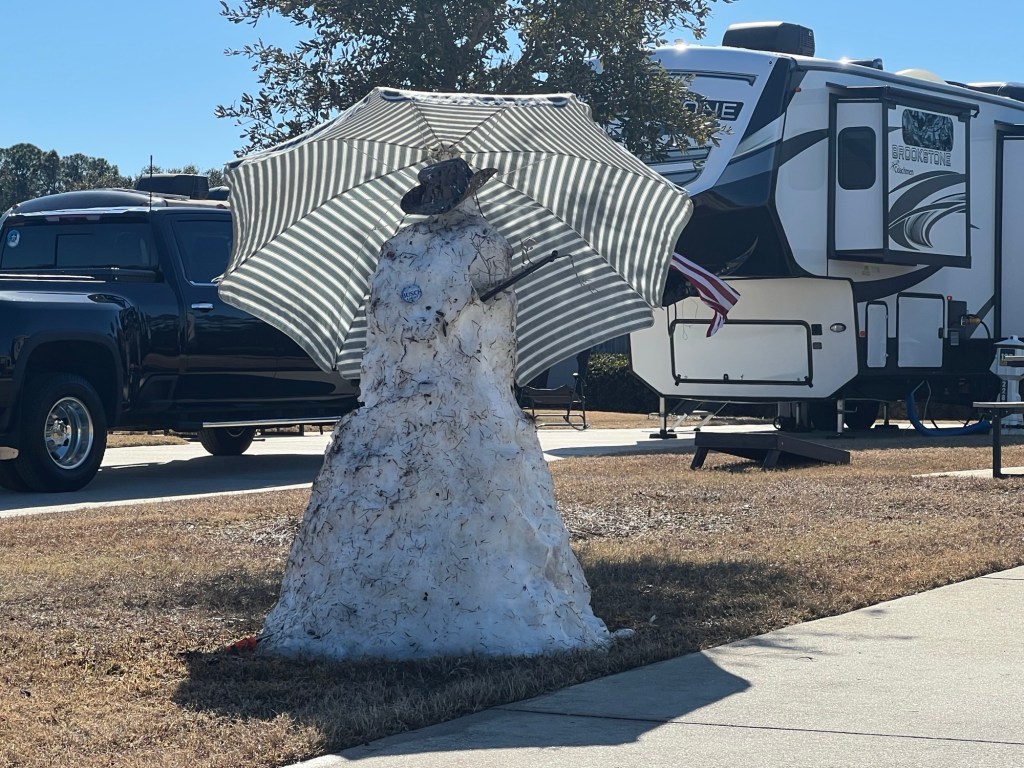
The snow man with the umbrella lasted almost a week.
We tried one of the the mobile groomers in the area. It worked well. They come to where we are with a spa in a trailer. Maggie got a bath and a trim. She always looks good. They are scheduled to come back in March.
Lloyd’s brother Tim and his wife Candy were here for the last week in January visiting.
Susan and I rode our bikes to the Woodside Cafe in the State Park to meet them for lunch on the patio. It gets chilly here but warms back up quickly in the sun.
Tim and Candy were here last year too. We had some great Quiddler games and another game (we don’t recall the name) where you have to bid on the number of tricks you would win. Sort of like Hearts or Bridge. It was fun too.
We got in as much biking as we could during December and on the nice days in January. Out biking buddies included Joe and Rhonda from Illinois and Sonny and Randi and Judy and Doug from Canada. Most rides were 10-15 miles with a few over 20 miles. The easy access to the bike trails in the State Park and in Orange Beach and Gulf Shores is a major part of why we like coming here.
Our arrival at Sun Outdoors Orange Beach RV Park in Alabama was about a week later than planned due to our stop for repairs in Nacogdoches, TX but earlier than it might have been. The folks at Xtreme worked hard to get us done a week earlier than the original estimate.
We stayed overnight at a Walmart in Livingston, LA on the way over. It was a roomy parking lot which was nice but the Walmart was a few miles off I10 in a busy neighborhood. Not the best place to drive through at late rush hour when it had been raining. But in the morning it had cleared up and was easy to get back to the interstate.:
We have been this way before, just get on the Interstate and go. Not too long and we were at Mobile and down through the tunnel under the ship channel. And then a long causeway over the north end of Mobile Bay, another 10 miles and exit at Bucees. Three exit lanes, one North, one South, and one for Bucees. We went South to the beaches.
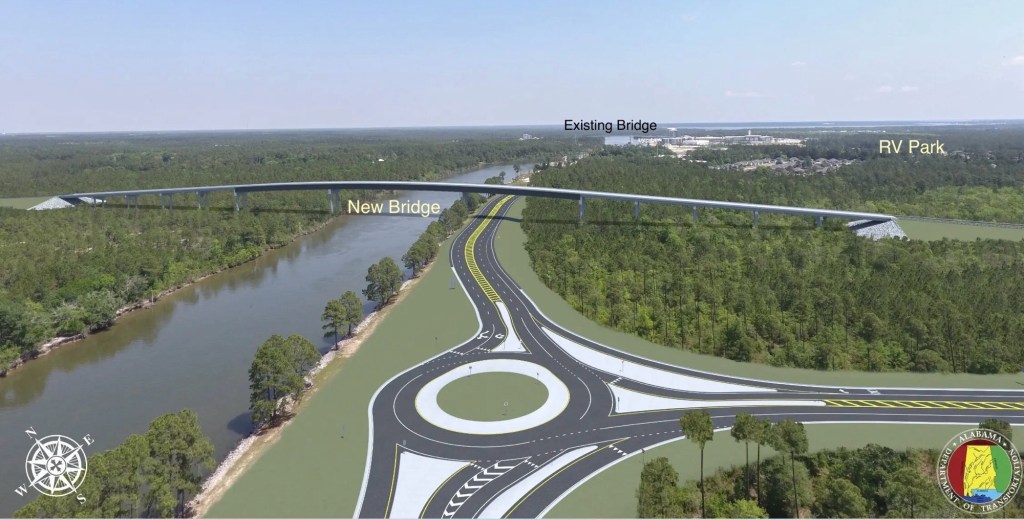
The Baldwin Beach Expressway gets you as far south as Foley then it becomes the Foley Beach Expressway. All heading for the beaches. You have to drive on a high bridge over the Intercoastal Waterway to get to the island where Orange Beach and Gulf Shores are located. This has always been a privately owned toll bridge. The State bought the toll bridge last year and made it toll-free and took control of the Expressways from the County to bring them up to state highway standards. It is also building a third bridge over the Intercoastal Waterway to the Orange Beach end of the island. All of these changes ease traffic loads on the existing bridges and will provide more hurricane evacuation routes. They are also building a pedestrian/bicycle bridge over the Waterway in Gulf Shores to increase the traffic lanes on the car bridge at that end of the island.
This is good but it is in response to the huge increase in population expected in the coming years. Foley, AL just to the north is the 10th fastest growing area in the country.
Life on the island may get busier, but life on the island still seems more relaxed than it is north of here.
The New Bridge and Giant Traffic Circle, Architect’s rendering.
At the end of the now-free bridge, we turn West for a quarter mile and then South into the RV Park.
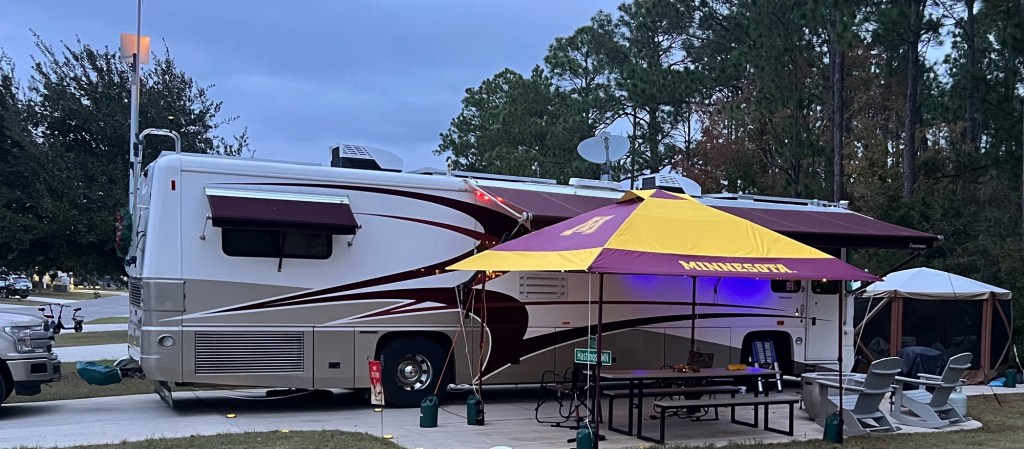
It doesn’t take long for us to get the circus set up. Christmas lights first.
We got a new canopy at Costco. We thought about bringing an umbrella but this works quite well for shade and some rain protection. There are lights in the canopy. Our pop-up tent in front of the coach works well as a garage for the bikes. We have no idea why there is a purple reflection under the canopy from the windows on the coach
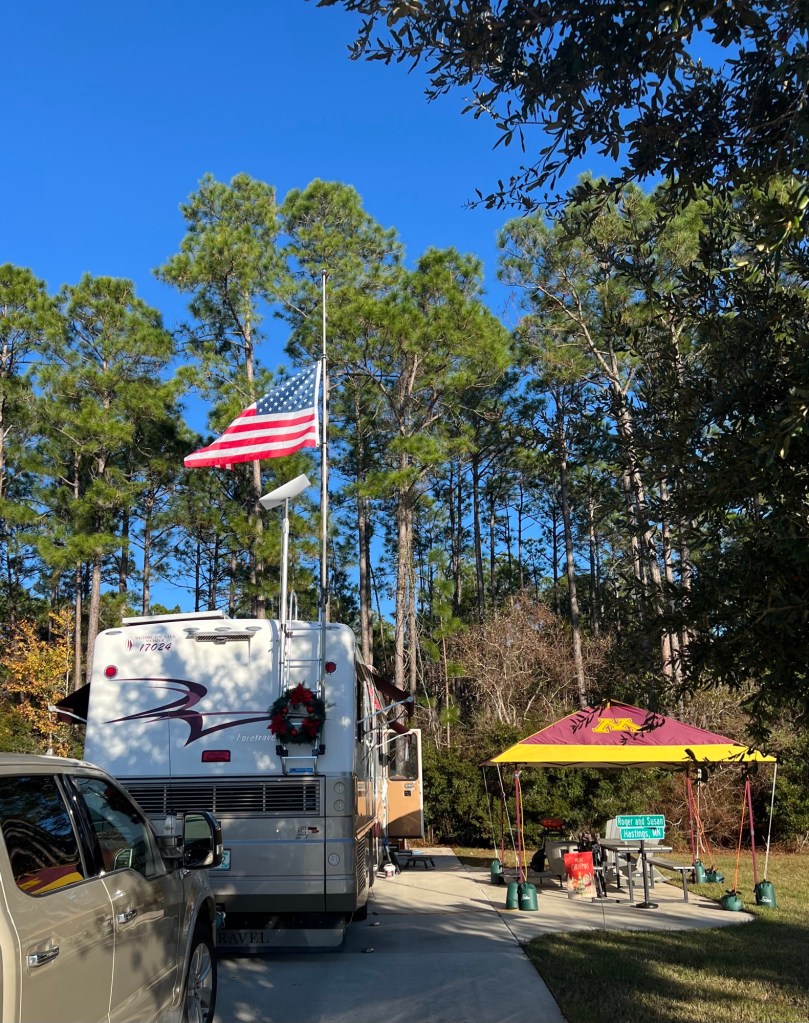
Flags up! Starlink up! Flag at Half Staff for Jimmy Carter. We even have a newly redesigned Minnesota State flag and a Pirate flag for when the mood suits us.
We always bring jigsaw puzzles along. This one was a Christmas gift. If is a nice image and fun to do. We work on them together, Susan seems to do more than I do,
This one is a laser-cut wooden puzzle. If you look closely there are animal-shaped pieces.
This picture was in the Vet’s exam room. We looked all over for a print or the artist and had no luck so I took a picture of the picture, did some editing to clean it up and make it bigger and had it printed at Shutterfly. We will frame it when we get home. And maybe make more for our dog friends.
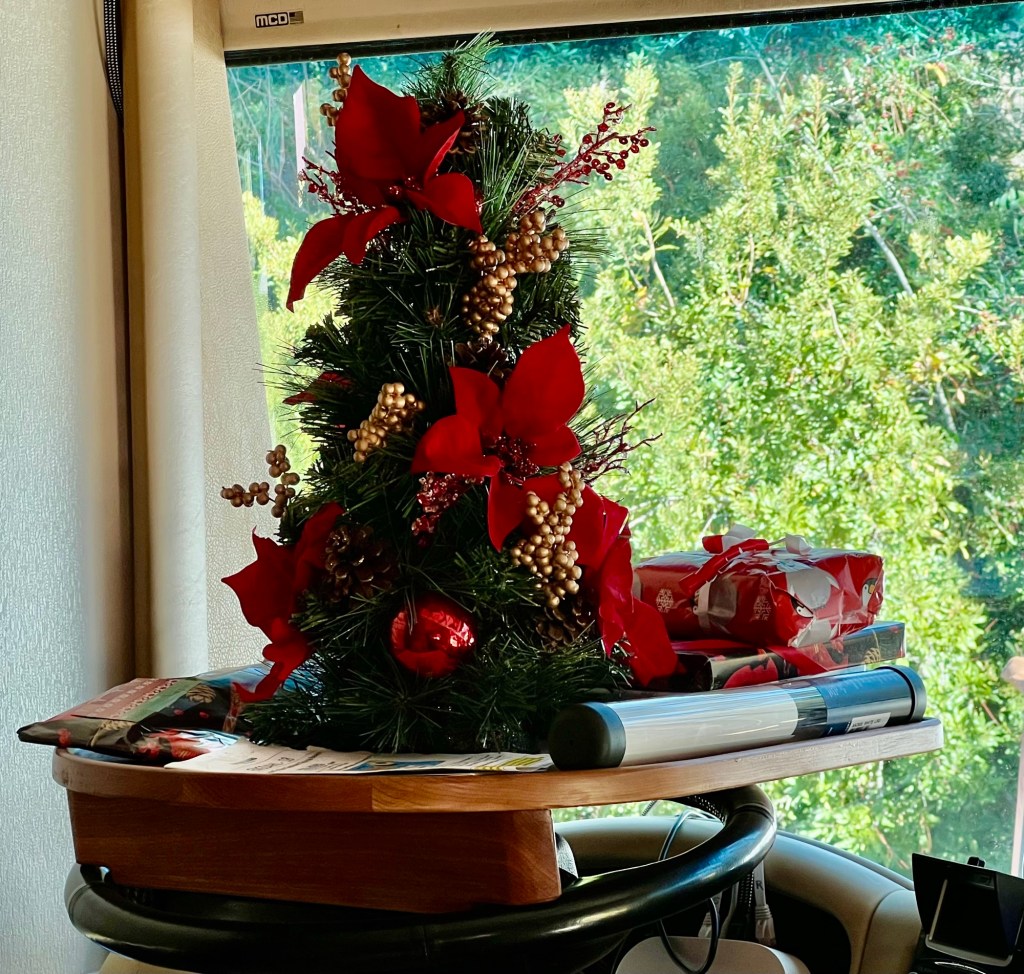
We have a small Christmas Tree, just right size for the coach. And there were gifts to fit underneath.
All good Scandinavian hot dishes need a soup base. This one came highly recommended. We have never seen it in the stores and if we did, we just might pass it up. It is the extra chunky part that wouldn’t sit well with me.
We made Swedish meatballs from scratch for Christmas Eve dinner. They were quite good, maybe not as good as Christmas Dinners remembered from when I was a kid but who knows how good those memories are. Next year we may bring fixings for a proper Swedish dinner from Ingebretson’s Swedish deli in Minneapolis.
Maggie likes the Dog Park here. It is mostly sand. She will chase her toy once or twice and then starts digging as deep a hole as she can. She looks like she is trying to bury it but we don’t think she quite has the bury and hide it idea figured out. Everything gets covered in sand.
We drove over to Pensacola to Joe Patti’s Fish Market. We stopped for lunch on the way there at the Oar House. A pretty good lunch. We came home with both raw shrimp for grilling and steamed shrimp for a peel-and-eat dinner. They are always good.
We made it to another New Year. Not much fanfare here for us old folks but we had a nice dinner. I don’t think we even heard the fireworks from the Wharf at midnight, we were fast asleep.
We are back in Nacogdoches, TX where the Foretravel factory is located. It is also the home of several other businesses that service and support Foretravel coaches. These include Xtreme Paint and Graphics where we are headed. Xtreme specializes in fixing and modifying everything to do with the fiberglass bodies of the coaches and painting the coach repairs and the coaches themselves. It is not just Foretravels, but they work on almost any coach.
Other specialists in town fix all of the mechanical systems in the coach. And interior remodeling and reupholstery companies. And resale outfits that sell and service Foretravels and almost any other brand you can think of. And of course, tire shops, custom chrome and lighting shops, and much more. When you come to Nacogdoches you can get just about anything you need or want for your RV.
Nacogdoches is also a college town, the home of Steven F. Austin State University. About 12,000 students make up a significant part of the Nacogdoches population of 32,000. One thing we notice when we are there is the vast selection of places to eat. Every fast food variant there is, most of the chain restaurants are represented, and lots of local places from BBQ to burgers to family diners. Anything you can think of to eat, breakfast, lunch, or dinner, you will find here.
We moved over to Xtreme from the Foretravel Factory campground on Sunday. A spot was ready for us to park and plug in.
Repairs and More
Monday morning we reviewed all that we thought we needed to get fixed with Rance and Greg from Xtreme and added a couple of other tasks. This updated the original insurance estimate. Greg reviewed all of the changes with the insurance adjuster and got the final OK.
Dave Cobb’s coach was in the main fiberglass work bay when we got there. By the time the insurance stuff was done, his coach moved to paint and we moved onto the service bay. At the end of each day, Greg moved our coach outside and plugged it in. In the morning it moved back inside. We were able to stay in the coach during the day.
Maggie got out frequently. There was an empty lot next door where she was able to roam around and get some exercise. And we went to the dog park almost every day if the weather was OK.
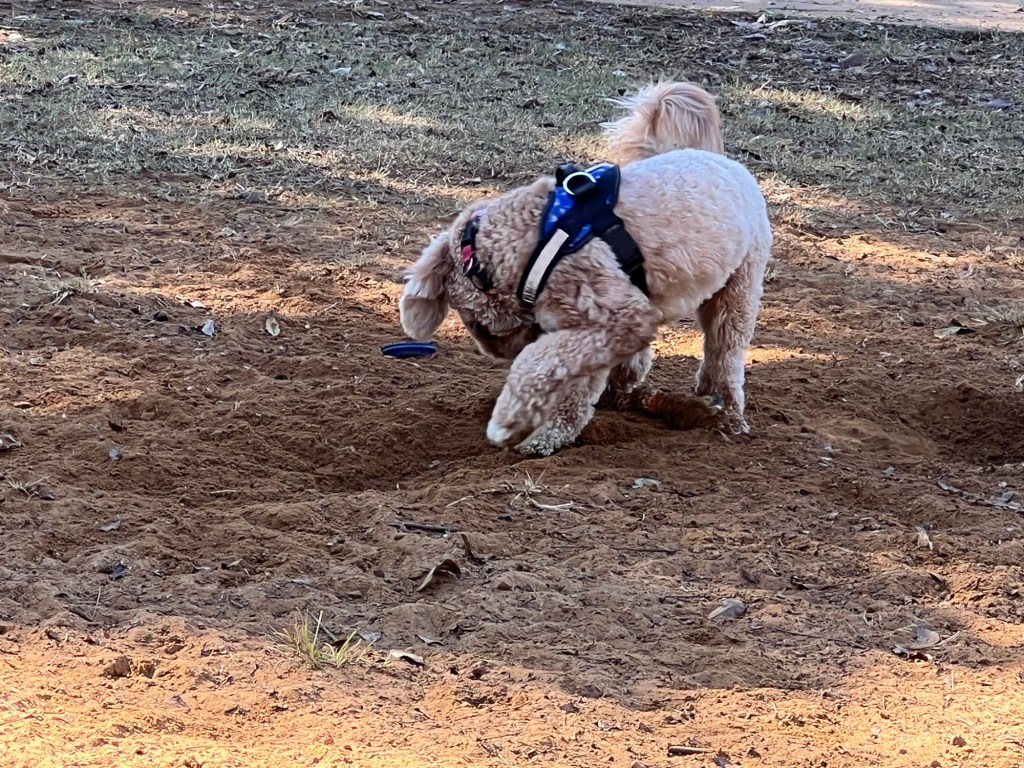
A place to explore and usually dig in the dirt.
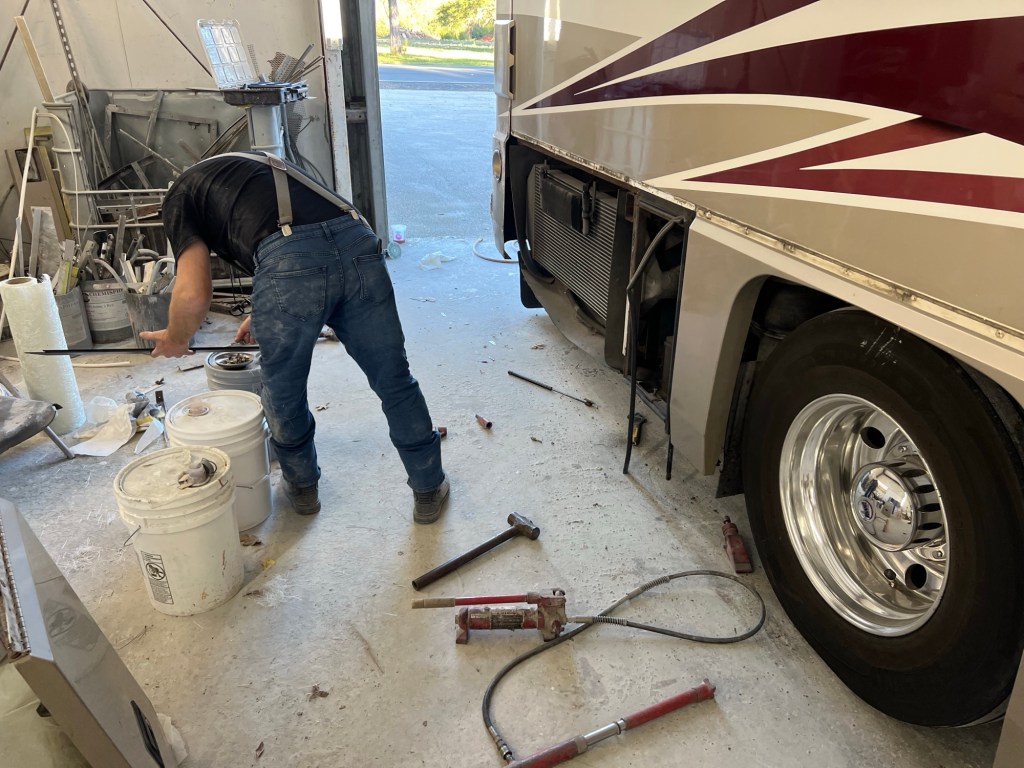
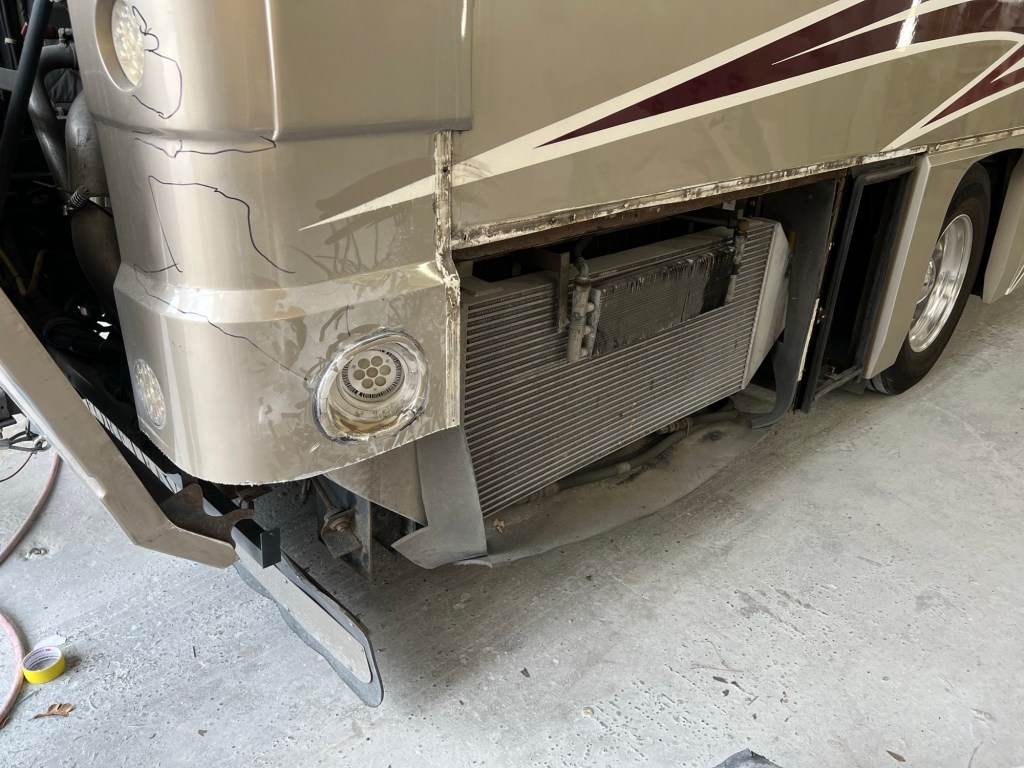
Rance (the Gandolf of fiberglass) tore right into things. He has done it before so he just takes things apart and gets to the fixing stage pretty quick.
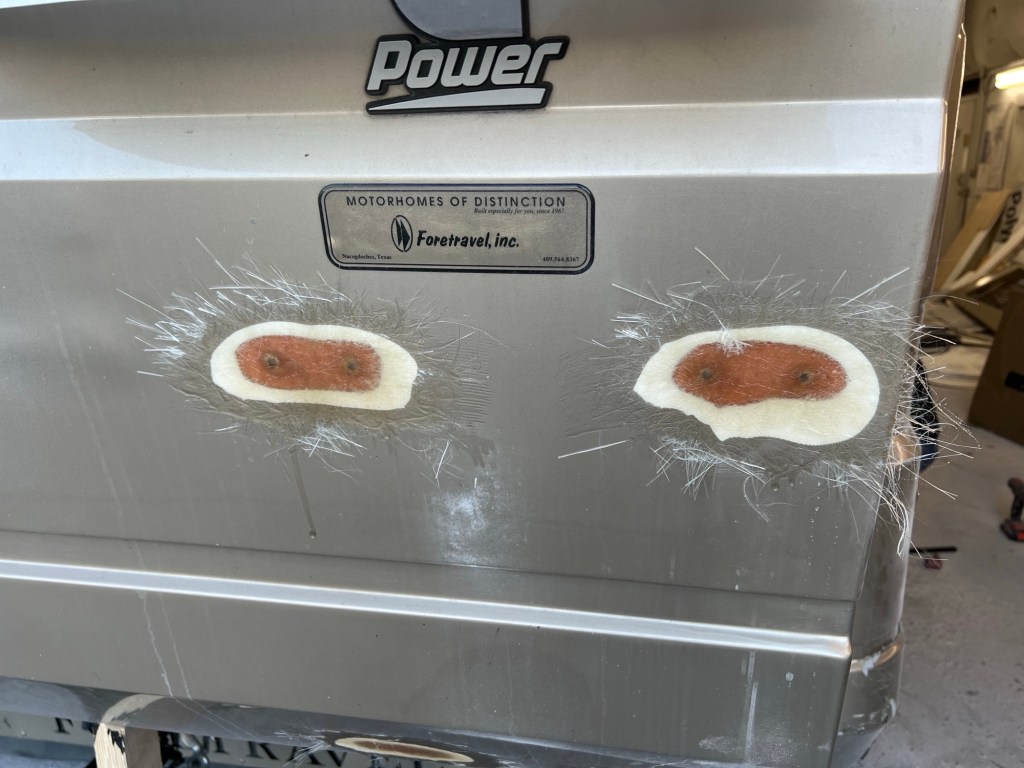
The crunched ladder was removed and discarded. There are no replacements available so he just filled the holes and repaired the fiberglass surface.
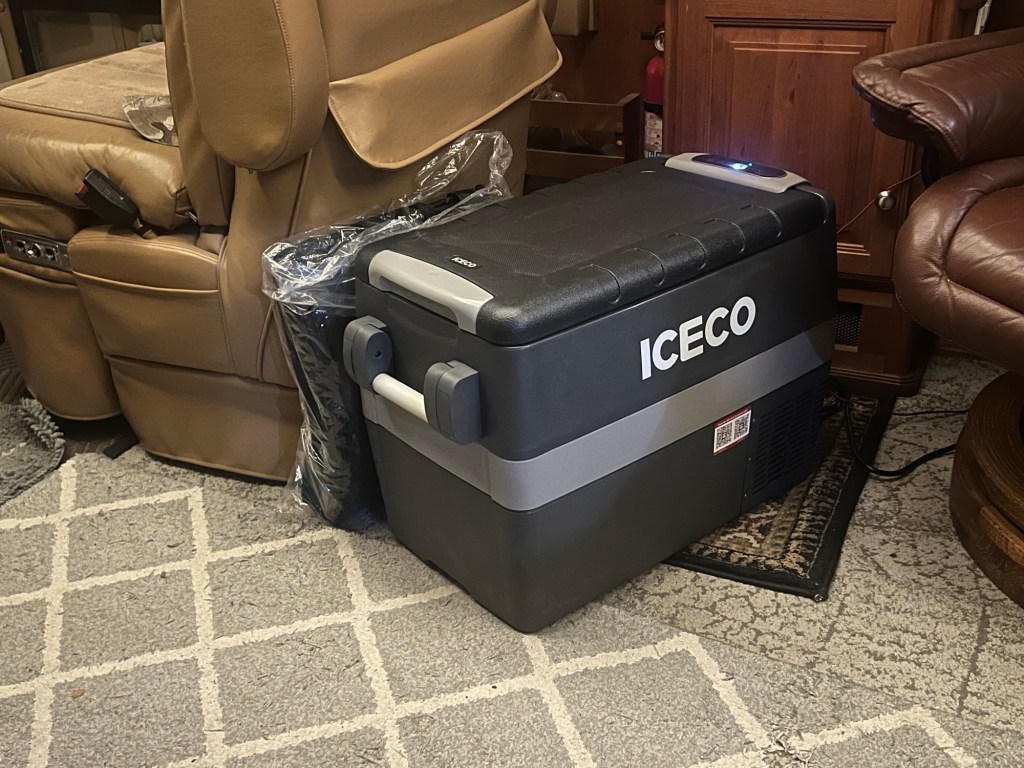
The freezer we ordered while we were in St Louis arrived. We brought it into the coach and plugged it in for a few days to confirm that it worked. It does very well. After a week or so I rearranged things in the basement and moved it down there. Somehow there is enough room for it and everything that was down there before.
Rance cut off the crunched lower corner. He did most of the repairs on the bench and later reattached the bottom section and added more fiberglass on the inside and the outside of the joint.
He repaired the docking light housing in place, I thought it would have to get replaced. He said it was faster and stronger just to rebuild it in place.
He also repaired the rear quarter panel that sits in front of the radiator the frame on the engine battery bay just ahead of that, and the battery bay door, all of which were damaged when the tow bar broke.
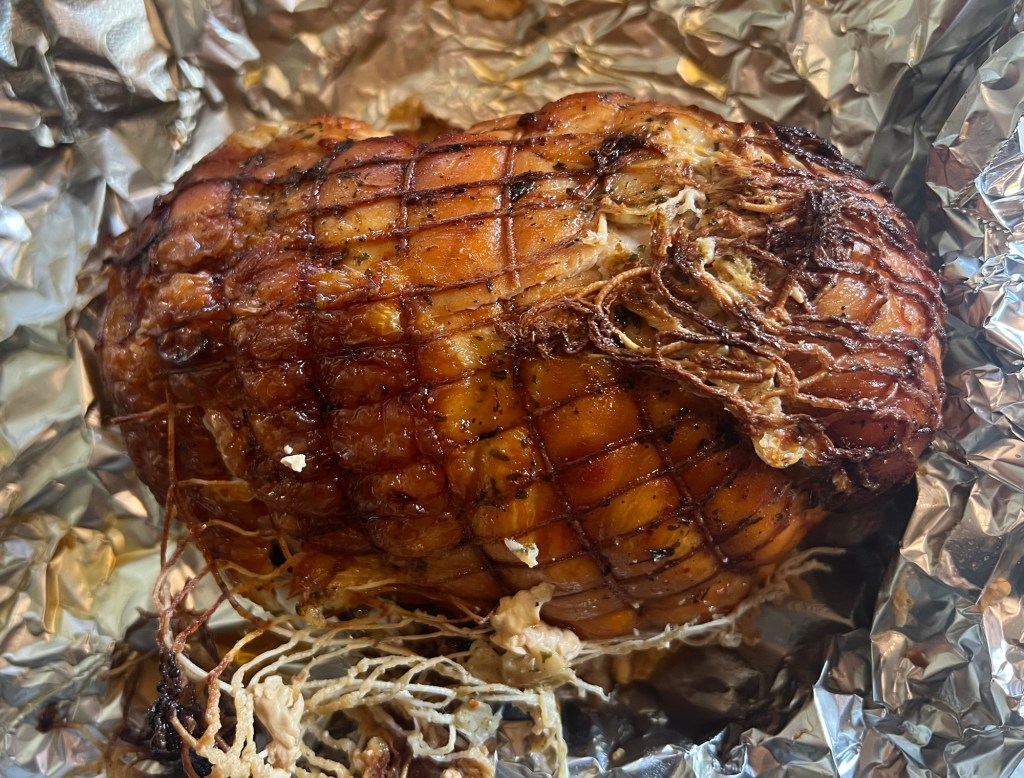
We were in Nacogdoches over the long Thanksgiving weekend. So we roasted a boneless turkey breast. It tasted as good as it looked.
And with some roasted yams with bits of marshmallow, gravy, and some stove-top stuffing it made a pretty nice Thanksgiving Day dinner. There was a pumpkin pie involved as well a bit later in the day.
The best part of a Thanksgiving Day turkey dinner as I remember it from when I was a youngster, was the turkey sandwiches that came that night or in the next days. When we were kids it was probably white bread, today a nice multigrain bread, Miracle Whip would have been what we got 70 years ago, today, Hellmann’s Real Mayonaise, then nice, generous slices of turkey, a bit of salt and what makes it wonderful, pepper.
When we were kids, the turkey probably sat out on the kitchen counter until it was time for sandwiches, the turkey might still have been just warm. I know enough about food safety now that that doesn’t happen but warming the sliced turkey in the microwave for 15 seconds or so has the same results. Now, it is a warm sliced turkey sandwich with mayo and pepper. Almost as good as dinner itself.
The dog park was a frequent stop in the late morning. We had Maggie’s throw toys with us, she would go get them and then play keep-away. And then find some dirt and try to bury her toy. The toys got dirty, Maggie got dirty, and it was her time to play and entertain herself. She got a couple of baths while we were there.
She had a trim before we left but it was growing out. By the time we get to Orange Beach, she will be overdue.
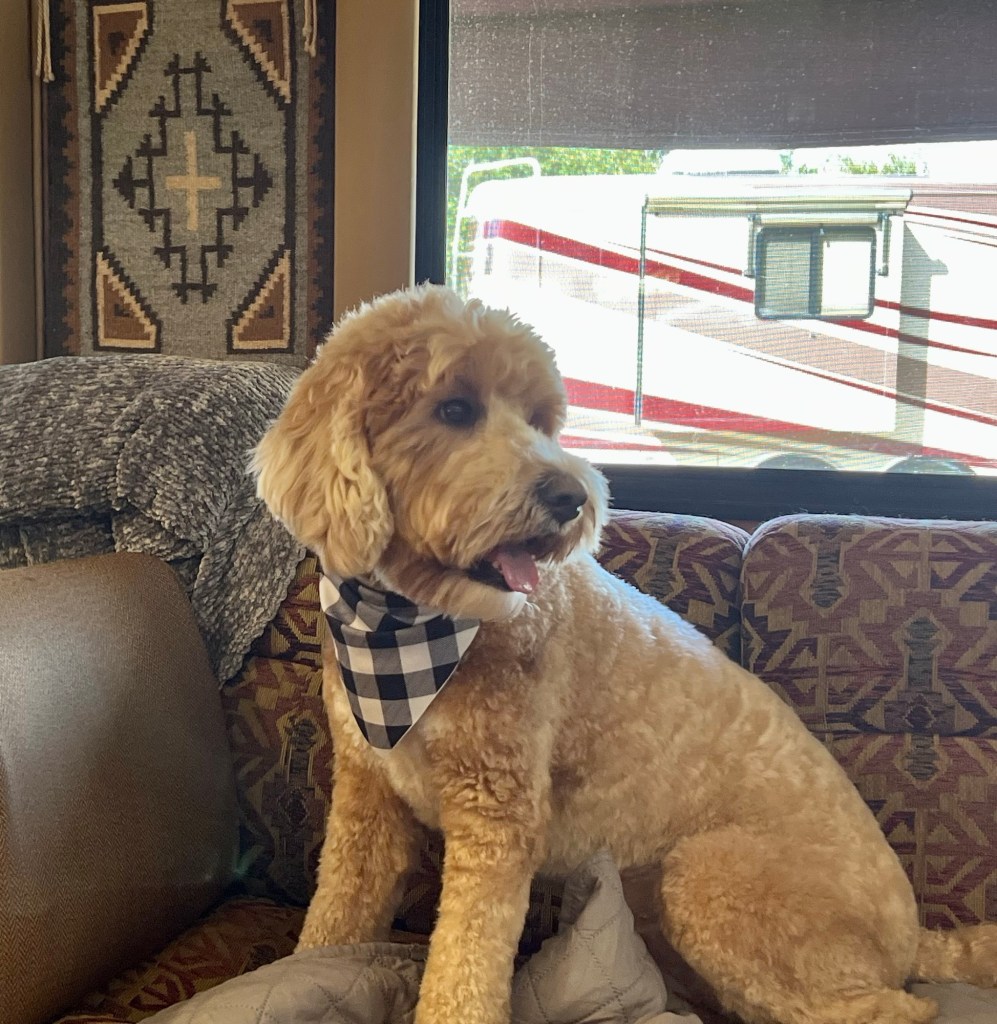
Maggie knows where she likes to spend a good part of her day, sleeping in the window. Once in a while, Susan sings her a soft lullaby, “How much is that doggie in the window?” Priceless.
Thanksgiving weekend meant we needed to drive over to the Foretravel campground to empty our waste tanks and add fresh water. So on Sunday morning we drove over and did what needed to be done.
That isn’t a DOT-certified driver’s seat. No passenger seat either. But it worked. While we were in NAC we checked with Infinity Upholstery about repairing some of the worn leather on the front seats. It was not inexpensive. Most of the labor cost is just disassembling the chair cover to get to what needed fixing no matter what we did. And at 24 years old, it seemed like recovering both chairs made sense.
We looked at lots of different UltraLeather options
And settled on this combination. They are a distressed look, breathable UltraLeather material.
So they came and removed the seats to reupholster them, it took about 10 days.
The result was nice, we like the colors, and the UltraLeather is very soft.
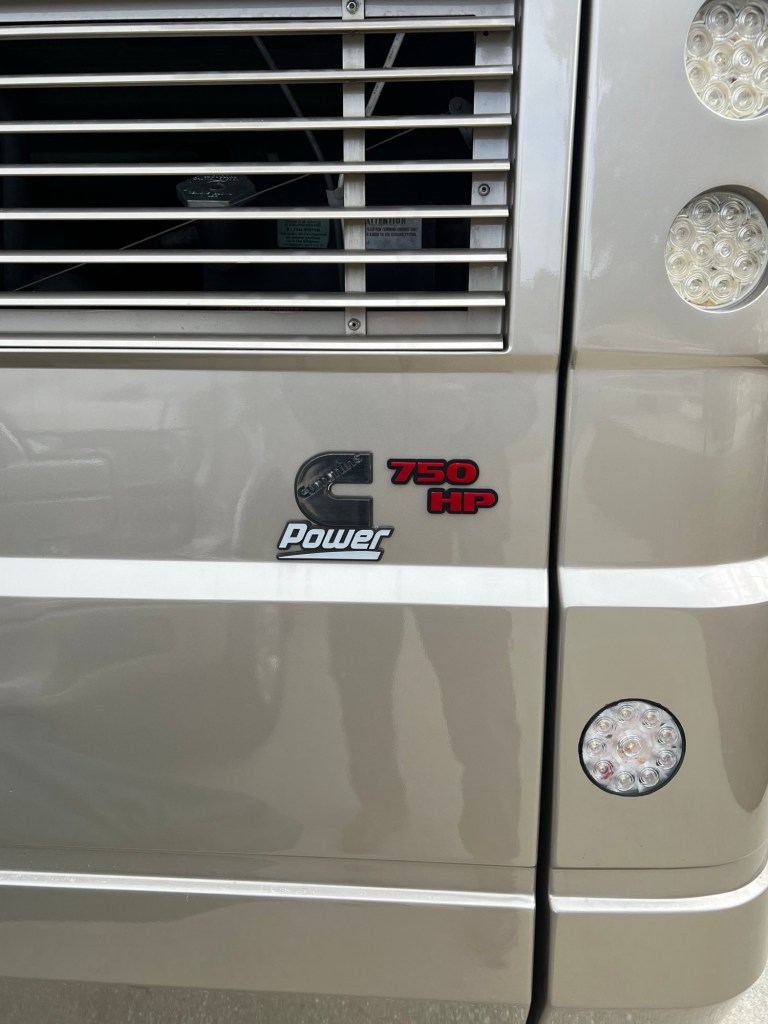
Rance finished up his repairs and adjustments. The rear corner looks perfect. The spots where the ladder holes were disappeared. The rear engine hatch fits the way it should. And the Cummins badge got an upgrade.
While we were in NAC, I looked at many different ways to add a side marker light and turn signal towards the back end of the coach. This is mainly for someone next to us. There is a front side marker and turn signal but the same thing would have been difficult to add along with the required wiring near the rear wheel and mounting it on the fender would have made it stick out too far. So I settled on the lights shown above. It is an LED light bar mounted to the fender. The amber lights are on when the exterior coach lights are on (any time the coach is moving) and is a sequential turn signal when the turn signal for that side is on.
The paint shop painted them the color of the body panel, I ran the wiring and Rance did the final connections. They needed a longer “on” signal than just the momentary flash signal to start the sequential lights so I tried a couple of different ideas to get them to work but now they do.
Lunch-a-Lots
When I was in Boy Scouts decades ago, one of the Patrols in the Troop was nick-named the Lunch-a-Lots. Pretty fitting when we are in Texas, Lunch out with friends is a frequent event.
Fittingly, one day while in Nacogdoches, we drove down to Livingston, Texas, about an hour away, to meet Rudy and Carolyn from Houston for lunch. It was good to see them.
Another day we drove to Woodville, Texas, about an hour and a half away, to meet Keith and Jo Newlin for lunch at a Boarding House-style fixed price restaurant. It was different but good. They brought out plates full of fried chicken, bowls of potatoes, coleslaw, vegetables, baskets of rolls, and dishes with peach cobbler. I liked the fried chicken but wasn’t too keen on the boiled collard greens. We were stuffed.
And Scott and Carol Seibert drove to Nacogdoches from the north part of Houston for lunch at Auntie Pasta’s. We met Scott and Carol about 10 years ago for the first time at dinner at Auntie Pasta’s. They have been good friends ever since. The food and company at Auntie Pasta’s is always good, well worth the drive.
And when Dave Cobb came to get his coach at Xtreme, we went to Nac Burger in Nacogdoches. This is a spin-off from Butcher Boys but over where the University is. Same food, good burgers, and all of the fixings.
So we were fortunate to have been able to connect with our friends from Houston and we enjoyed spending time with all of them. We frequently stop there in the spring to see them but this spring we are going to head home by going up the East Coast.
We also had a very nice lunch with Mary Elizabeth Jordan who lives in Nacogdoches and then back to her home for a visit, coffee, and dessert. She and her husband, Chappell have been friends for many years. Chappell died a year and a half ago. They were and still are the most gracious hosts. It was nice to see her.
Heading for Orange Beach
We were wrapping up things in Nacogdoches. Rance finished up a last-minute item on a Saturday morning and gave the back end of the coach a quick wash. It was raining. We left and drove to Lafayette, LA, about 1/3 of the way to Orange Beach. On Sunday the weather had cleared and we left for Orange Beach with an estimated mid-afternoon arrival.