

Some electro-babble ahead.
Several years ago we added 1200 watts of solar panels to our coach and 6-100 amphr LiFePO4 Battleborn Batteries. These changes included a Sterling 60-amp battery-to-battery charger, a 120V Sterling 40-amp battery charger, a Victron Multiplus 3000VA inverter/charger, Victron solar charge controllers, and new wiring and controls to improve safety and system management.
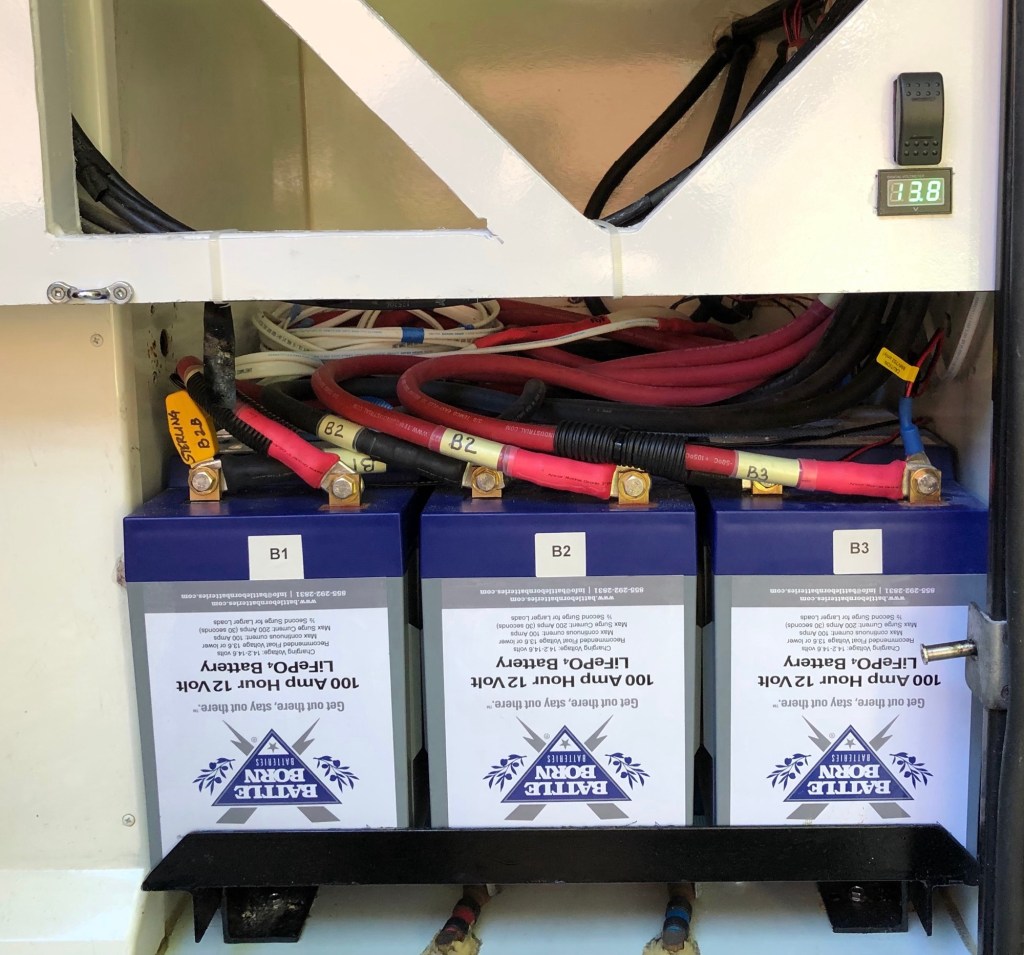
The solar chargers and the 40-amp Sterling battery charger are configured to charge both the house batteries and the start batteries.
The battery-to-battery (B2B) charger takes 12-volt power from the engine-driven alternator when the engine is running and charges the lithium batteries with a limited amount of power in a multi-stage charging process. Lithium batteries will generally take all the power that is available when charging and that often overloads the alternator. The B2B chargers manage alternator loads and lithium battery charging rates.
We were fairly early adopters of the lithium battery technology and were amazed at the improvement in available power compared to our then 7-year-old Lifeline AGM batteries. We had essentially doubled the available time we could spend running on just batteries. The solar panels were able to recharge the Lithium batteries for each day’s use on most days.
In 2024 I increased our solar capacity to 1800 watts. I could have gone to as much as 2500 watts if I had replaced all of my existing panels with newer and more powerful panels. But that meant much bigger solar chargers, bigger wiring, new fuse blocks, and combiners. A lot of time and expense.
1800 watts of solar is sufficient to recharge our normal power consumption (about 3800 watts) for about 9 months of the year. In the winter months, the power the panels produce is less (shorter days, lower sun angle) but still enough to put most of what we use in a day back into the batteries. On some days, it will recover all of our usage.
Our off-grid time is mostly in the summer and generally at higher elevations. We have gone as long as eight days with nothing but solar to recharge our batteries. During this time we ended up about 15% short of full recovery for all usage by the time we left. And we had two rainy days in those eight days.
It was an amazing stay.
Lithium battery technology has improved since our original installation and prices have come down by about a factor of four
Vatrer Batteries makes a 300 amp-hour drop-in replacement for 8D AGM batteries. They also make a 460 amphr battery that will fit into the existing Foretravel battery racks with some minor modification. These have steel cases, Bluetooth connection, a more robust management system, and an on/off switch. You can get them with internal heaters for extreme conditions. We have never seen conditions in our battery bay where there has been a need for battery heaters.
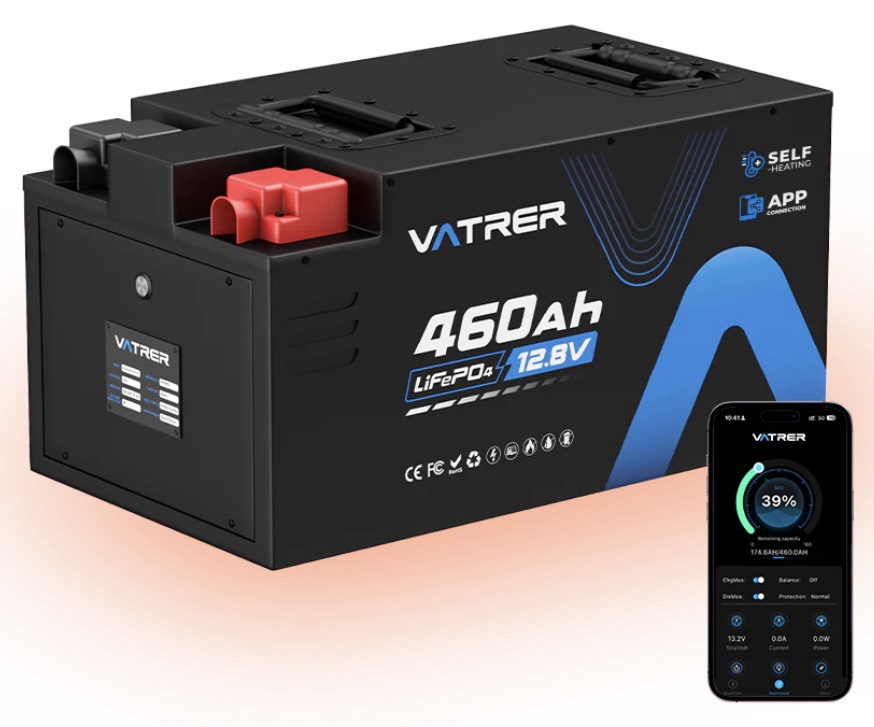
I bought two Vatrer 460 amphr batteries in January 2025 and had them delivered to my neighbor at home. I was going to keep my 6 BattleBorn batteries and make a second battery bank using the 2 Vatrers batteries. This was a fairly complicated project. I had to make a new battery rack, wire up new switches, fuses, and electrical bus bars. And make lots of new cables.
I was explaining all of this to someone and they asked why I didn’t just sell my Battleborn batteries to someone and use the Vatrer batteries in the existing battery bank. I didn’t think I would find a buyer for them but as soon as I looked for a buyer, they got sold.
So I ordered a third Vatrer 460 amphr battery and a few more parts I needed to use three Vatrer batteries in my house battery bank.
In August, my friend Dave came to Hastings. His coach is the same year and length as ours. We removed his old AGM batteries, his original battery racks, and the LP tank.
We removed the Battleborn batteries from my coach as well as the panel with the switches, fuses, battery shunt, and bus bars, and the battery rack that held the Battleborn batteries. We also removed the panel with the Sterling battery-to-battery charger.
We reinstalled all of these components in Dave’s coach. It was pretty easy to do, everything just fit in his coach as it had in ours. We made a few new cables for the battery-to-battery charger and installed that in the bay where his big LP tank had been.
This swap doubled his battery capacity compared to what he had, improved his charging capacity while he drove, improved safety, and added much more useful information about his battery state of charge status.
We double checked everything, turned it all on and it was working as expected. We started up the coach’s engine and checked the charging through the Battery to Battery charger, it was about 55 amps. Just what was expected.
So Dave had a new house bank of Lithium batteries for not much more than he would have spent on a new set of Lifeline AGM batteries with about half the capacity of the lithium batteries. And the lithium batteries will last about three times as long as the Lifeline batteries would have.
So, if you need to replace batteries in your RV, lithium batteries provide more capacity, longer life expectancy, and more reliability and safety. And they are much cheaper over time than AGM or GEL batteries. You are very likely to never have to buy batteries again.
I modified the Foretravel battery rack to fit the Vatrer batteries, I needed an extra half inch in the lower rack to fit the batteries crosswise (side to side) rather than lined up with the length of the coach. This made the battery connections much easier and provided better access to the batteries built-in on/off switch.
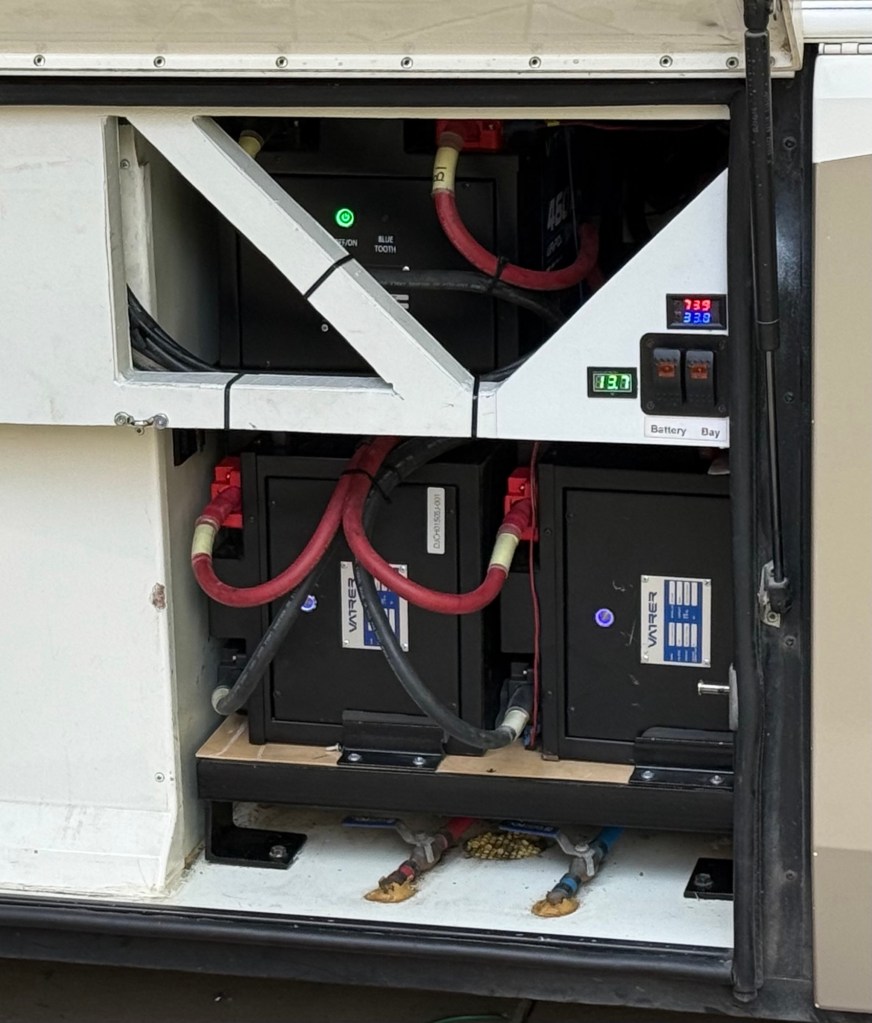
The upper battery is mounted with the terminals facing up. The lower batteries are mounted on their sides with the terminals facing the front of the coach.
All of the plus and minus 3/0 battery cables are equal in length within 1/8”. They connect to the plus and minus bus bars. Each bus bar is followed by a disconnect switch. The plus side continues on with a 400 amp fuse and then to the coach common plus distribution point. The negative side continues on through a Victron Smart Shunt and then to the coach’s common negative distribution point.
The green digital meter is the battery voltage. The red digital meter shows the temperature in the battery bay. The blue meter shows the lower temperature at which a temperature controller powers the fans that move warmer air from the AquaHot bay into the battery bay.
There are three Victron 50-amp battery-to-battery chargers on the back wall of the bay where the original LP tank was located. The B2B chargers were mounted on a panel in the shop. This makes it much easier to install in the coach, just mount the panel and hook up just a few cables.
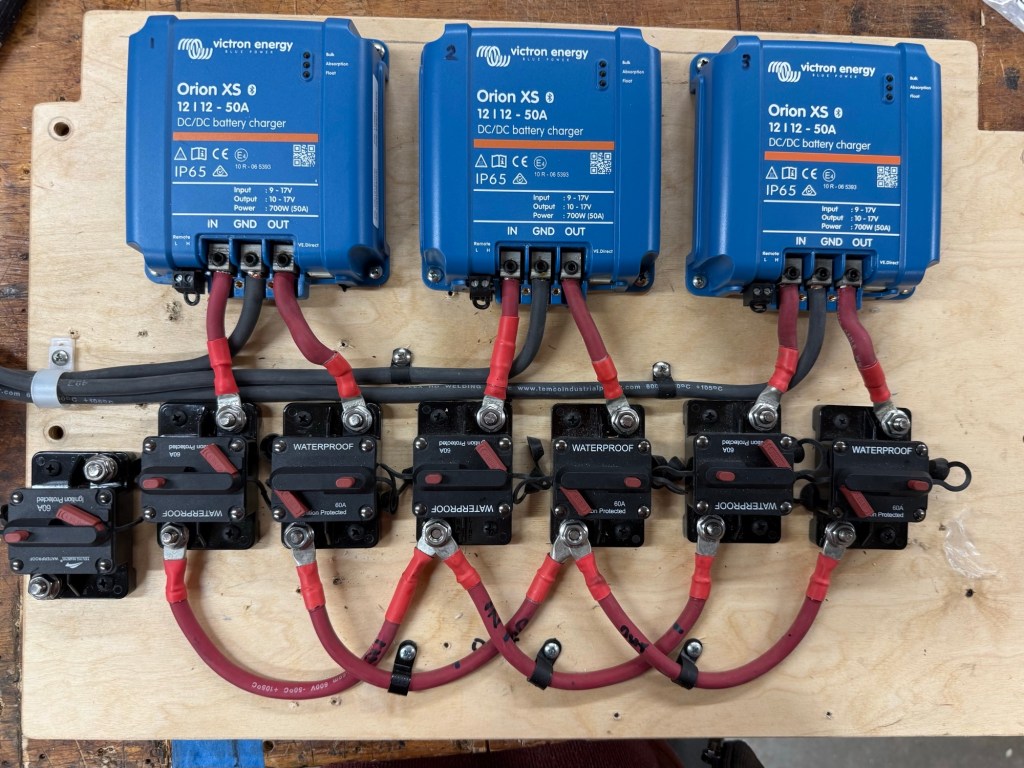
Once everything was connected connections were tested, the output of each battery to battery chargers was confirmed and the chargers were turned on to bring all of the batteries to 100% charge.
I wanted to run an endurance test. The coach was in the barn so no solar power. The landline connections to the coach were disconnected. The refrigerator was on, the basement freezer was on, the AquaHot heat was on, the lights were on, and the internet electronics were on. The inverter was on supplying 120v power. This is a pretty complete basic load on the batteries.
The timer started. 72 hours later the battery bank capacity was at 35%. There was enough left to go another full day and still have about 14% of total capacity remaining.
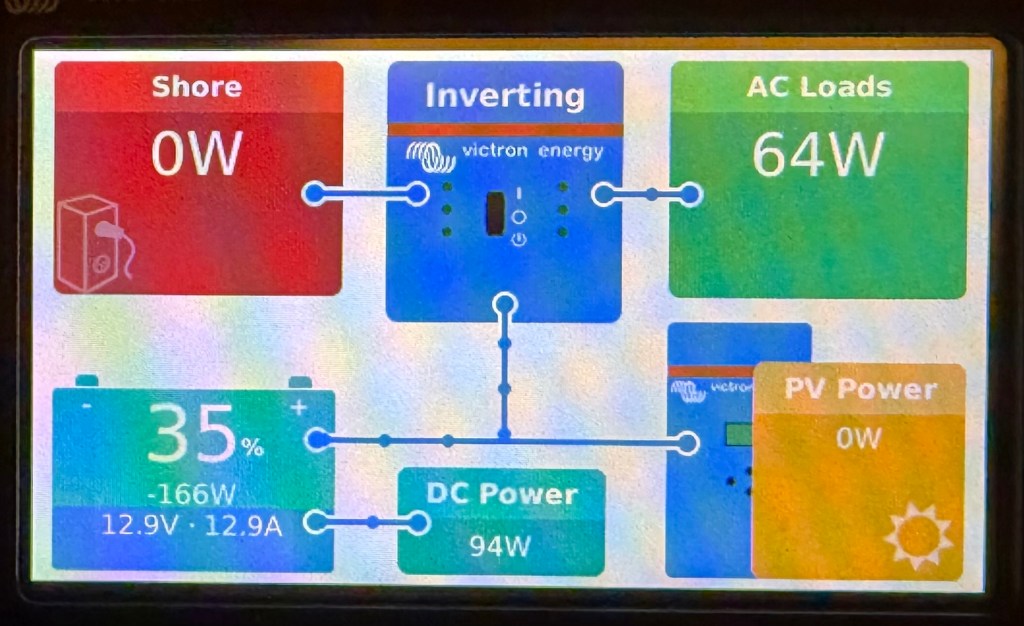
I reconnected the landline. The 120v loads switched to the landline and the inverter quit inverting. The charger started Bulk charging. The 40 amp charger came on as well. The two chargers were adding a net 1474 watts (113 amps) into the house battery bank.
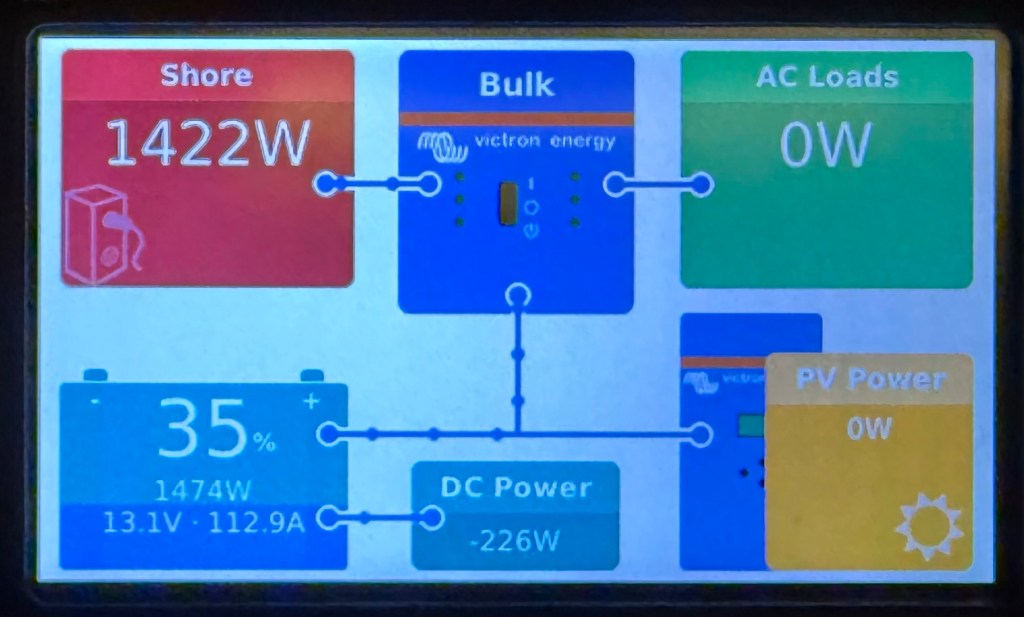
The charging rates and voltages change as the batteries return to full charge.
This was a pretty good test, I was pleased with the performance.
When we left for Alabama in November we stayed at Walmart’s for the first four nights. When we arrived at Walmart each night the batteries were at 100% charge from Solar charging and the Battery to Battery chargers. And then from about 4PM to around 9AM when we left in the morning we would use about 15-18% of battery capacity. We made coffee with the coffee maker, cooked with the induction cooktop, used the microwave, and ran the refrigerator and freezer in the coach and the freezer in the basement of the coach.
Once we started driving the batteries returned to 100% charge usually by noon.
In Orange Beach, all battery charging is being done by the solar panels. And all 12-volt loads are being supplied by the lithium batteries. We use as much as 4% of our battery capacity overnight and that is usually recovered by 10AM.
The Vatrer batteries have an expected life of 5,000 charge cycles. Each cycle is 100% charge to 0% charge and back to 100%. If we used 50% of our capacity every day and recharged to 100%, that would be 1/2 cycle per day. For 5,000 cycles we should get 10,000 days. That is 27 years. We won’t ever have to buy batteries again. And not the next owner either.
I think we are set for batteries.
More later. Much love.
Roger, Susan, and Maggie.

