New Orleans, Louisiana, March, 2020, Part 2.

It is now early March, the coronavirus has been renamed the COVID-19 virus. Much of Europe is being overrun. The Seattle area is suffering. New York is about to get overrun. We are aware of what is going on, keeping an eye on things, learning best practices, watching little or nothing happen at the highest levels of government except ignoring it.

French Quarter

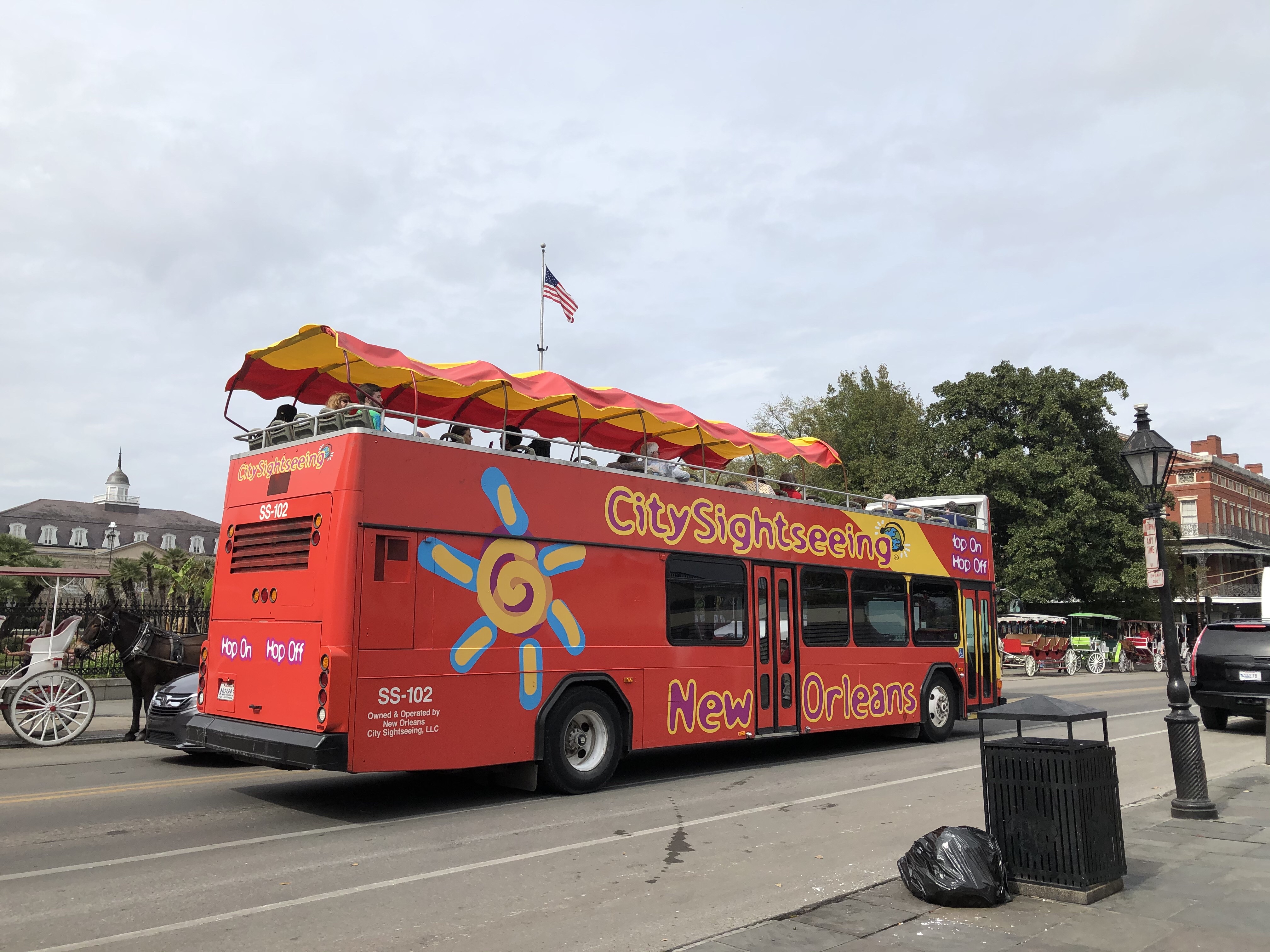
The Hop On/Hop Off bus took us around the parts of the city that never flooded. The French Quarter at Jackson Square was one stop. There was a walking tour as well. And carriage rides. And lots of traffic.
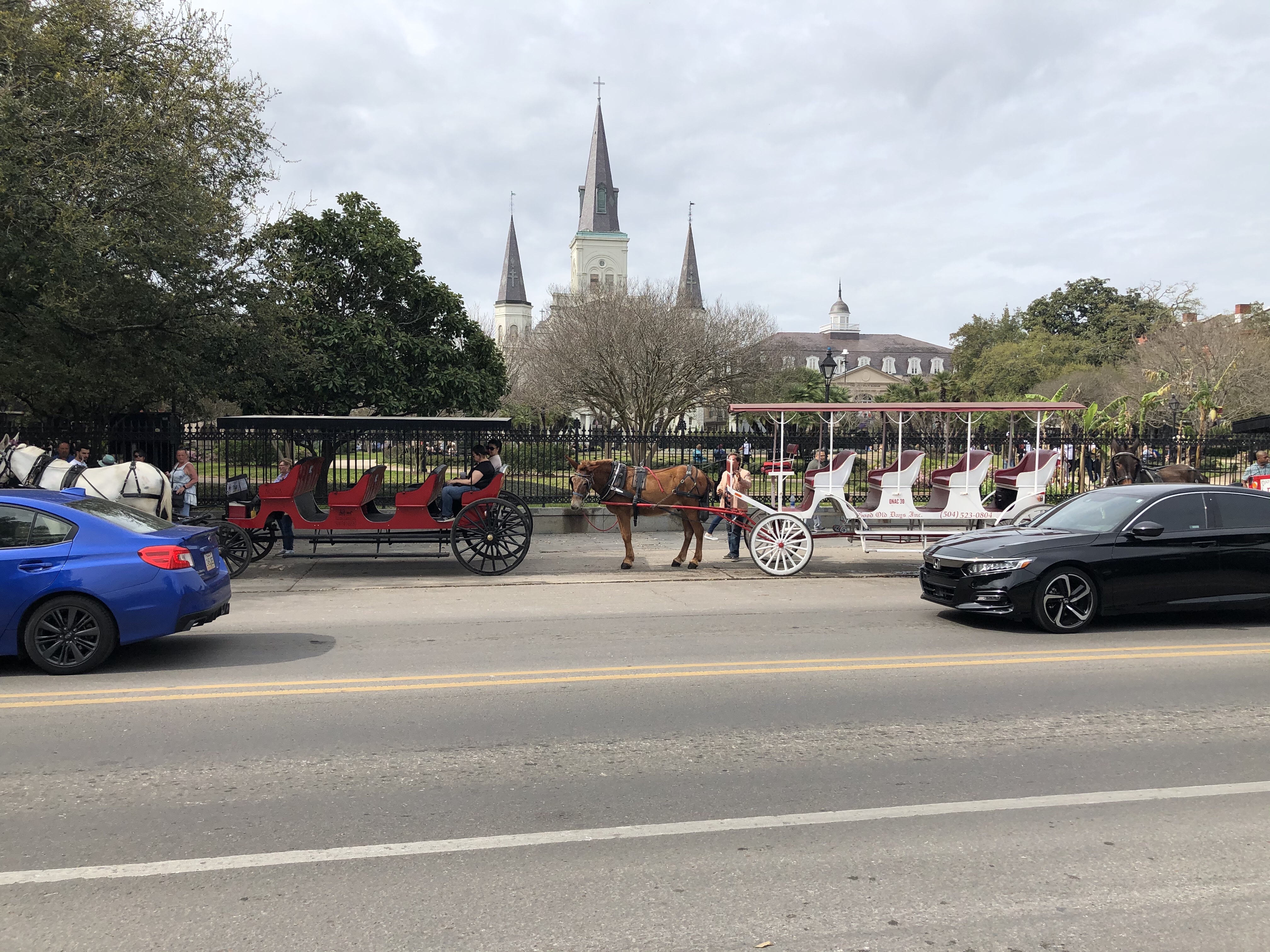
I am not sure what the French Quarter on Bourbon Street looks like today, in the evening in the early 80s to a young choirboy from Minnesota it was dirty, smelly, lined with music spots and carnival barkers trying to get to come in and see things your mama would not have approved of. Drinking in the streets, partially clad women, wanton behavior right here in the Crescent City.

We did not get to see that. In fact we didn’t even go down Bourbon Street. The street sweepers and water trucks were over there cleaning up from the night before. But at the intersections we got a peek and a whiff.

So the instructions were the same, don’t lean on the buildings and watch your step. There seems to be no inclination to fix the streets or sidewalks in this city.

The French Quarter is one of the original parts of the city. Lots of old buildings, some with street level shops and apartments above for those who could afford them. We learned the difference between a balcony
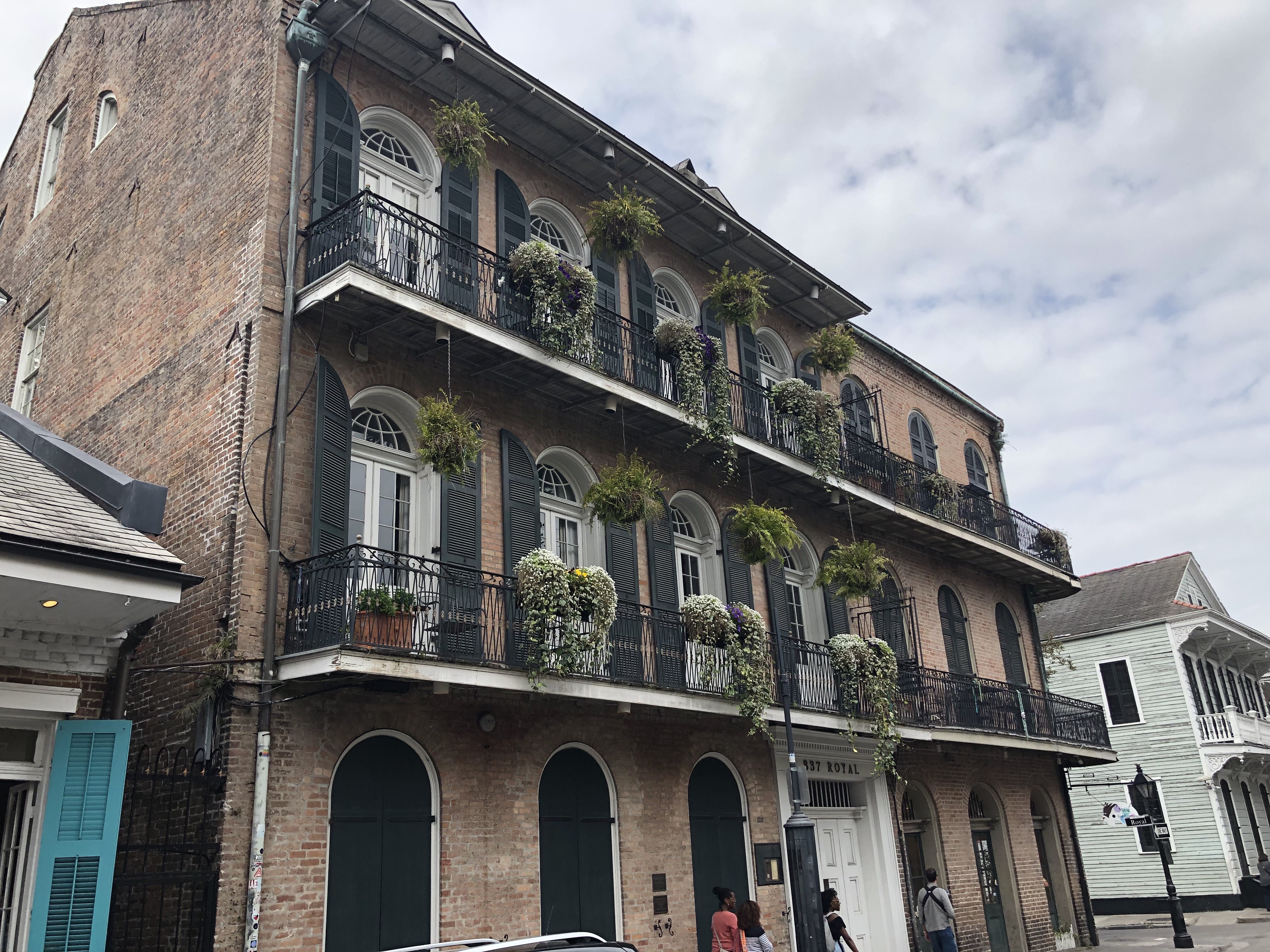
a self supported extension on the side of a building, generally less than half the width of the sidewalk below. And a gallery
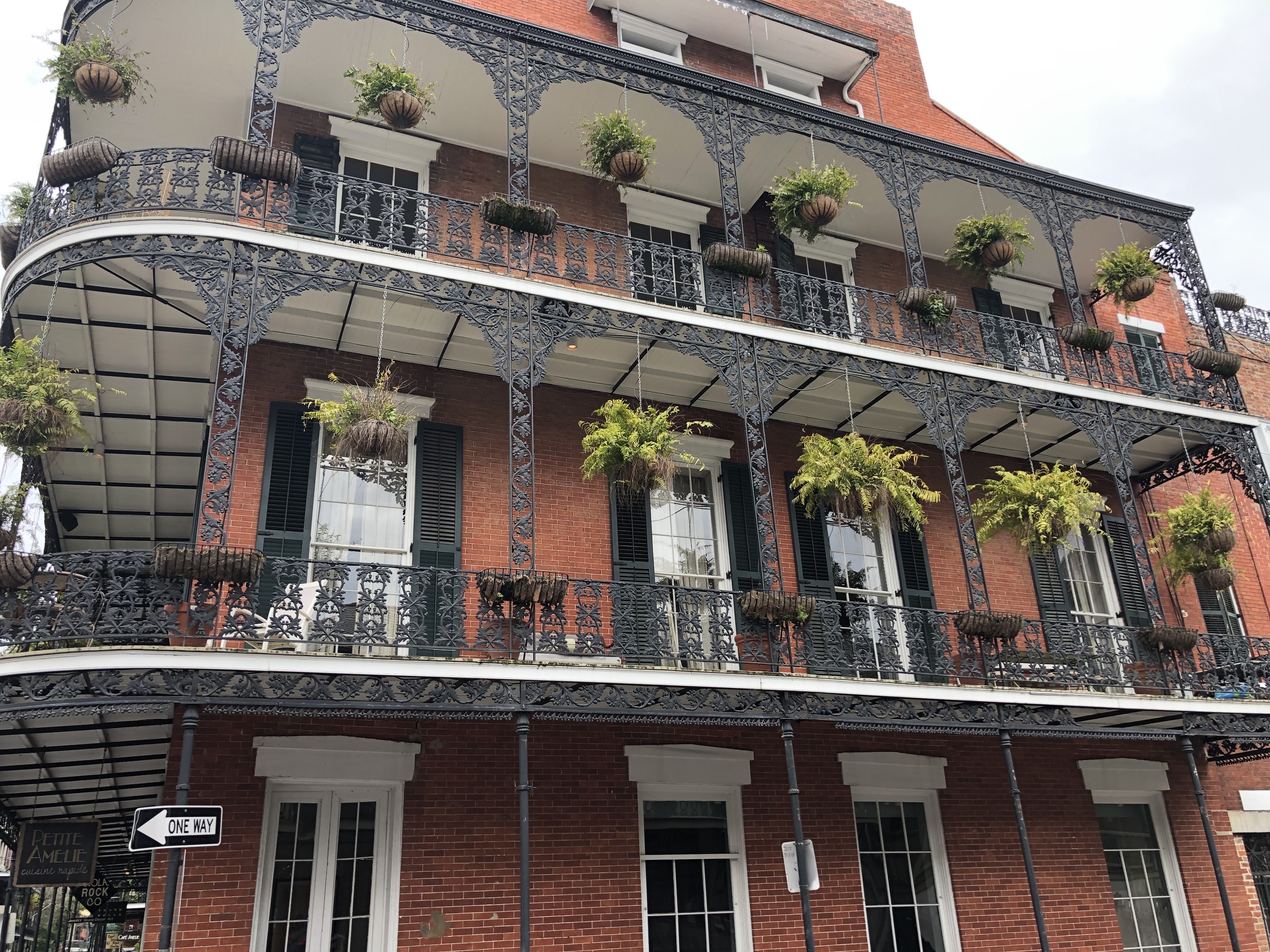
a side of the building structure supported by columns generally the width of the sidewalk below. If it is raining look for a gallery. Many of these buildings had the lower levels converted from stables to car parking. Some had discrete entry alleys through the buildings side to a center courtyard and access to the apartments.
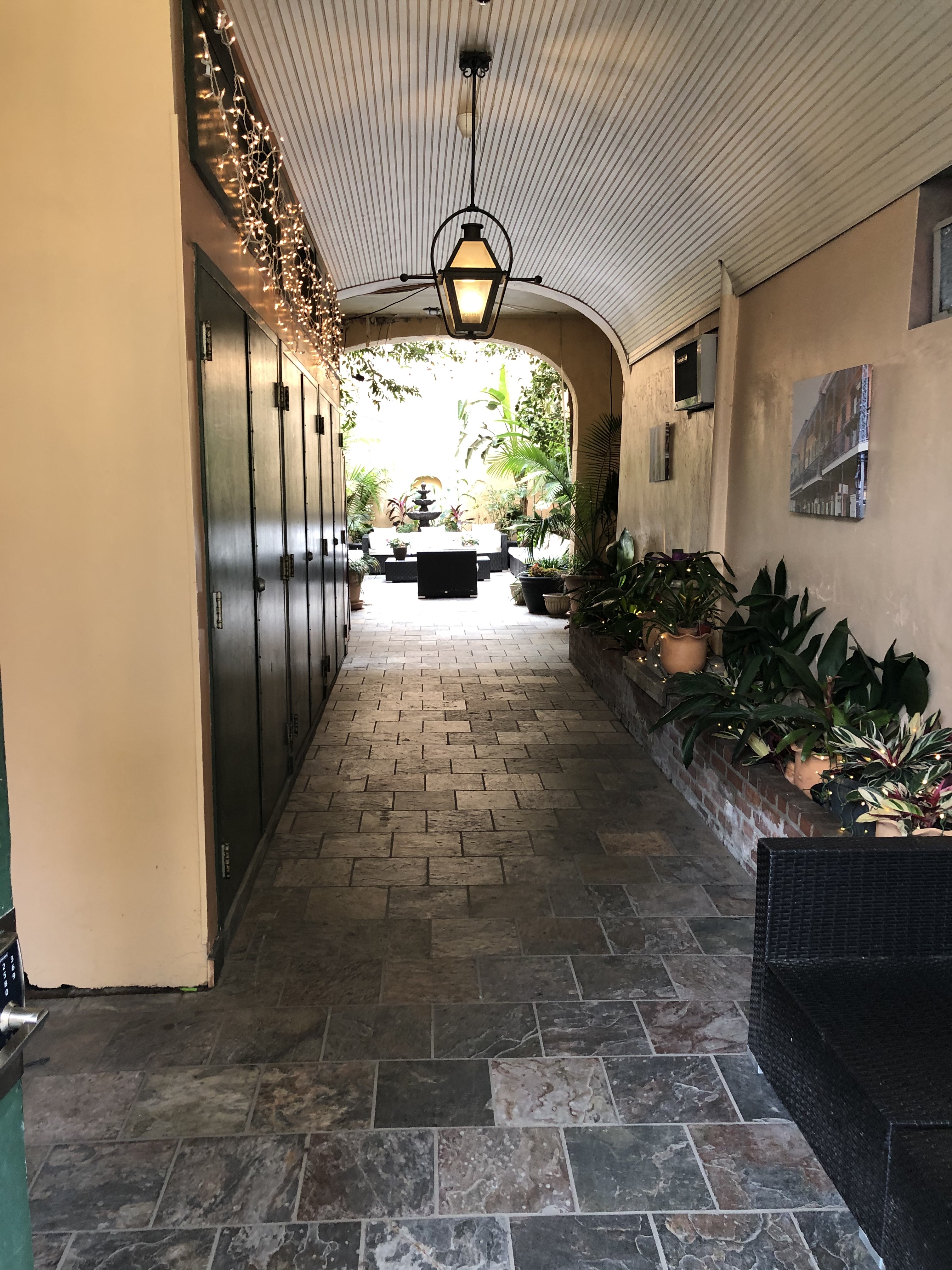
These were quite elegant looking.

We went by an old convent turned into a church turned into a museum of the Catholic Church.
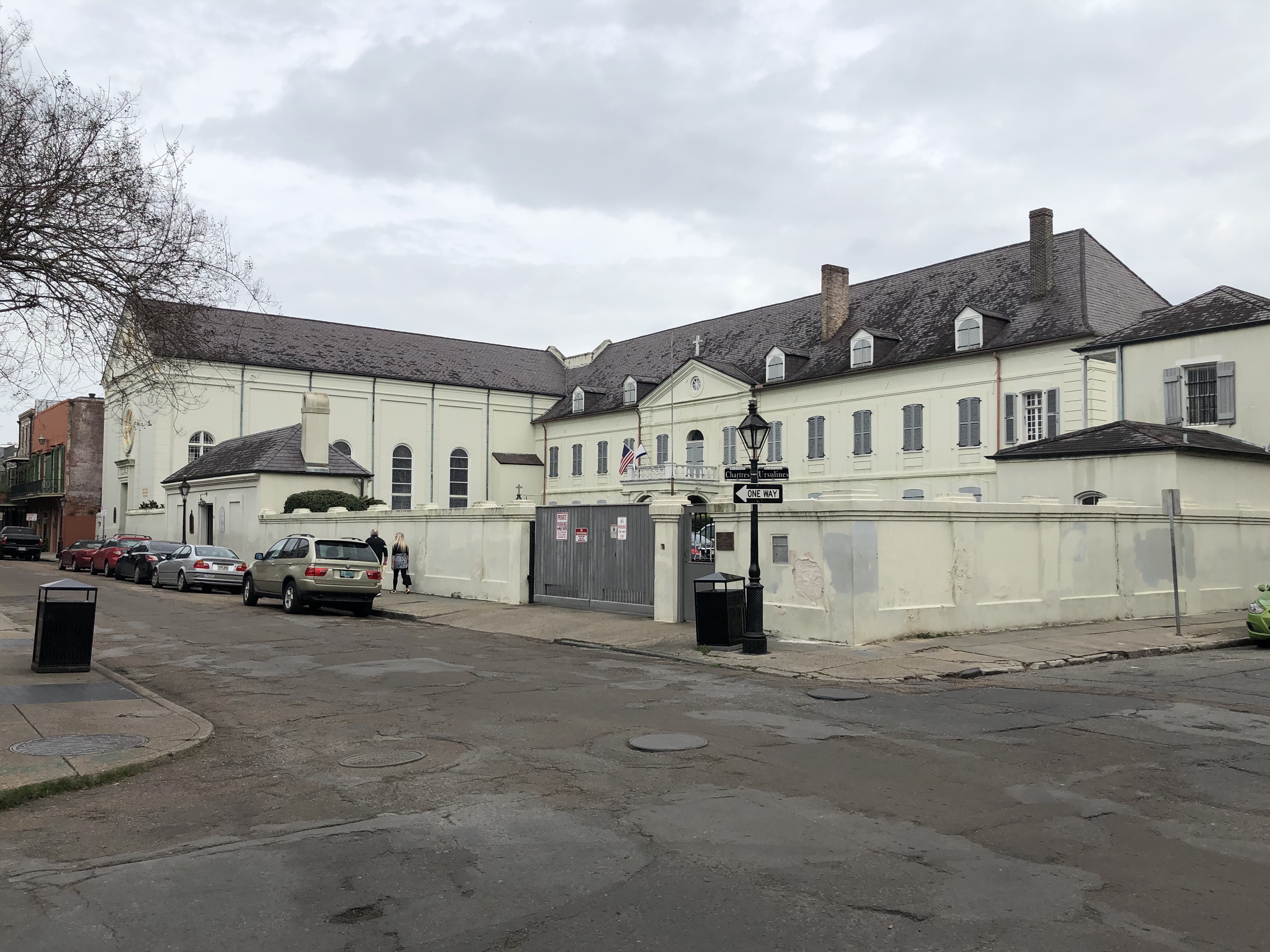
The guide mentioned a museum dedicated to the effects of Hurricane Katrina on the city and the people that was not open that day. The Presbytere.

Jackson Square is quite lovely. Busy, noisy, lots of people.
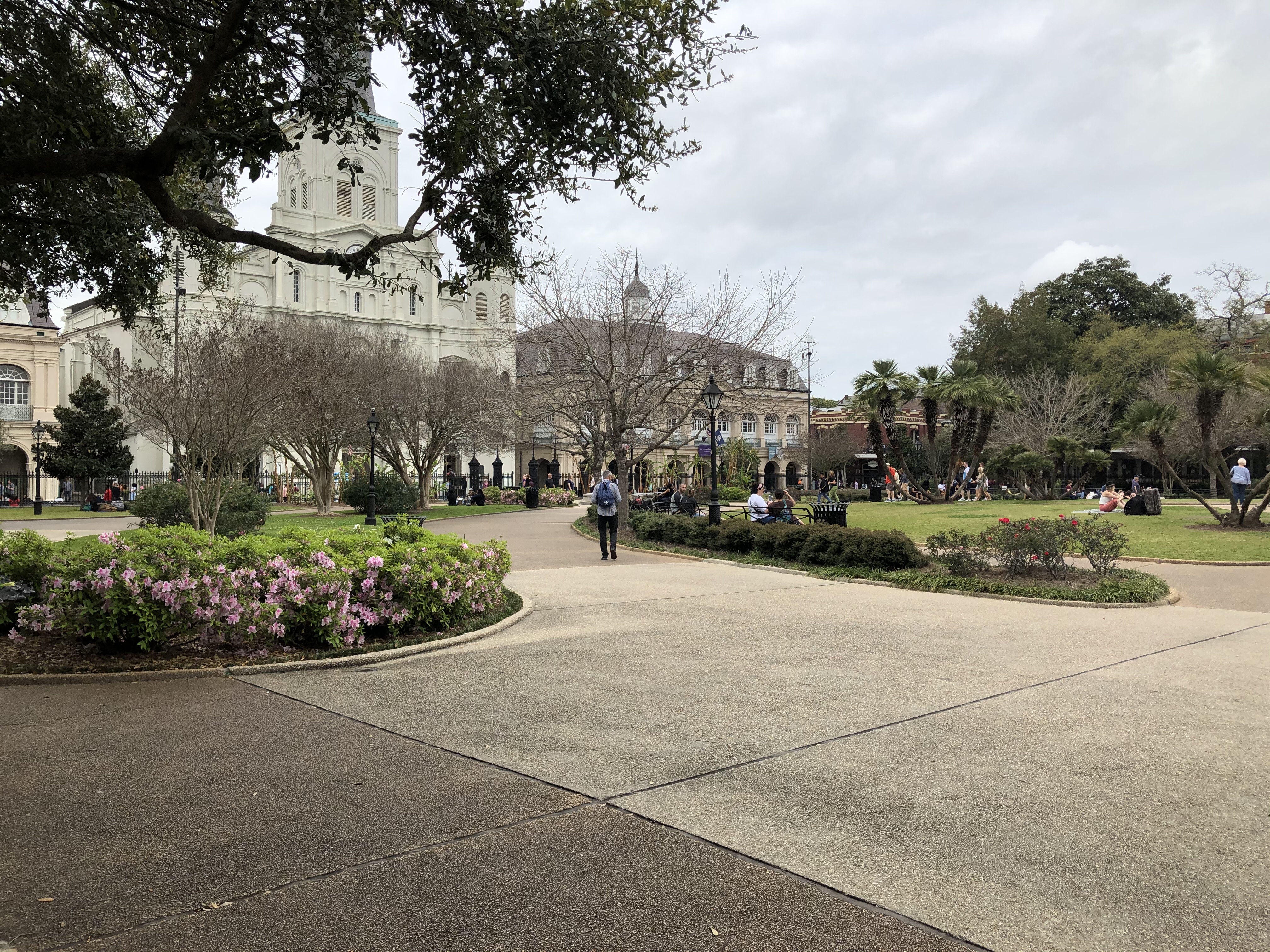
The big church is the St Louis Cathedral. At the other end of the square was Artillery Park
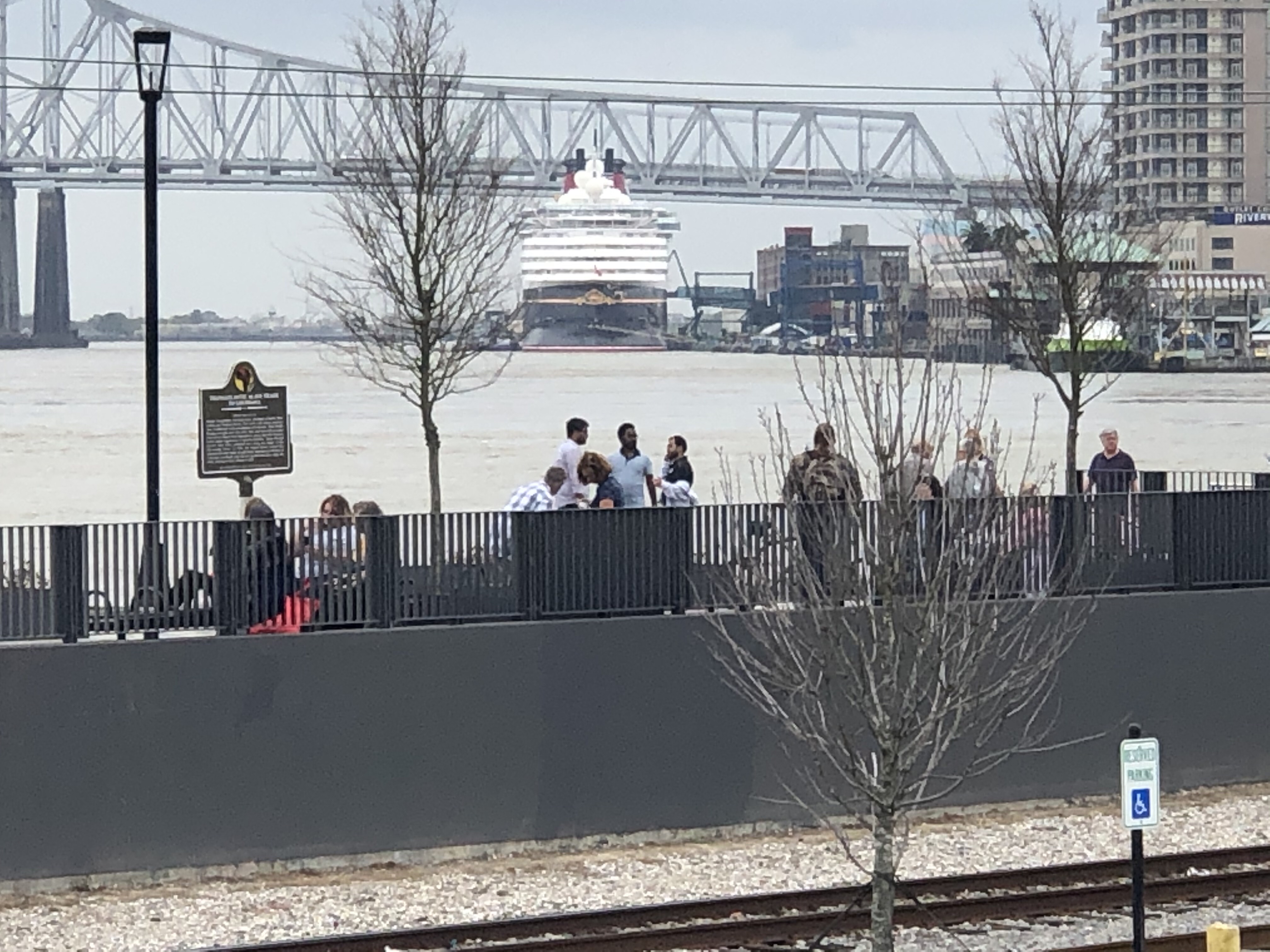
which over looks the Mississippi River.
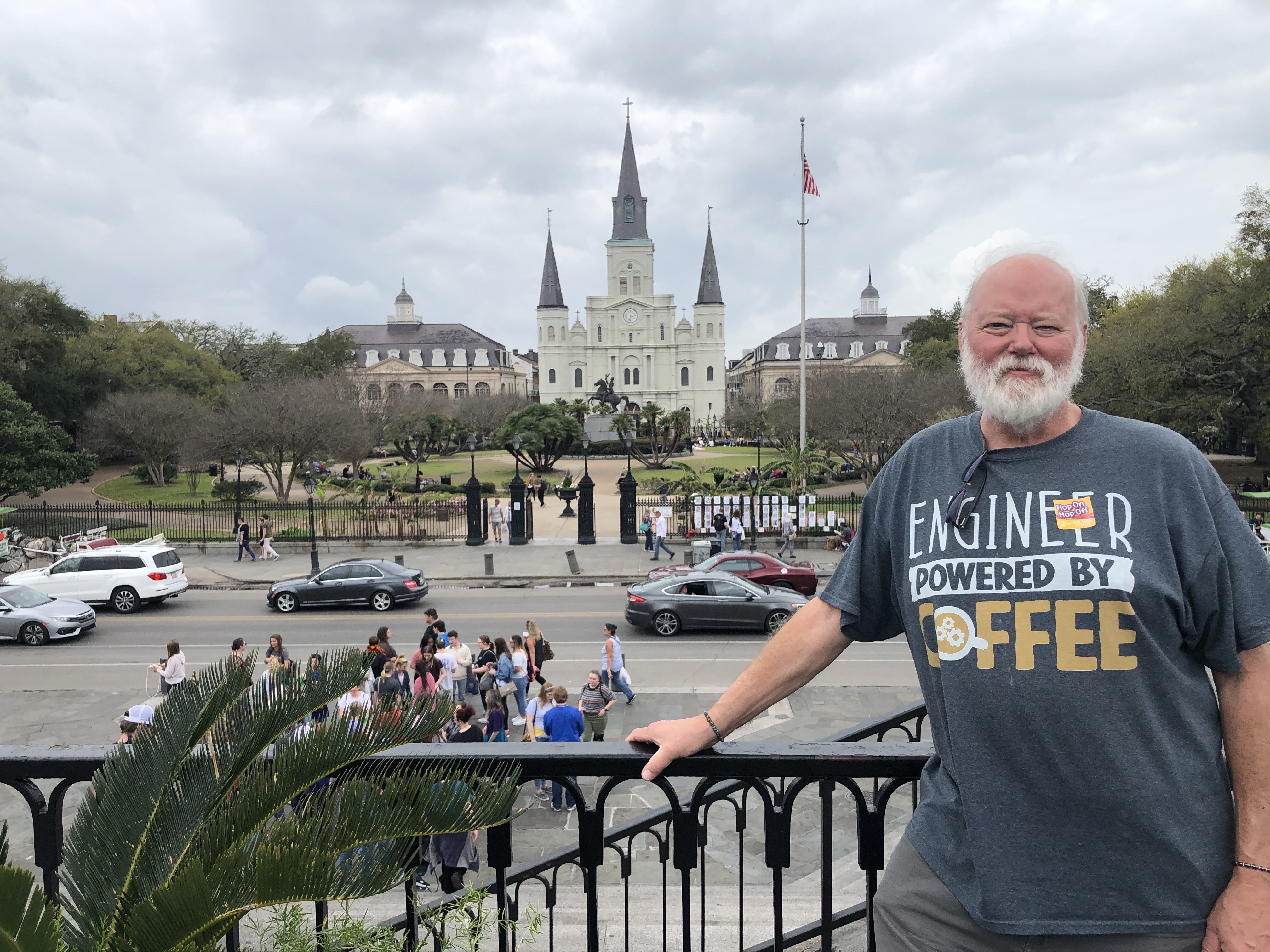
On either side were old buildings originally living quarters, one side for Catholics, one side for Protestants and every one else. Today they are luxury apartments with luxury rents, some as much as $7,000 per month we were told. They are also the oldest apartments in continuous use in the country.

We walked a block or so the Cafe duMonde for a cup of coffee and a beignet. It was packed, no lunch there just coffee and beignets. They look like little puffed up fried doughnuts except they were a bit hollow kind of like a sopapilla. And not just dusted with powdered sugar but buried in it.
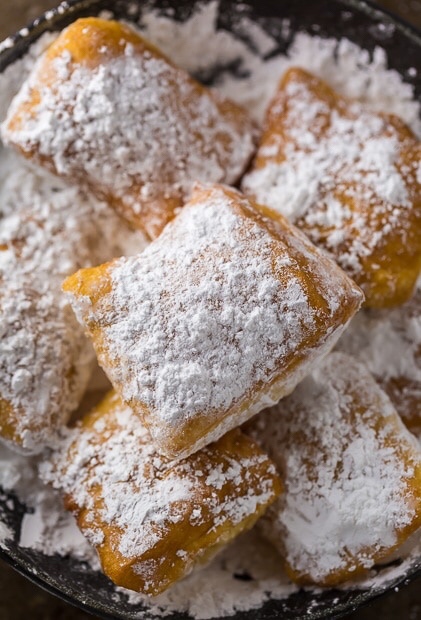
Three to a plate.

We were sitting at a tiny round table wondering if anyone was ever going to come and take our order. There was another couple nearby looking for a table. We invited them to join us. And then the waiter came, cleared the table took our order for coffees and beignets. Our treat.

These folks were from England, here in America to see as much as they could while escaping the cold and winter dreariness of home. Gee, we were doing the same. They were fun to chat with. He had been to the USA a few times on business, she had not. A chance meeting, the best kind sometimes. Several beignets came home with us in a greasy bag.

Back on the hop on/hop off to the station, actually an old railroad station. Fun to look around, nice gift shop of course. Car park nearby and another successful navigation session back to Bayou Segnette.
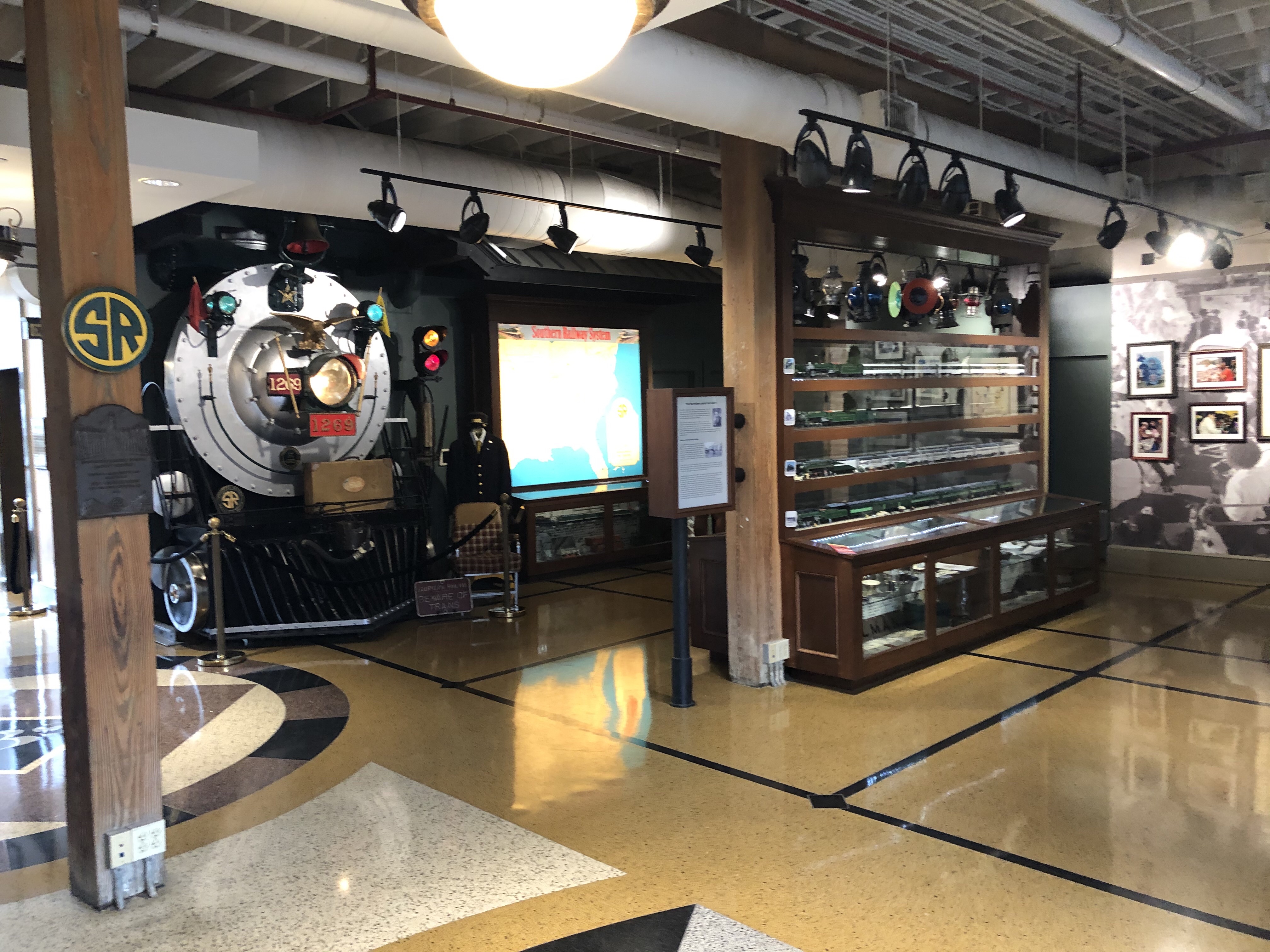
Ravages of Katrina

Along the way we saw block after block of abandoned buildings, a huge VA center, a hospital, a hotel and more. All boarded up. No renovation, no tearing them down for something new just rotting away. All flooded during Katrina and deemed too hazardous to do anything with mostly because of massive asbestos contamination. They sit empty, too dangerous to fix, to dangerous to tear down.

Ravages of Progress

There was much talk on the tours about how New Orleans prided itself on restoring and rehabbing old buildings We saw many examples of nicely done old building being used in new ways. They were pretty proud that they had figured out how to sink footing hundreds of feet into the mud to now hold up modern buildings.

And then this …
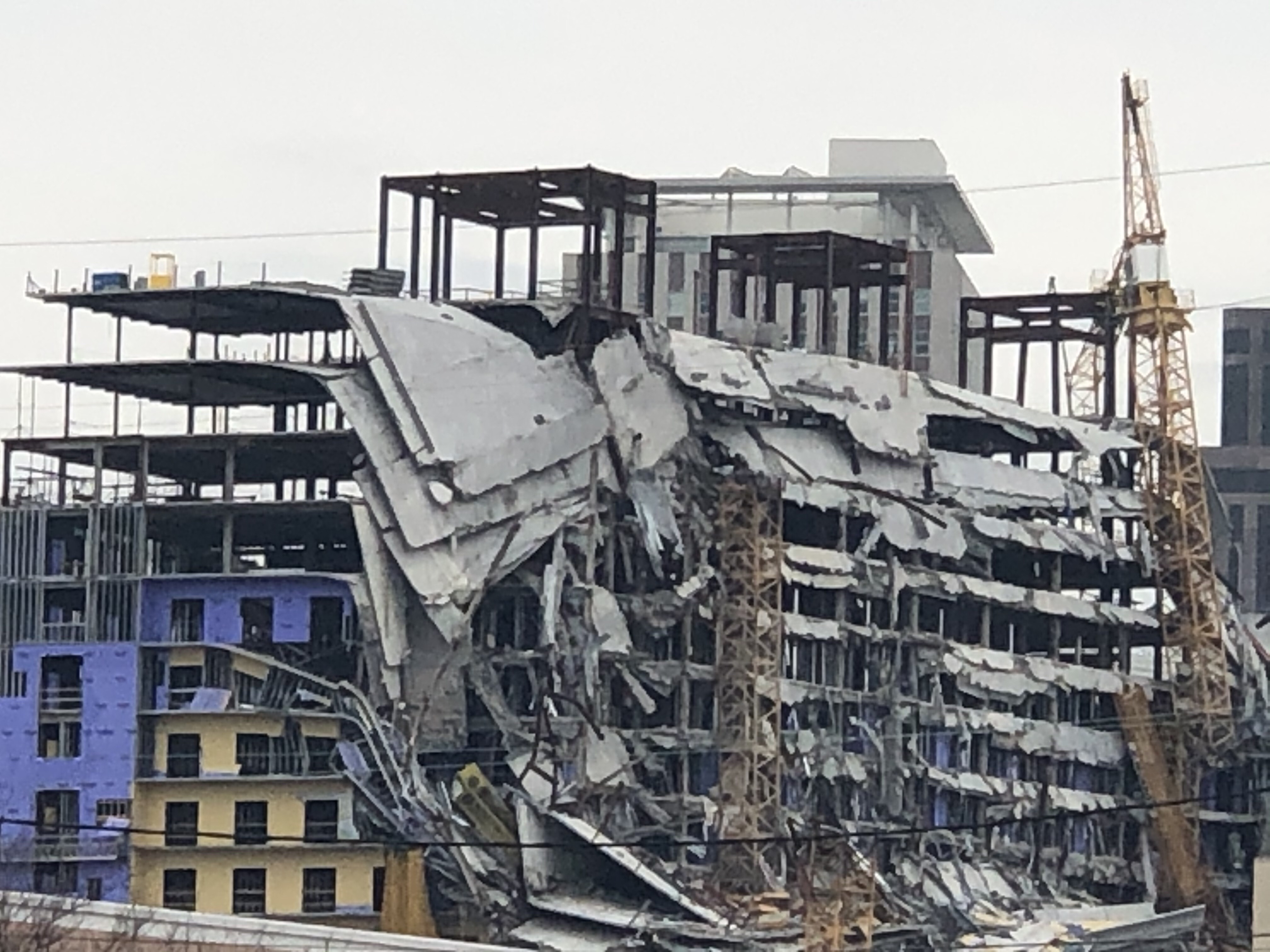
what we thought was some new modern art building. But no it was a monument to sloppy construction and poor design.
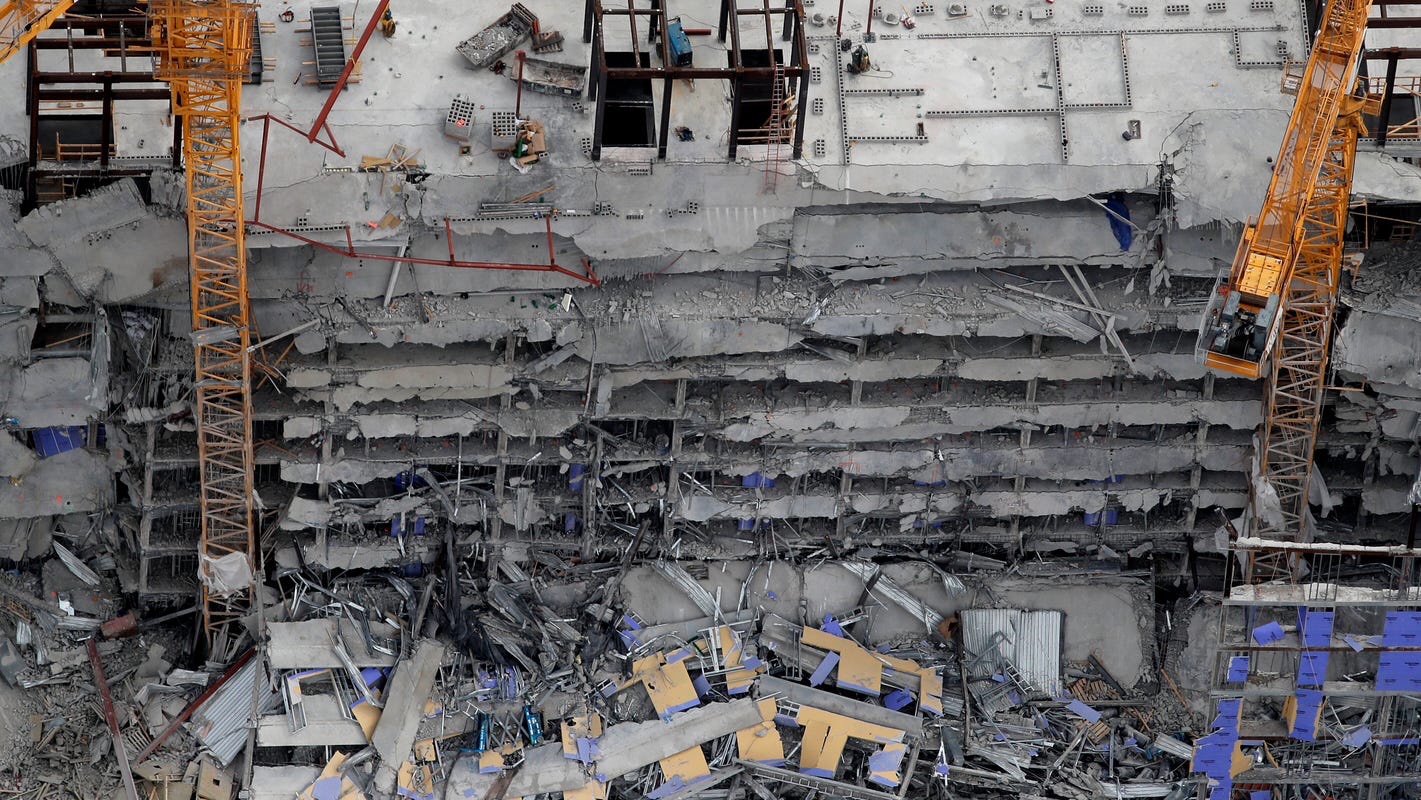
An 18 story Hard Rock Cafe Hotel under construction collapsed killing several workers. A building that was cited for willful and serious safety violations by OSHA as well as serious design flaws apparently overlooked in the permitting process. It collapsed in October of 2019 and like the Katrina ravaged buildings it still stands as an unwanted monument.

World War II Museum

The hop on/hop off took us by the World War II Museum for a look. There was nearby parking so we decided to come back another day to check it out.

This is a big museum, five buildings, some very old repurposed buildings in the New Orleans tradition and some newer ones as well. We went through three buildings. One focused on the war in Europe. Like many newer museums these days it followed history in a timeline which helps understand how history unfolded. The road to Berlin down one path.

The second building had a more home front focus. Factories to build the war machines, the tanks, the air planes the bullets and bombs. And more at a human scale the uniforms and equipment each person needed to get by with every day. Food rations, boots, personal things. It is hard to imagine the scale-up to get ready and continue on in an endeavor of this scale. And at home, ration cards, limited gasoline, sugar, meat, flour… everything for the war effort. Grow a victory garden, make flour sack dresses, reuse and repair for as long as possible.

We hear these words again today in this COVID-19 pandemic, “we are all in this together.” Are we all today with the same commitment for the common good and the common welfare as these people were then? Nowhere near it seems now compared to then when we all believed in common goals, common goodness and common sense.

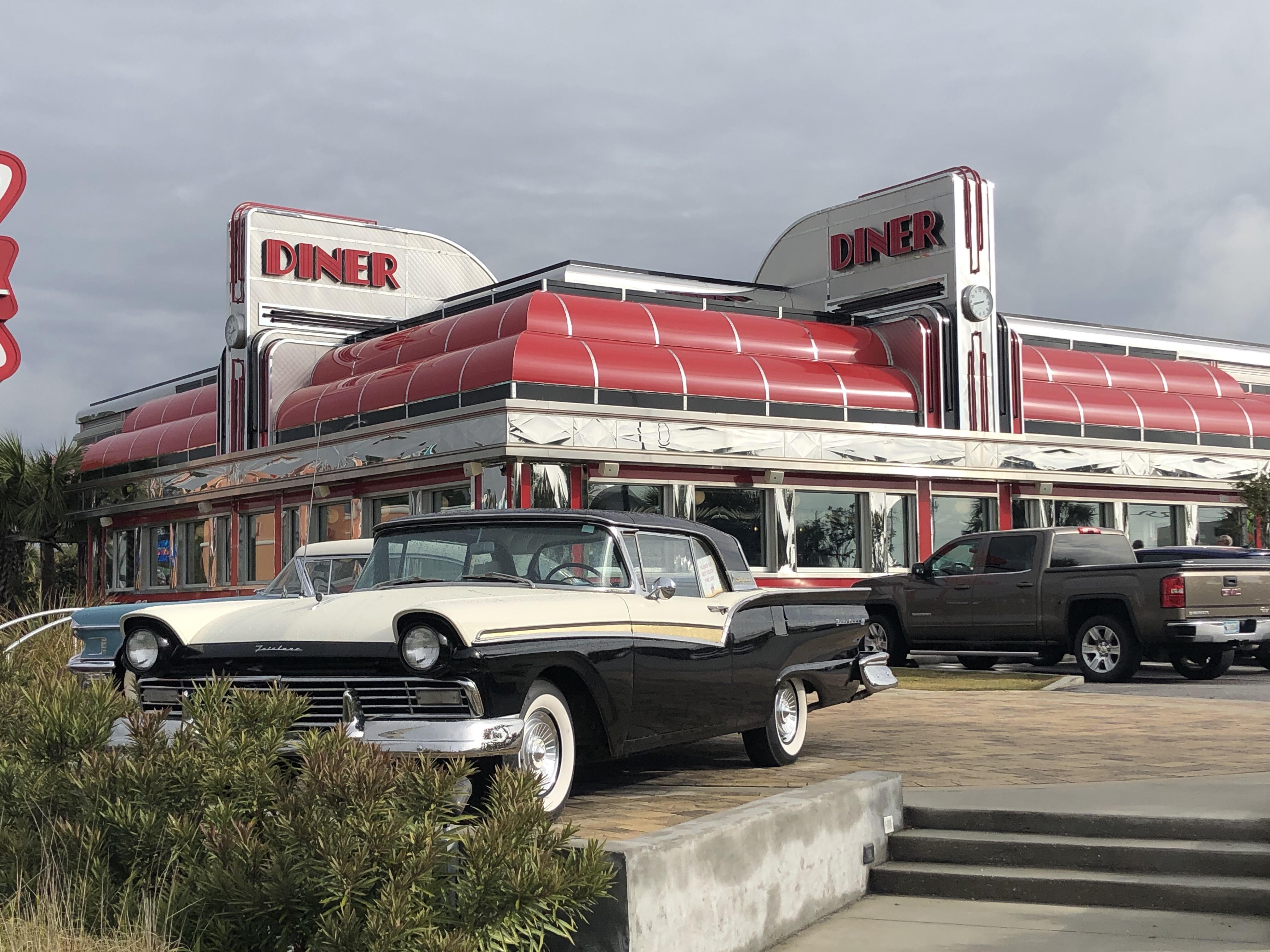
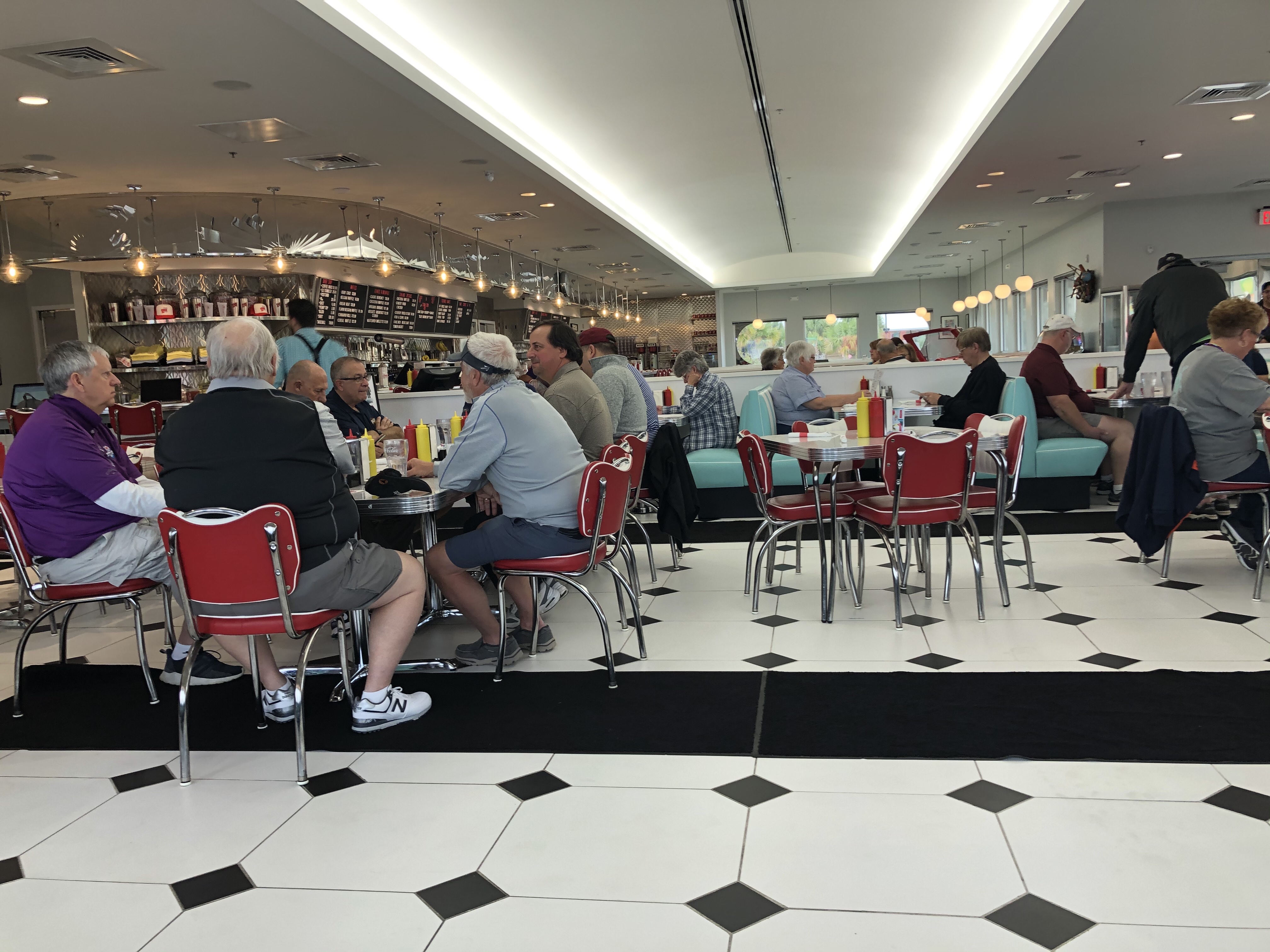
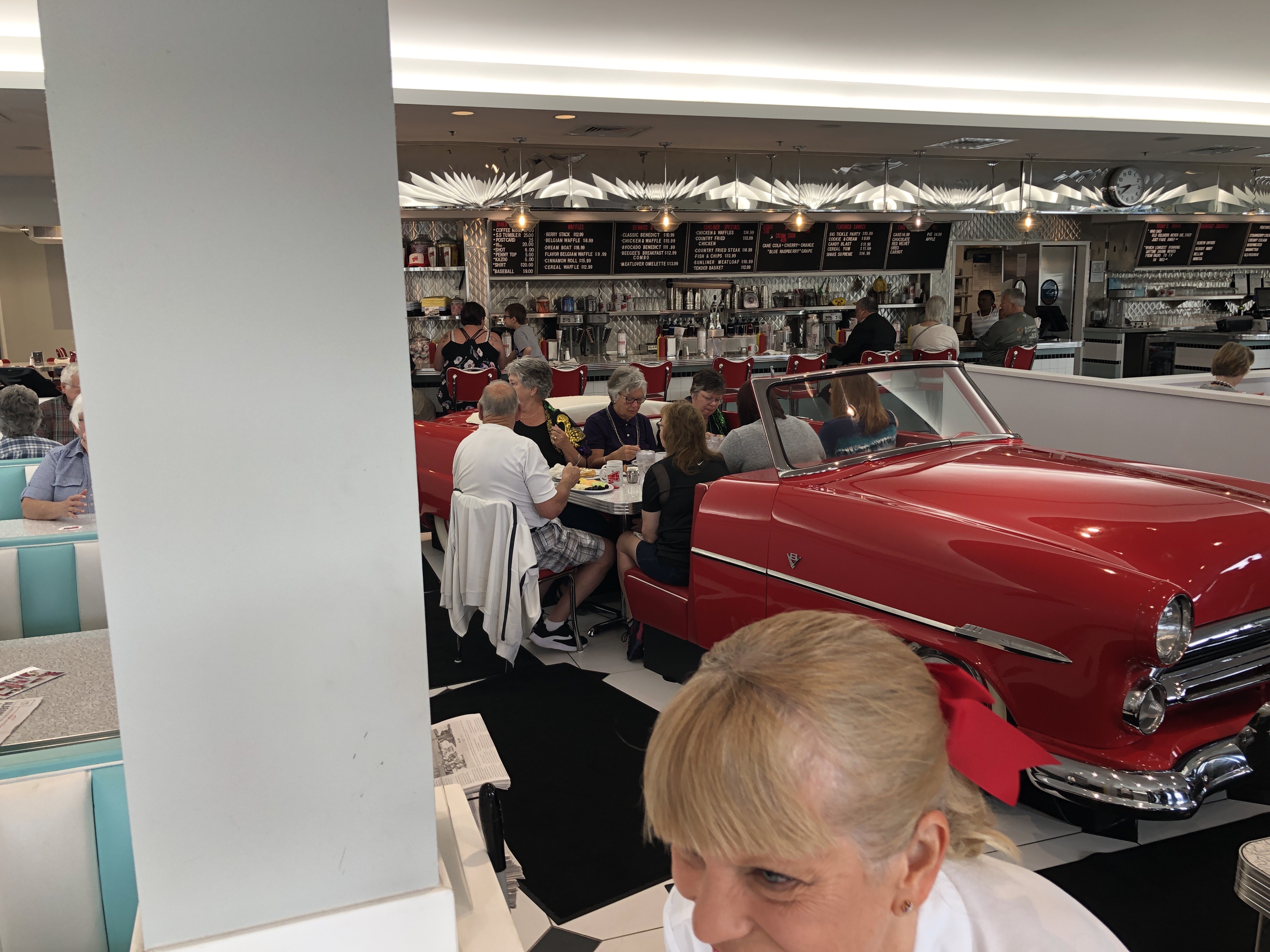
Somewhere in here we got a bite to eat at a 1950’s looking cafeteria sort of thing. I had a meat loaf sandwich, Susan had a BLT. And a shared chocolate malt. All better than we expected. Looking back, it was crowded, close, no concern for the coming pandemic.

The third building was an immense open building with airplanes hanging from the roof.
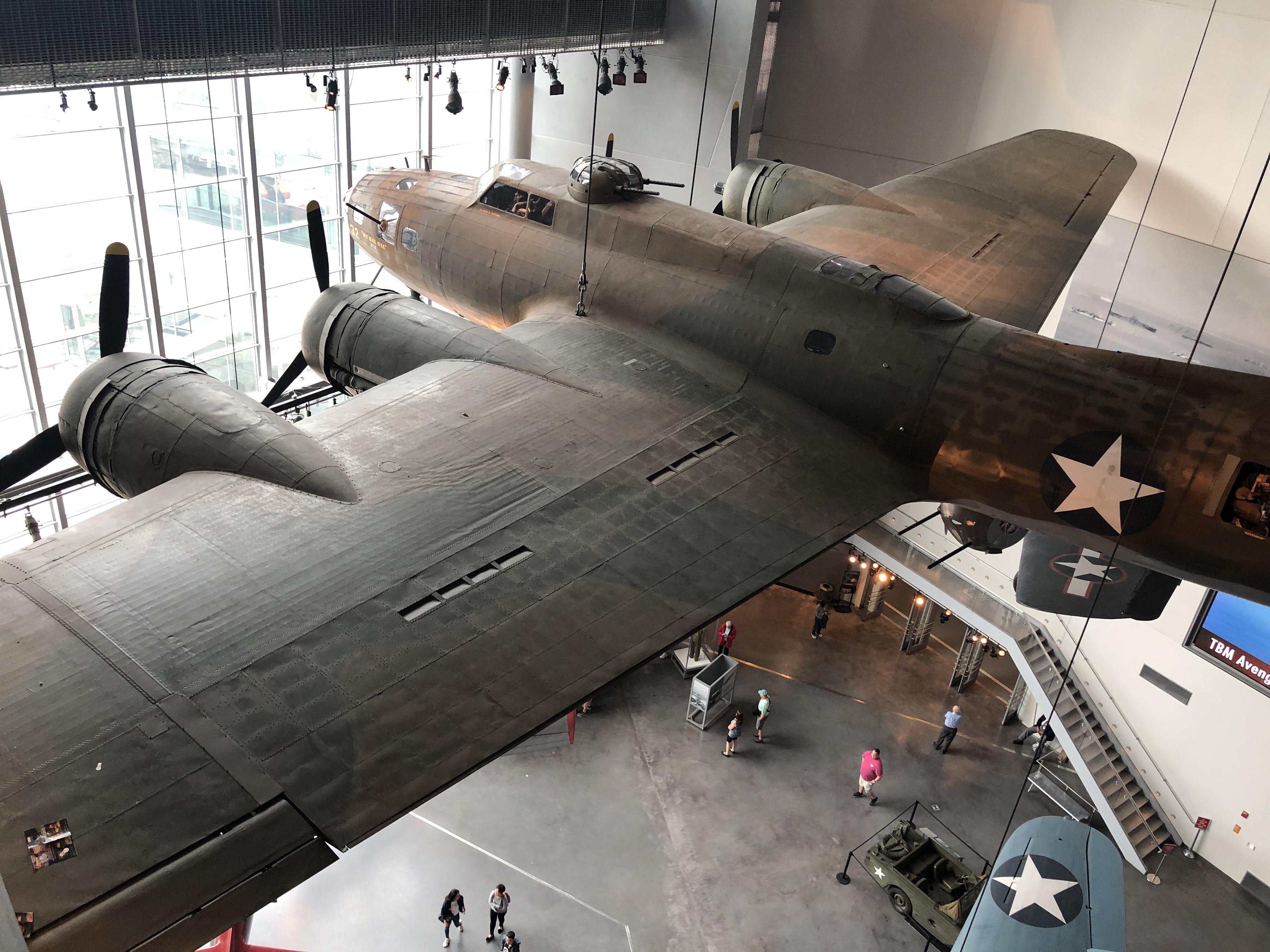
A giant workhorse in Europe, a B17. Thousands and thousands of bombing missions, 10 men to a crew, shocking losses. Each of these big bombers with four 1,000 hp engines could carry 4,000 pound of bombs per trip.

And the other personal favorite of mine, an F4U Corsair.
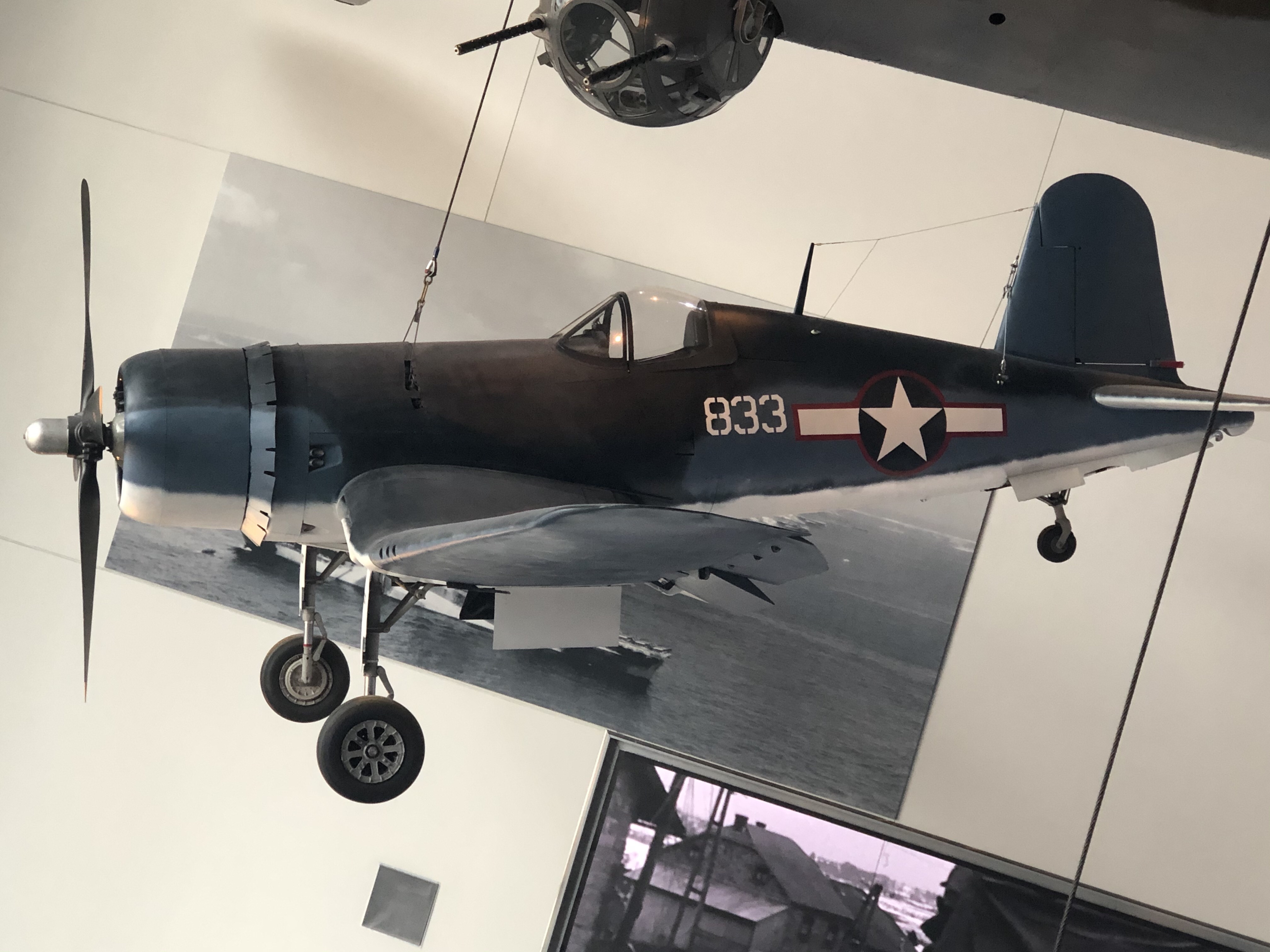
Built later in the war for the Navy and Marines mostly in the Pacific it had a single 2,500 hp engine and a single pilot. Each of these plane could carry 4,000 pounds of bombs.

Susan waited patiently for me as I crawled through the four levels of catwalks to see it all. She was nearing her museum limit.
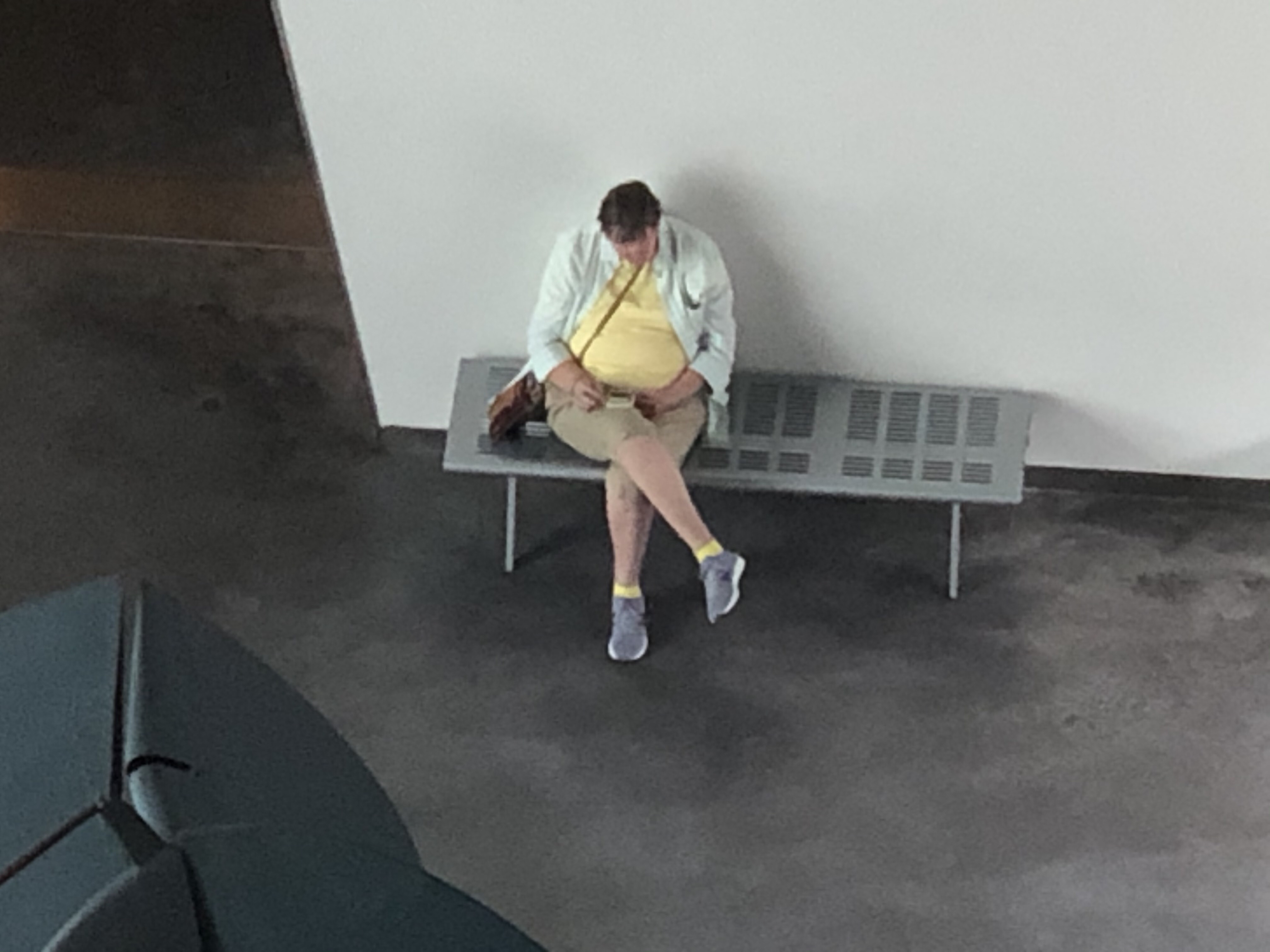
On the way out heading for the car park we were pooped. We saw a bench with an older fellow … we asked if we could sit with him. He was the silent type so we did,
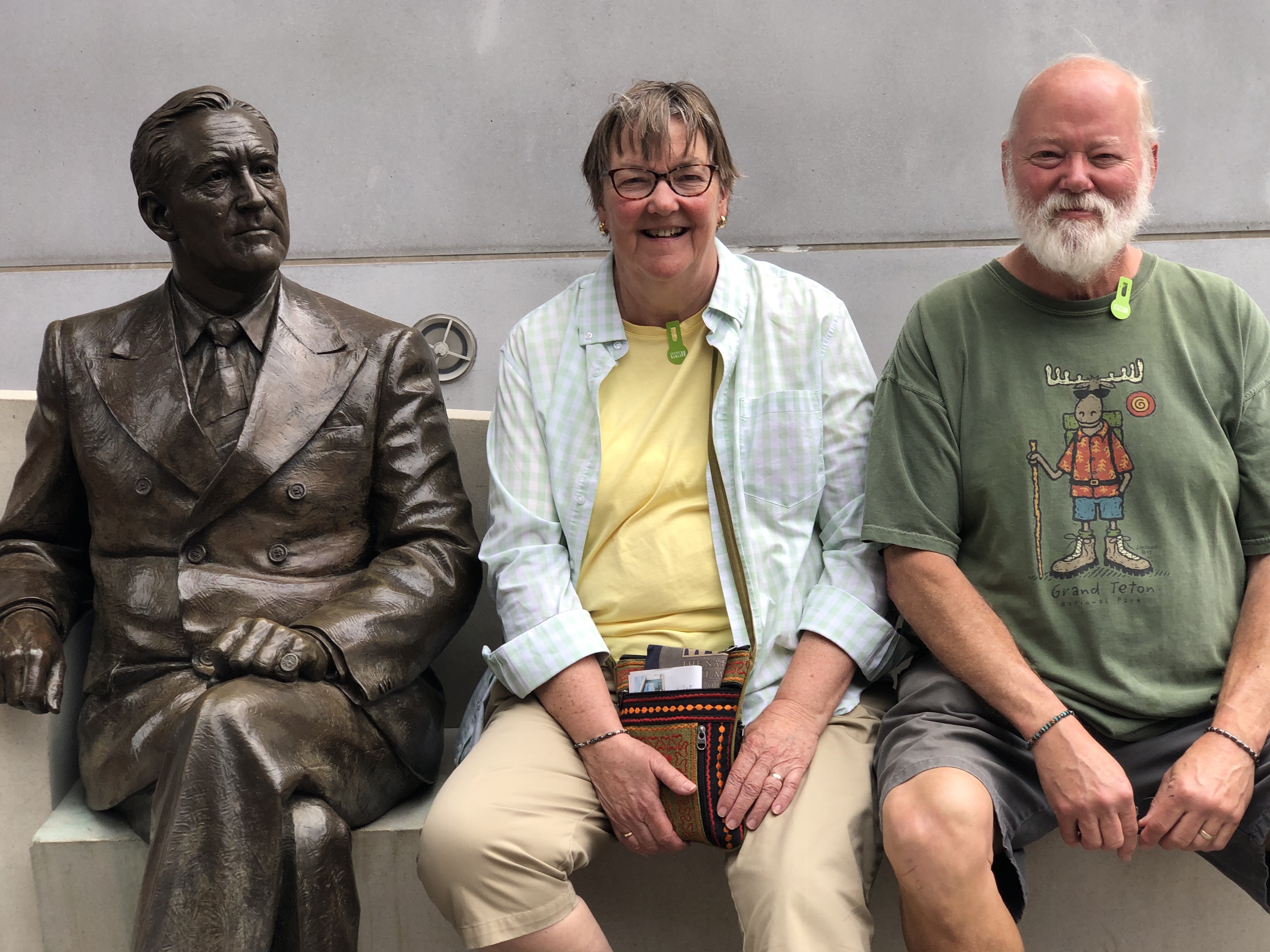
A decent sort, comforting, calm and solid, a steady gaze on the way ahead. We felt good and reassured stopping for a minute with him.

As Far As We Could Go

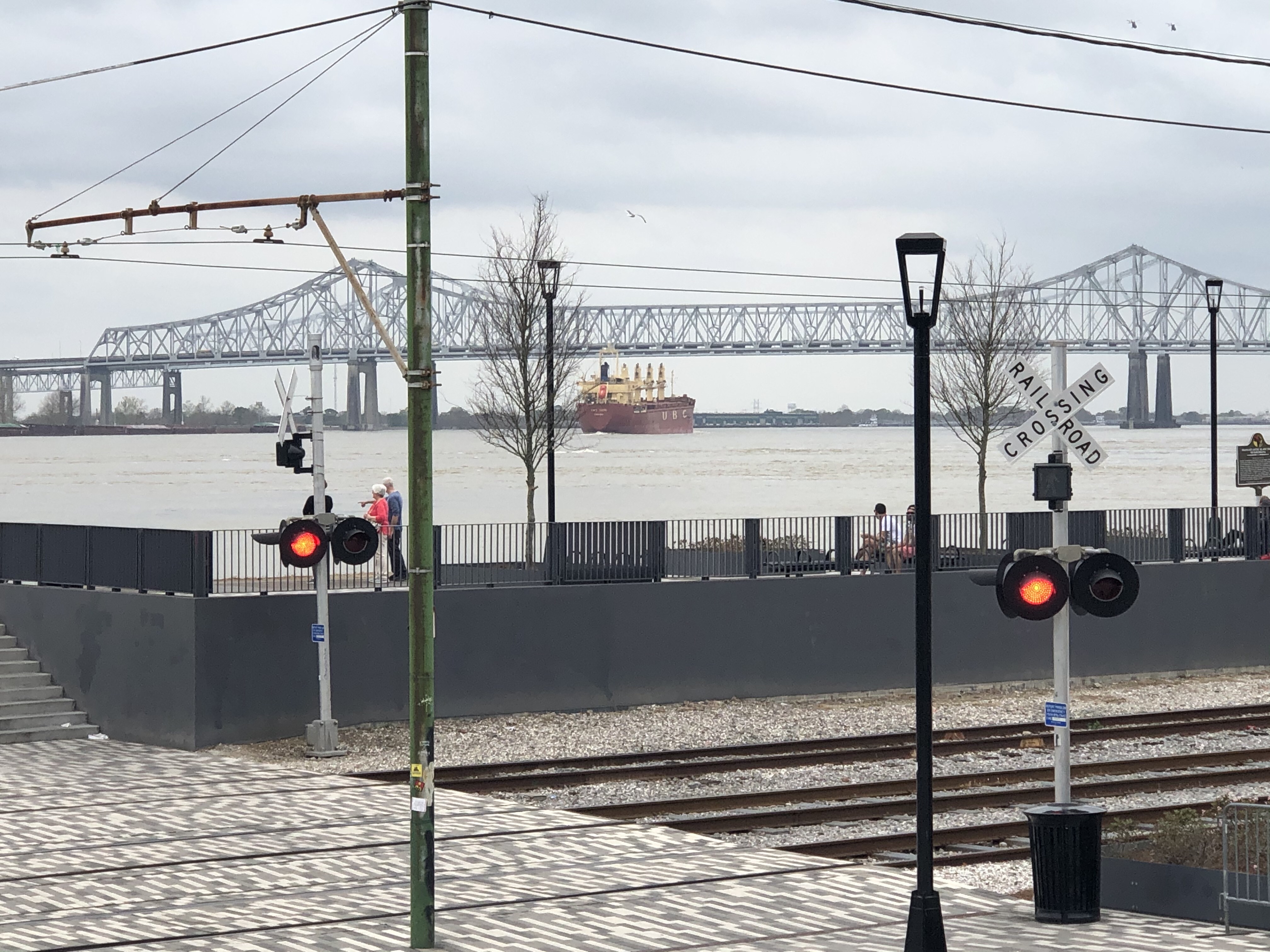
We have been to the very beginning of the Mississippi River, walked across its humble beginning flowing out of a small lake in northern Minnesota. As some of you may know we now live on a bluff along the left side of the Mississippi River (heading up stream) about three miles upstream from Lock and Dam #2 in Hastings, MN. Where does it all end? Off we went in search of the end of the river.

The Mississippi River turns into a huge network of channels as it spreads out through the delta. Any one could be the main channel which in a boat one might follow the correct one. In a car you can only follow the road.

For us it ended in a flooded road just south of Venice. At some other time of the year we might have gotten further but for today we are at the end of the river,
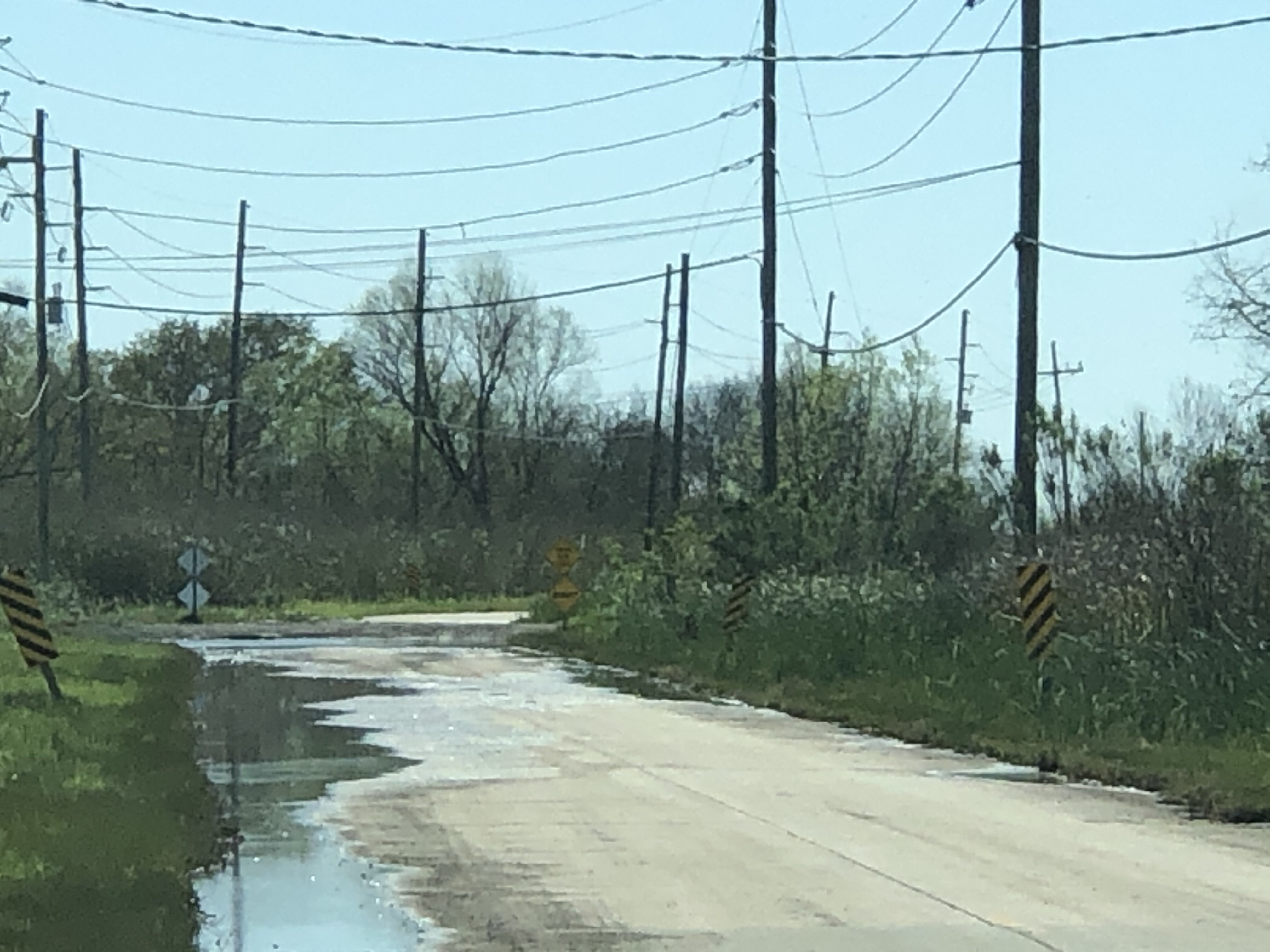
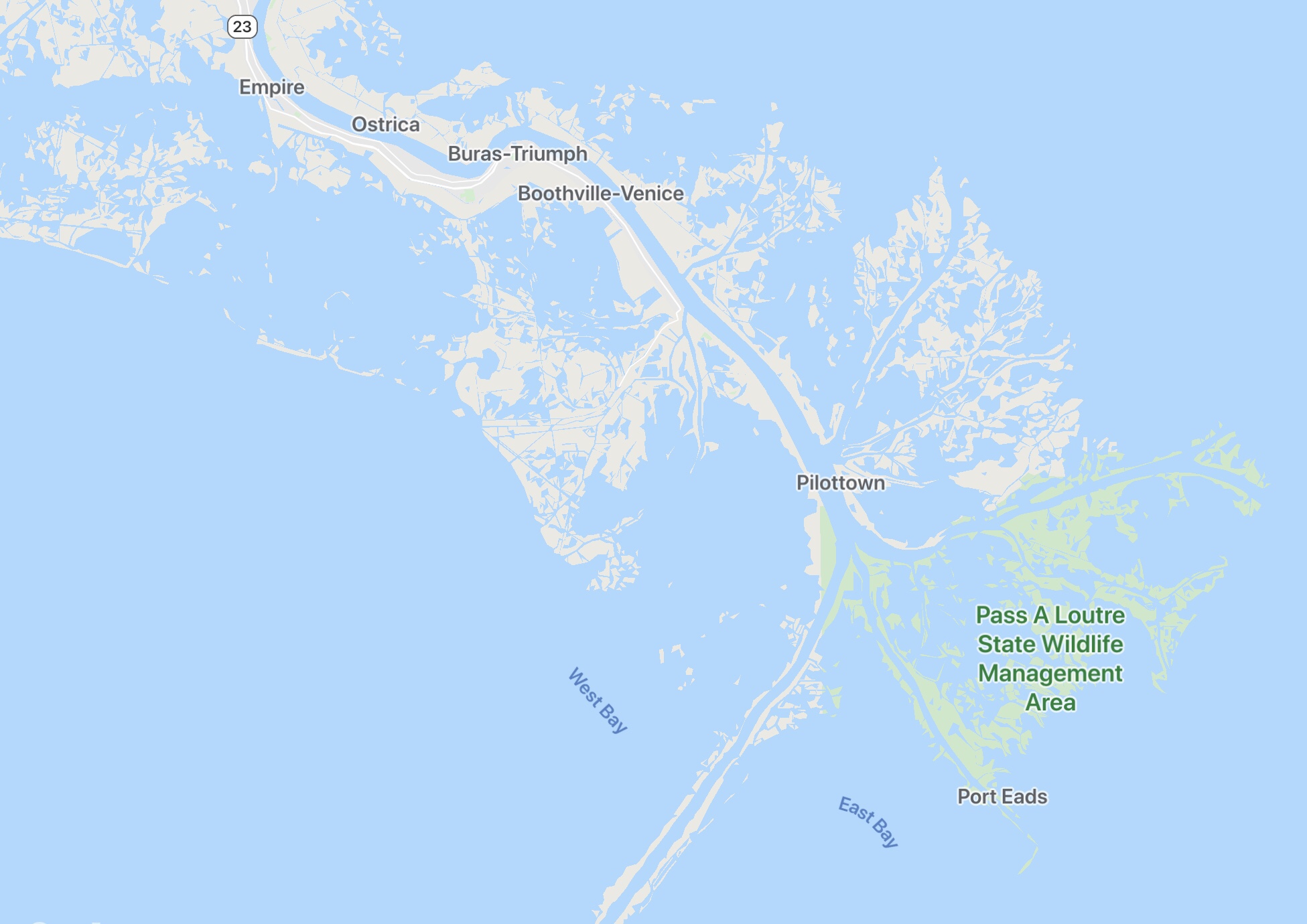
There was a ways to go but no road that day.

Lunch at a place that said EAT.
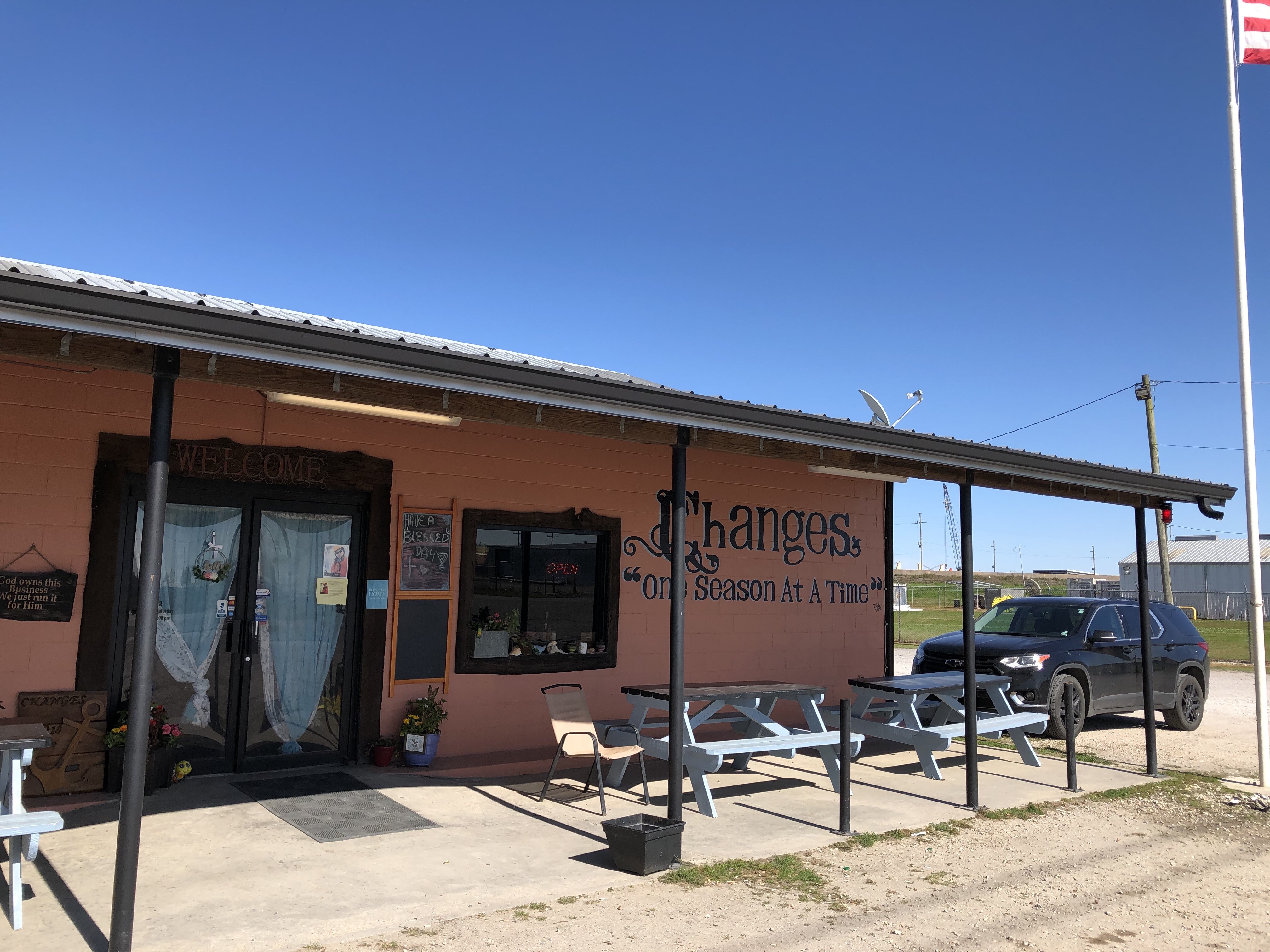
It was good, people were friendly. Definitely a working neighborhood. Fishing, boat repair, helicopter bases to shuttle people to off-shore oil rigs. Lots of mobile homes on stilts.

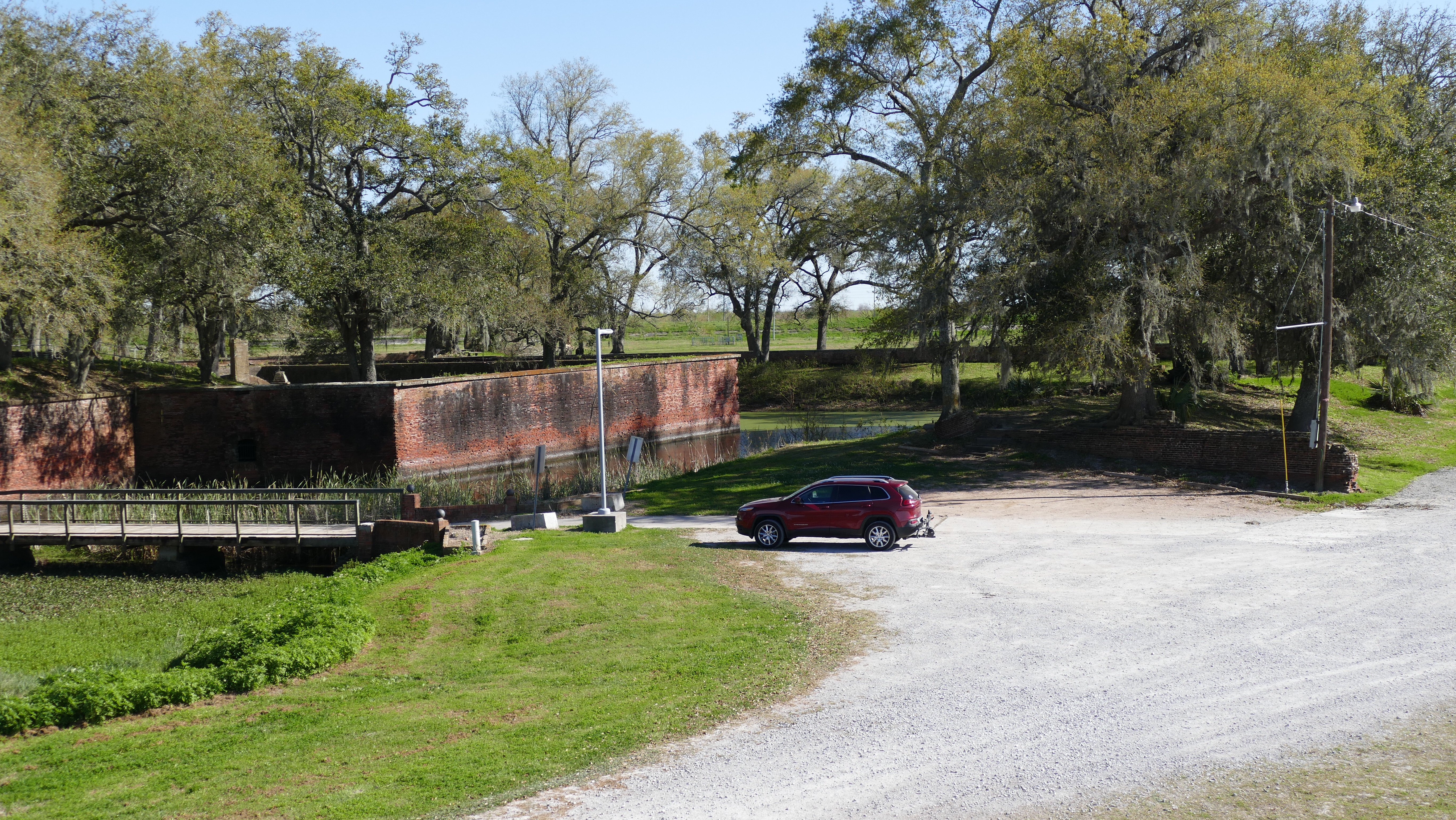
Most of the river was on the other side of the levee. Except at Fort Jackson built in 1822 to protect the river.
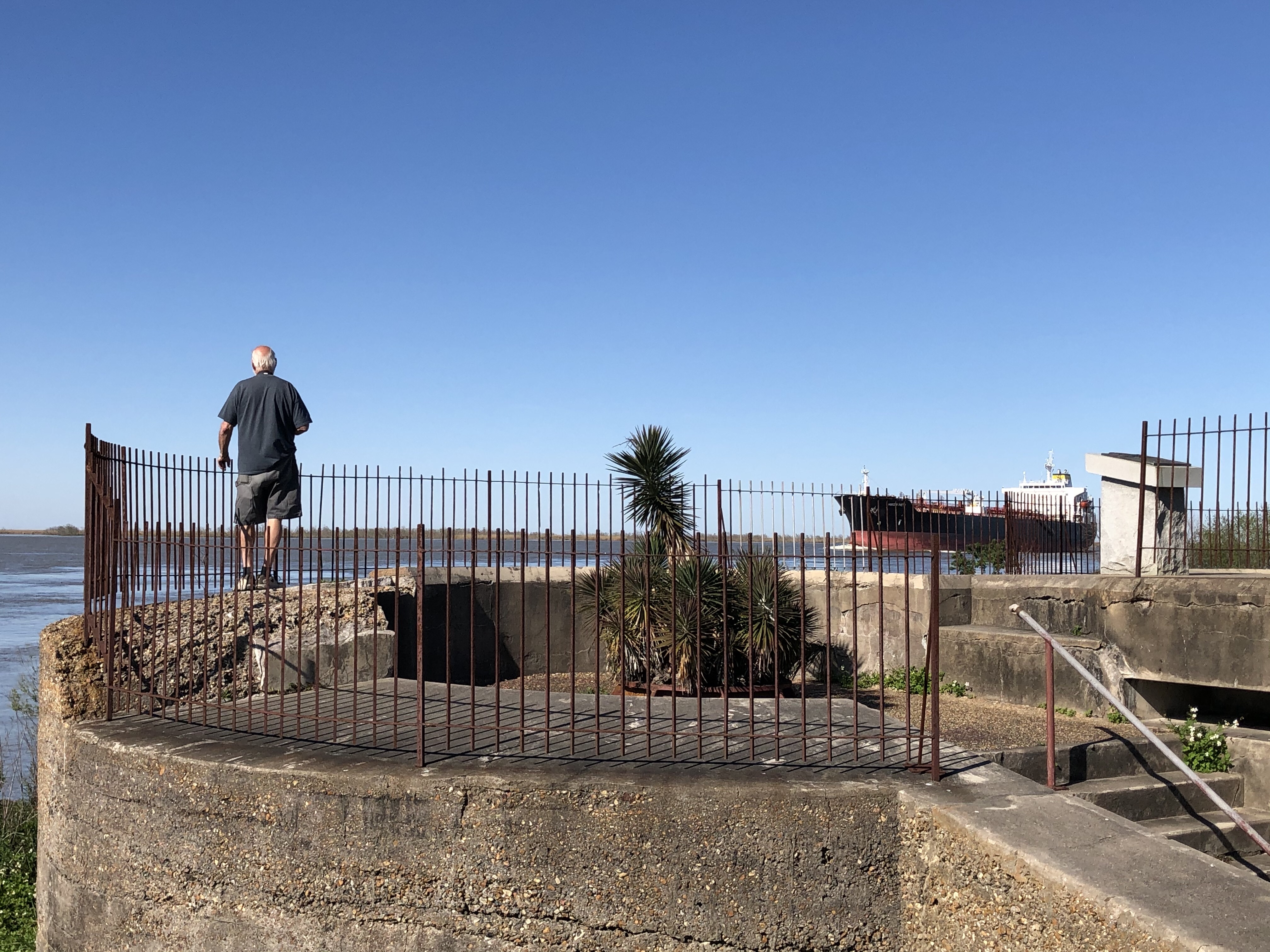
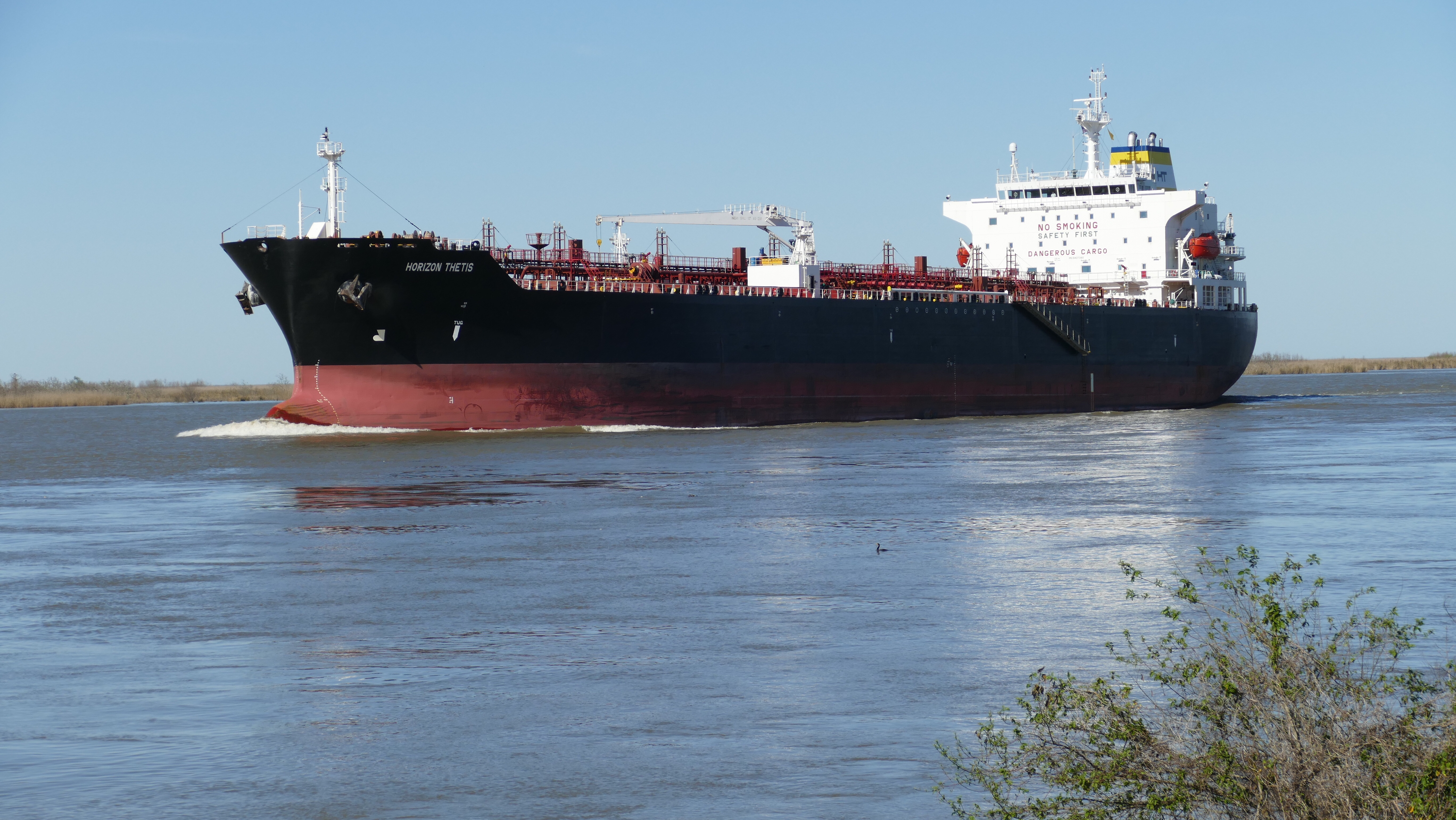
Ships were going by on one of Americas busiest waterways.
Just across from this place was Bayou Mardi Gras. The first known place named Mardi Gras. In this part of the river nothing is very permanent. It is there, somewhere, no one knows exactly where as the river changes as fast as time.

Heading for Baytown

Oh my, NOLA was a whirl wind. Just a week, so much to see. We would come back, stay at Bayou Segnette again. I would really like to see more of the city, more of the people, more of what Katrina took and people rebuilt. The visitor section of town is nice. The rest is where life happens. We are going to get back one day.

Now on to Houston, Baytown to be precise. Our plan was to see Rudy and Carolyn, see Scott and Carol, see Keith and Jo, probably eat more than we should. Best laid plans, you know how that goes. We got the word the day before we left Bayou Segnette that there were new plans.

More Later, Much Love

Roger and Susan
New Orleans, Louisiana, March, 2020, Part 1.

The only time I was in New Orleans was in the early 1980s on a business trip. Susan has never been there. So between Orange Beach and Fredericksburg, TX we stopped in New Orleans (NOLA). Sounds like some government agency.

Bayou Segnette State Park

We stayed in Bayou Segnette State Park in Westwego. West of the river and New Orleans but not far.

It was a very nice park, reasonably sized sites. And right in the middle of a bayou which is a slow moving flow of water through a swamp. Our guess is that the bugs might be bad here in the summer.

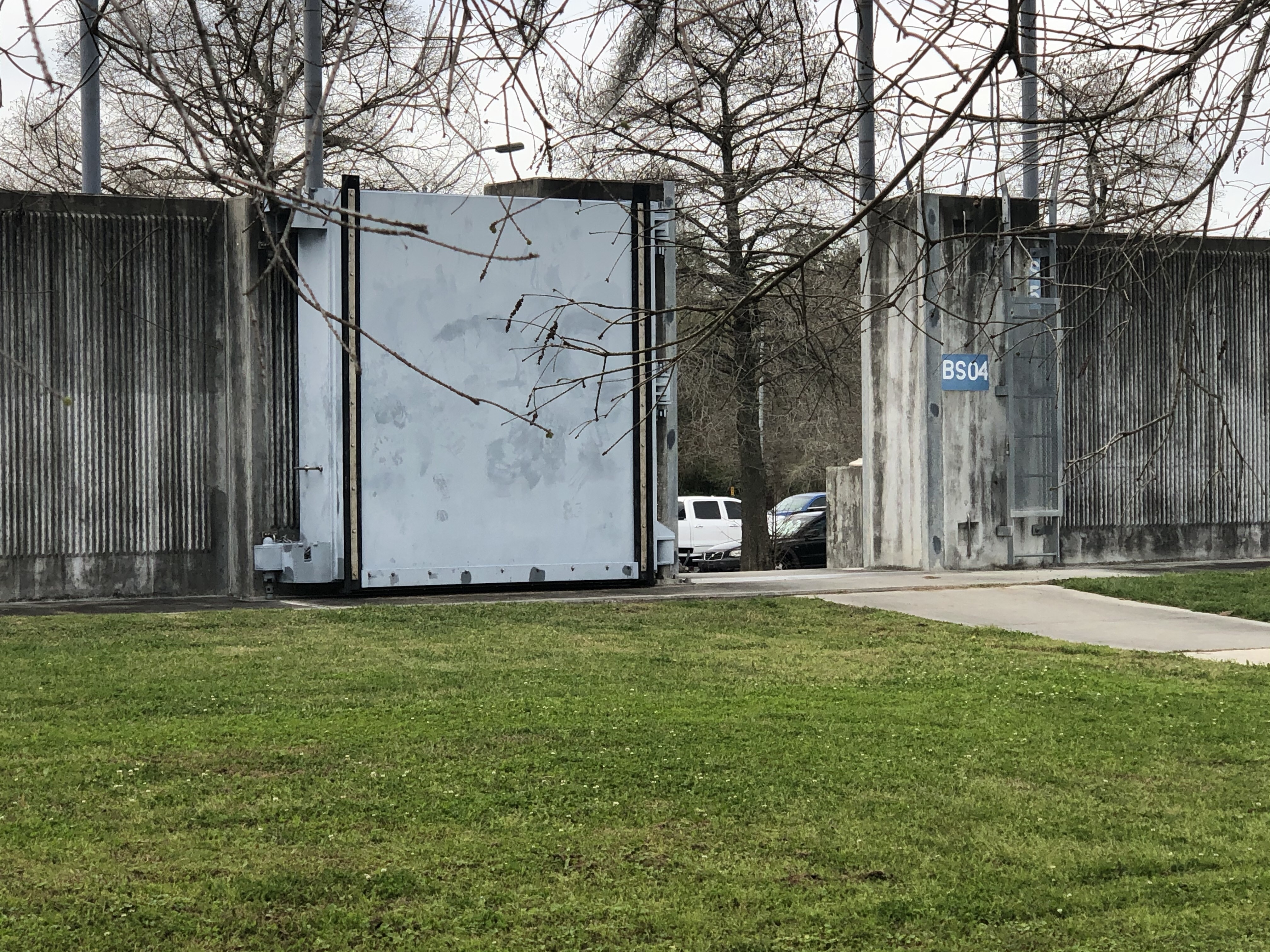
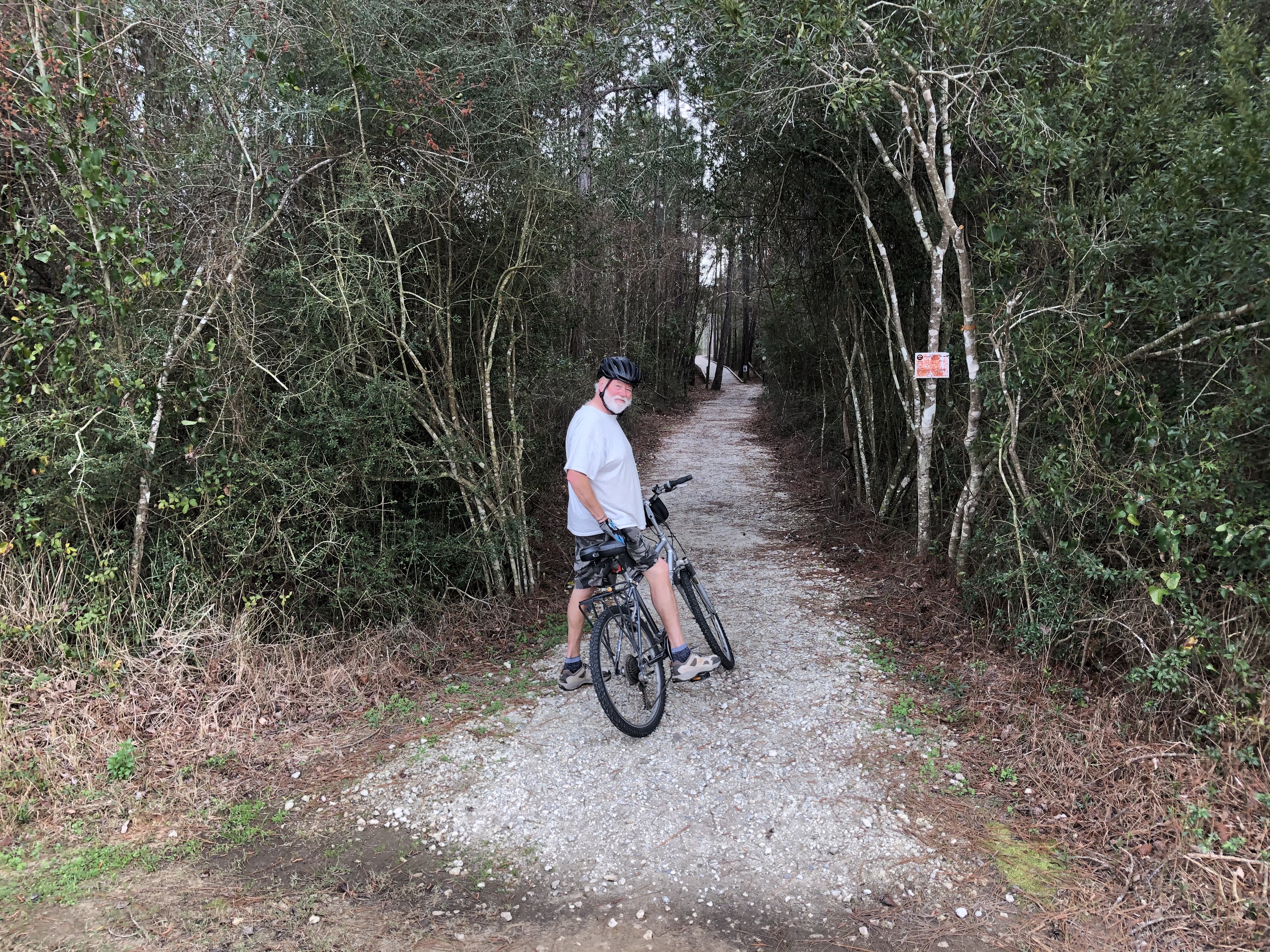
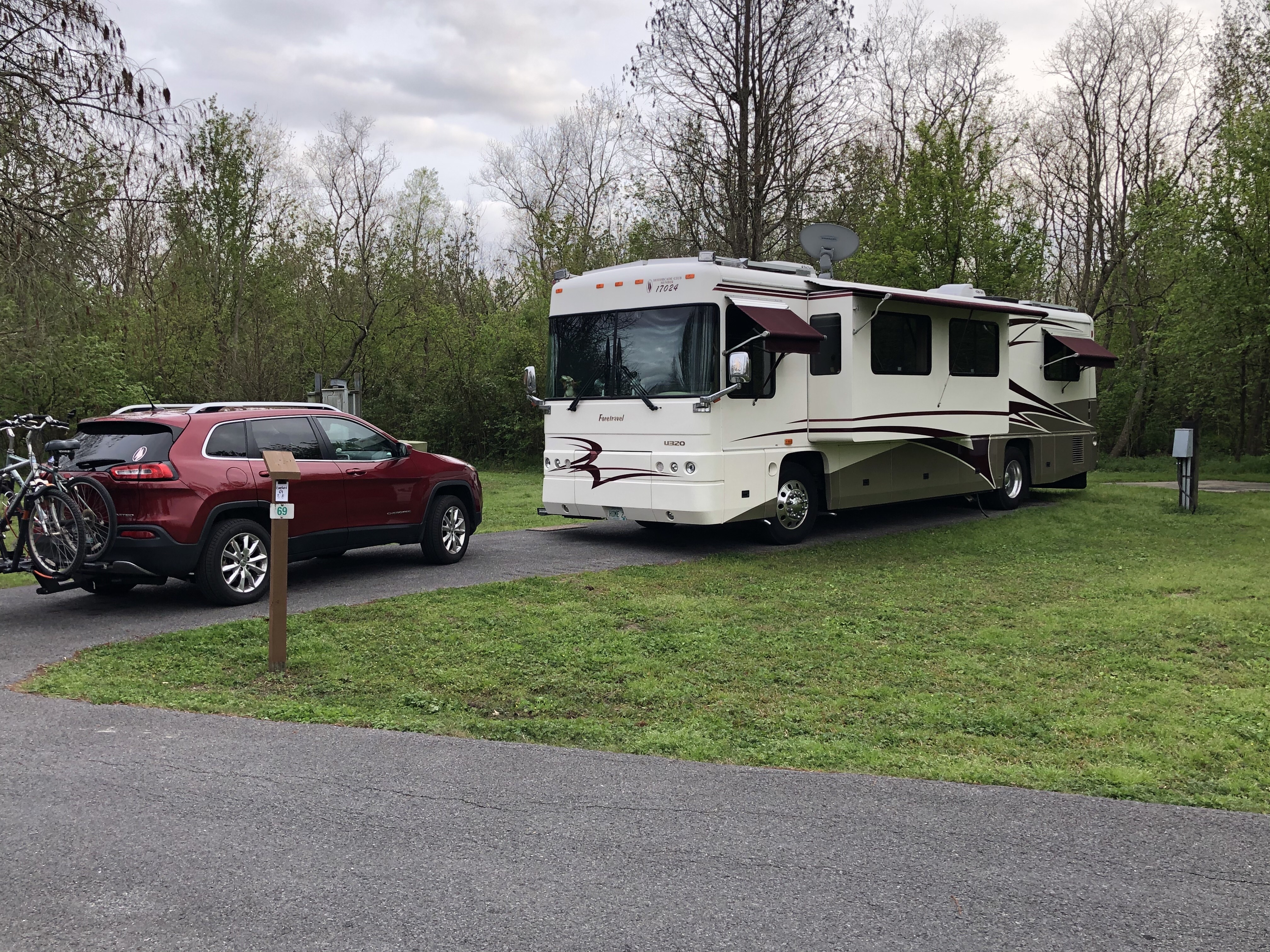
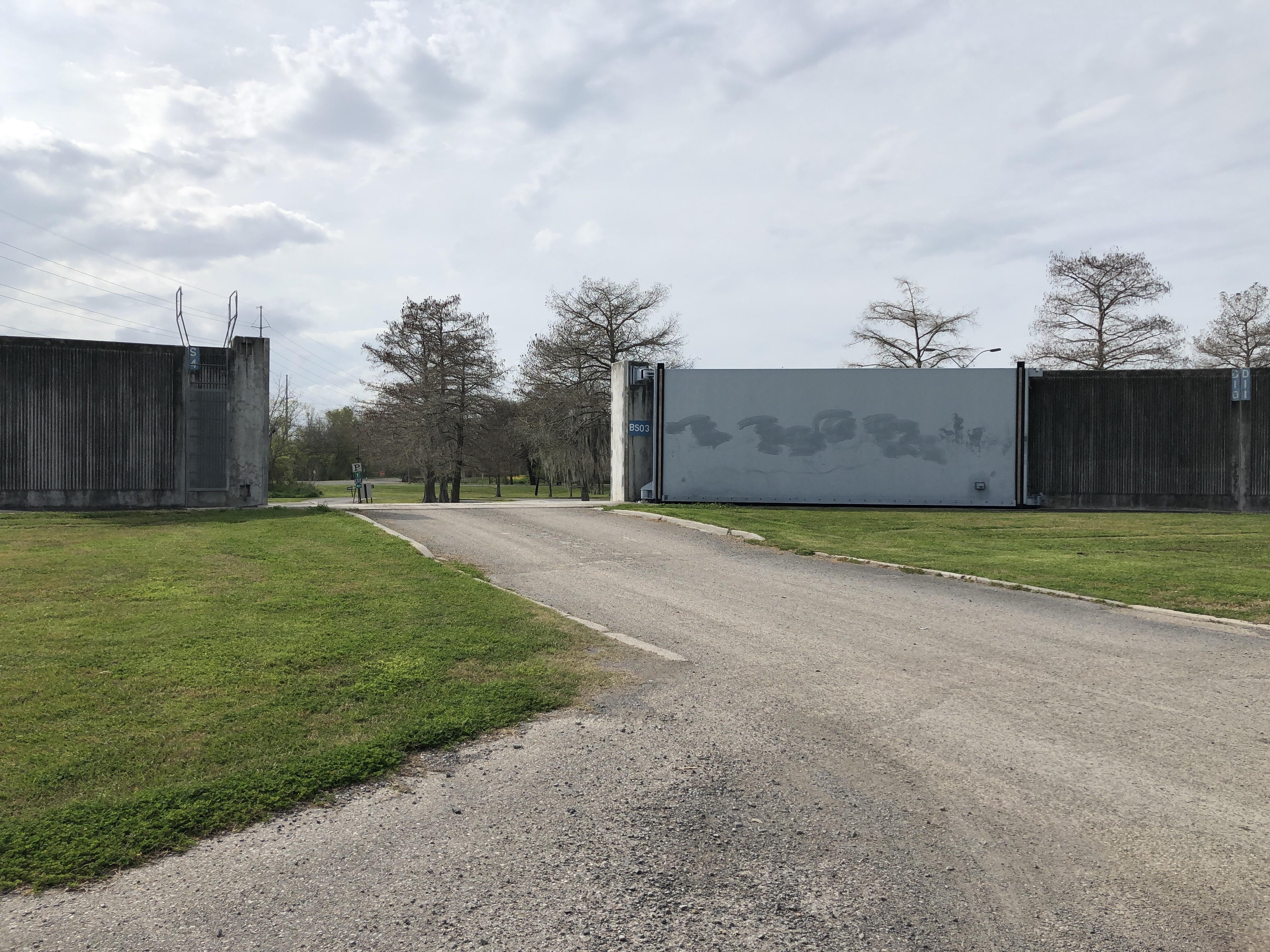
The park had a boat launch, a water park, lots of picnic areas and a long enough set of roads. We got in some bike riding. The park is along side of a massive levee with a 10-12 ft high concrete wall on top of it. There were huge steel gates that we open for passage to the other side.

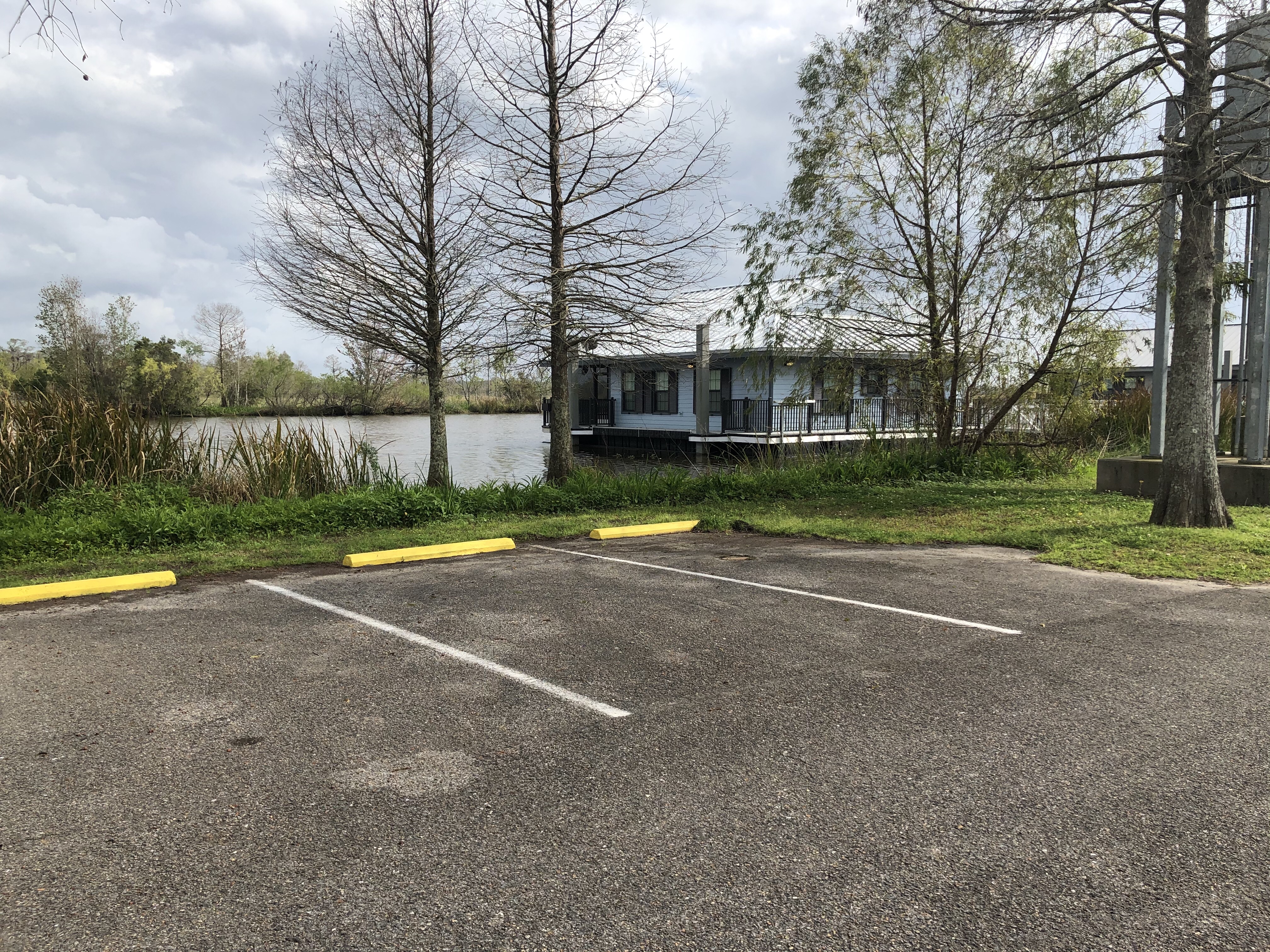
On the other side of the levee and wall was a waterway leading into the fishing docks at Westwego at one end and somewhere else at the other. There were 16 floating cabins along this road. Each had 2 or 3 bedrooms, a kitchen and a living room and a nice porch. They each had air conditioning and satellite TV and their own wifi antennas. Even if the river flooded and the road was under water these would just float up on tall stilts that held them in place. Each had a power pole much taller than the cabin and the transformers and electrical equipment was above the top of the levee walls.

Down by the boat launch the walls were even higher. There were more big gates to protect the fishing harbor.

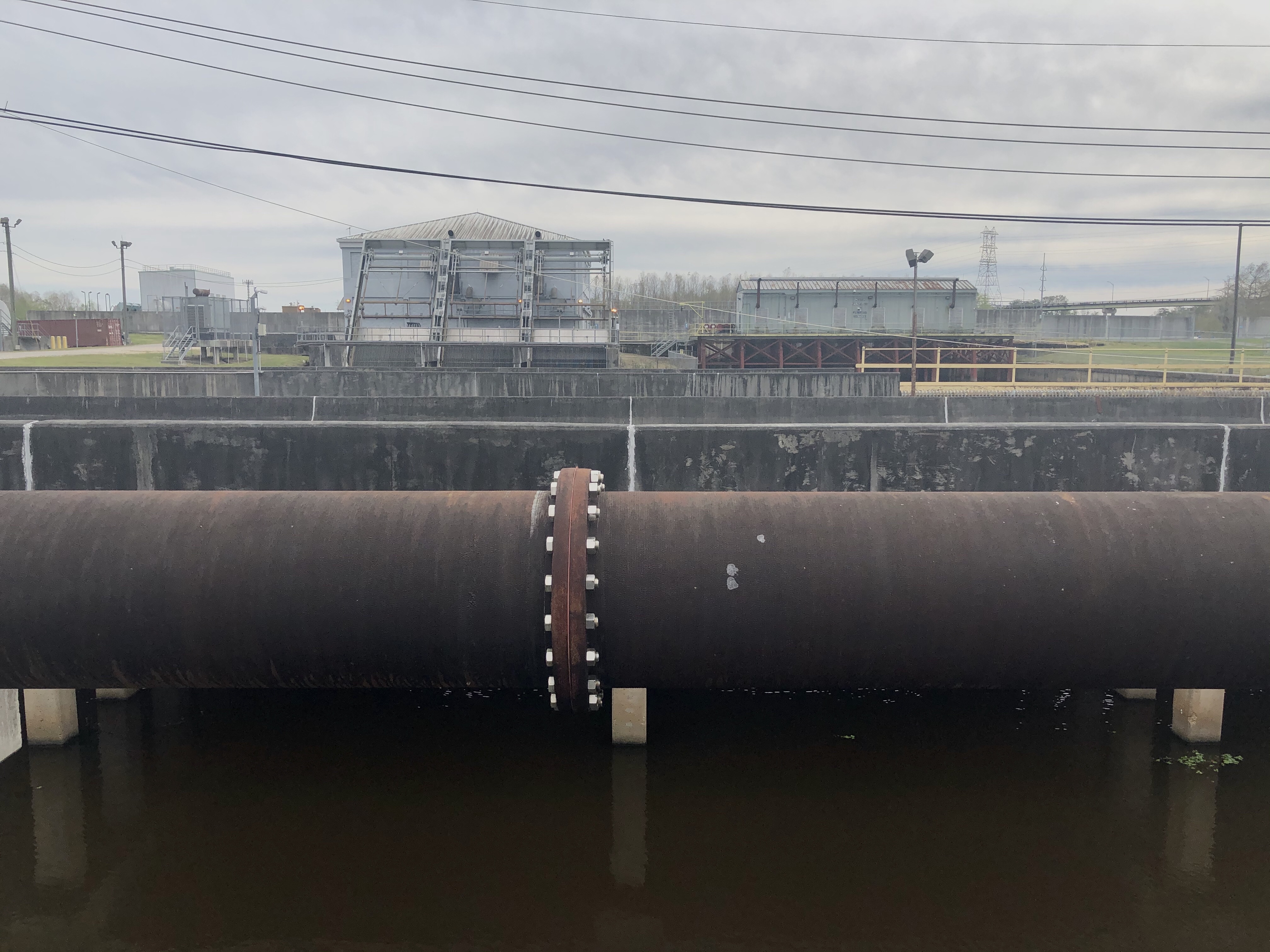
All of the water lines were elevated and there were huge dams with sliding gates to manage flow.

Over the River, the Mississippi River

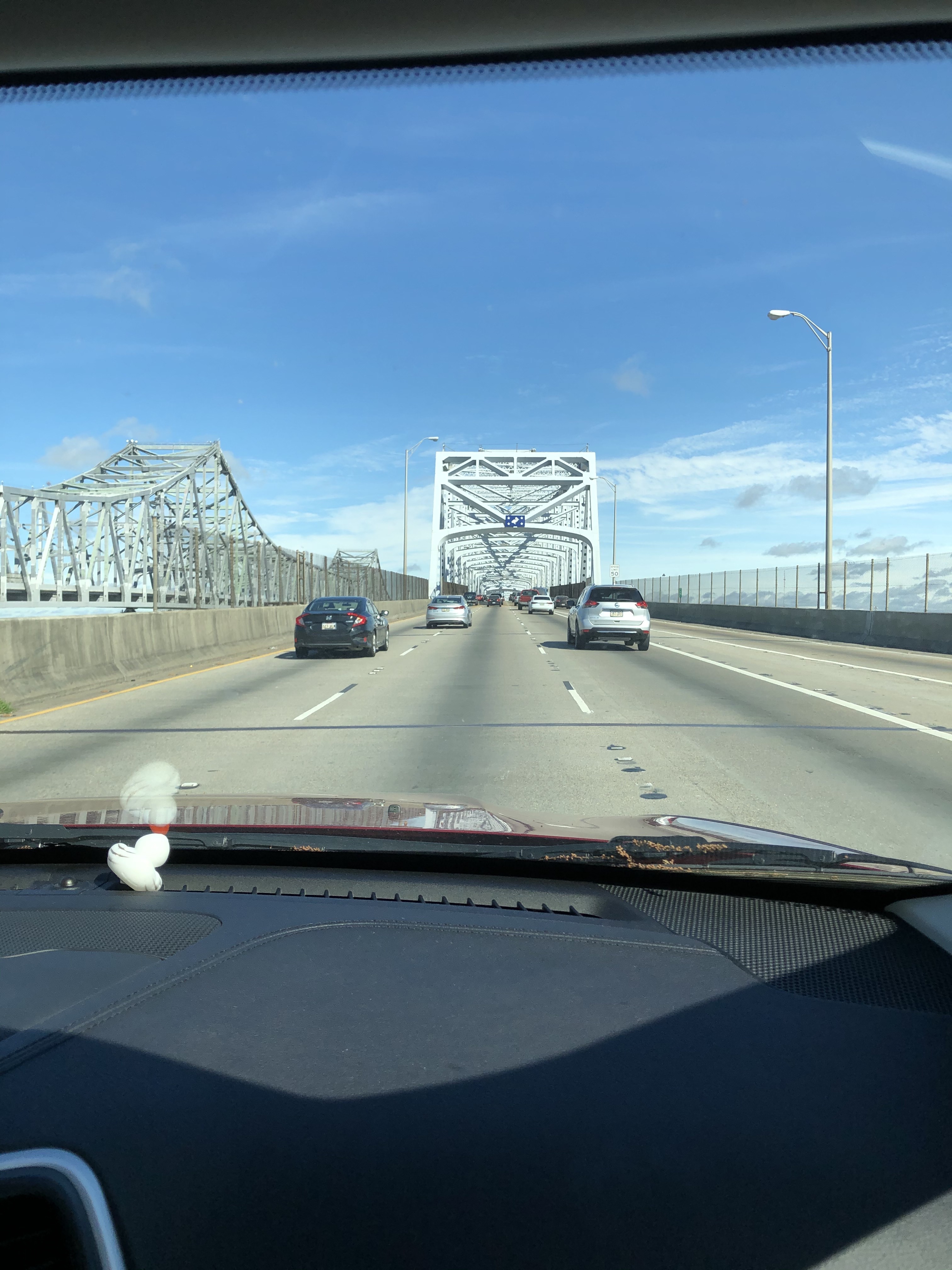
There were two ways back over the river into New Orleans and both took about a half hour. Both involved bridges and elevated highways. Almost every highway in New Orleans and the surrounding area is up on stilts, not just because of flooding in a metro area which is mostly below sea level but because the city is so densely populated and crowded with buildings.

These are big, old riveted together bridges. The kind that look like any one piece could fail and the entire bridge would collapse into the Mississippi River just like the one in Minneapolis did several years ago. Four and five lanes in each direction.

We were here at the very beginning of the COVID-19 pandemic. No sense of concern at all while it began to explode in the Seattle area.

The Garden District

Some of you might be familiar with one of our favorite musicians and songwriters, Randy Newman. He was born in LA and grew up in New Orleans. Many of his songs are about the South and growing up in New Orleans and the Garden District is mentioned more than once.

We bought tickets on an open air tour bus with a guide that made 22 stops (hop on! hop off!) on its way around town. At two of those stops there were guided walks of the Garden District and the French Quarter. So we found the bus station, inexpensive parking and got on the bus.

This bus was a double decker with the upper deck being open to all of the noise and commotion and smells as we went by. The Garden District stop was not far along on Magazine Street, one of the avenues with lots of shops and eateries. They pointed out one of the spots where NCIS New Orleans shot an episode. We got off at the Garden District stop and had a 45 min wait until the next walking tour started so we crossed the street and found a coffee shop up a block or so and had a coffee and an almond croissant. I have had better. And then back to wait for the walk.

The walk leader showed up and counted off the 28 people who could go in each cluster. She gave us all the rules: don’t walk in the gardens, don’t lean on the houses or walls, stay in a group and most important watch where you are walking. She repeated that a couple times. Everybody ready? Walk this way. We didn’t even get across the intersection before a woman face planted in the street. Believe me it sounded terrible. Just flat out, face first into the street. Amazingly she was uninjured and was making comments about her bad knee. The caution to look down where you were walking got repeated a couple more times.

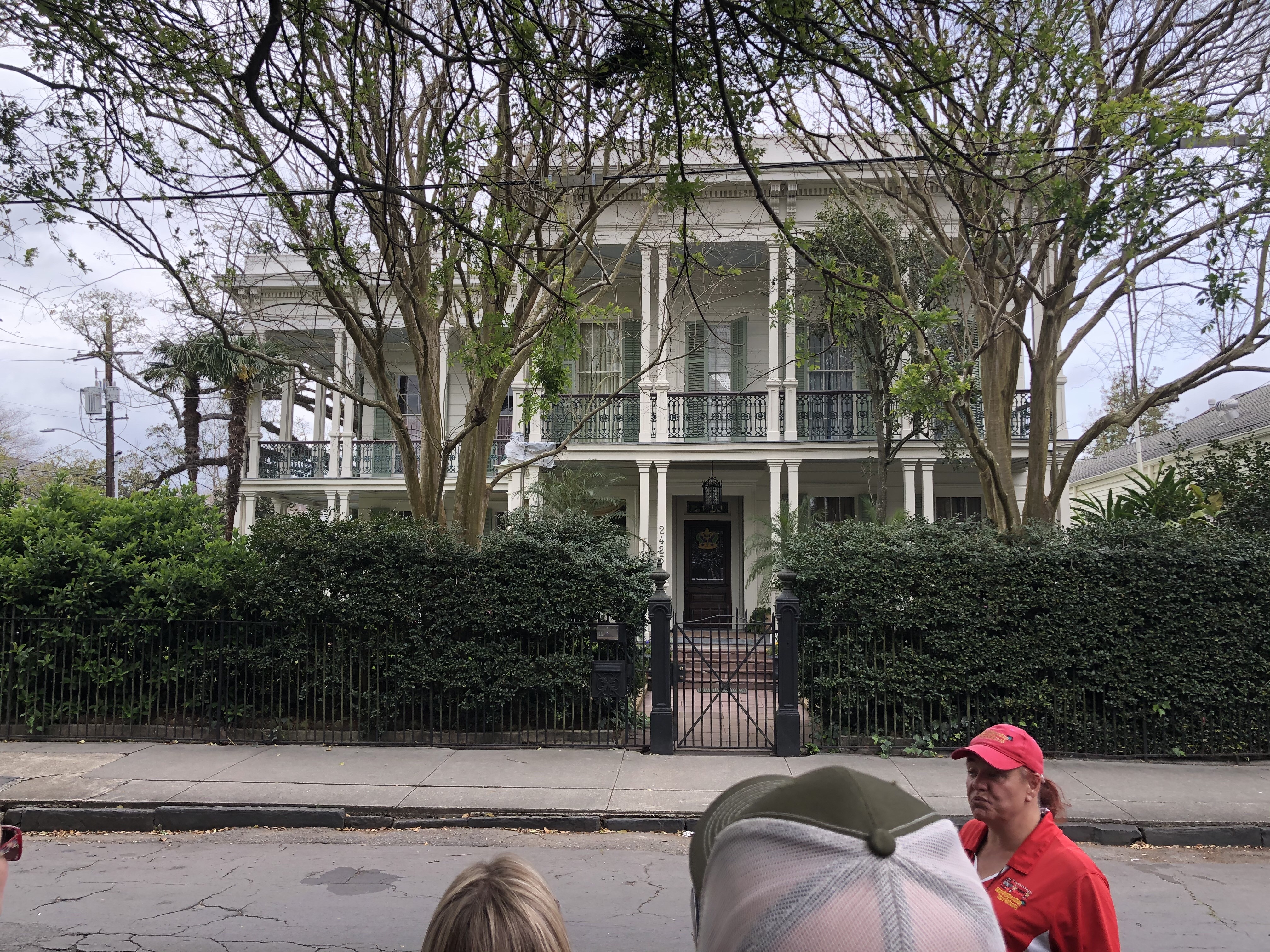
Down the street past some nice older homes. The Garden District was an early part of the New Orleans area, originally farms, these were bought up by a wealthy land developer who realized the land was more valuable for very upscale homes for the New Orleans elite. The land was divided into generous blocks, four lots per block so everyone lived on a corner. Maybe an acre apiece. And the high and mighty moved into the garden district building expansive homes. The major streets were grand divided avenues with trees down the middle. Many became street car lines. Some of the street cars came from Minneapolis and St Paul after the Polad’s (they own the MN Twins Baseball team) joined with General Motors to get rid of the street cars that ran from Stillwater to Lake Minnetonka and replace them with General Motors busses. The street cars that were not burned went to New Orleans and Mexico City.

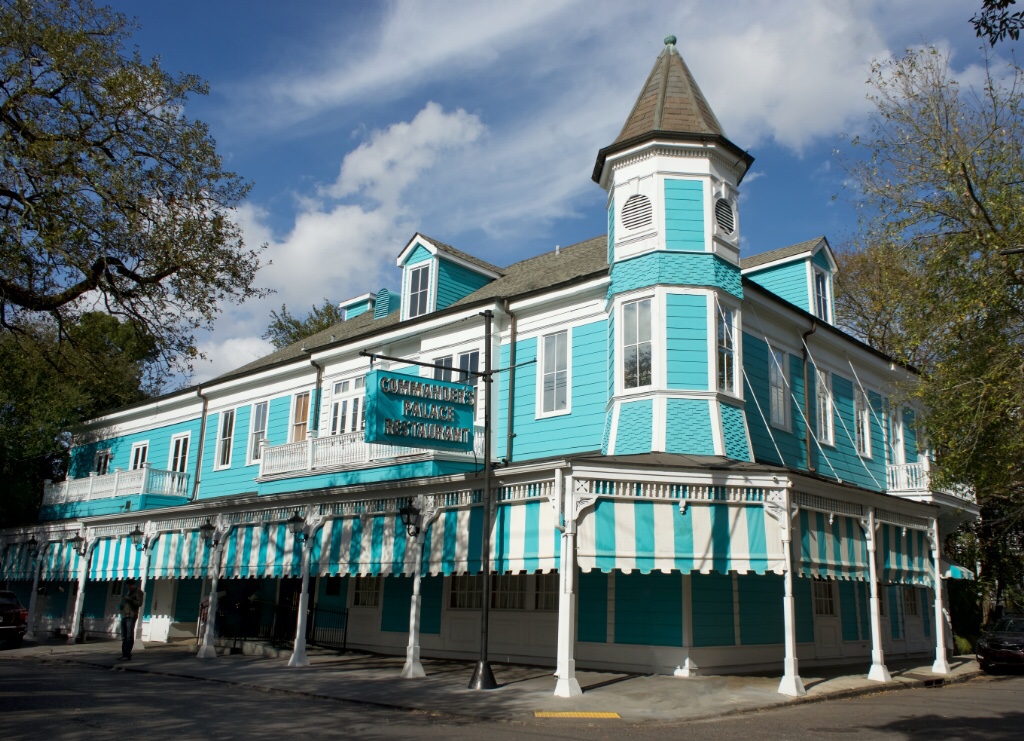
We walked down a sidewalk, watching every step, they were very uneven, to a corner where there was a famous restaurant. The Commander’s Palace. It was more famous in its early days as a brothel upstairs and fancy dining downstairs. Today just fancy dining up or down. The walk leader said some of the upstairs tables were in high demand.

We never got back there to eat.

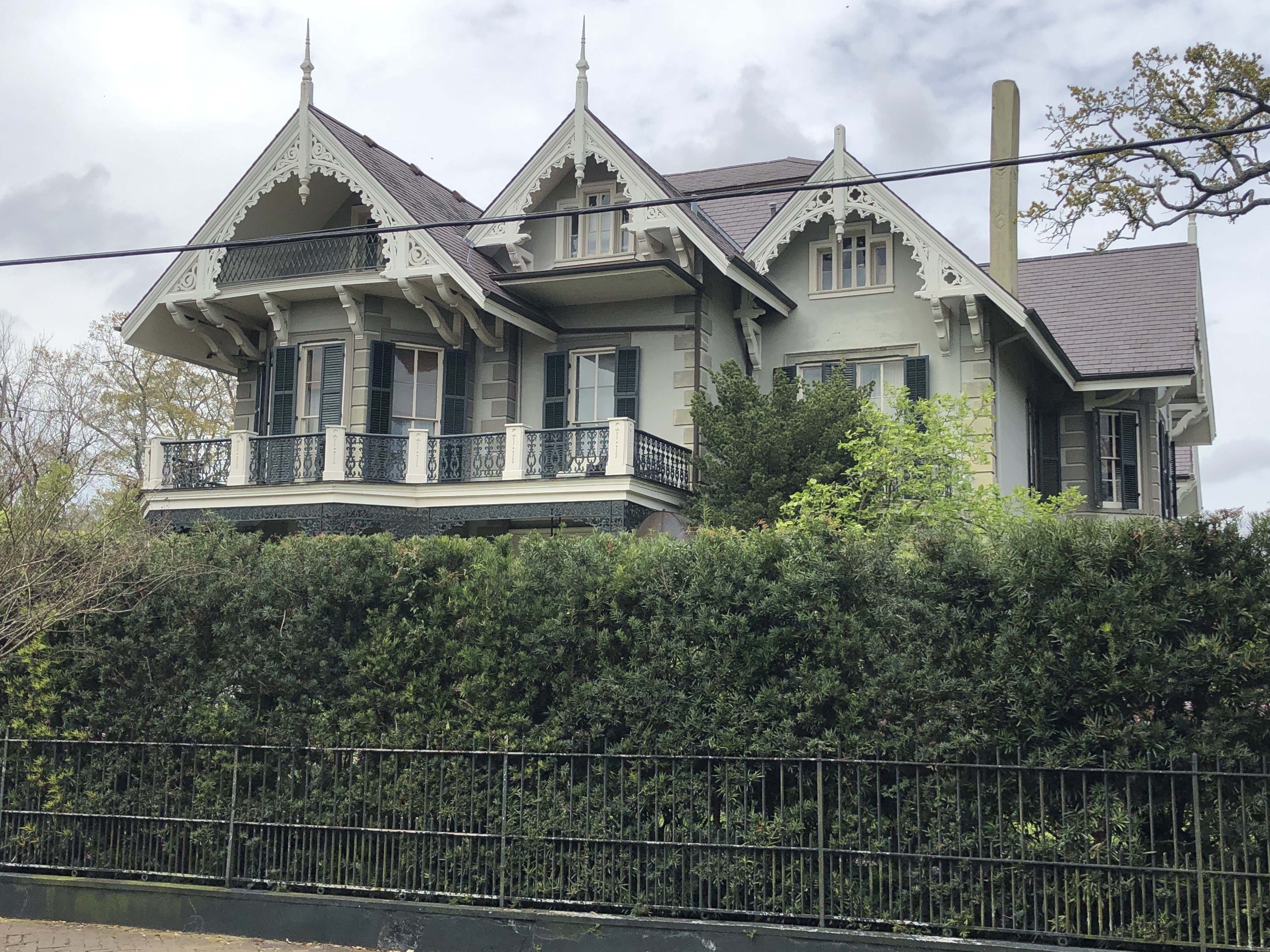
We turned the corner and went past a home owned by Ann Rice where she wrote many of her books. A few doors down across the street was an immense “cottage” done in more of a Queen Anne style that what you might expect in New Orleans. It was built by a wealthy business man as a honeymoon cottage for his son and bride who were expected to move back to the father’s home after the honeymoon until they started a family. The cottage was a temporary thing to be sold off as surplus after its initial use. Well, the newlyweds liked the life they started in the cottage and never moved out for the rest of their lives. After the cottage stood empty for a bit until another single lady came along looking for a place to stay in when she was in New Orleans. Not her primary home mind you, just a second home.

Nestled in behind a substantial hedge Sandra Bullock now lives here when she is in town.

Another block or so to the next corner lot was a huge Italianate style home. The original owners built it as just a rectangular home but found it too small so the took the plans for 1/2 of the house and added that on to the side to make a T shaped home. Many years later and many years ago an up and coming Hollywood type and his then girl friend were looking for a home in New Orleans and bought it. They still live there, married now with their dog. The tour leader said they are often seen letting the golden lab out the front door or coming to the gate to fetch the morning news paper. We didn’t get to see John Goodman or his wife but we did get to see a puppy come out the front door followed by the golden lab who came to the gate a-wagging her tail. “Pray tell what else would she wag?”

We thought all of that was pretty neat. It turns out the Garden District was one of only two areas in New Orleans that didn’t flood during Katrina. We wondered about all of the homes and businesses and people in the 80% of the New Orleans metro area that did flood. The hop on, hop off tours don’t go there.

Pascal’s Manale Restaurant

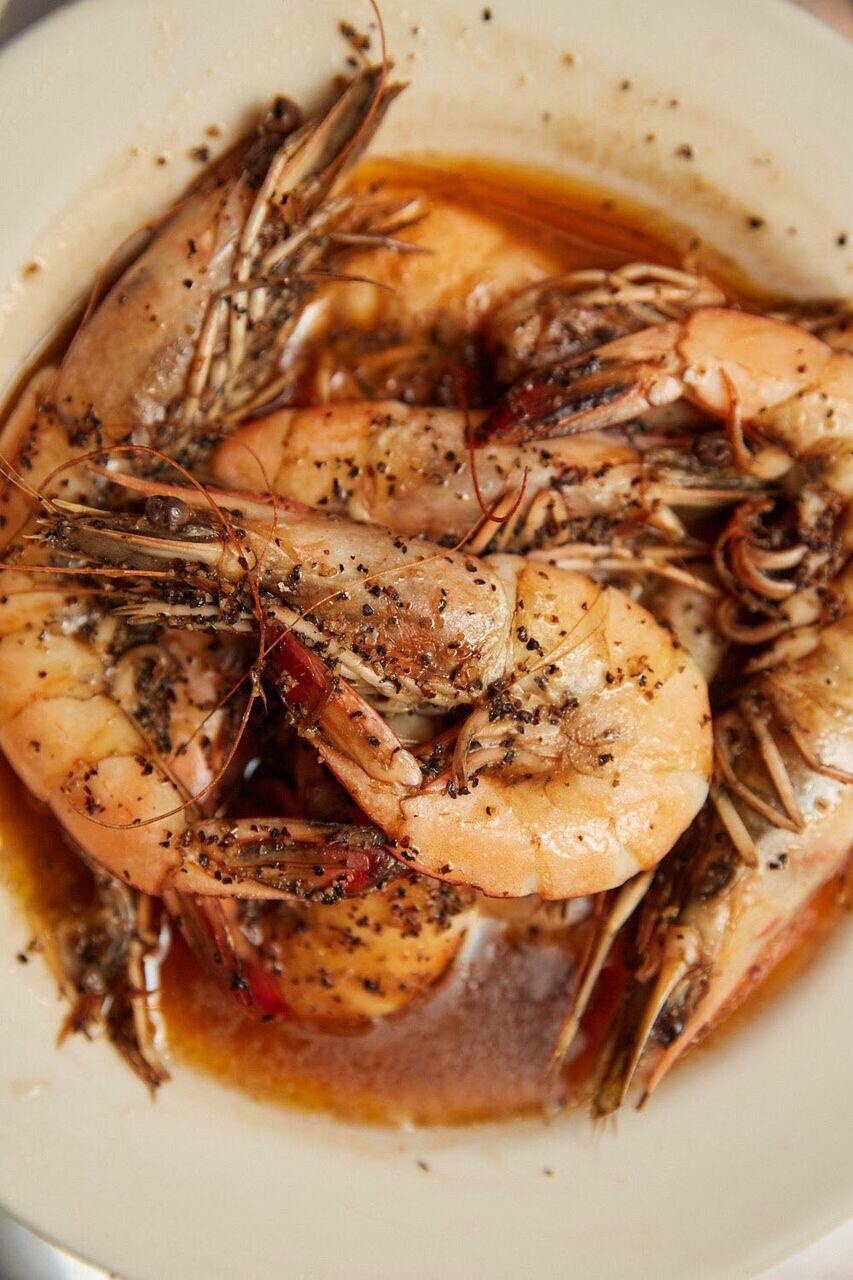
It has been so long since I was in New Orleans and then only for a couple days in the early 1980s that I have no recollection of it at all. Except for a memorable meal at Pascal’s Manale Restaurant. Barbecued Shrimp. Nothing like it anywhere else. We did manage to find the recipe for it published in a cook book and made our own Pascal’s Manale Barbecued Shrimp for several of our porch picnics when we lived in St Paul. A dozen or so folks shared picnic fare on long tables on our front porch. We all got our annual share of butter and New Orleans cajun spice, baguettes, potato salad and more. We hadn’t discovered gumbo, cheesy grits, beignets and more bits of New Orleans cuisine that we now hold dear.

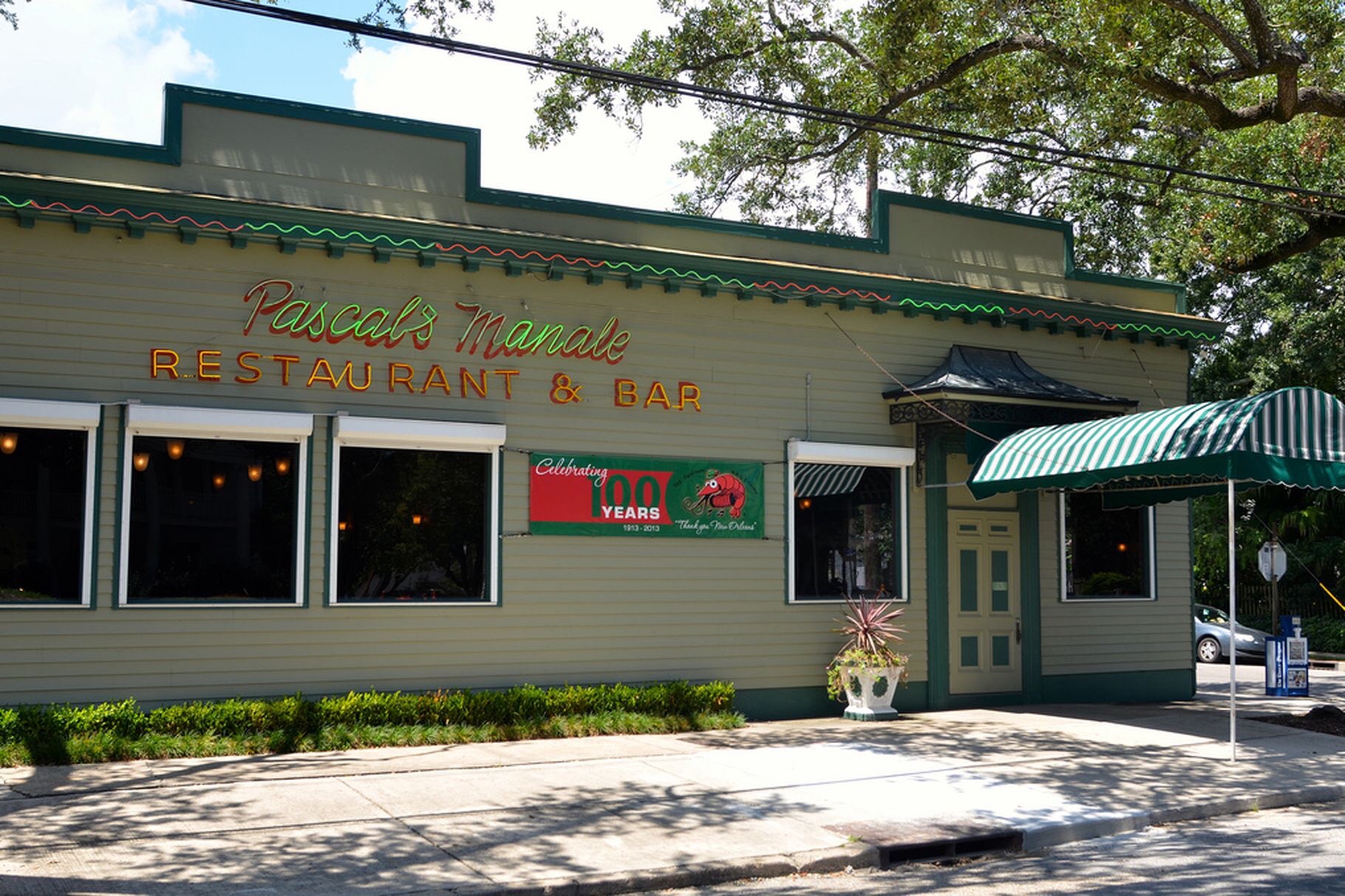
So we made reservations to pay a return visit. I had no idea where it was or what to expect. It has been on the same corner in the same old corner grocery store since 1913. They have added a room here and there but it is still small and wonderful.

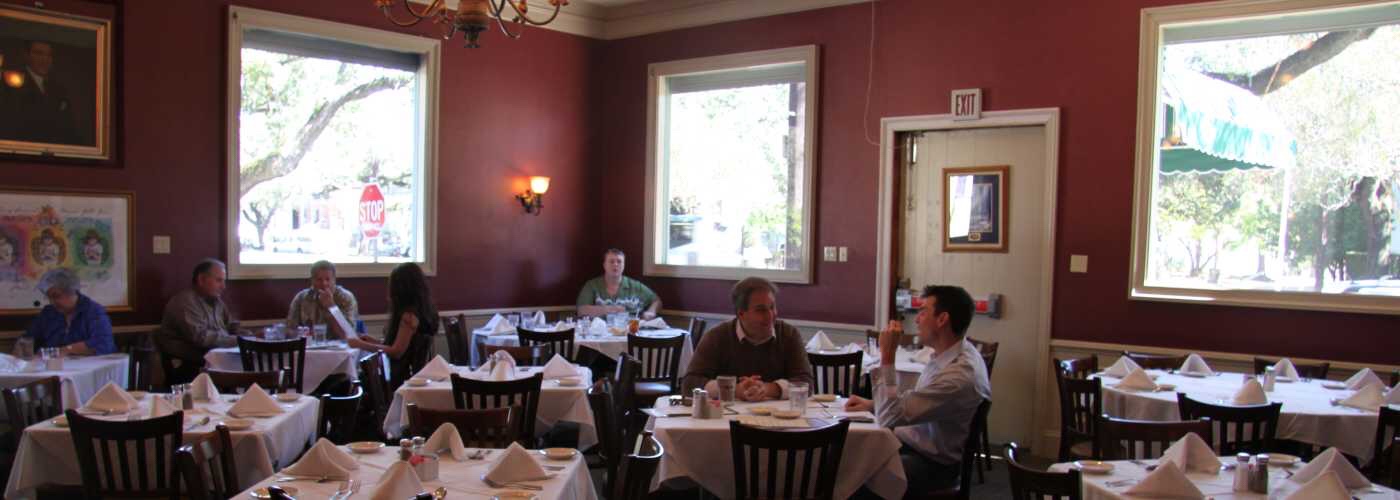
Not what one might expect, a bit understated on the outside, but casual/formal in the inside.

White linens and us in our shorts. If you order the Barbecued Shrimp all pretense is set aside, they bring bibs.

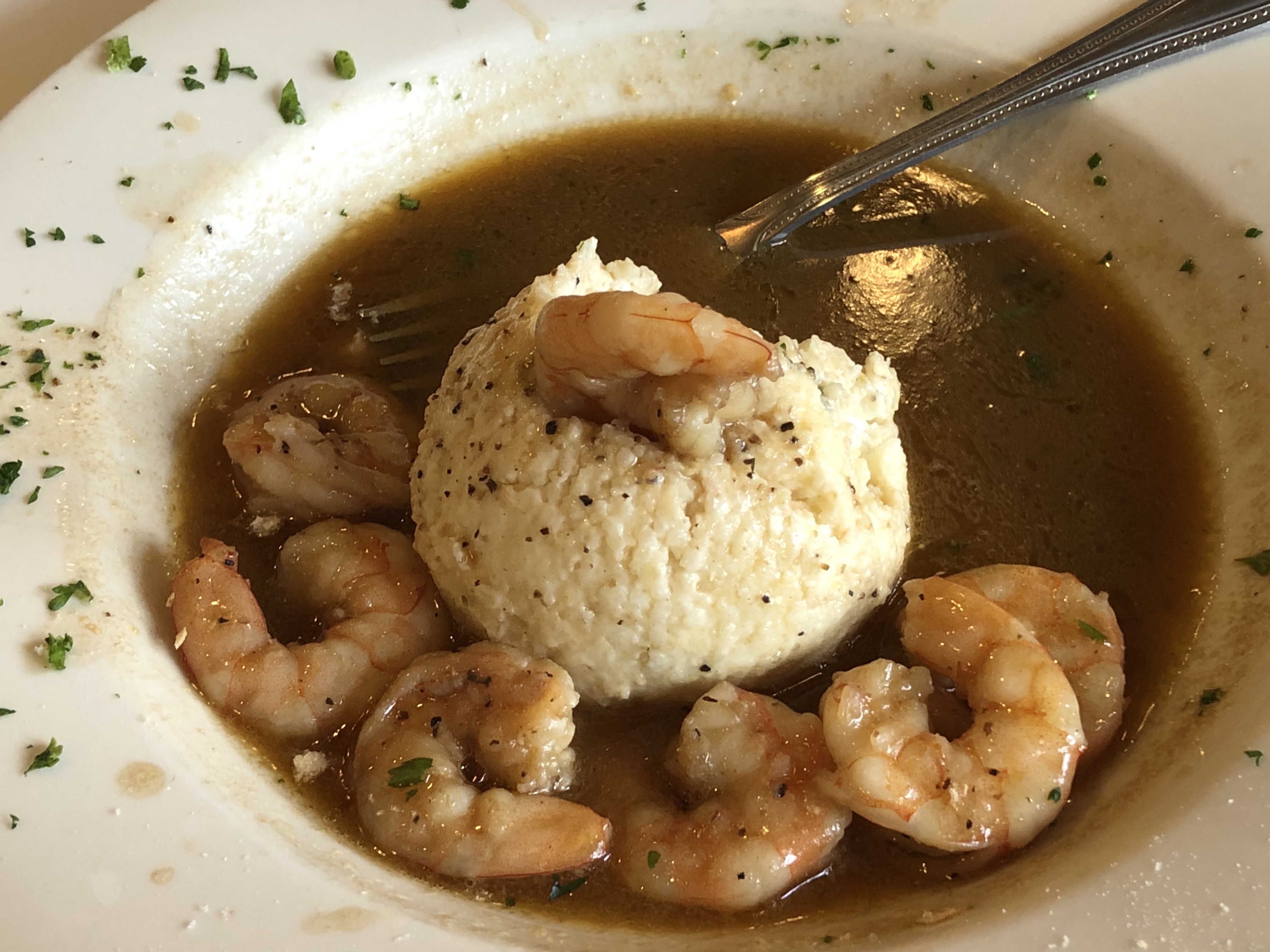
You need them. We had the same thing but a lunch sized portion with grits and the peel and eat bits removed.

It was wonderful. Was it as I remembered? I don’t know. My imagined dinner was probably more like what we used to make. In any case it was very good. We had a bowl of gumbo too.

We topped it off with a shared key lime pie and a cup of what you would expect in a fine restaurant, good coffee.

All those who remember the porch picnics raise your hand. Maybe its is time for a feast renewed.

There is too much more to cram in one blog so…

More Later, Much Love

Roger and Susan
COVID-19 Update, Late March 2020

Susan and I are doing fine. We are in Fredericksburg, TX in the now 1/2 full Fredericksburg RV Park. When we have been here before it is always “No Vacancy”. Most of the folks we were going to see here decided not to come. Some did and we were glad to see them. More on that later when I catch up on Blog Posts.

No reported cases yet in Fredericksburg or the surrounding county. Most stores are closed. Food places are generally only open for take out. All of that is supposed to end on April 4th.

The big grocery store (H-E-B) and Walmart are open and reasonably well stocked. We got TP at Walmart yesterday!

Pretty easy to be as isolated as we want to be here. Everyone here is very friendly and the weather is nice. We are fine. We hope all of you are as well.

More Later, Much Love,

Roger and Susan

Odds and Ends, Orange Beach, Alabama, February 2020

Hot Dog

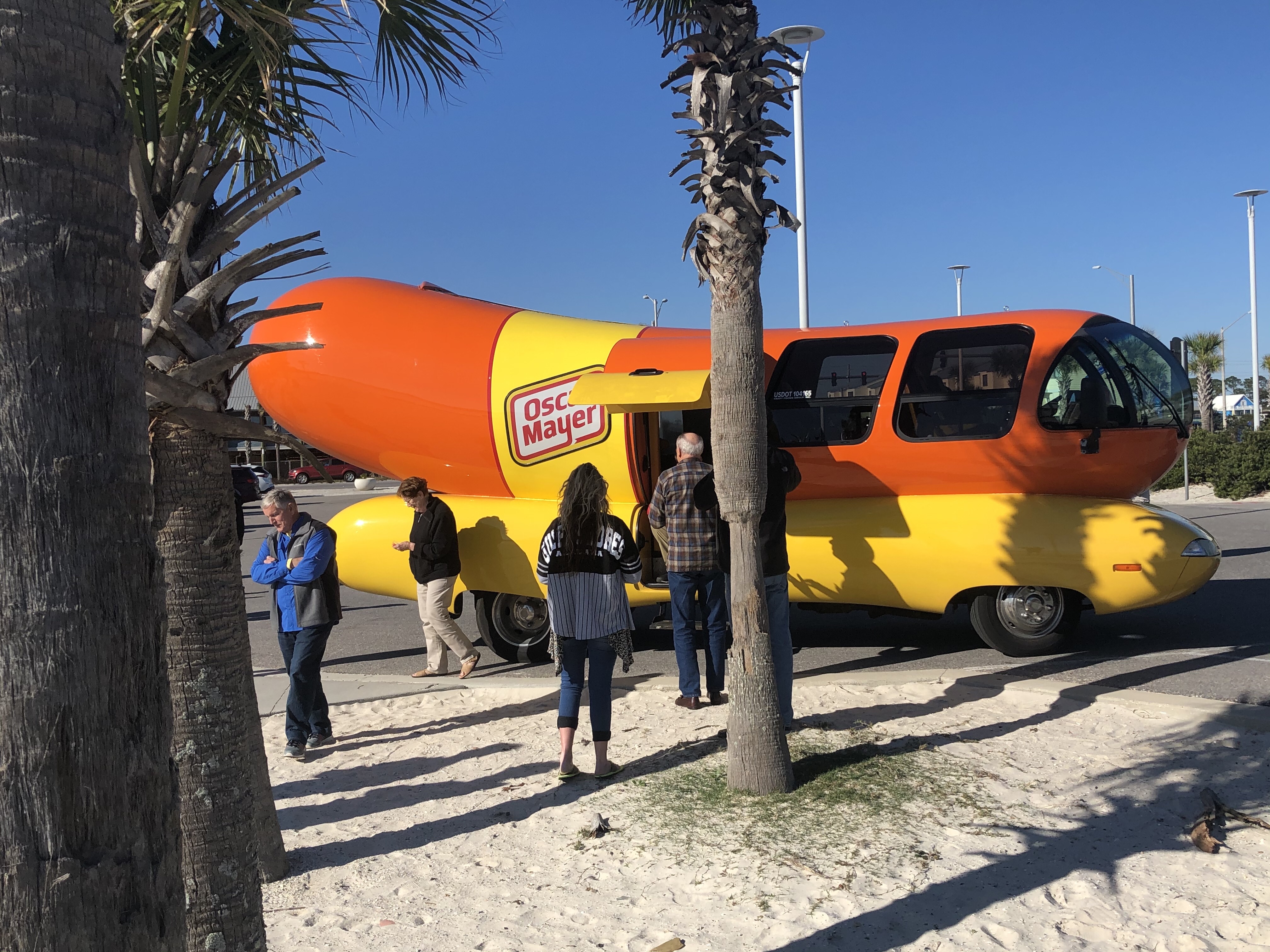
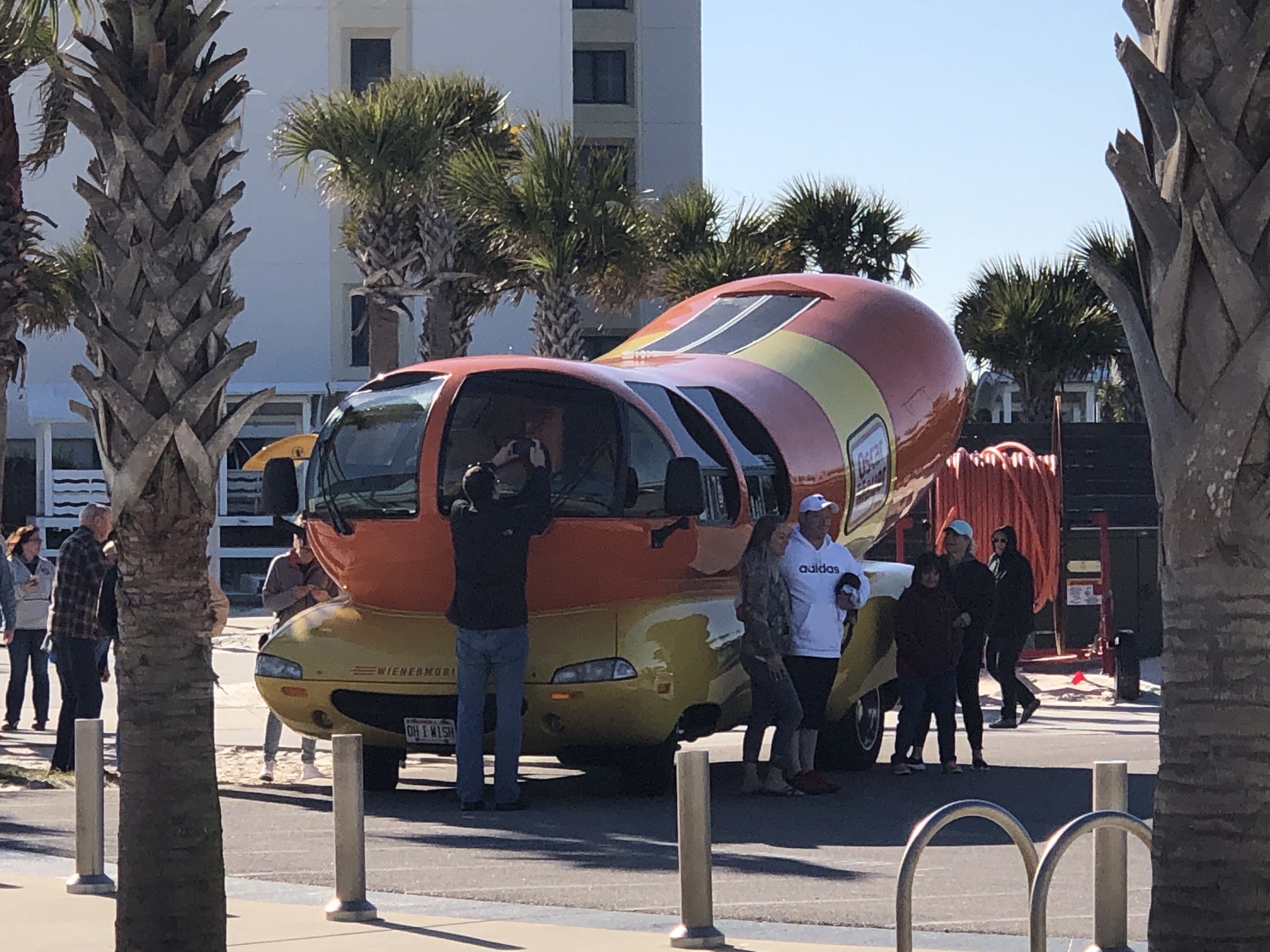
One day walking at the beach we saw what we all wished we would be someday.

It was pretty cool, just drove up, they opened the doors and people started showing up for pictures. Two person crew, dressed in OM outfits. We though maybe they would be fulfilling everyones dreams, free hot dogs, but no. Maybe they were giving out coupons. But it was fun to see.

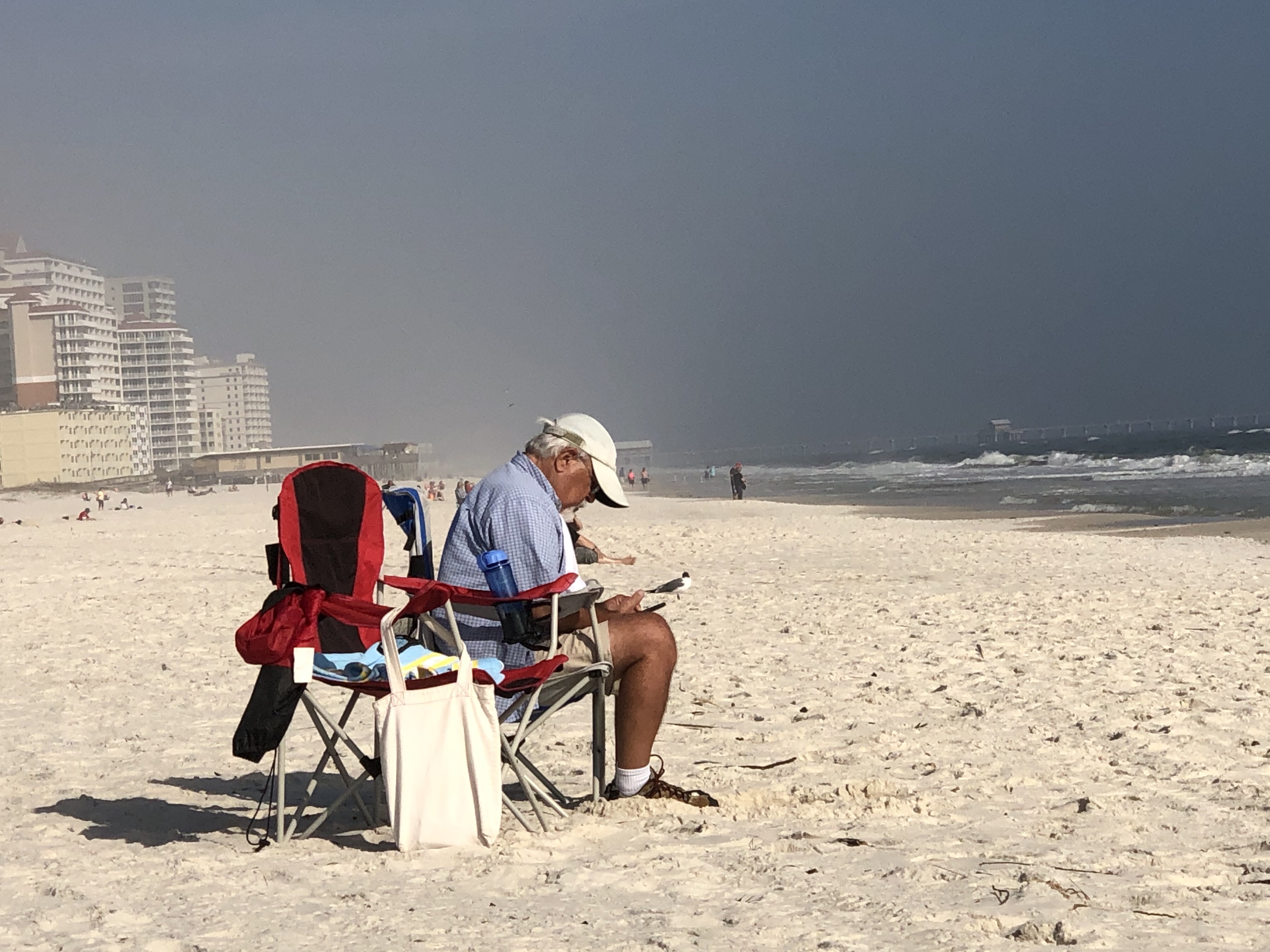
Beach

This is not us but lots of beach to sit on and walk.

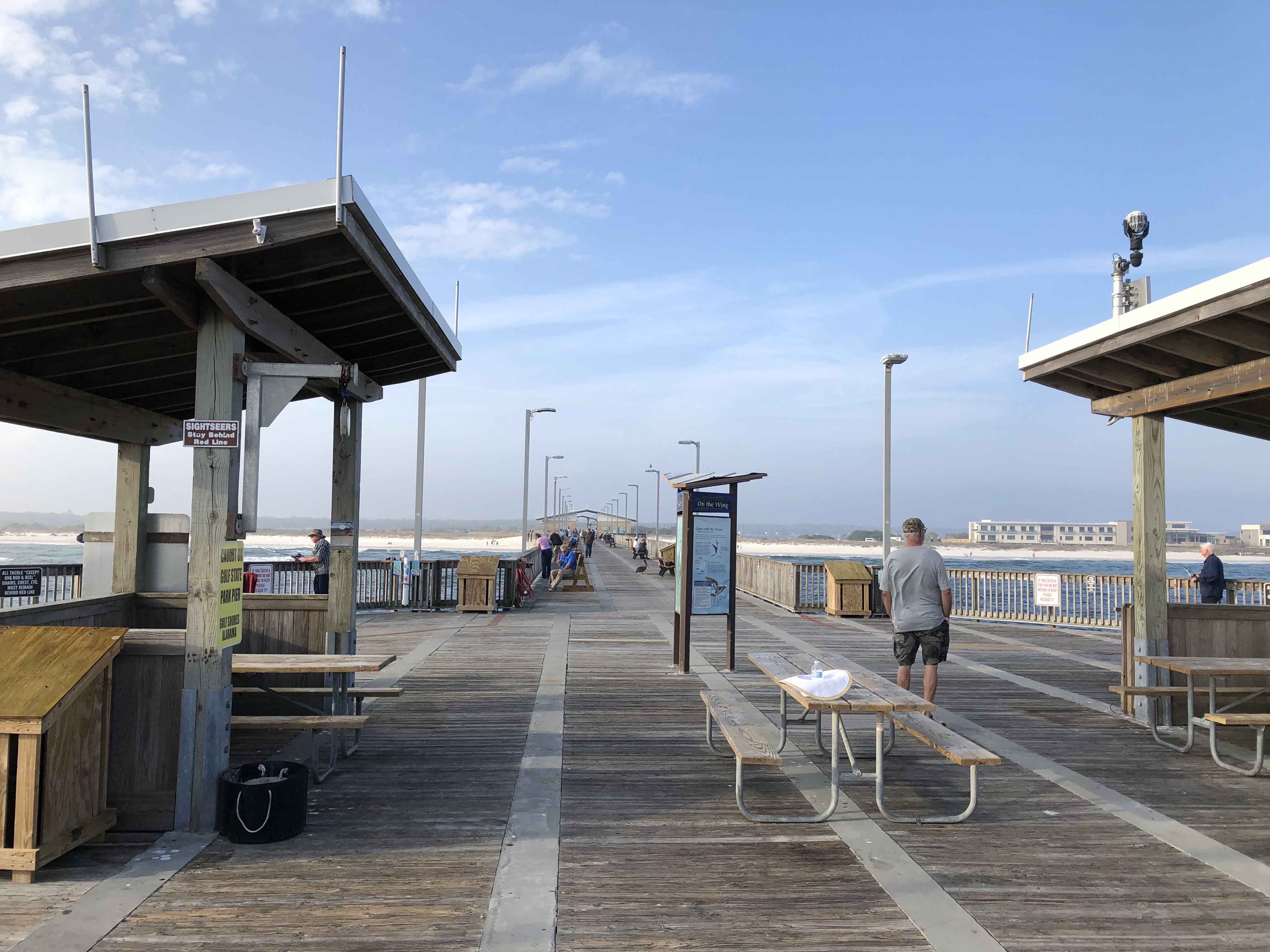
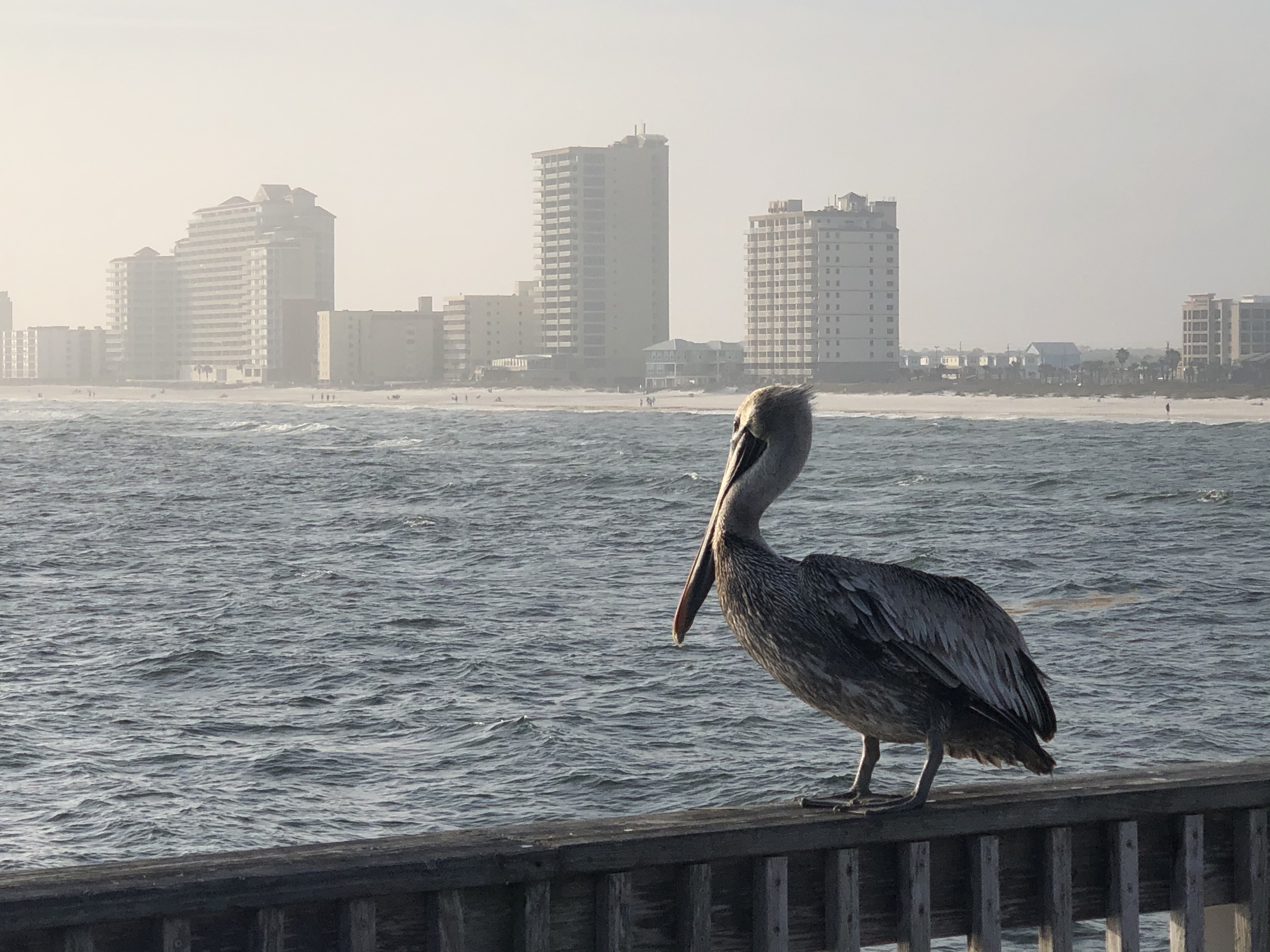
Great big long fishing pier. Complete with pelicans.

RVs

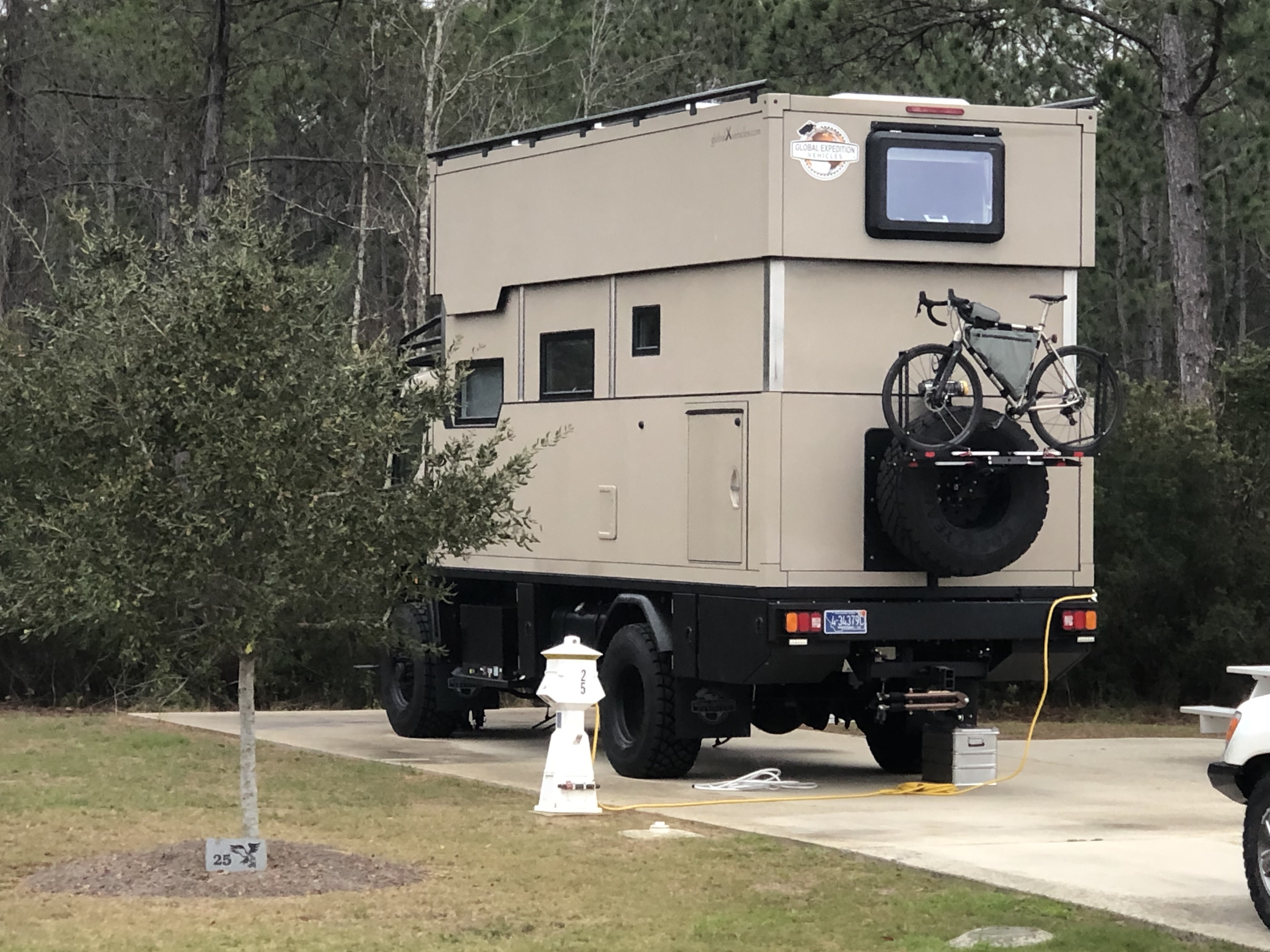
One day this RV showed up in the campground.

A GlobalX Vehicle. An off road monster with a vertical slide, bedroom was on the second floor. I talked to the owner, they had just picked it up and were on a shake down trip. My guess is that with those giant tires and suspension there was indeed some shakin’ goin’ on. He said maximum speed was 58 mph but it drove OK. Probably have a ladder stored somewhere for getting the bicycle down. And a fork lift to get the spare tire off.

Where do you go with one of these? Probably out in the BLM lands in Arizona. We have seen others like this. Kind of an oddity.

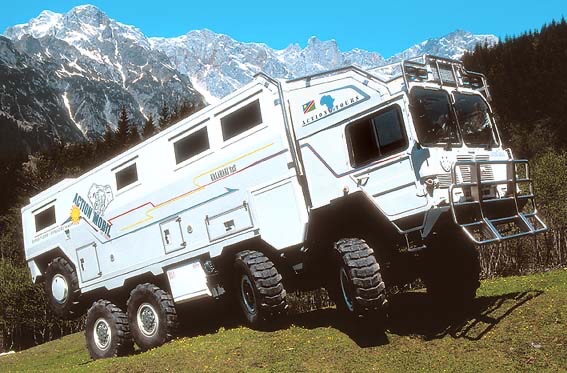
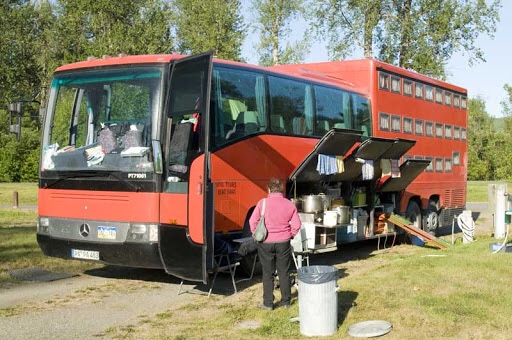
These were very amazing. We first saw these in 1980 in Utah and they are still around (newer ones though).

Signs

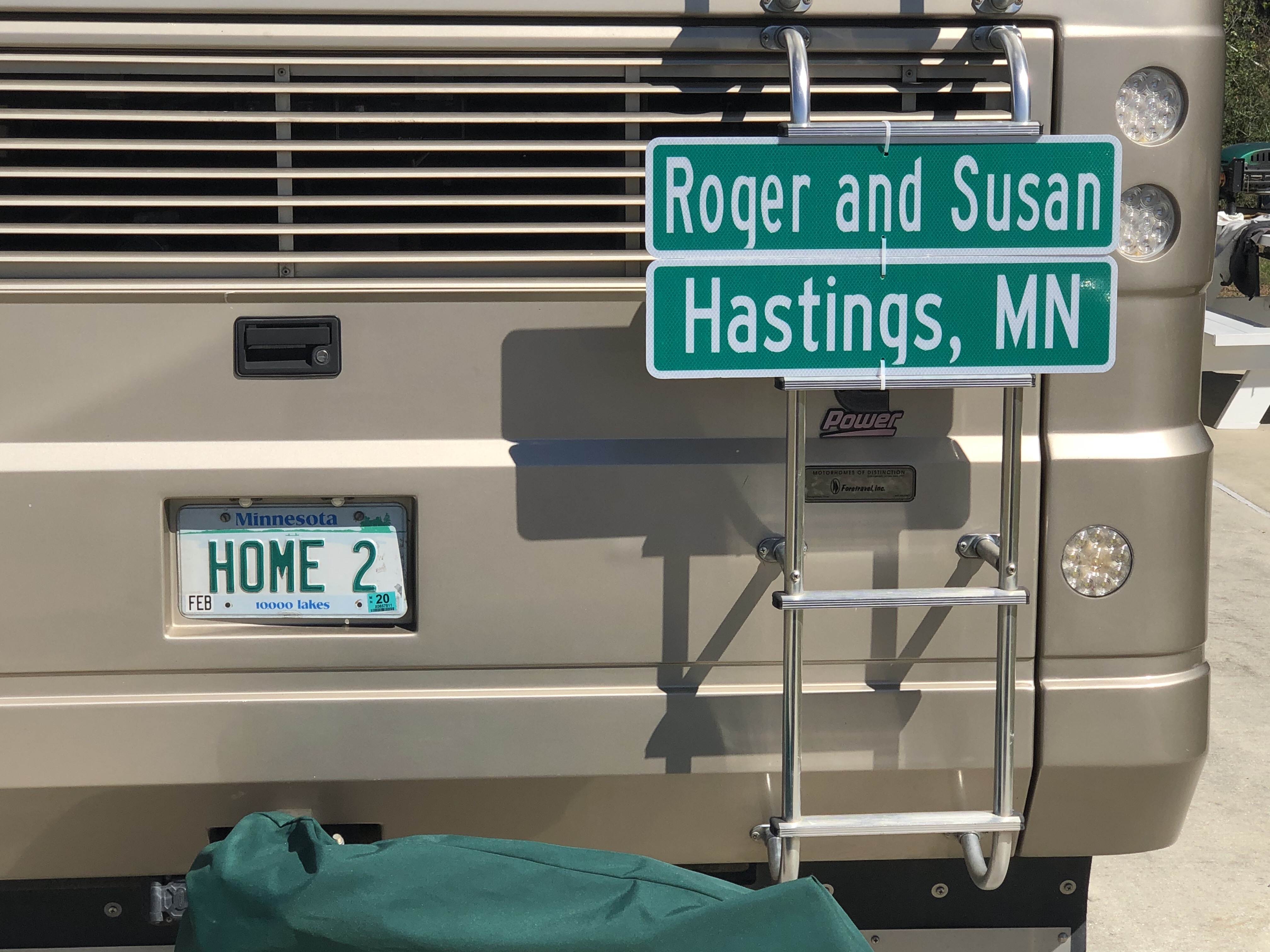
We have been looking around for a sign to put at our campsite while we are there. Who we are, where we are from. At every corner the answer was staring us in the face. And easy to get at Amazon.

Now all we have to do is find a post.

More Later, Much Love,

Roger and Susan

Mardi Gras, Gulf Shores, Alabama, February, 2020

Mardi Gras is a season. It starts each year on January 6 and runs through Fat Tuesday the day before Ash Wednesday, the first day of Lent. That means the length of the season is different each year. The big events of the season are the Mardi Gras parades which happen during the season culminating with the biggest parade on Fat Tuesday.

I don’t know much about it so I am paraphrasing a bit here.

Mardi Gras is French for “Fat Tuesday“, reflecting the practice of the last night of eating rich, fatty foods before the ritual fasting of the penitential Lenten season.

The first U.S. Mardi Gras occurred in Mobile in 1703 with a secret society, the Masque de Mobile, formed to organize the celebrations. This society is similar to the “krewes” in New Orleans who sponsor the elaborate floats used in the parades before and during Mardi Gras. The celebration arrived in New Orleans soon after its founding in 1718.

About a century later street parades had become established in many cities in Louisiana and Alabama and many krewes had formed, their members remaining anonymous and their faces hidden by masks. In 1872, a “King of Carnival,” Rex, was introduced to preside over the parades. The tradition of float riders throwing trinkets to the crowds also began in the 1870s. Typical “throws” include beads, cups, coins and stuffed animals.

Well all of that and Moon Pies.

All of this sounds like the St Paul Winter Carnival except there it is cold and in the winter.

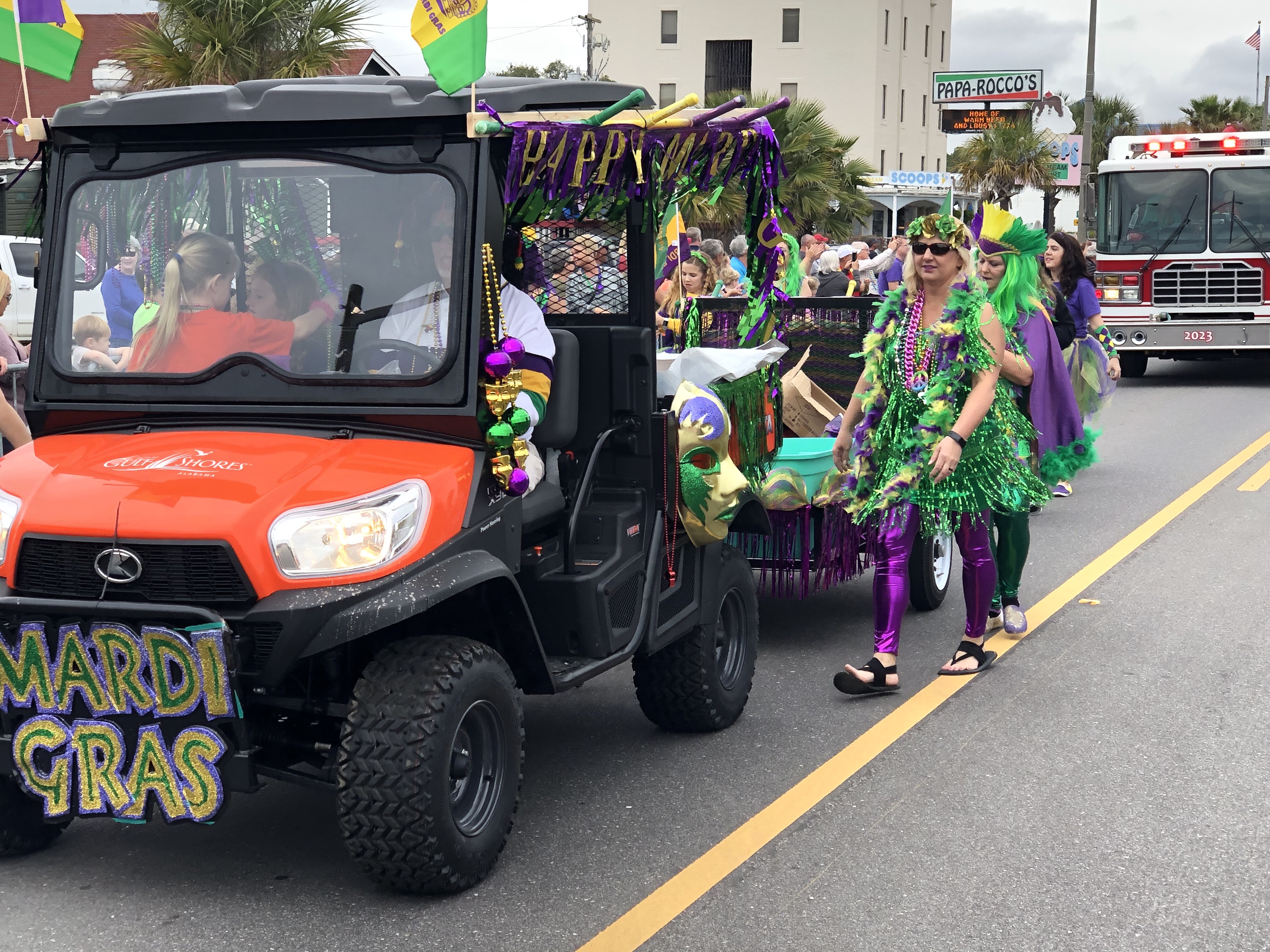
Orange Beach and Gulf Shores had several parades in the days before Fat Tuesday but the really big one was at 10 AM in Gulf Shores.

We headed for breakfast about 8:15 at the Sunliner Diner. We got right in and had an unremarkable breakfast. Service was slow and inattentive. In just about every way imaginable a blah breakfast.

I suppose they hoped the decor would make up for it. Ya it was pretty 50s like right down to the black and white tile floors. Trouble was most of the folks coming here found the floors really slippery so they had long black runners everywhere people walked. There was even a cut up Chevy or some other old car with a table in the middle.

We ate, drank poor coffee, paid the bill and left as long lines had formed to have the same experience.

The Mardi Gras Parade route was right down the street in front of us. There were barriers on either side of the center two lanes to keeper the “catchers” from getting too close to the “throwers”. There were some chairs but this is mostly a stand up event. Folks had those two wheel grocery cart bags for all of the expected booty.

At 10AM we could hear sirens and drums and music at the far end of the route but it took 45 minutes to get to where we were. We were right at the barriers, not really very crowded on our side but 2-3 people deep on the other side.

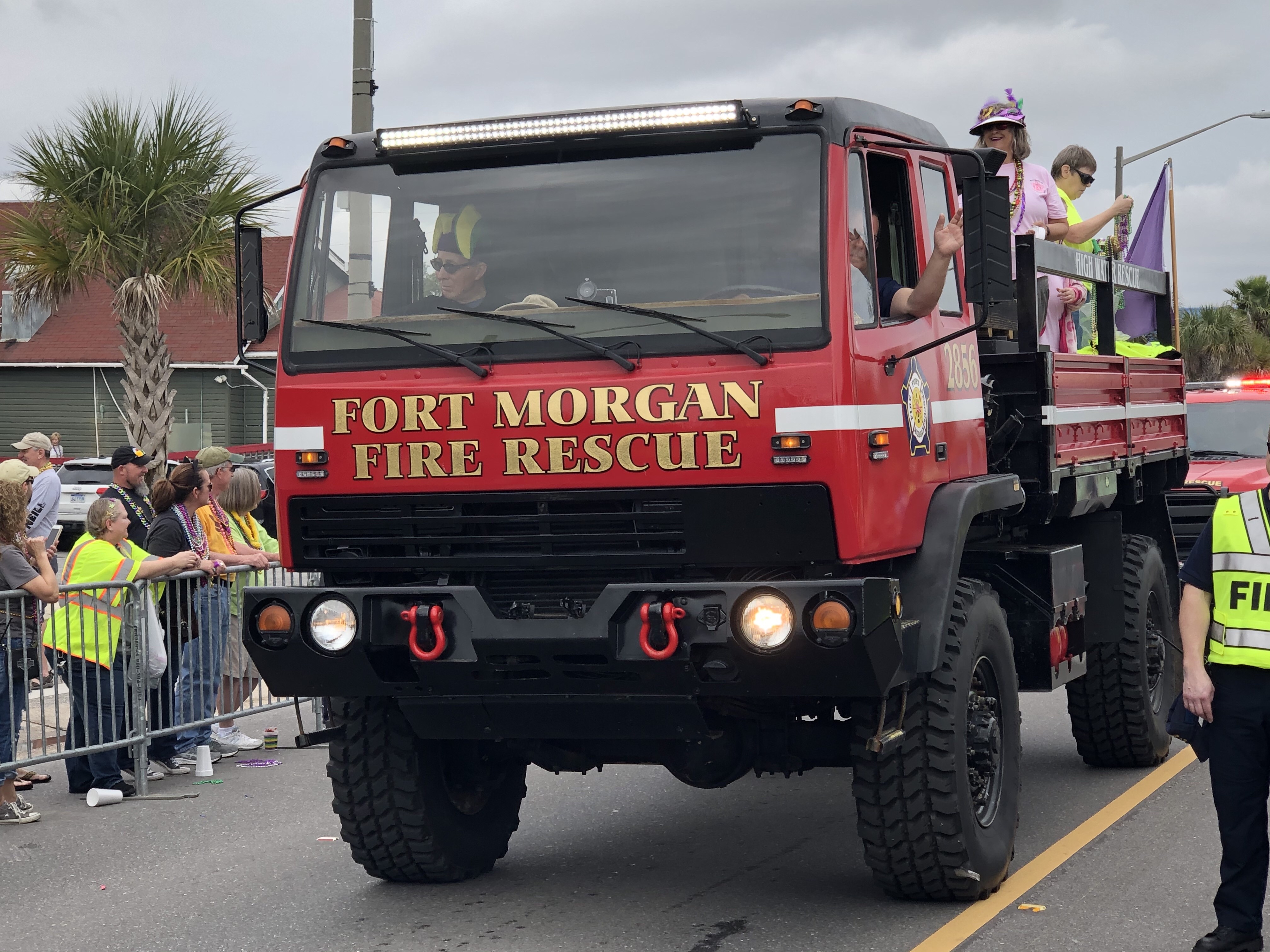
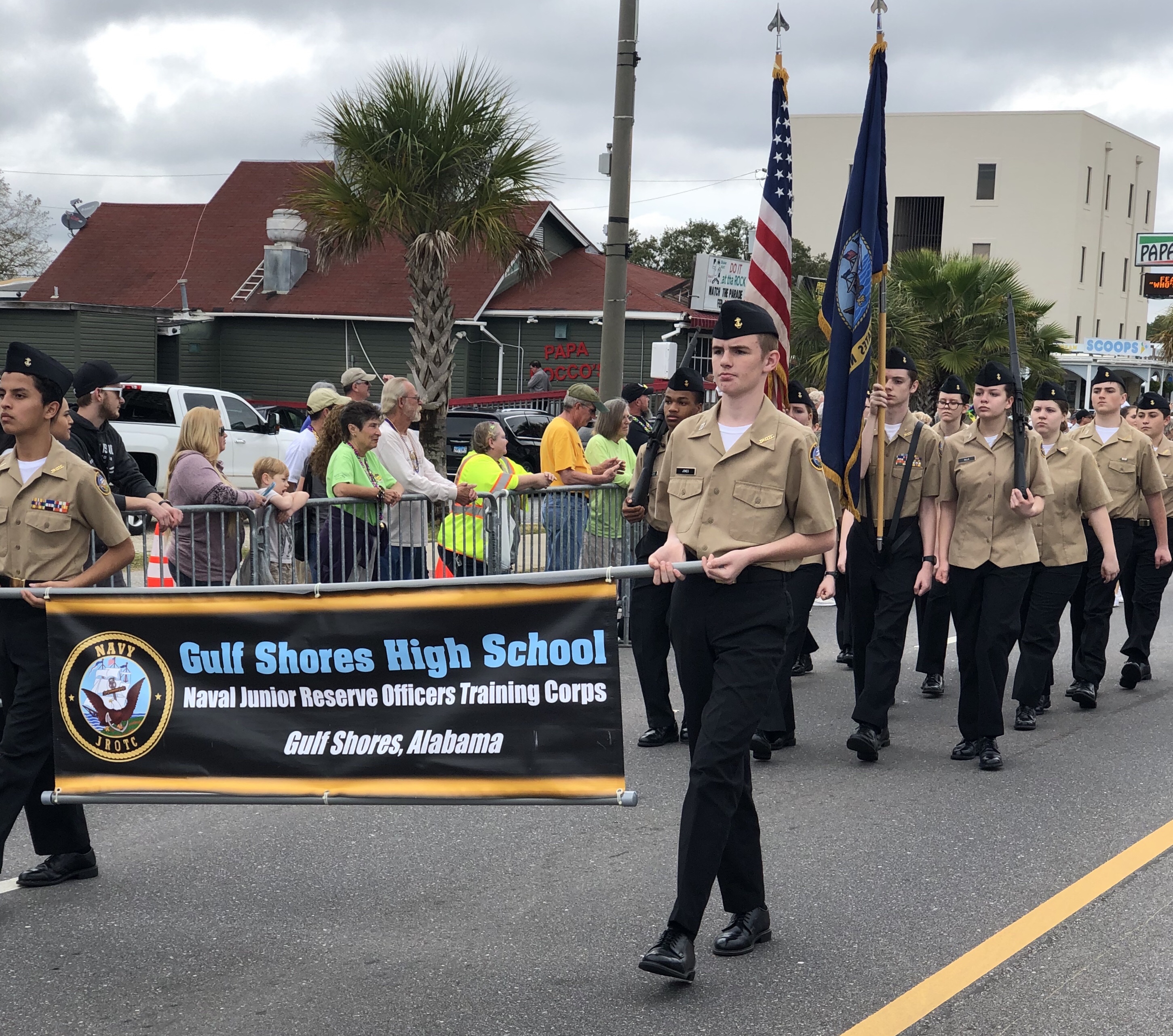
The police cars went by first to make sure everyone was behind the barriers followed by the Gulf Shores HS Naval Jr ROTC.

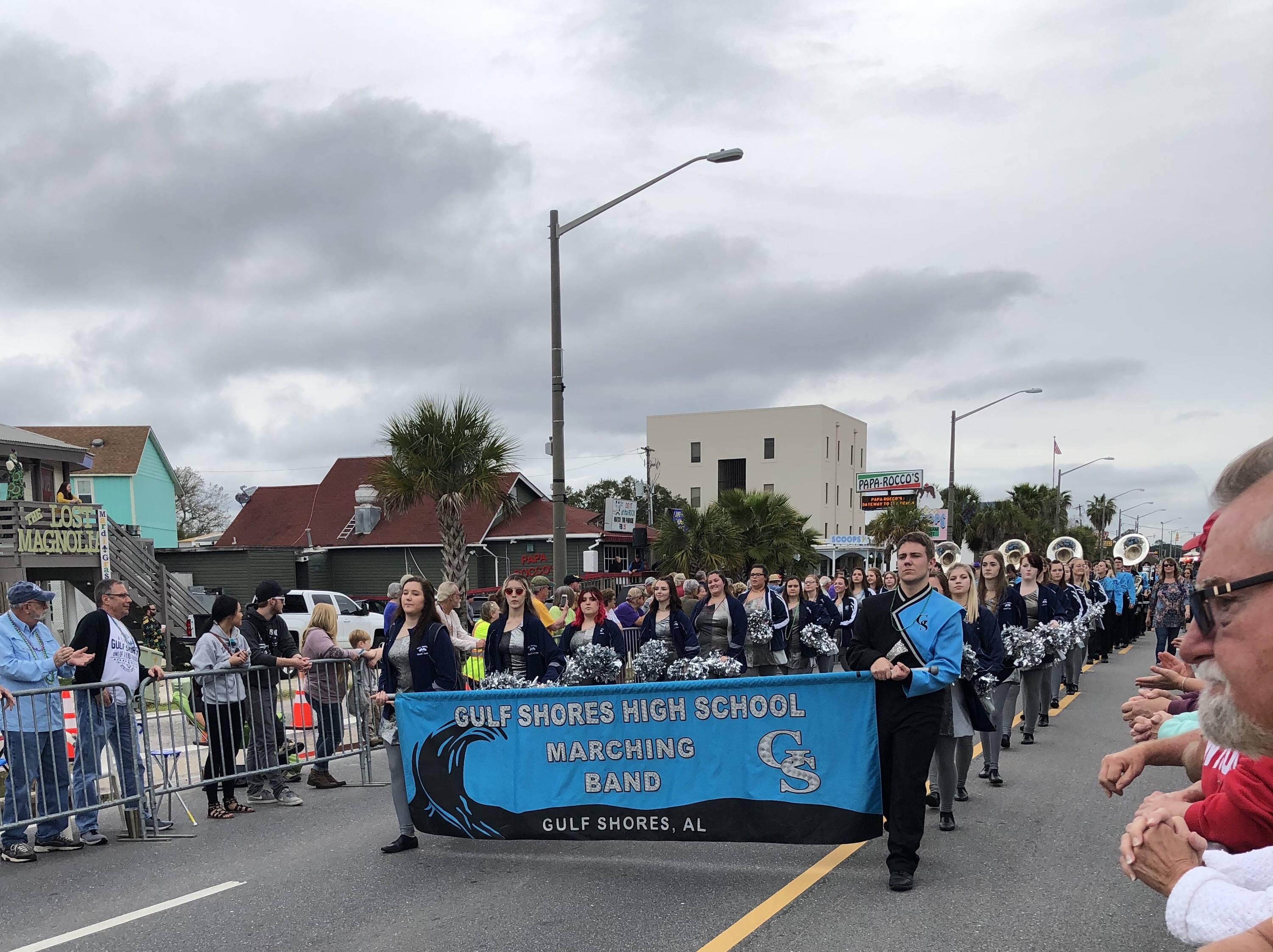
And of course a rousing marching band.

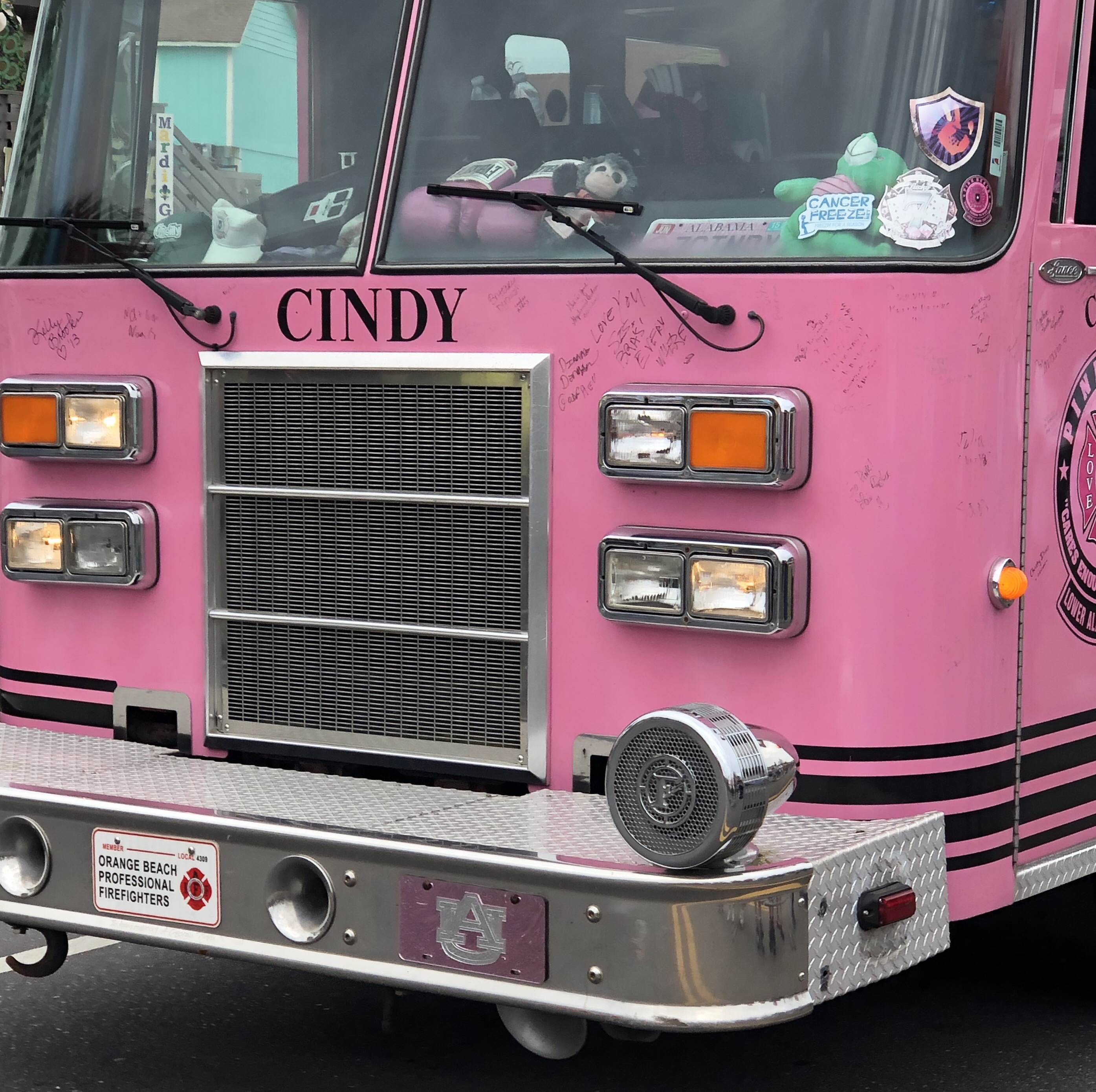
And Cindy the Pink Fire Truck.

And very colorful characters and more fire trucks.

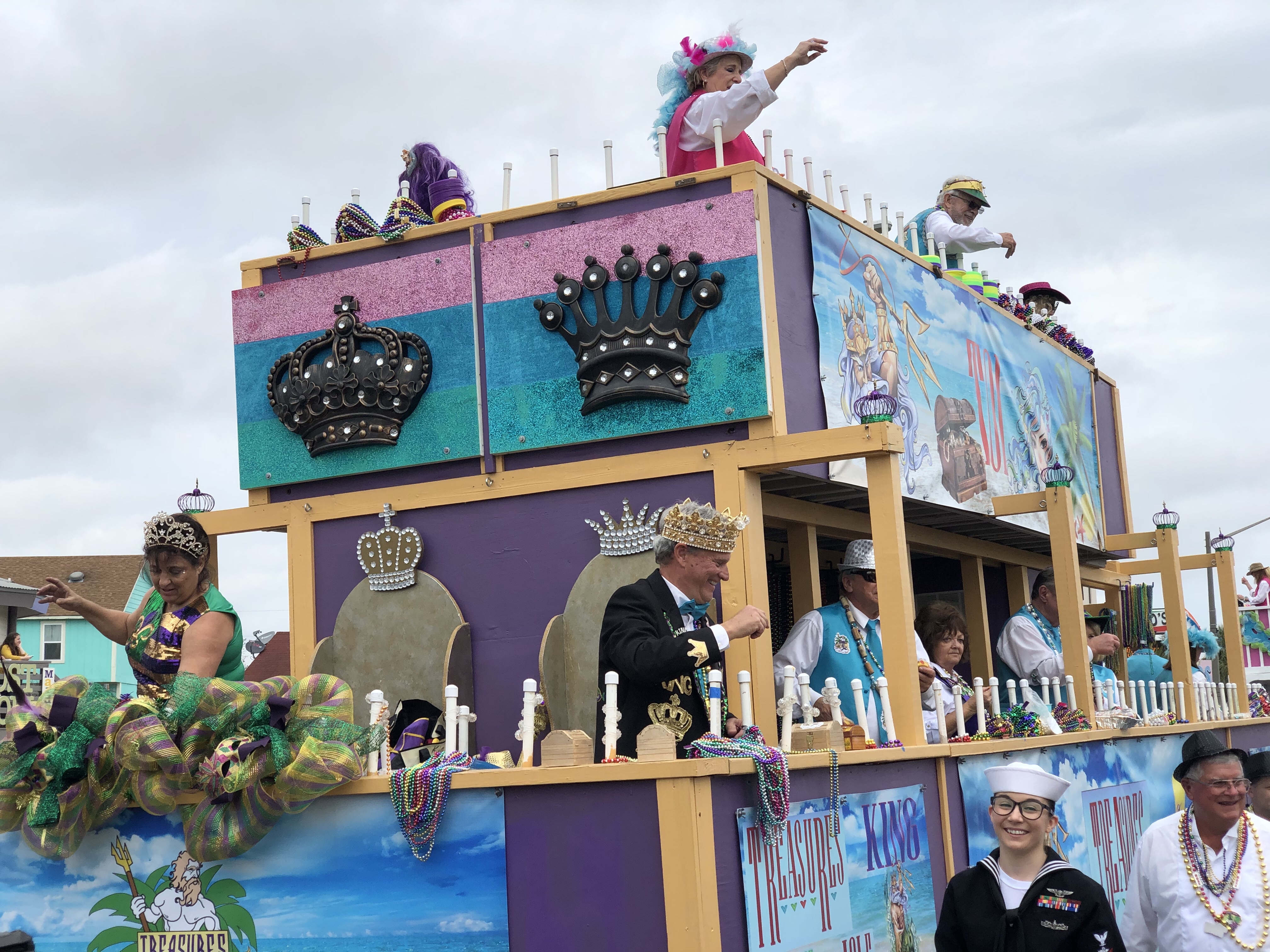
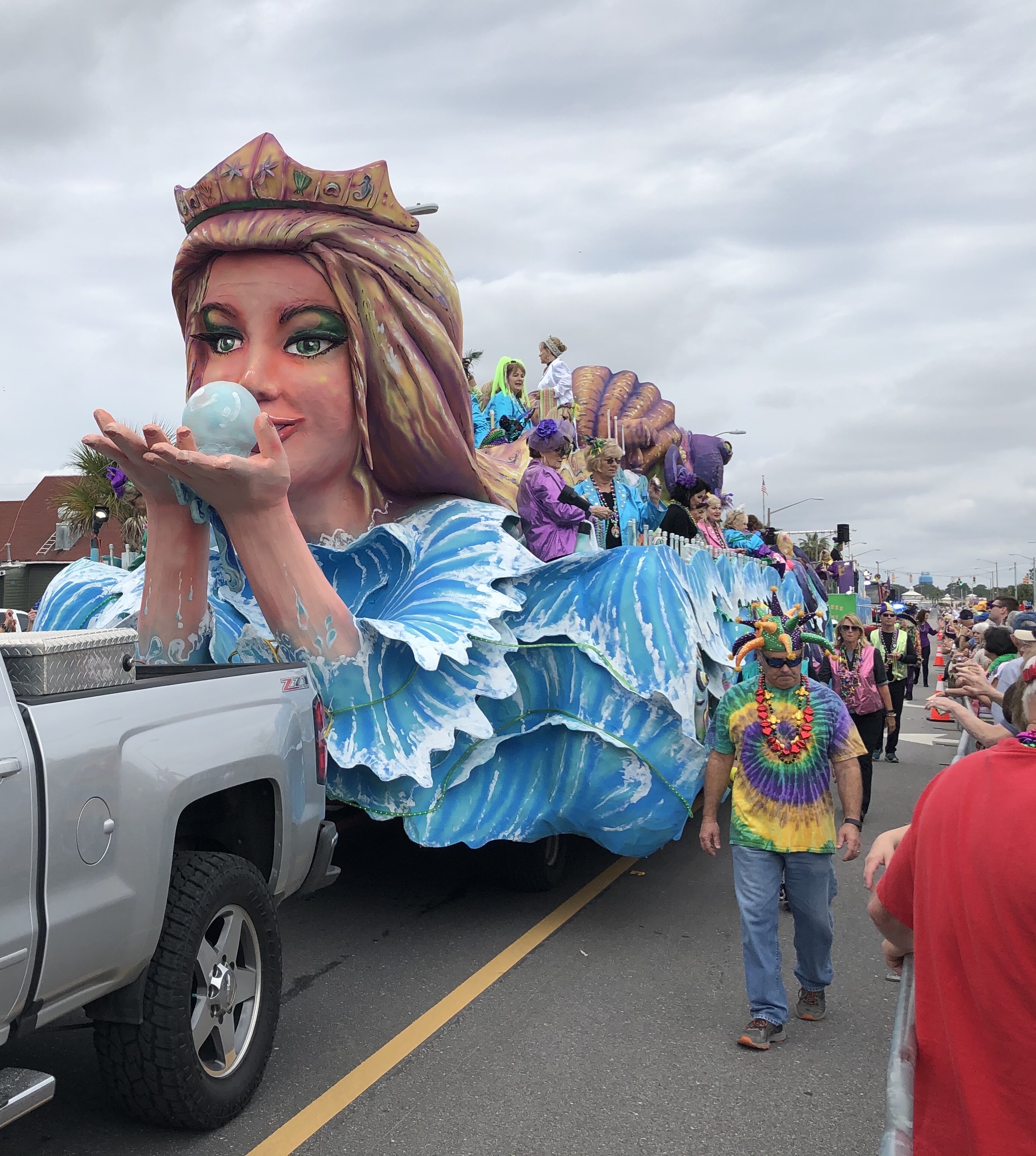
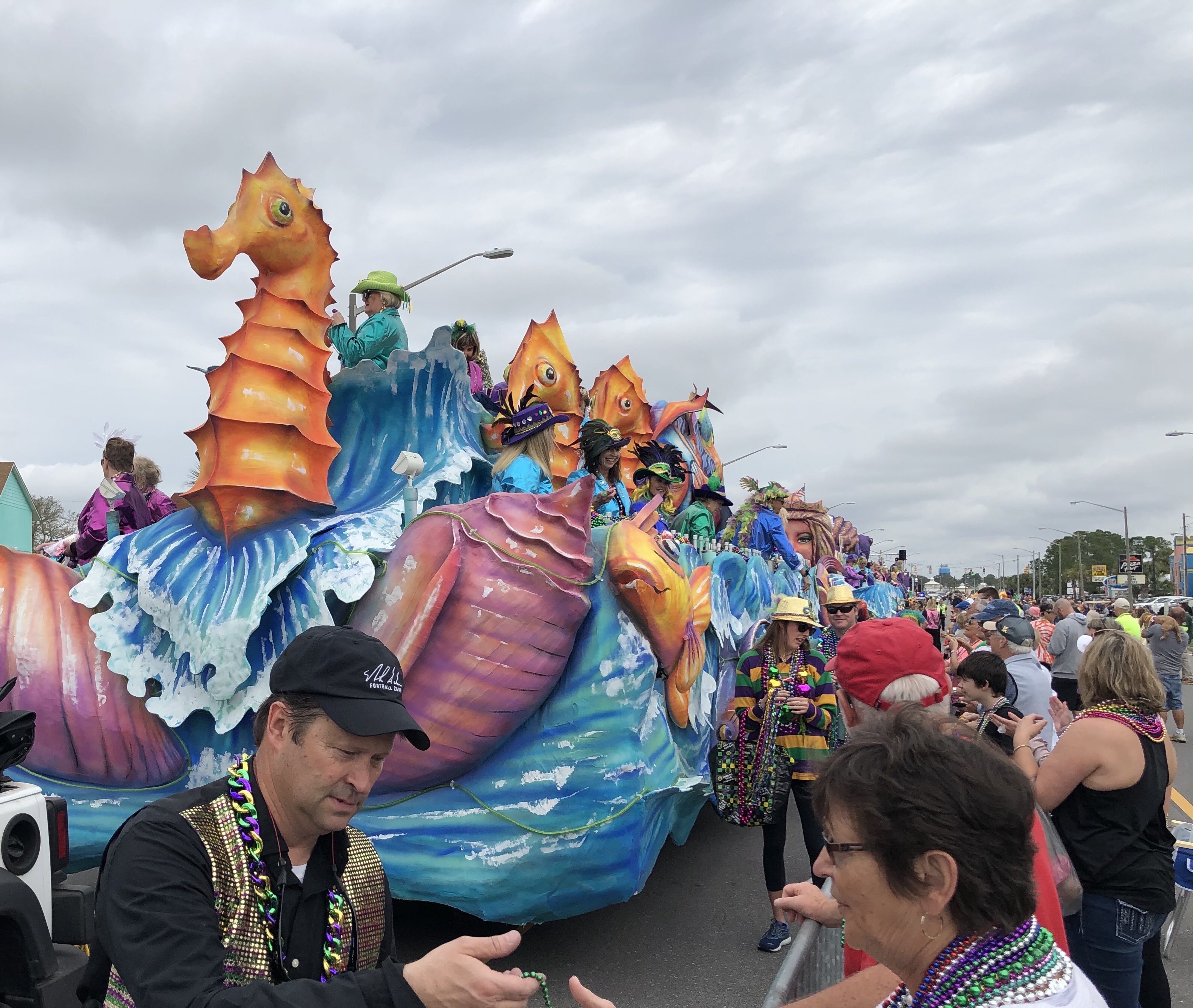
And floats of every description, some two stories tall so that there was room for more throwers.

And hats too.

Susan was ready for bling.

Between the two of us we got quite a bit. It seemed that if you made eye contact with a thrower you were quite likely to get some trinkets. We got a rubber duck, a plastic cup, maybe a dozen moon pies and maybe 50 strands of shiny beads.

Most of the beads went into a plastic bag to bring home. They had a distinct plastic smell. The duck is on the dash of the Jeep.

The moon pies … well there are many forms of soggy cookies making a sandwich with marshmallow filling in a variety of packaging. Some have a powdered sugar coating, most something else undefined. They may be a treat somewhere but one bite and the rest went into the trash.

All in all it was great fun. After the parade there was a tremendous traffic jam that added about 10 minutes to our trip back to the campground. Kind of nice being in a smaller town for all of this.

A few weeks later we were in New Orleans where they had 53 Mardi Gras parades during the “season”.

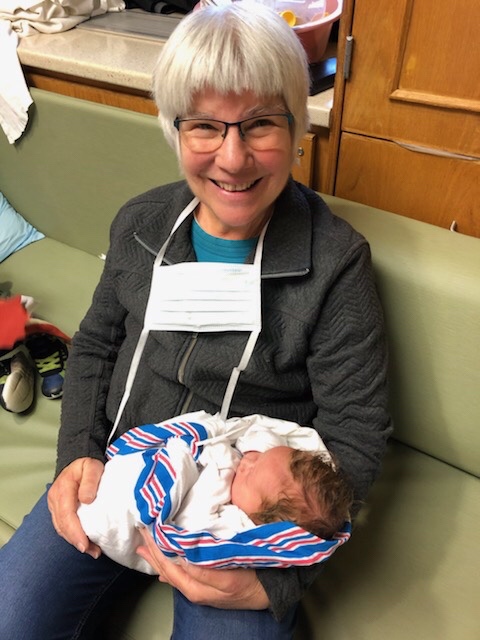
And at the same time our friends Ted and Karen became grandparents.

We are very happy for them.

More Later, Much Love,

Roger and Susan

Boom Boom Boom Boom! Mobile, Alabama. February, 2020

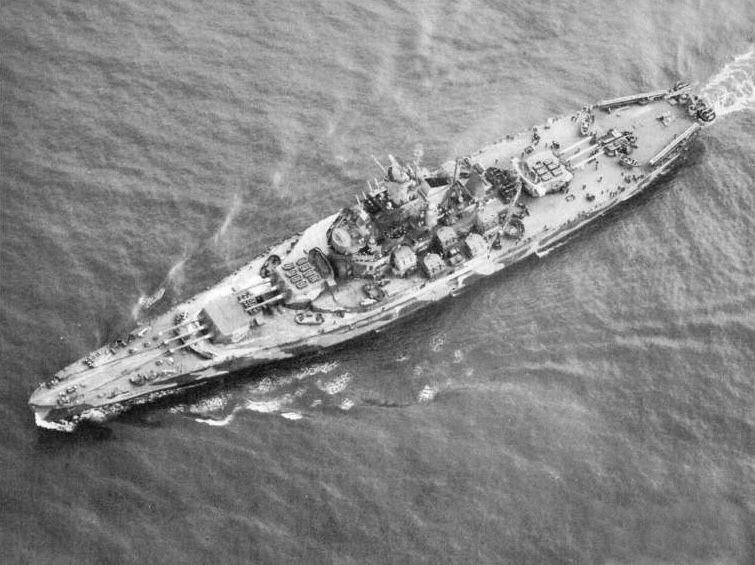
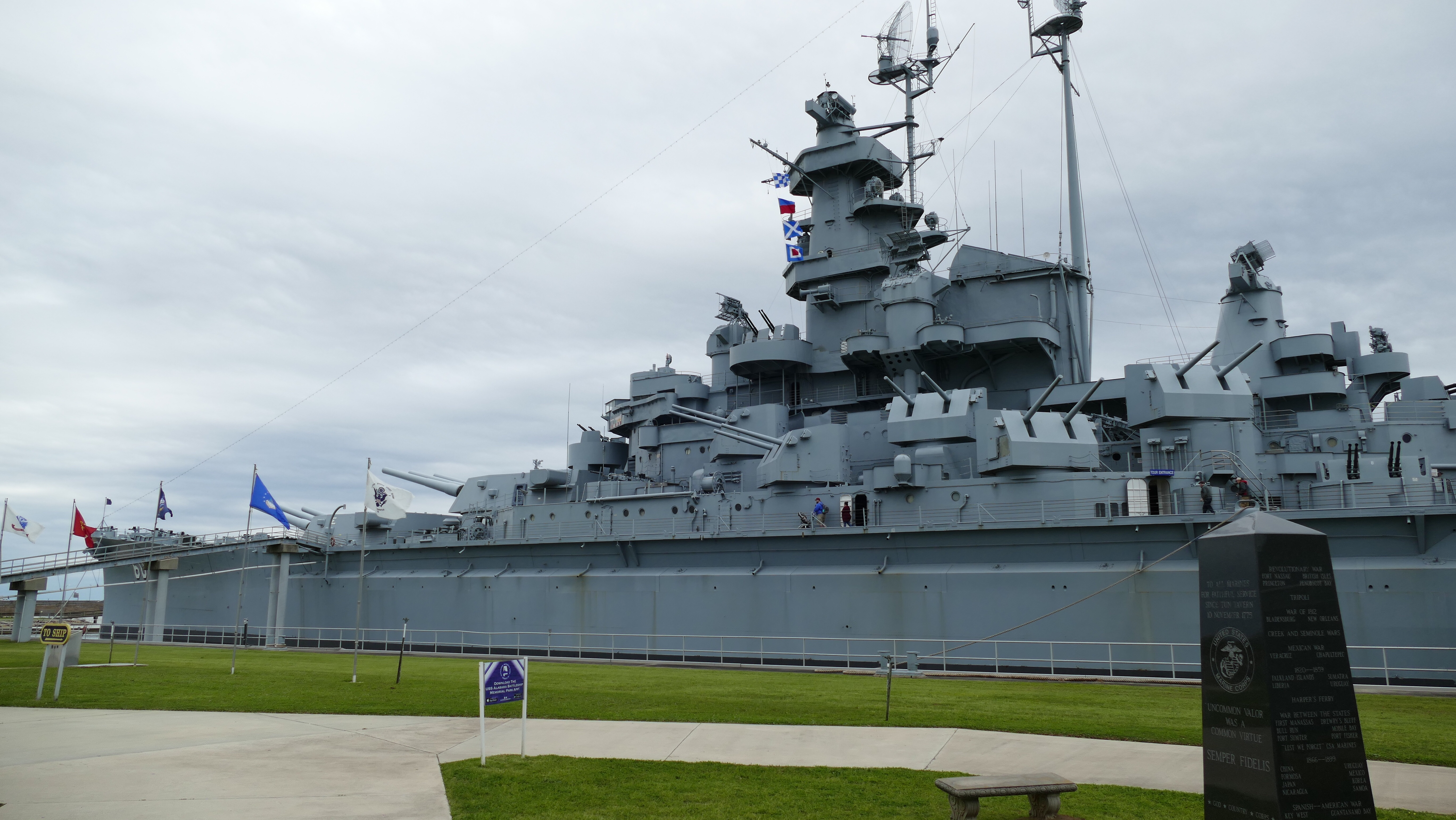
The Battleship USS Alabama, (BB-60) was one of four 1930s South Dakota class battleships. They were shorter than later battle ships to comply with existing treaties regarding displacement but were equipped with three main turrets with three 16″ guns each. The smaller ships with larger crews were crowded.

The Alabama construction was begun in 1940, launched in early 1942, commissioned in late 1942 and served in the Atlantic protecting convoys to the Soviet Union until it was sent to the Pacific in 1943 where it was primarily used in aircraft carrier task force support but also participated in several of the major battles in the Pacific.

It was decommissioned in 1947 to the Pacific Reserve Fleet until 1962 when she was stricken from the Navel Register.

In 1964 it became a Museum ship at Battleship Memorial Park in Mobile Bay. The Memorial Park also has a collection of aircraft, tanks and the SS-Drum, a submarine from the WWII era.

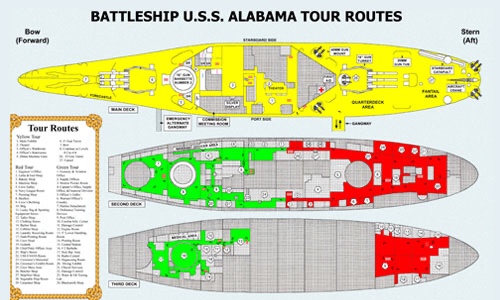
There are three tour routes through the battleship. One goes way down deep where the boilers and steam turbines drive four huge propellors with more than 130,000 HP at speeds up to 27.5 knots (33 mph). That is pretty fast for a ship that weights more than 46,000 tons. Lots of ladders up and down.

The deep down tour took you to where the ammunition was stored and the bottom of elevators that carried powder bags and shells up to the 16″ guns and to the 5″ guns.

There were also the fire control stations where there were giant gyroscopes that provided a stable platform for the mostly mechanical computers that churned out the when and where to fire the big guns to shoot and hit something 20 miles away while both the Alabama and the target were moving forward and up and down and side to side in the open sea.

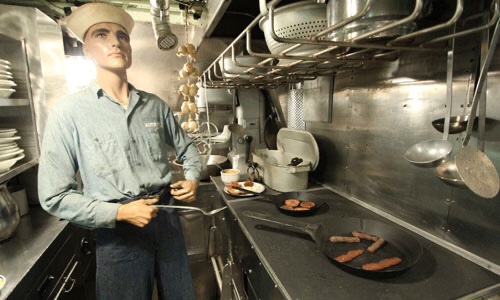
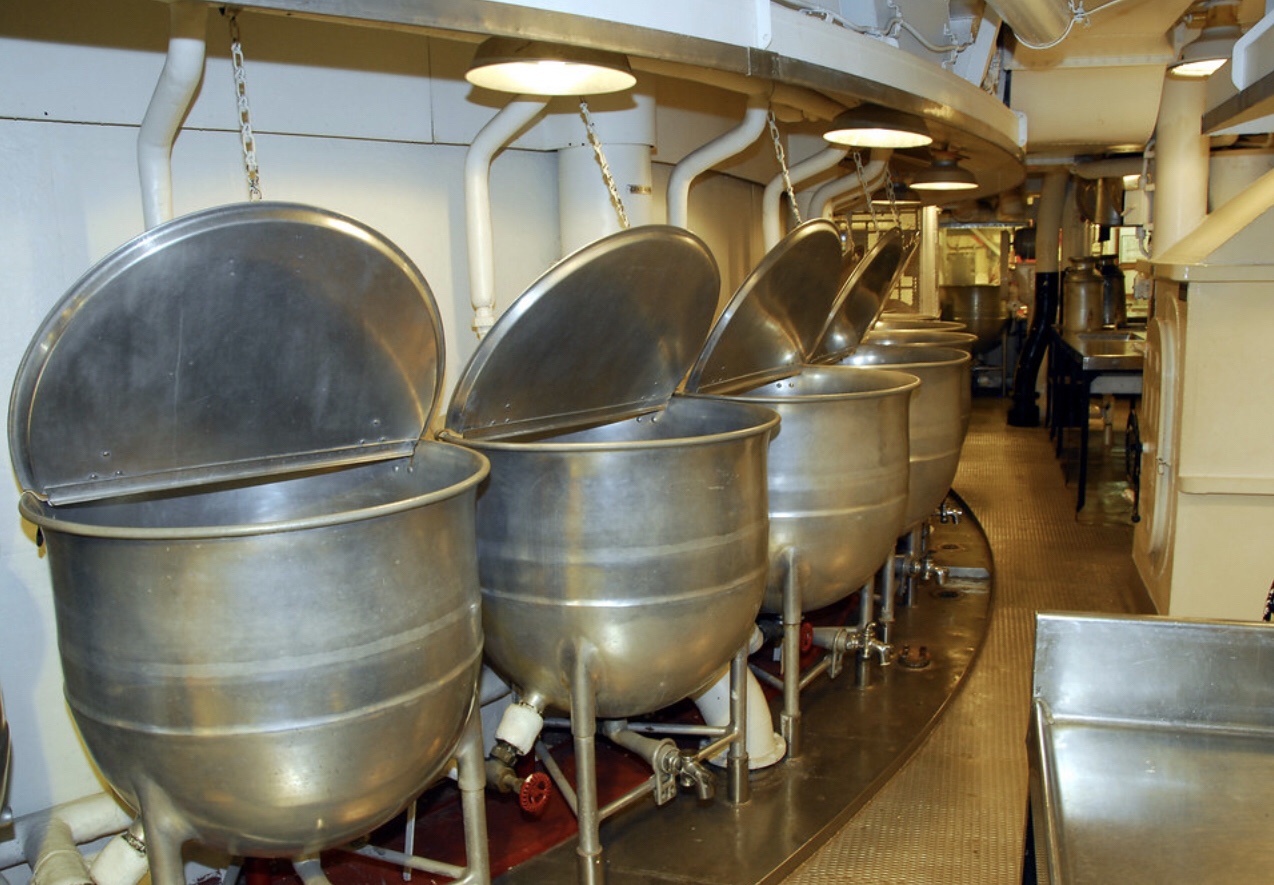
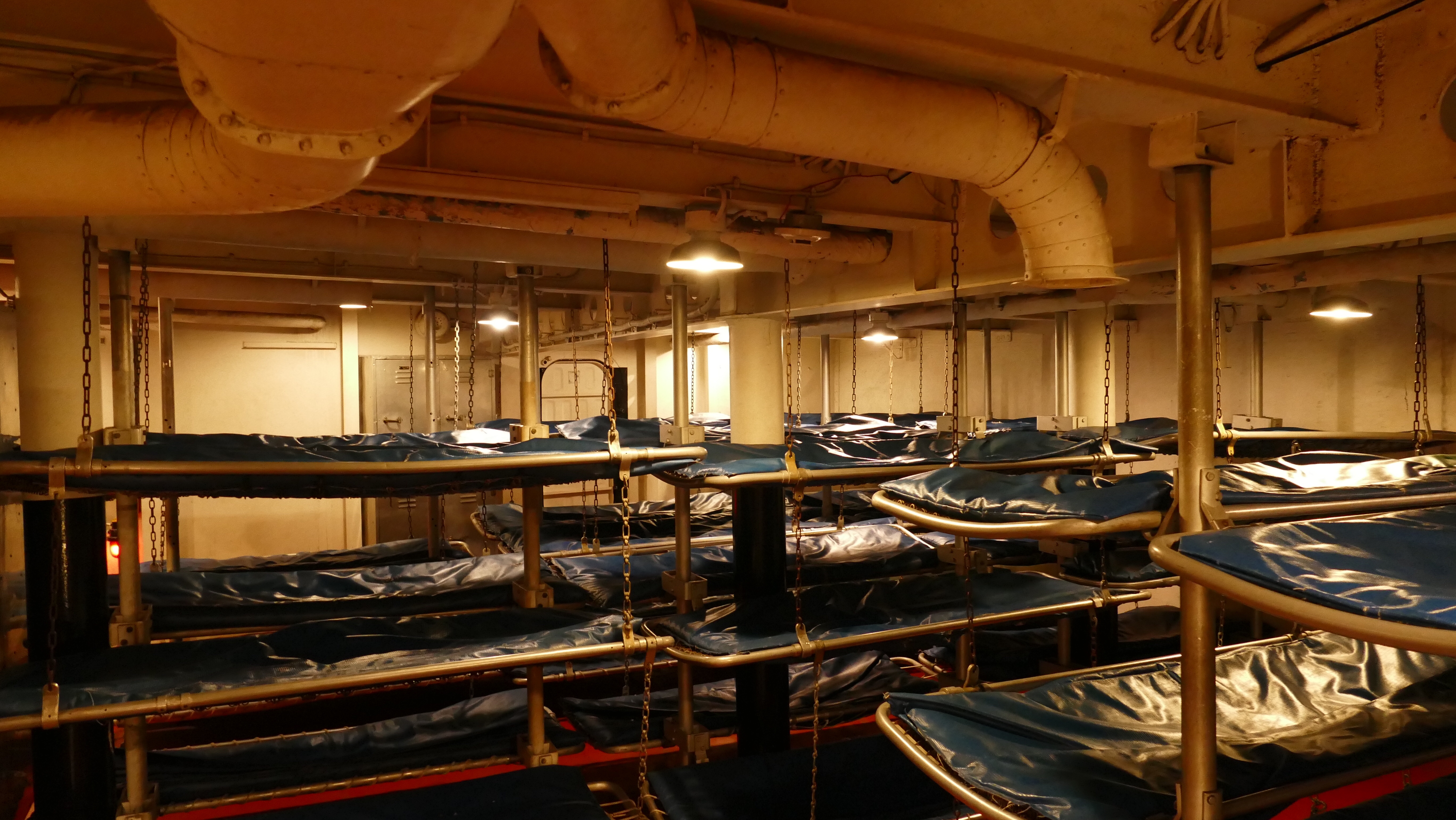
Another route leads more through the middle of the ship where most of the crew quarters and all of the support services were. These included berthing areas, messing areas, machine shops, damage control, sick bay, ships store, the barber shop and everything else the 2,500 officers and crew needed.

Lots of big cooking stuff for 2500 eaters.

There were three distinct classes on the ship, enlisted men, non-commissioned officers and Officers. They all had their own service staff, dining areas, ward rooms and quarters. It looked like it would have not been much fun being an ordinary seaman. Some had real berths. Most slept in hammocks hung from hooks when in use and stowed away at other times.

The last route was up many levels from the main deck of the ship to the upper levels where the bridge and combat control center are and levels above that for lookouts.

The battle bridge section where the Captain would have been during combat was enclosed in 16″ thick armor. The door looked like a small but thick bank vault door. All of the movies I remember seeing never looked like that.

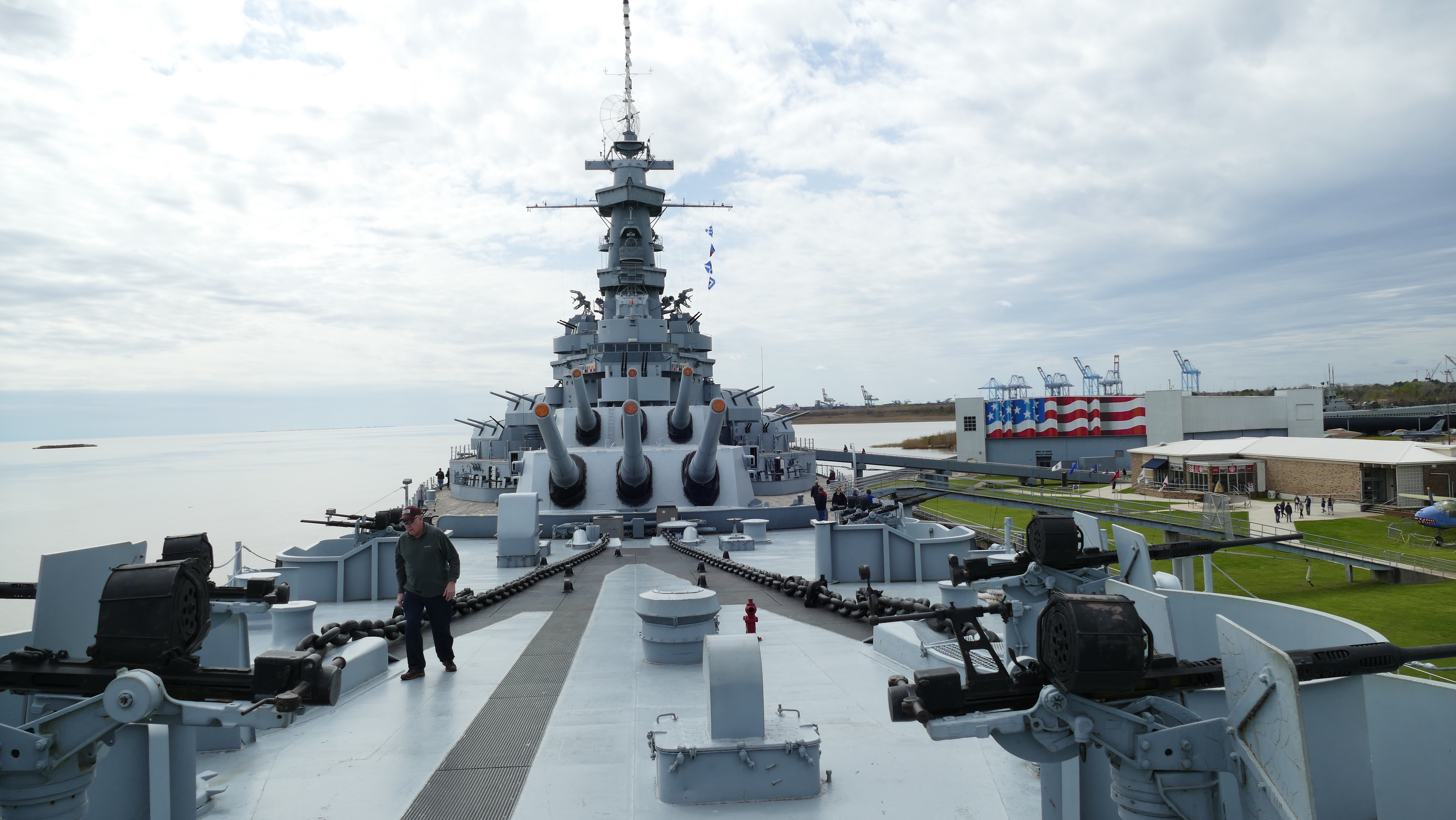
From the very point of the bow it looks narrow and menacing. When we drove up to the Memorial Park we though it looked smaller than we expected. But it was not.

The three main gun turrets with three 16″ guns each were immense and the structure under what you can see went all the way to the bottom of the ship. All of the powder bags and shells were stored inside the heavily armored core of the gun turret tower. It appeared that the entire turret tower rotated as the guns turned to aim.

The front armor face of the turrets had 18″ thick armor. I found it interesting that these giant plates were jointed together with joints that looked like woodworking joints for strength.

It was a very big ship. It still would have been a terrifying place to be in a sea battle.

There was a lunch place on site where we had a quick lunch before moving to the hanger building and the USS Drum submarine exhibit.

Lots of familiar airplanes in the hanger.

And right next door, well outside, was the USS Drum (SS-228). 311 ft long, 27 ft wide, 13,000 mile range, 83 officers and crew. All on 13 75 day patrols during the 4 1/2 years it was in service from 1941 to 1946.

The tour started near aft end, down into the sub and moved forward. Susan waited outside.

We toured a submarine in San Francisco. There were alot of people on that tour and the sub really felt crowded, probably like it would have been in actual service.

The USS Drum was empty except for me and a couple volunteer folks doing some restoration work, a never ending job.

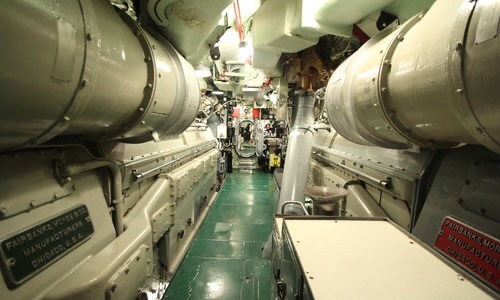
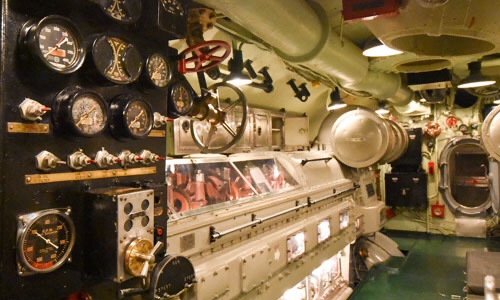
The sub had four huge Fairbanks Morse diesel engines that powered generators to charge batteries and drive electric motors to turn the propellors. The forward and aft engine rooms were the biggest spaces in the sub.

Almost as big were the forward and aft torpedo rooms. There were 10 total loaded torpedo tubes and 14 spare torpedos for reloads. 24 total.

Every other space for every function was small and crowded, most had multiple functions. Knobs, dials, pipes, valves were everywhere. Lots of training for the crew to know what everything does.

We have a young friend in the US Navy Submarine service today. He said the submarine school was the hardest school he ever went to. He said one of the hard parts was that everyone needed to know how to do almost every job.

I crawled out of the small sub space back into the sun. We had enough of climbing up and down ladders in tight spaces. Coming back would be worth it for a closer look. Maybe next time.

More Later, Much Love,

Roger and Susan

Bellingrath Gardens and Home, Theodore, Alabama, February 2020.

We look for places like the Bellingrath Gardens and Home to visit. The 65 acres of the Bellingrath Gardens was a very pleasant place to visit on a day that was cool but sunny. We also toured the Bellingrath Home.

Where does something like these gardens and a fine home come from? Well money helps and Walter Bellingrath did pretty well as one of the first distributors for Coca Cola when it was available in soda fountains and then as a major bottler of Coke when it became available in bottles. He and his wife Bessie lived in Mobile and bought a former fish camp south of Mobile on the western side of Mobile Bay and began to develop a summer home. Bessie brought a taste for elegance both in the new home and in the garden spaces. Walter was a bit of a scrounger.

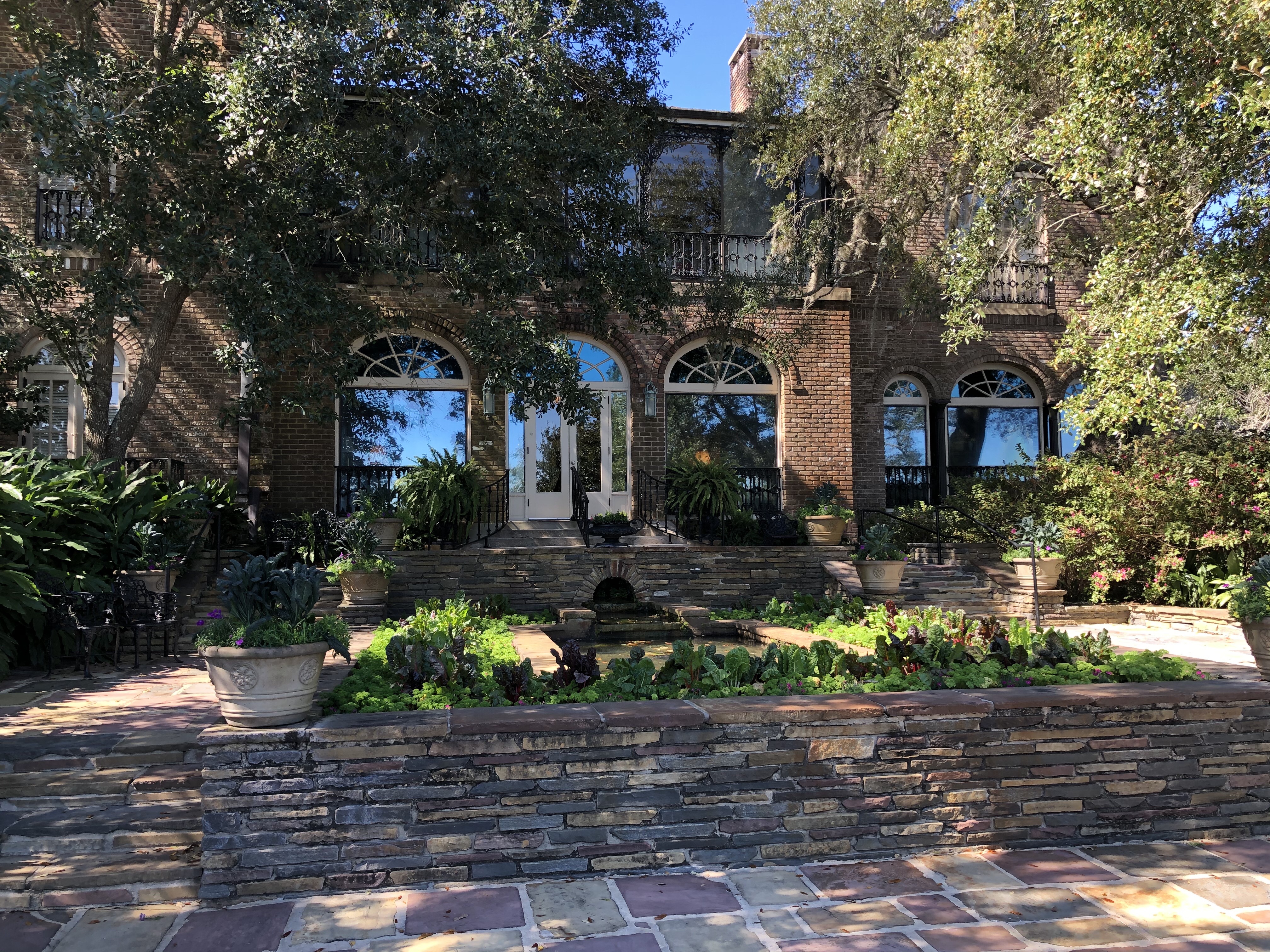
The 15 room, 10,500 sq ft Bellingrath Home was built in 1936 with bricks salvaged from an 1852 home of Alva Smith Vanderbilt Belmont. The extensive ironwork railings came from the Souther Hotel in Mobile which was being torn down at the time. The flagstone walkways, courtyard and terraces came from sidewalks in Mobile that were made from cast off ship ballast that came from England during the height of the cotton trade. Mr Bellingrath wanted the stone, Memphis wanted paved sidewalks so a swap was arranged. Much of the structure is concrete for durability in the Southern climate. Bellingrath also owned a decorative concrete tile company so his tiles were used in many areas of the home.

They wanted the most modern home possible so they installed electric fixtures and wiring in anticipation of electricity someday coming to the remote area and a large generator to supply power until 1940.

Ultra modern bathrooms (at least for 1935) were installed. The pale green, peach and cream colors look more like something from the 50’s.

The kitchen had German silver countertops, electric and gas stoves and ovens and electric refrigerators and freezers. It reminded us of the kitchen at the LBJ Ranch House we visited a couple years ago but there was no beer on tap.

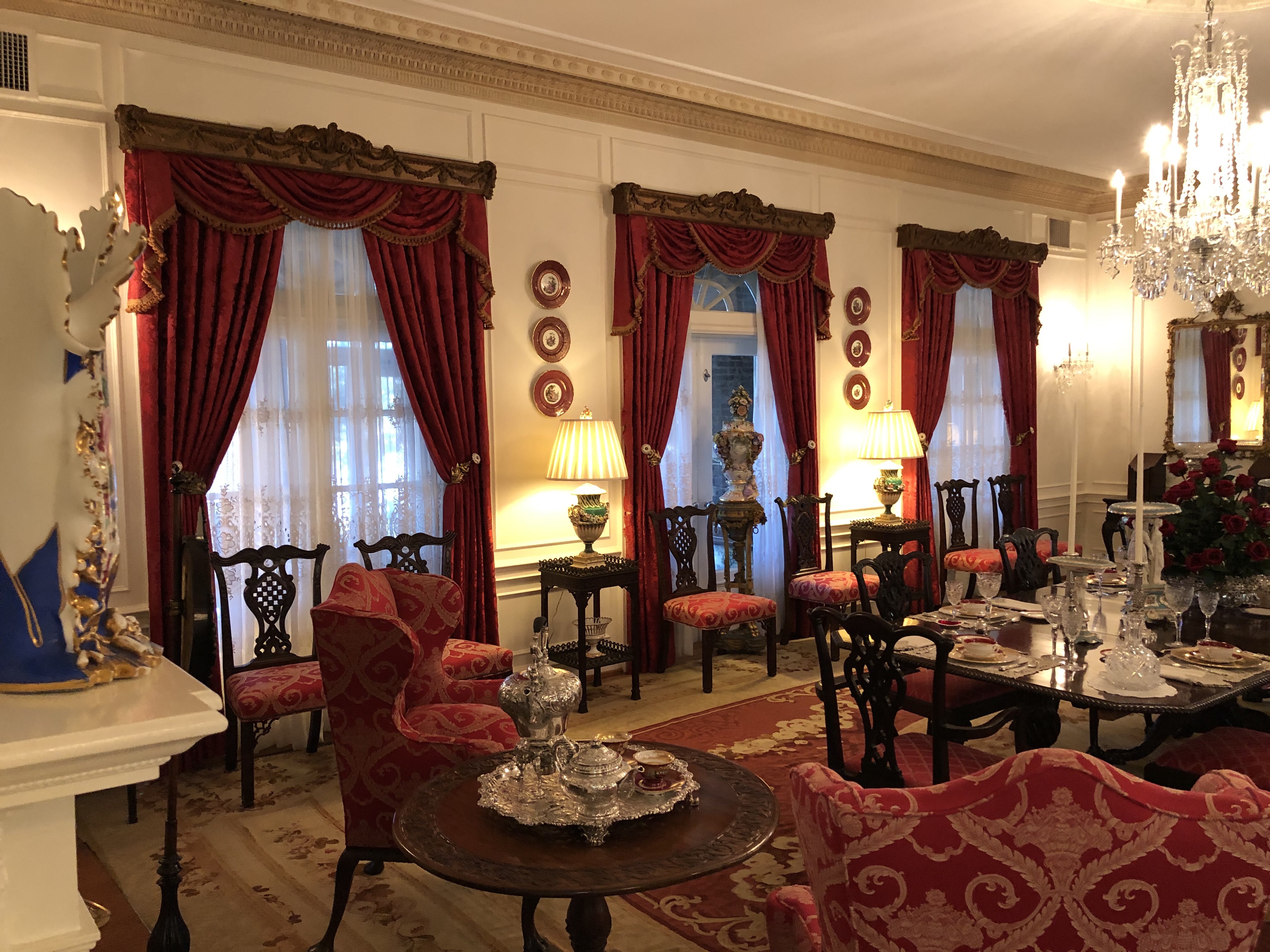
Today the home is just as it was when the Bellingraths lived there. They were the only people to have ever lived there. All of the furnishings are original. Bessie was a scrounger in her own right and shopped at the “garage” sales of the day and managed to find sets of silver for her butlers pantry, dishes from all over the world and a very nice Tiffany Lamp for just dollars at the time. Today it is worth tens of thousands of dollars.

The front door.

The Formal Dining Room

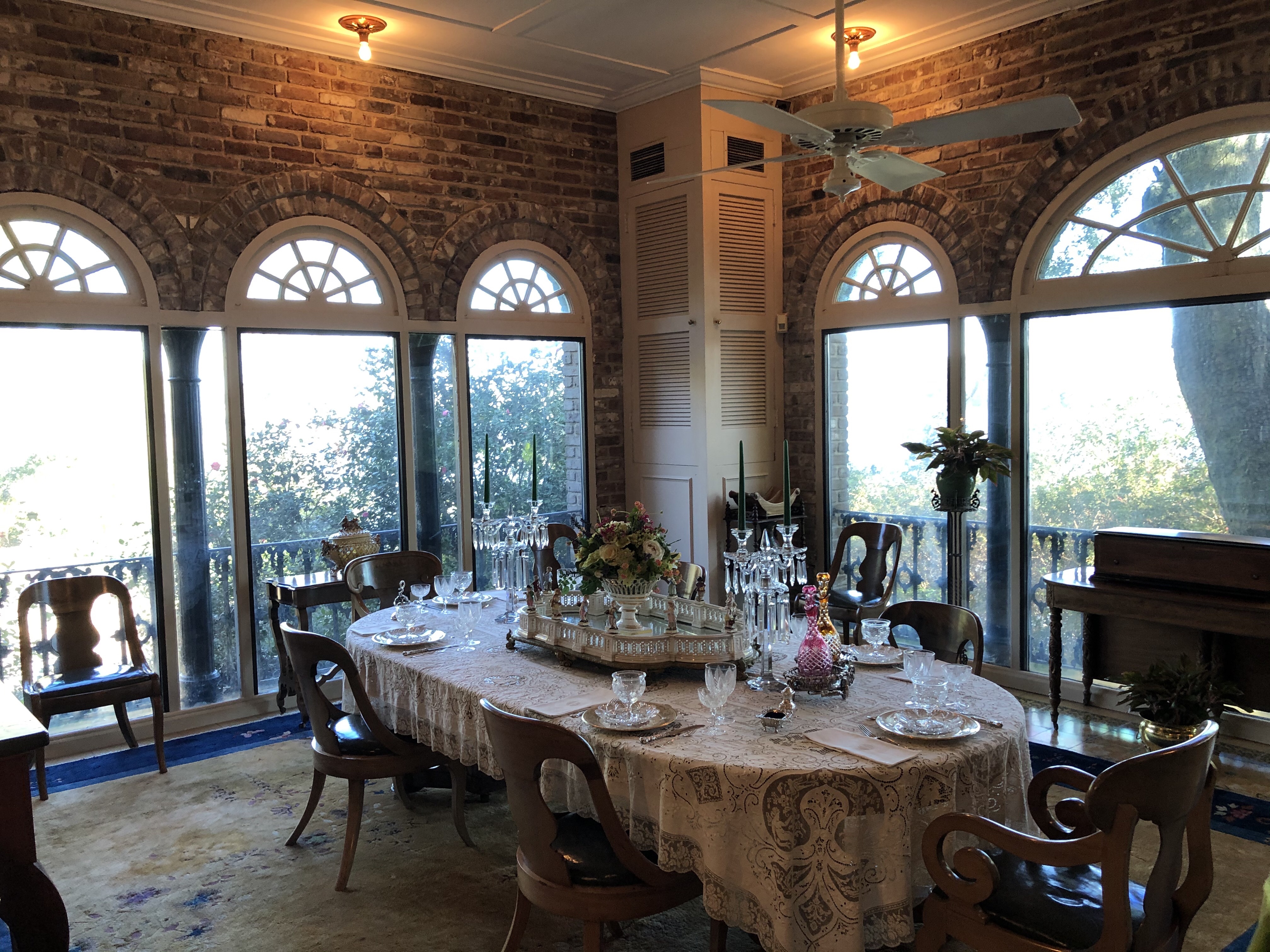
The Casual Dining Room. There was a third dining room as well.

Your basic Bed Rooms

And Kitchen

The Butler’s Pantry

In 1932, before the house was built, the Bellingraths opened their gardens to the public for a Sunday afternoon to see the spring flowers. More than 4,700 people showed up creating huge traffic jams. By 1934 the gardens were open to the public year round.

Bessie passed away in 1943. In 1949 at age 80 Walter Bellingrath announced the formation of a foundation to oversee the home and gardens. Walter died in 1955 and the home was opened to the public in 1956.

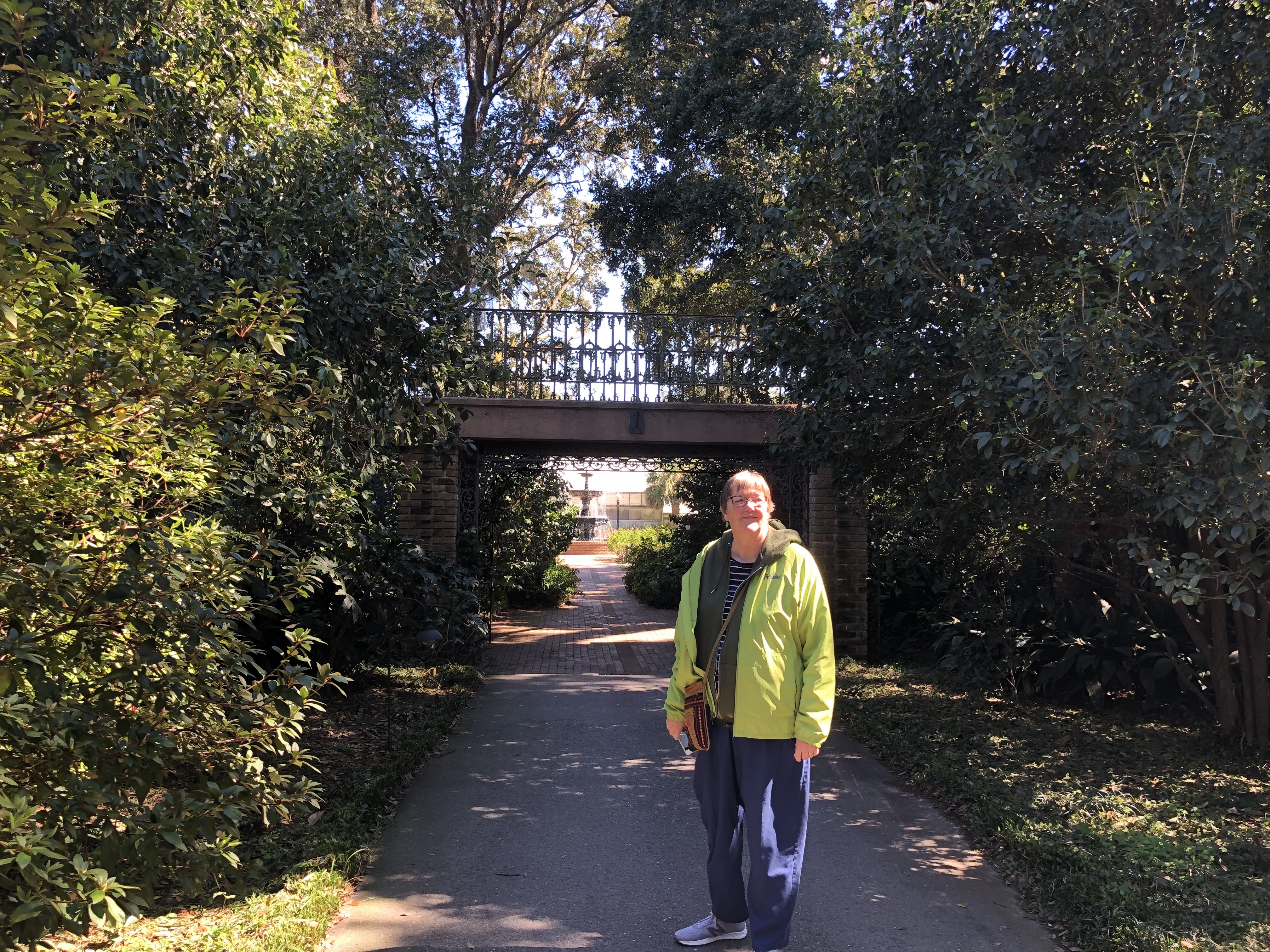
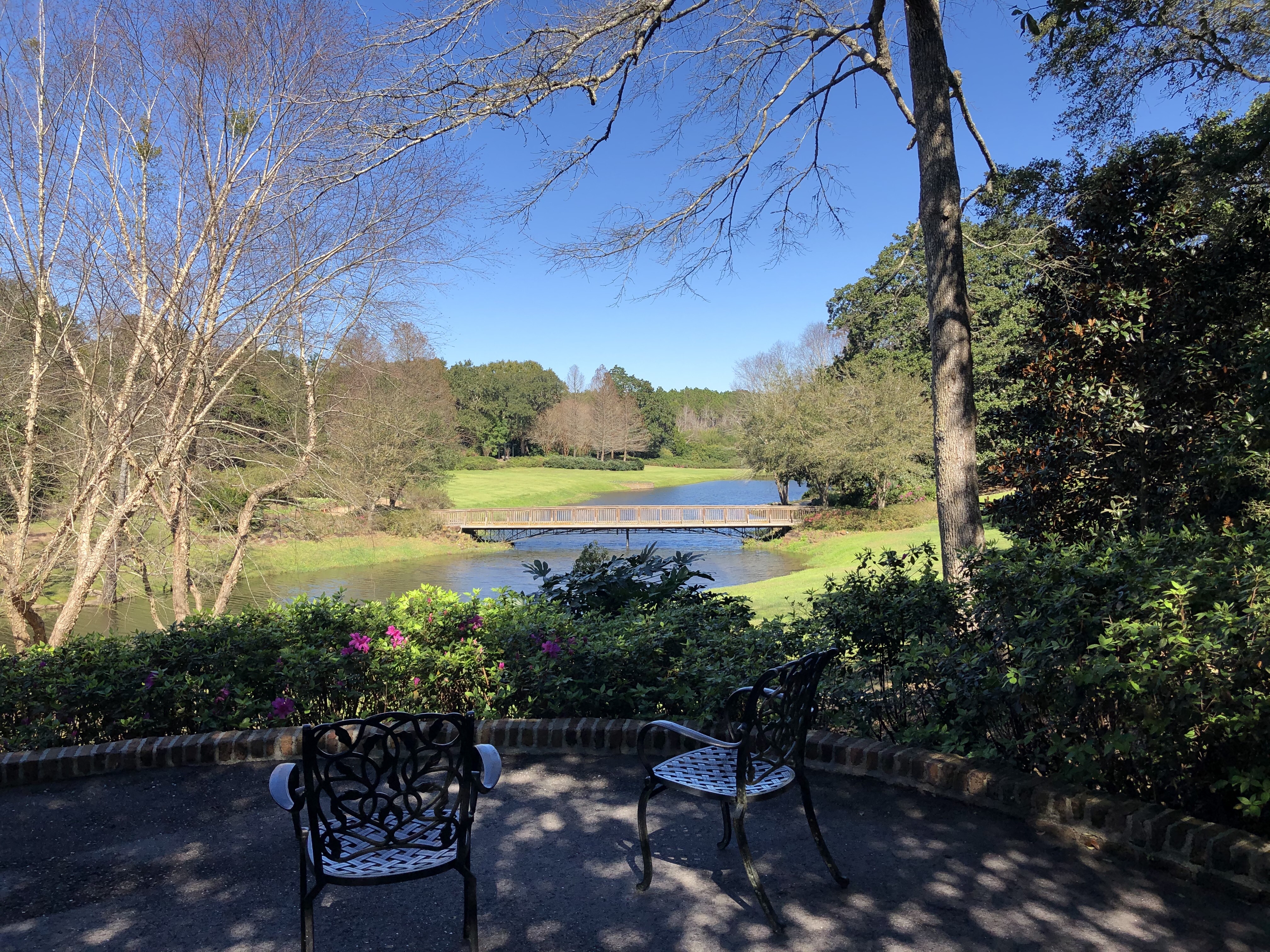
The Bellingrath Gardens are a beautiful mix of open spaces, small focus areas, ponds, quiet sitting places and intertwining paths. They lead past a green house and a hot house through the Rose Gardens, past the Asian Gardens, along side the Great Lawn and the Live Oak Plaza up to the house and down to the River Pavillion. We were about two weeks ahead of full bloom and still they were wonderful.

The Rose Gardens past the bridge.

A quiet spot overlooking Mirror Lake.

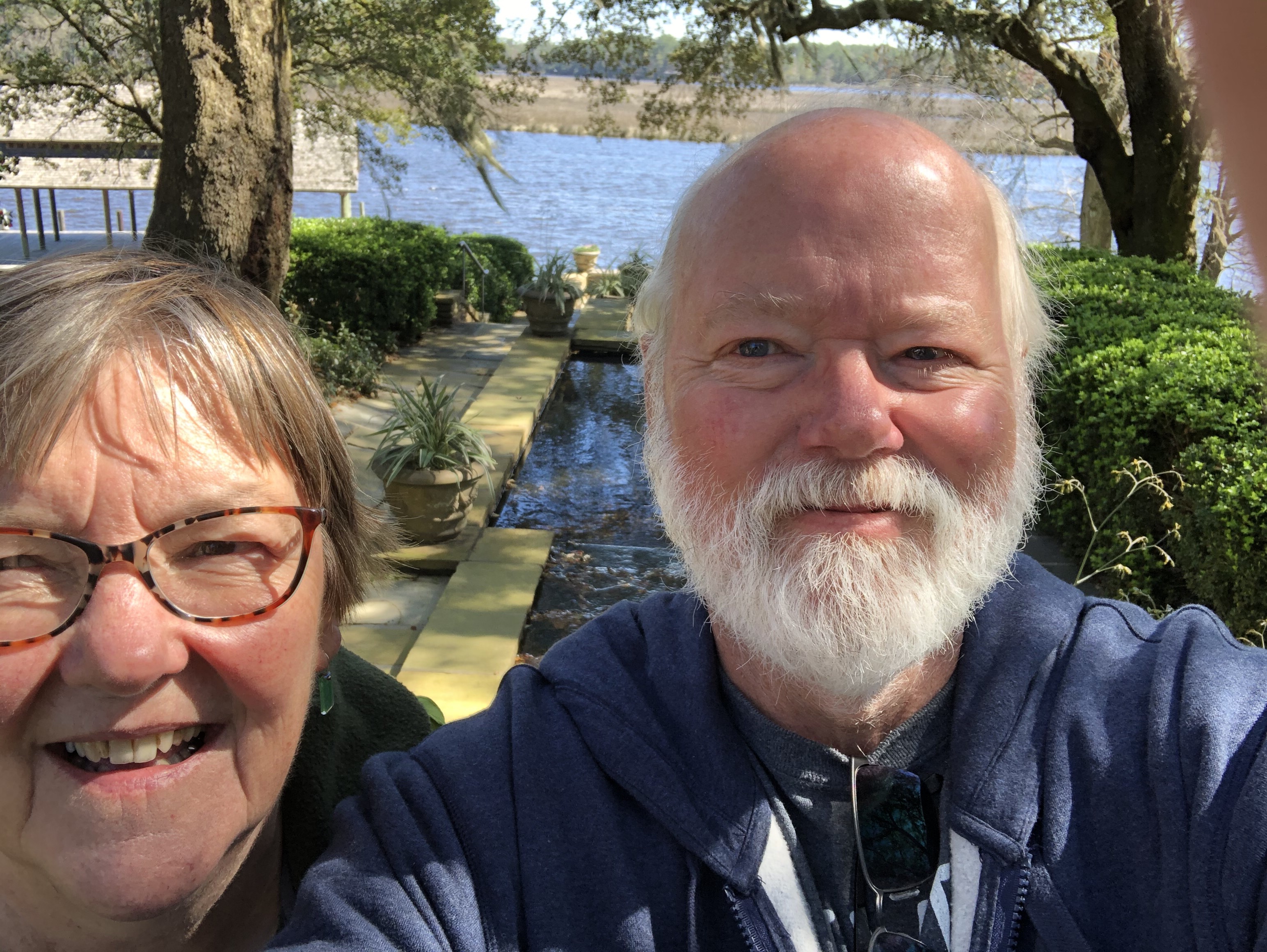
Looking down toward the Fowl River.

A terrace and a river side pavilion and boat landing.

We had a nice lunch there as well and as is almost always the case there is a Gift Shop. I found some nice cards and we both spotted something that we would normally never get but it was just so perfect.

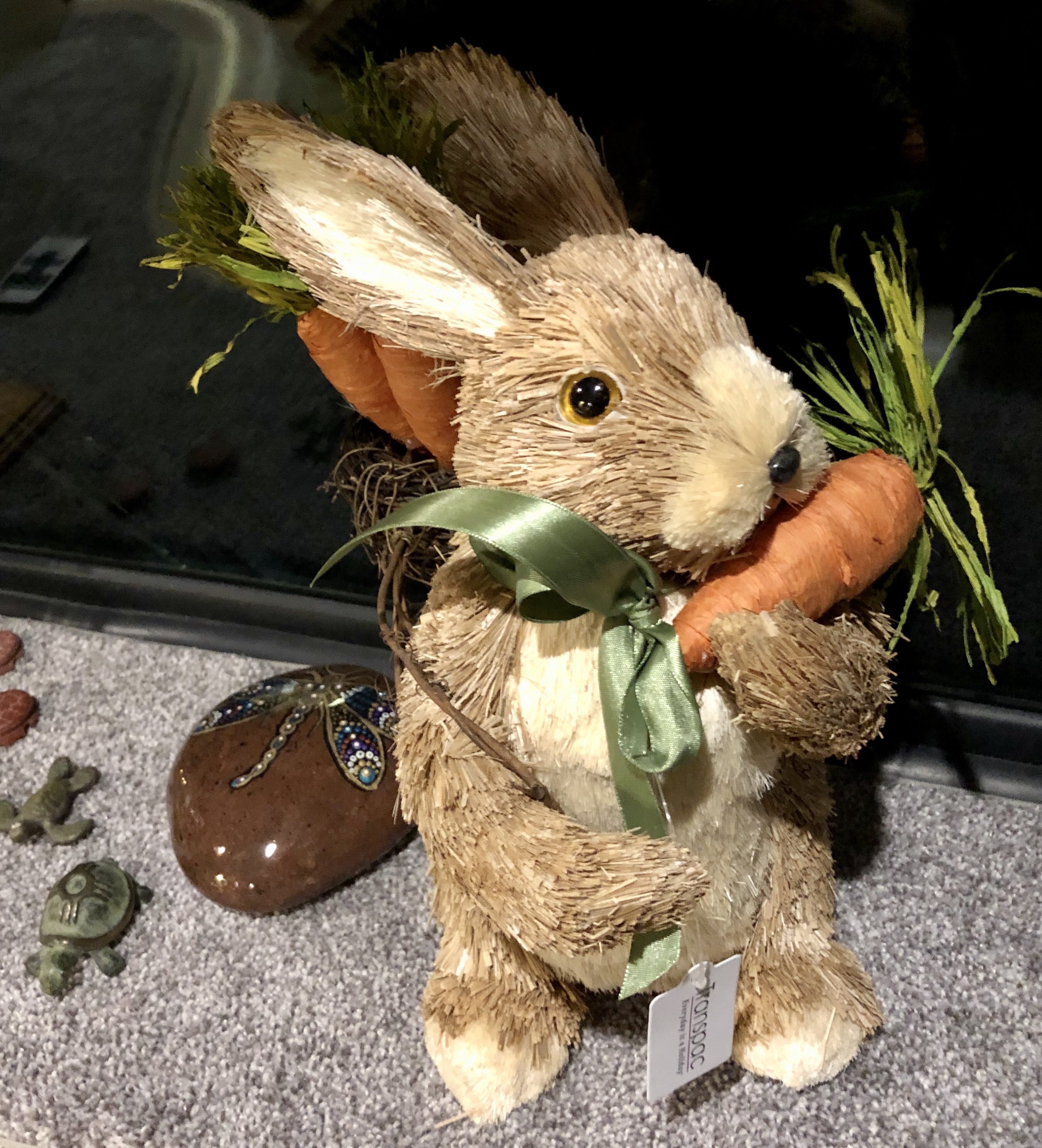
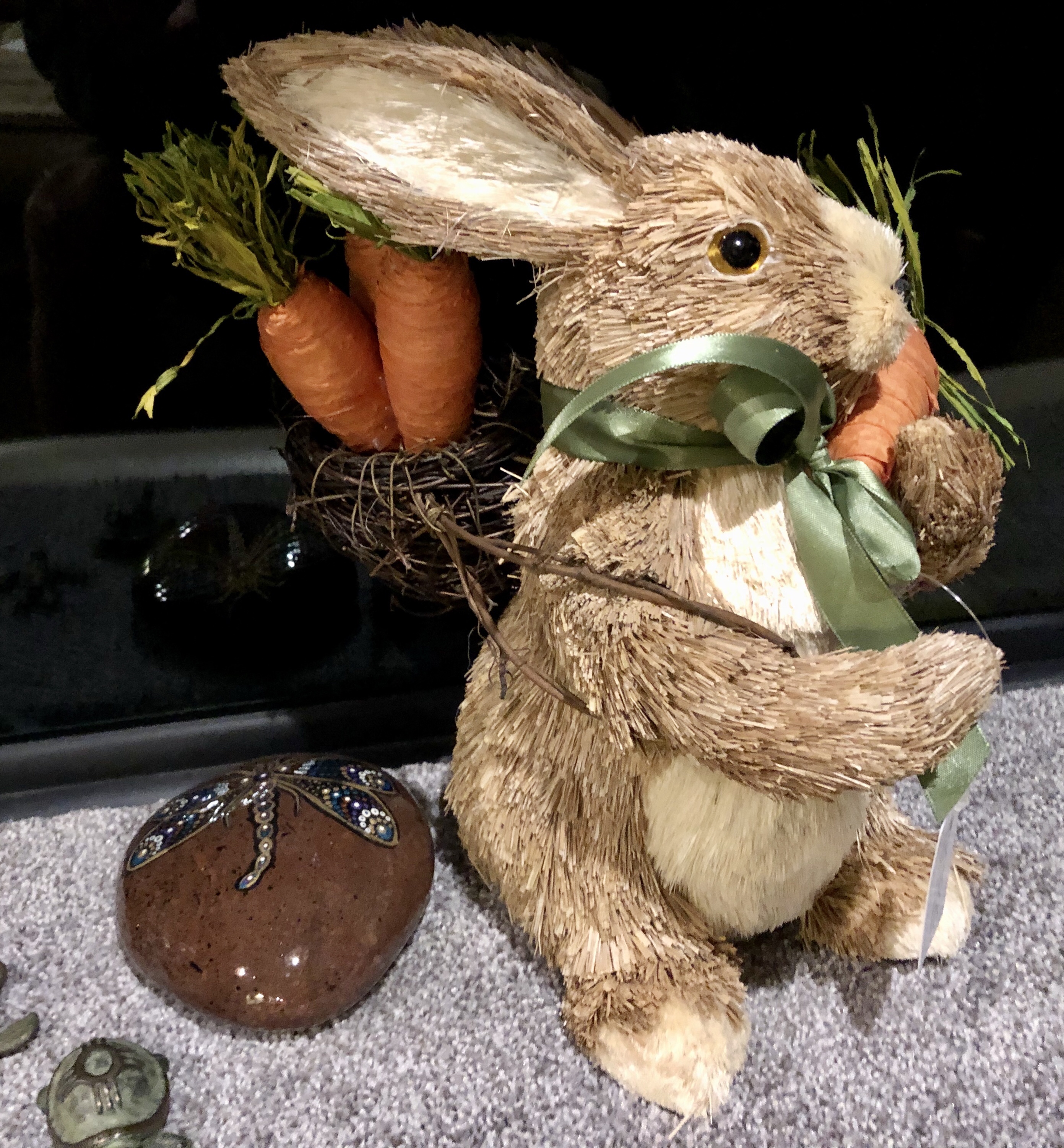
A perfect bunny made of dyed fibers complete with carrots.

And a little back pack with more. She is sitting on the dash next to our traveling turtles and dragonfly on a rock.

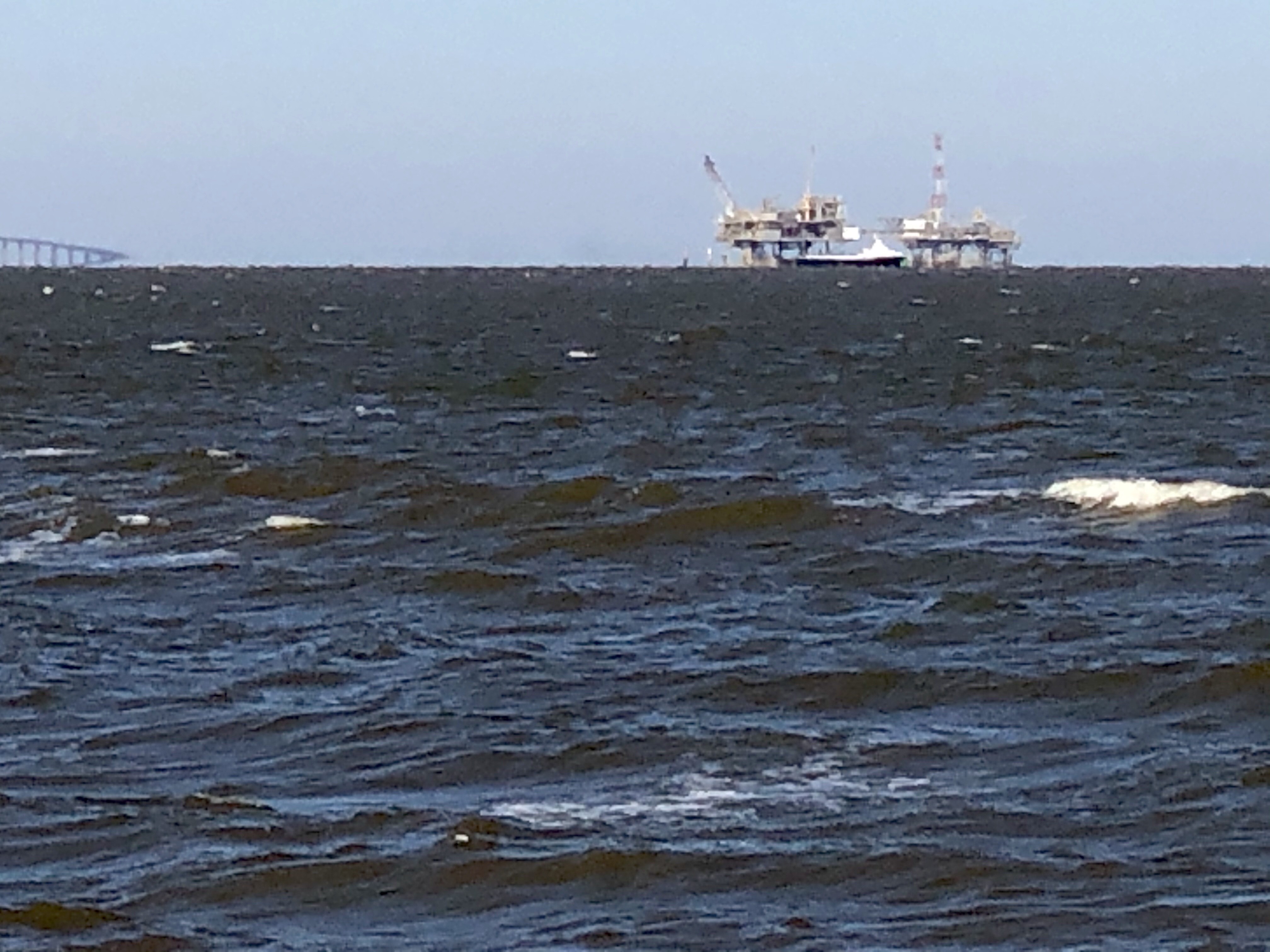
All this was possible because we took the ferry across Mobile Bay from Fort Morgan to Dauphin Island and then the causeway to the west side of Mobile Bay. Schedules were tight so we didn’t get to spend much time on Dauphin Island.

It was windy with lots of waves.

And a salt water car wash.

Susan and I were on Dauphin Island in 1977. We had a week in the middle of the winter. We headed for Big Bend National Park, the weather was terrible. So we went East to the Great Smokies, it was snowing. So we went south and ended up on Dauphin Island for a day and a half, got sunburned and headed home. That was our first RV trip.

More Later, Much Love,

Roger and Susan

Fort Pickens, Gulf Islands National Seashore, February, 2020

We wanted to go see the Naval Air Museum at the Naval Air Station, Pensacola and the light house there as well. Our friends Bill and Jan Velting from Michigan were staying over at Fort Pickens, a National Historic Site on Santa Rosa Island which is part of the Gulf Islands National Seashore. That is a long way to see an old Civil War Fort that was part of the defenses of the entrance to Pensacola Bay where there were important Naval shipbuilding facilities and depots.

We made arrangements to meet them at the entrance to the Naval Air Museum, about 45 minutes from Orange Beach. Then we started checking on parking, is there a cafe there and that kind of details and it started looking like there were restrictions on getting in. The more we dug the worse it sounded so we finally called. Because of security issues at the Naval Air Station you had to have a current DOD issued ID to get in. We don’t have one. We checked back with Jan and Bill, they were looking for the same info and came to the same conclusion. Just no way to get in.

Plan B. We were half way there by this time so after a bit of internet searching we chose The Oar House in Pensacola for lunch. We all headed in that direction. It was a nice place on a busy waterway. Food was good.

We decided to go back to Fort Pickens to see what that looked like. Jan and Bill had driven from the campground down to the fort to see what it looked like. It is at the very end of a long narrow sand spit at the opening of the bay.

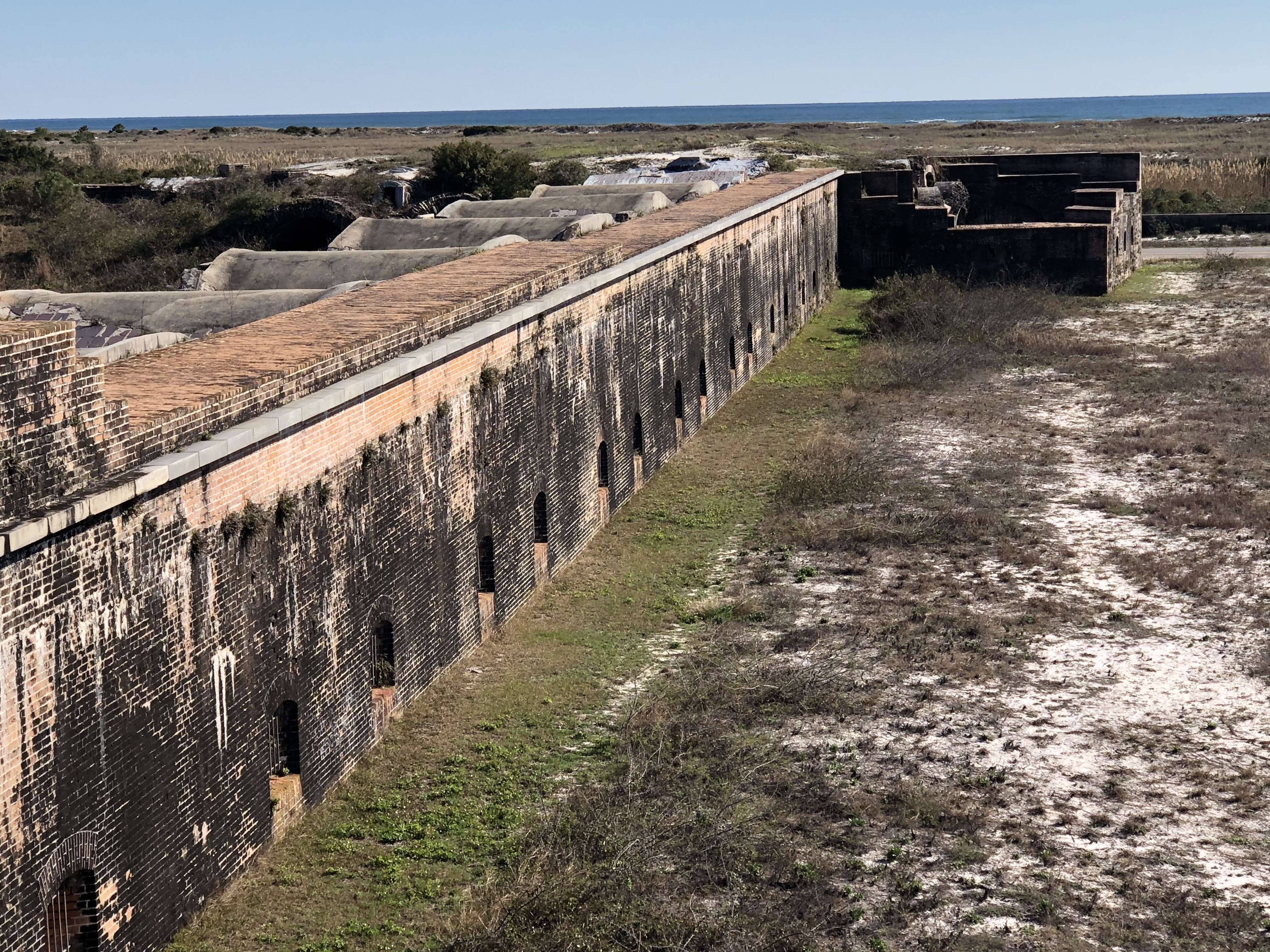
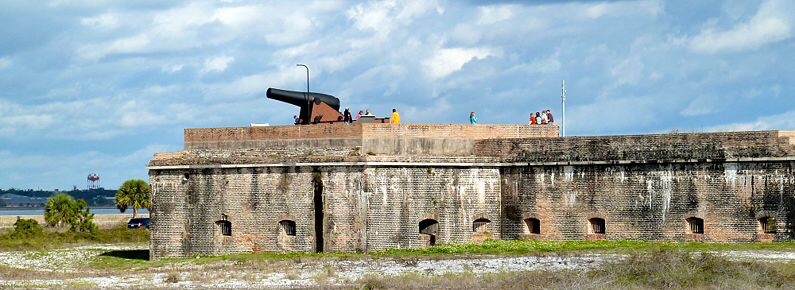
Fort Pickens was built in 1821 by the US Army using millions of bricks, lots of brick layers and slave labor. It was well armed with large cannons of the design of that era. There were large enough to shoot across the bay opening to bombard smaller forts occupied by the Confederate Army.

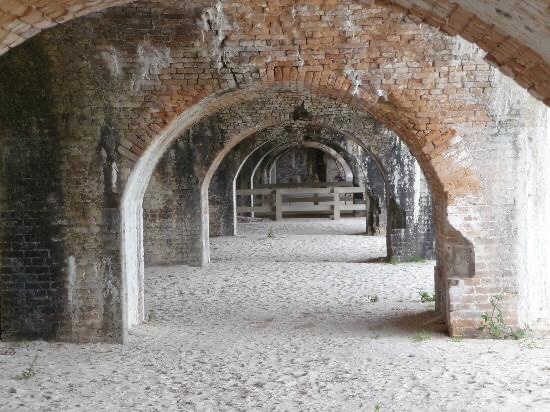
The outside walls were vertical with windows for cannons inside the walls. The walls were backed up by arched vaults. The arches we mirrored under the exposed vaults to form the foundations under the sand.

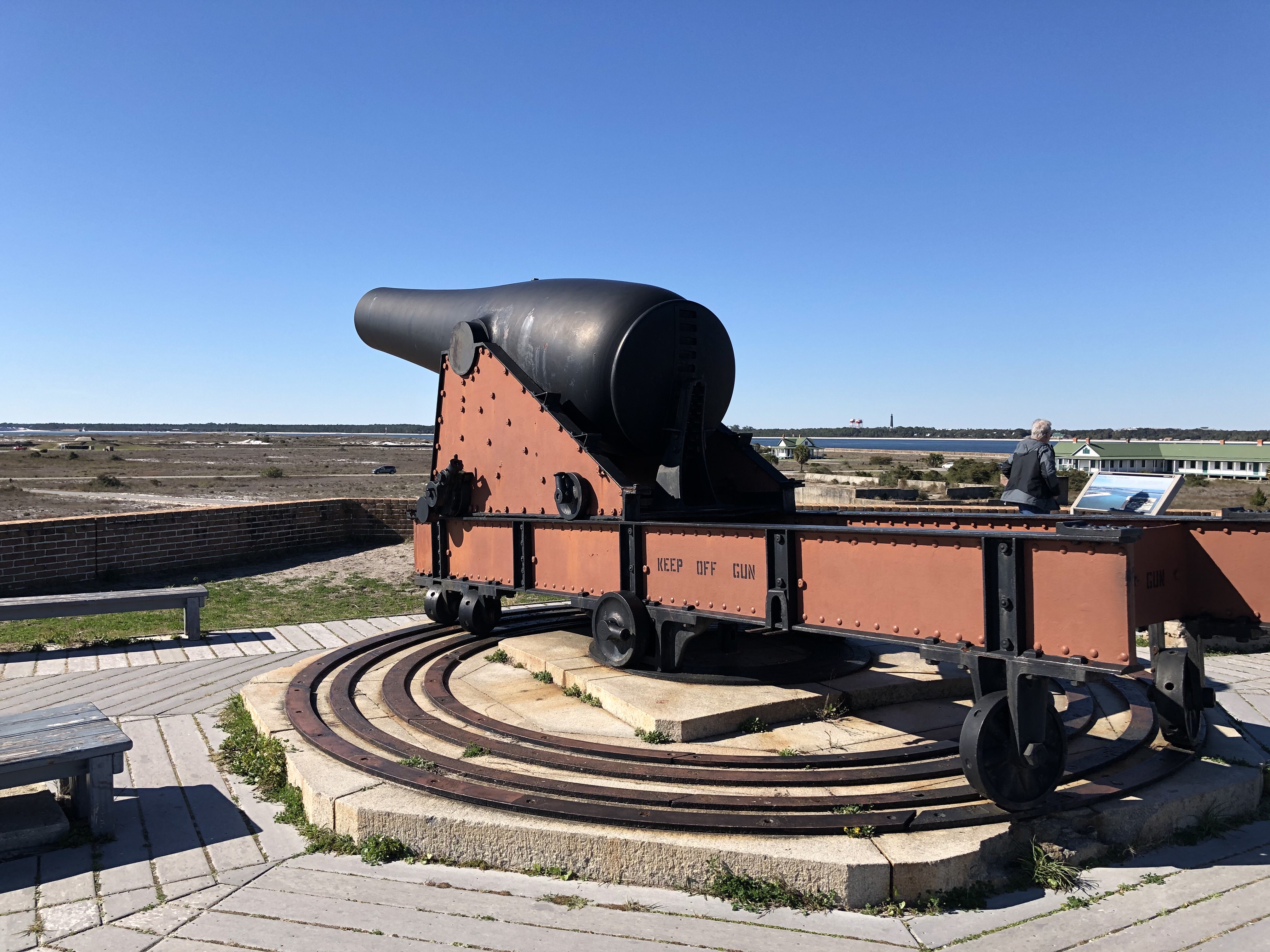
The giant Civil War cannons were out in the open and on circular tracks so that they could be aimed to shoot in the general direction of something. Shooting cannon balls wasn’t very precise.

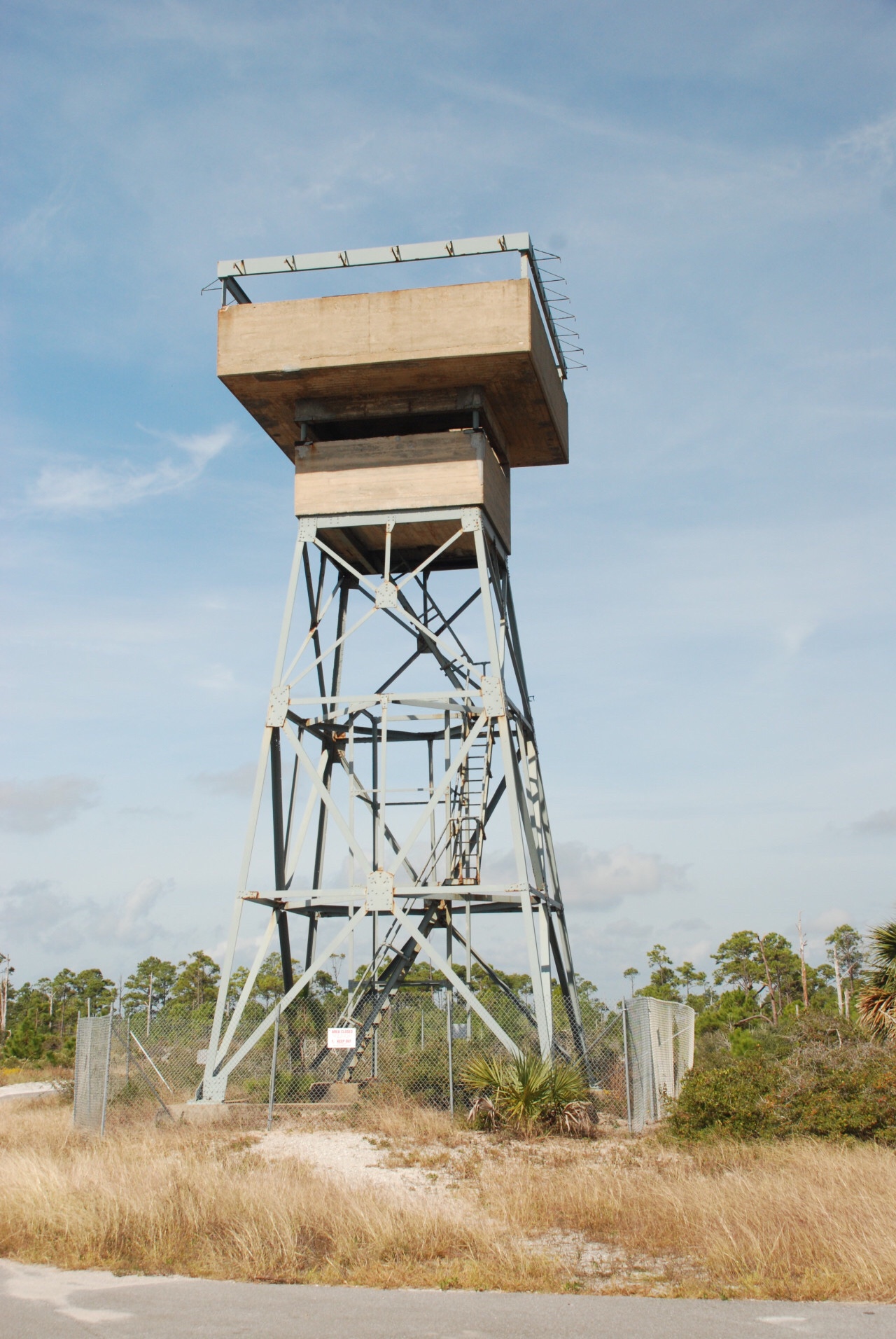
By the end of the 1800s the fort was obsolete. Modern rifled artillery could easily penetrate even the thickest parts of the masonry walls. So the Army built a new Artillery Battery within the old Fort and equipped it with disappearing 12” guns that could shoot shells weighing more than 1000 lbs at approaching ships 8 miles off shore. That was assuming they could see them in the fog and mist. So there were also observation posts to help see better.

This wouldn’t have been my choice of jobs when the shooting started.

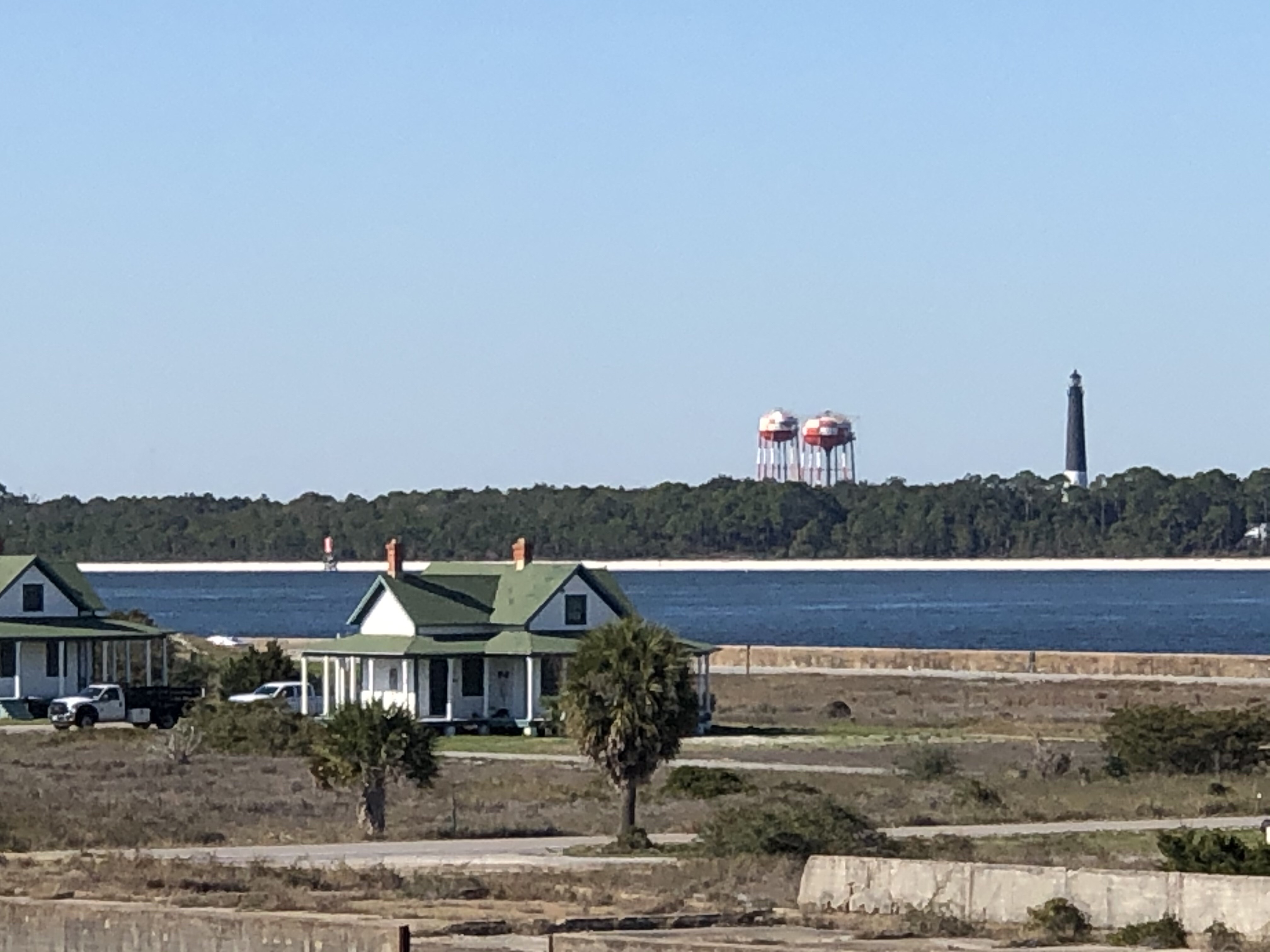
From the Fort walls looking across the bay we could see the Lighthouse at the Naval Air Station (NAS) and the red and white water towers near the Naval Air Museum. That’s as close as we got.

The Blue Angles are based at NAS Pensacola and starting in April the practice at the beginning of each week. This is a popular place to see the airshow. Missed that too.

When we approached the old Fort and the new one inside we couldn’t help thinking we had seen this before. The outside fort looks very much like Fort Pulaski near Savannah that we visited several years ago. It was also a masonry fort held by the Confederate Army. When the Union forces approached and set up their new rifled artillery at what seemed to be far out of range the Confederates felt safe until the bombardment began and the longer range, accurate rifled artillery shells almost destroyed the fort before the Confederates surrendered. The walls of Fort Pulaski are still full of holes.

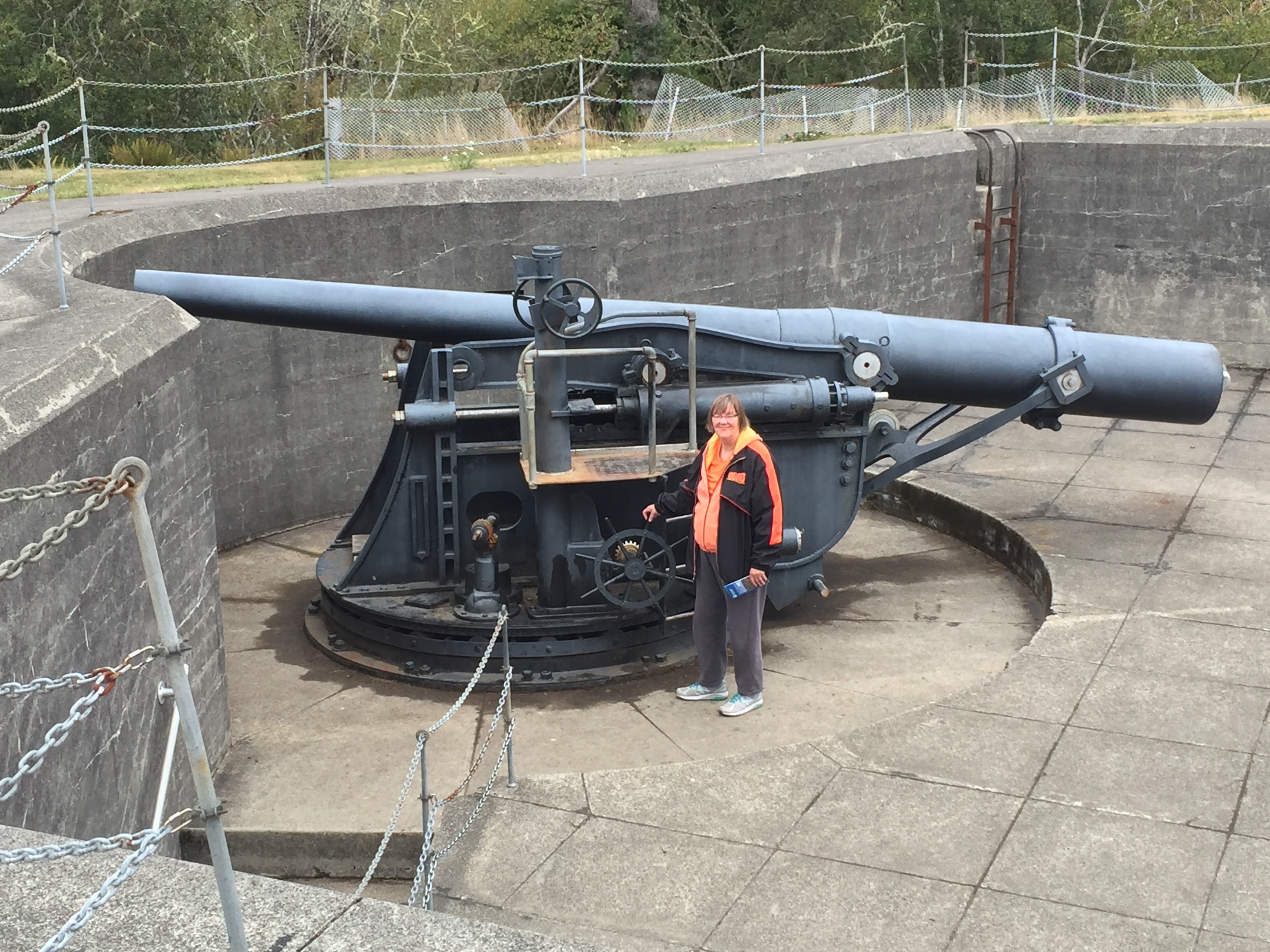
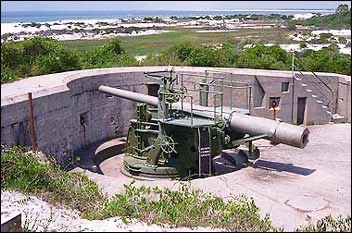
And the newer inside Artillery Battery looked very similar to the ones we saw at Fort Stevens on the Oregon Coast near Astoria. They should have, they were built using the same basic plans adopted by the Army by the Army Corp of Engineers. The guns were the same. The walls looked the same. Deja Vu all over again.

This is from Fort Stevens.

And at Ft Pickens.

The new guns were much more protected compared to the Civil War cannons.

We went back to Jan and Bill’s campsite. It was a nice campground with electric and water. Sand everywhere with brush and small trees. It was right in the middle of the sand spit, water in either direction just a couple hundred yards away. Jackets on for a cool and windy day.

We met Jan and Bill several years ago at Maumelle COE Park in Arkansas. They are from the mitten part of Michigan and head anywhere warmer and ice free in the winter. We sure enjoyed their company and are very pleased to see them on the road.

More later, Much Love

Roger and Susan
Orange Beach, Alabama, February 2020

We left Vicksburg heading for Orange Beach, Alabama. Orange Beach is just to the east of Gulf Shores, probably a more well known name. Both are on the east side of Mobile Bay on the gulf coast. Pensacola, Florida is about 40 miles to the east. In between are a lot of condos and beaches.

Gulf State Park.

We have been trying to get reservations at Gulf State Park for several years but it always seems when we check there is nothing more than just a few days or maybe a week at a time. It is surprising since it has a campground with 500 full hookup sites. Maybe that was why … it is a popular winter destination. So while in Orange Beach we went to the park headquarters to find out what the secret was. Call on November 1. Last year on November 1, 2019 reservations opened for November 1, 2021 through April 30, 2021. The gal at the desk said it was all booked in just a day or two.

We rode bikes in the park on every nice day and the camp sites were quite nice. Many were large with big grassy areas and trees were all over. 50 amp electric, good park wifi, water and waste hookups at every site.

Maybe 2022 will be our year.

Pandion Ridge RV Resort.

Pandion Ridge RV Resort is just to the north of Gulf State Park. They share a common property line. One of the popular bike/hike trails in the park cuts across the corner of the Pandion property. Our friend Rudy Legett has been here with the Prevost Community for an UnRally and with his friends from the Newell Gurus. Rudy reported that it was a nice park so we signed up for a month. If you sign up for three months it is less per month than for just a single month but it is a new place to us. Testing the water.

It has about 150 sites, each 45 ft wide by at least 100 ft deep. We were in a pull-in corner site along a row of big pine trees that was wider and maybe 125ft deep. Another 20 ft to the trees made it feel very roomy and private. The concrete driveways were wide enough for two cars and there was a generous patio area with a picnic table. There are two swimming pools, a big hot tub, two laundries, two common area gas fire pits, golf carts to rent, two pickle ball courts, two dog runs, two horse shoe pits and a nice sand volley ball court.
Pickle ball seems popular, sort of tennis on a smaller court with paddles and a whiffle ball. So it all goes a bit slower. Lots of pairs of couples playing. You can check out the necessary equipment to play or it looked like many had their own toys.

One of the pools was adult only and at a therapeutic warm temp. It was 4 ft deep, just right for short laps or as we saw many just walking laps back and forth. It looked very familiar. I did that for a few months after back surgery before starting to swim laps at the YMCA in Hastings where the water was in the low 80’s.

We signed up for Feb and got a bonus day. It is Leap Year. Feb 1 to March 1. The price does not include electricity so they charge you for how much you use. When you include that it is just slightly more than the state park.
Almost every morning we walked around the park down every road and one complete loop was just under 1.8 miles. Most of the time we did a few extra roads in the section to get to two miles. If we rode our bikes around the park there was an extra section we did and 2 complete laps was 4 miles, often we did 6 miles and never left the park.

We often rode to the end of the resort and through the woods, across a raised wooden boardwalk that crosses a marsh area and along another trail through the woods to the paved trail in Gulf State Park. One way went around a few lakes, the campground, some marshes, a fishing area, the park store and laundry, the park headquarters, a restaurant and connected to pedestrian/bicycle bridges across the coastal road to the beach. The other way was more remote but went by the community ball fields, a butterfly house, more rustic hiking trails. Either way looped around to cross park trail and back to near where we started.

Either way was almost 12 miles. If we rode through the park campground, which we did more than once, looking for perfect spots it could be longer.

So in a month we probably rode close to 50 miles and walked 40 miles. Susan is my fact checker on this and she agrees this is about right.

Gulf Shores, Orange Beach.

These are side by side communities sharing a very long white sand beach. Gulf State Park along the beach front interrupts the string of beach front condos. At the west end of the long skinny island is Fort Morgan, a military fort dating back to the Civil War. There is a ferry across the opening to Mobile Bay to Dauphine Island. From there a causeway connects to the west side of Mobile Bay.

Heading east the highway follows the coast line and the endless condos towards Florida and Pensacola.

Pandion Ridge is on Canal Road which follows the intracoastal waterway. There were often large tow boats and barges moving one way or the other along the intracoastal waterway from Mobile Bay heading east. Downtown Orange Beach is east on Canal Rd from Pandion Ridge. There is a big shopping center and the old down town which is not at the beach.

Heading west on Canal Road led to connectors to the State Park, Fort Morgan (20 miles away) and the beach. There was plenty of free, easy parking right at the beach. With people watching, sitting in the sun and walking right there. There was a huge beach volleyball tournament one day. There was always wind and kites flying. Some days it was windy enough for the kite surfers. Something to see and do every day.

Some folks I know from Habitat back home have been coming down here in the winter for 20 years. It took a bit to connect with them but we did and we joined Bob and Kathy Hamer for lunch at the Sea N Suds. This is right on the beach, further out towards the water than the condos. It has been a family owned local spot since 1975. Nothing fancy, not real expensive but really good food.

More to come. Much love,

Roger and Susan

Vicksburg, MS, January, 2020

Vicksburg, Mississippi is about four and a half hours from NAC on the Mississippi River. It was a key site during the Civil War for control of the river. The Union wanted to control the river to maintain supply routes up the river and to divide the Confederate states. The confederacy wanted to deny the supply lines to the northern states and the Union.

Most think of the Civil War as something that happened back east or down south. There were significant parts of the war fought “out west” as it was along the Mississippi River.

We stayed at a casino campground. It was inexpensive and convenient. And the Casino had a great cafe for lunch. We followed the driving route through town. Unfortunately not much to look at. Downtown was trying to revive itself but there were a lot of empty storefronts.

There were Confederate cannon emplacements all along the river to guard against ships going upstream and to protect Vicksburg.

Vicksburg National Military Park

We have been to the Gettysburg National Military Park. The parks are similar in they have a driving route around the battlefield area. These roads pass monuments dedicated to the various battalions from all of the different states involved on both sides. Many of these battalions were fairly small, maybe less than 100 men led by a local guy who got a commission in the army. And his militia battalion became part of one army or the other. At Vicksburg there were more than 100 militias from Illinois for example.

All of the monuments were along the Union or Confederate lines. You can see the line of them in this picture. The cannon aren’t the ones that were actually there but very similar. This whole row was cannon emplacements. The entire area is rugged hills. At the time of the siege most of these hills were bare with some areas devoted to small farms.

The Confederate army had fixed positions for their cannon mostly to protect the city. The Union cannon placements were much more mobile and adjustable to re-aim as needed. Confederate cannon fire was quickly returned from several positions as the Union artillery changed their firing direction. This was tough on the fixed Confederate positions.

These Union cannon positions were firing at the Confederate lines where the spire in the distance was located. It is less than 300 yards away. In one location a Union Artillery unit dismantled their cannons and hauled them over rugged terrain to a ridge overlooking the Confederate lines only 100 yards away.

The Shirley House is the only structure in the battlefield to survive the 47 day siege from March 29 to July 4, 1863 of Vicksburg. It has been restored to like it was at the time (with some modern add-ons like gutters and electricity).

With the Confederate positions more fixed and the Union more mobile it was mostly a matter of time before injuries and running out of food, medical supplies, ammunition and resources led the Confederate General Pemberton to surrender to the Union’s General Ulysses S. Grant on July 4, 1863.

This happened at the same time as the defeat of the Confederate Armies under Robert E. Lee at Gettysburg, PA, July 1-3, 1863.

These were critical events that shaped the remaining time of the Civil War.

After the Siege

Federal troops remained in Vicksburg for almost 14 years after the siege ended. It remains largely a sense of perspective if it was occupation or reconstruction. Certainly Vicksburg, largely destroyed by constant bombardment, was rebuilt. With time civil liberties were restored and many freed former slaves moved to Vicksburg to start new lives. While there were efforts to improve schools, housing, food sources and legal aide for all of the poor southern people there is ample evidence to show African Americans were burdened with Jim Crow laws and many other disadvantages that were finally outlawed by the Civil Rights Acts of 1964. And yet even today many of those disadvantage remain in the deep south.

Torpedos Ahead

The Union commissioned a fleet of eight river going iron-clad gunboats. These so-called City Class boats were built in 1861 by James Eads and were all named after cities. These were wooden flat bottomed boats with iron cladding. Powered by steam engines the 512 ton, 175 ft long and 52 ft wide barges could manage a top speed of 4 knots. Her crew of 251 enlisted men and officers manned the boilers and the 14 cannons of various sizes. The biggest were 8″ smoothbore cannons.

The USS Cairo was the lead ship in the class and arrived south of Vicksburg in April of 1862. It led supply boats to the north of the city and with seven other Union gun boats engaged and defeated eight Confederate gunboats.

It returned to patrolling the Mississippi River and on December 12, 1862 while on a mission north of Vicksburg on the Yazoo River to destroy Confederate Batteries and remove obstructions in the river it was sunk by two torpedos (an underwater mine) electrically detonated by volunteers on the river bank. A huge hole was torn in the hull and it sank in fairly shallow water and mud in just minutes. There were no casualties. It sat there and sunk in the mud and silt until it was gone.

Discovery!

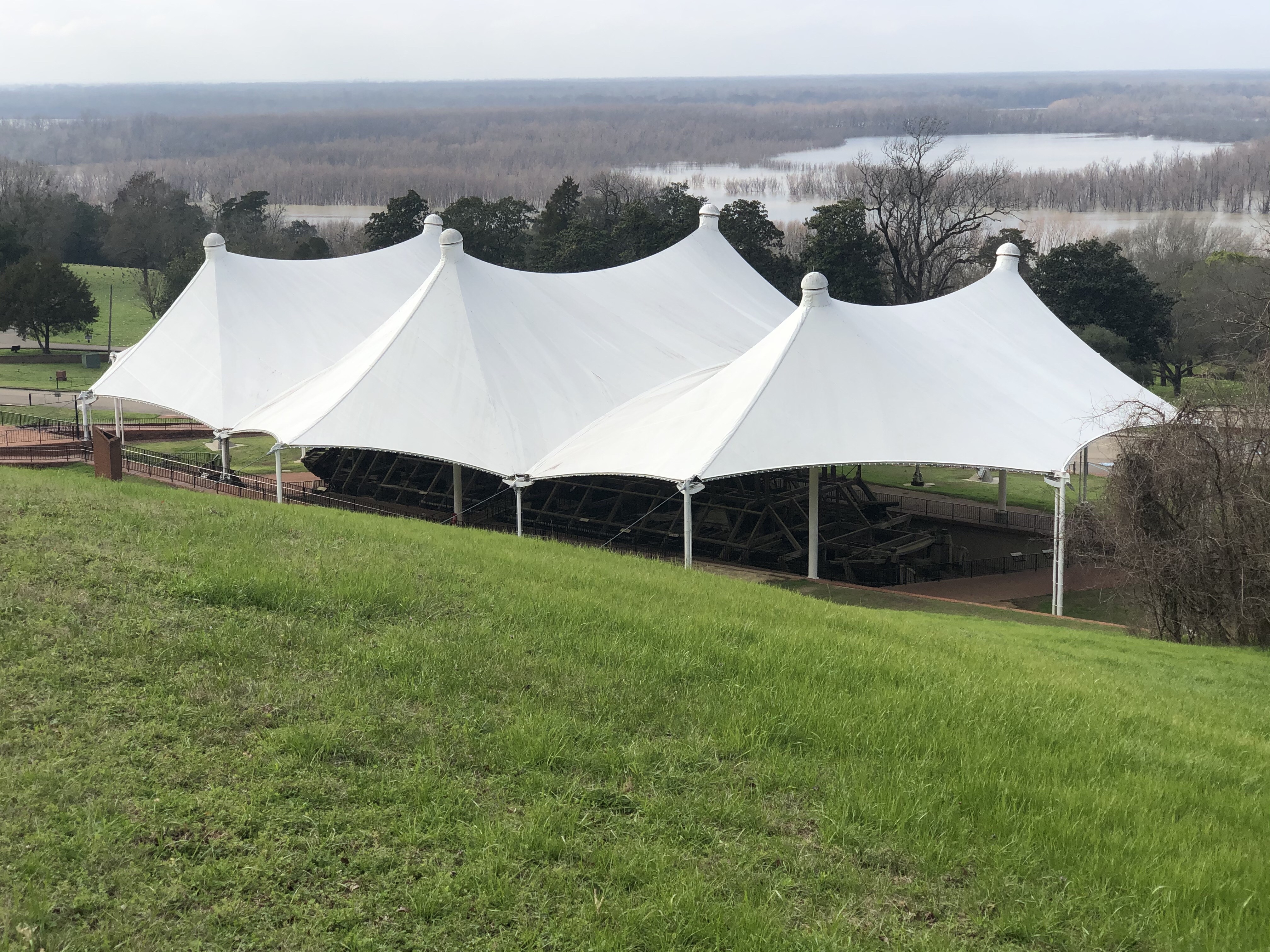
In 1956 it was discovered by using recollections of where it was and a simple magnetic compass. It was almost entirely buried in silt and mud which preserved much of the artifacts. A long process of salvage recovered small pieces one at a time until the hull remained. It was a difficult but successful operation to recover the hull in pieces. It has all been moved down to a restoration display in the Military Park under a large fabric structure.
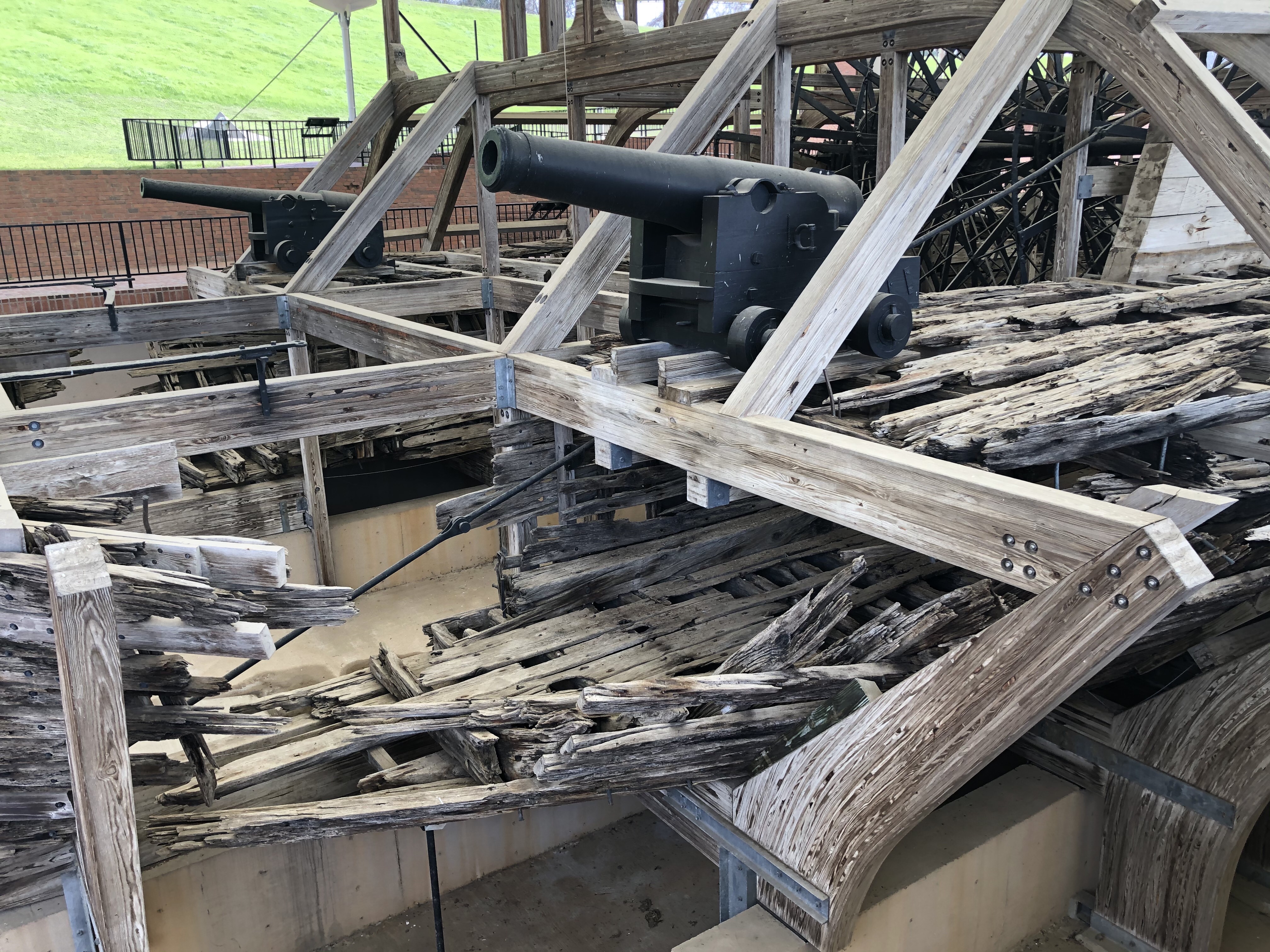
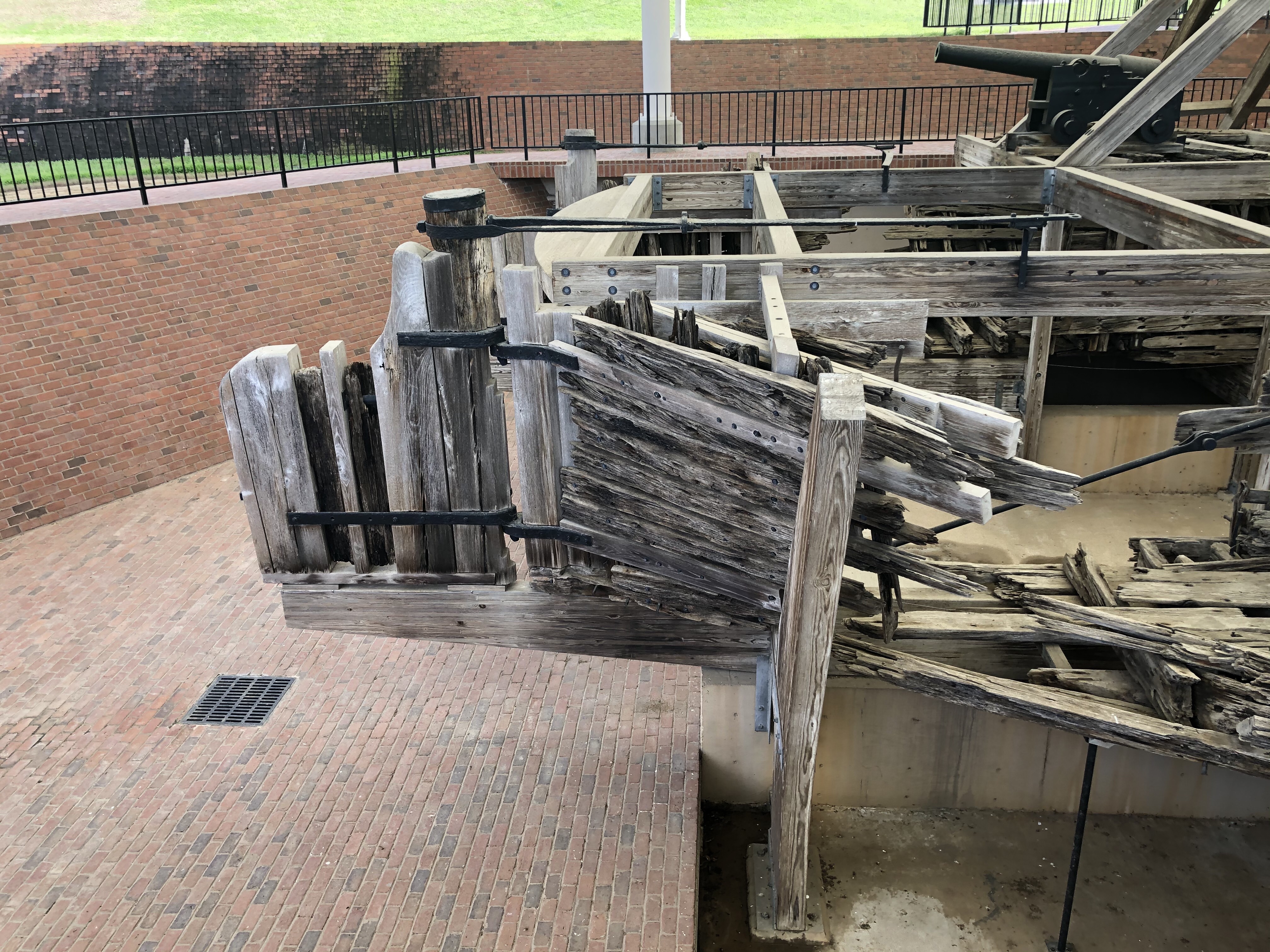
You can get a pretty good idea of what it looked like. A new framework holds the old hull in place.

The massive hole where the torpedoes exploded is easy to see.

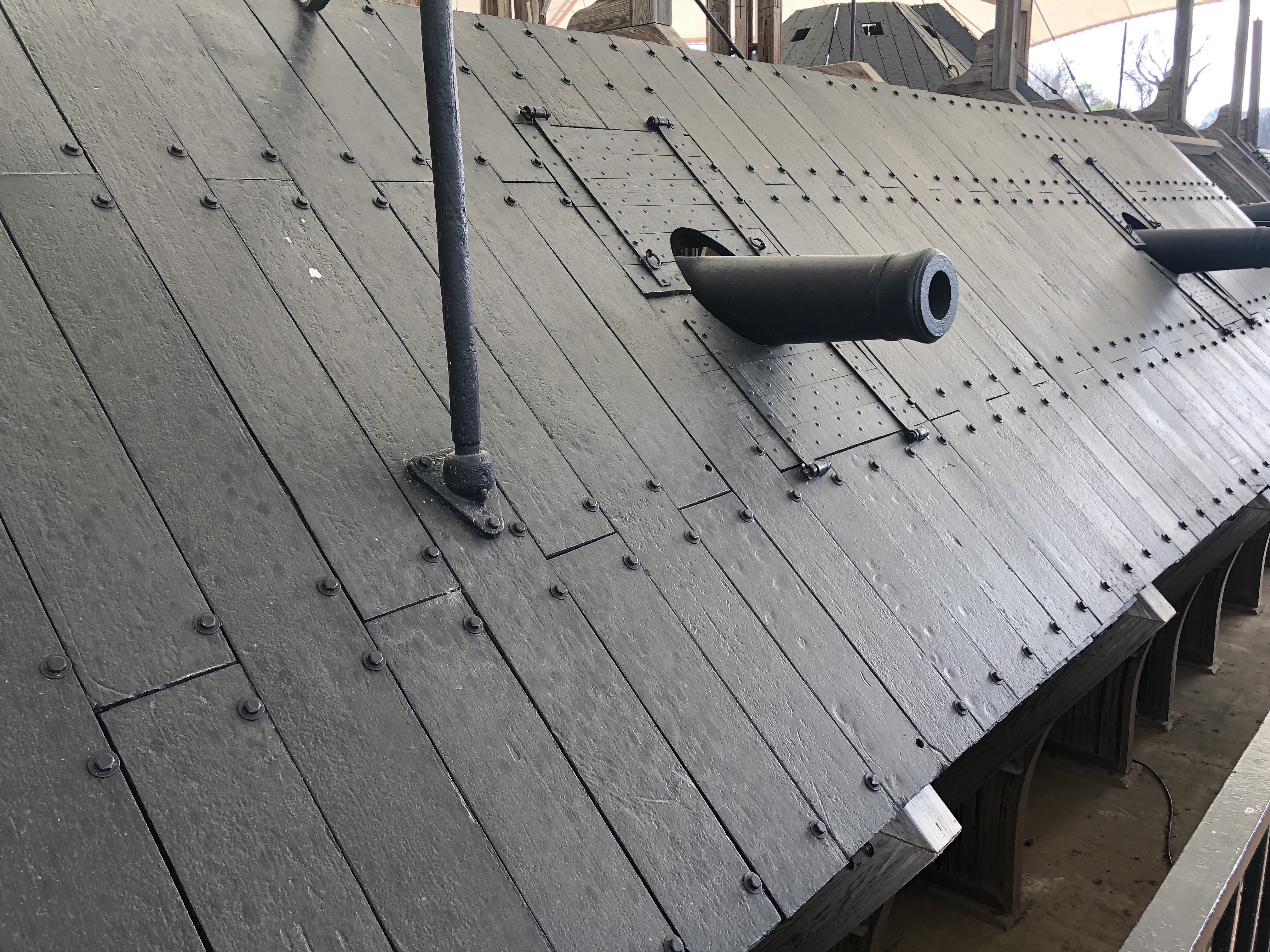
Much of the iron clad armor survived and was recovered.

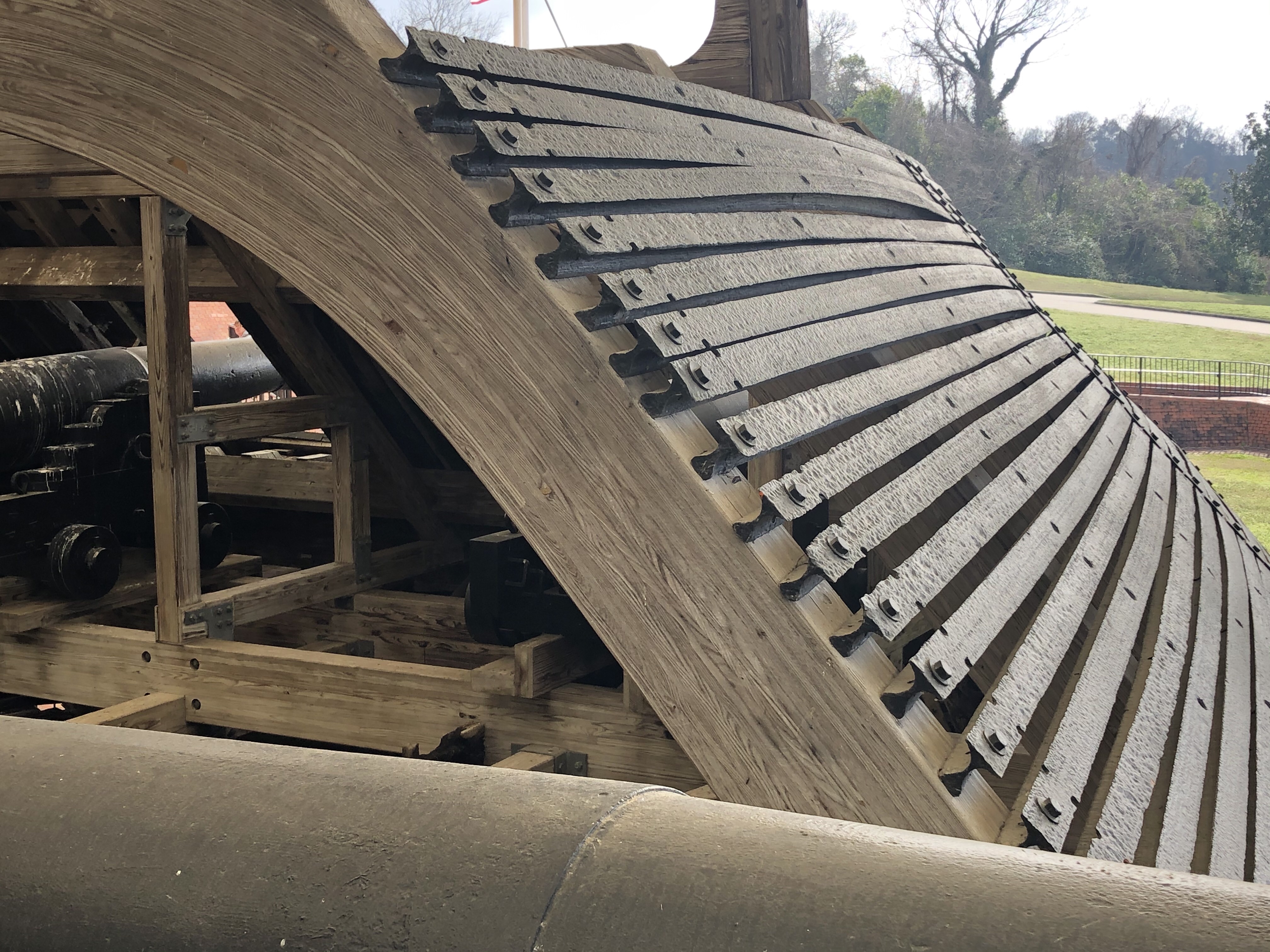
The curved part of the upper structure near the front was actually covered with sections of railroad rail. They used what they had.

They were able to recover parts from the bow to the stern, even parts of the boilers and paddlewheel.

It was an interesting stop. Natchez is not far south of Vicksburg and is worth a visit next time we are this way.

It is time for the beach. Our next stop for a month.

More to come, Much Love,

Roger and Susan