Blue Ridge Parkway

Saturday, April 12, 2014

[Sorry the pictures didn’t make it. Google Blogger, what can I say.]

We got to Asheville yesterday afternoon. We are staying at Bear Creek Campground.  It is on a hill so there is really no creek and probably no bears. We did some weather checking and rearranged some plans to accomodate the expected rain on Monday and maybe a chance to see the last part of the Master’s golf tournament.
We drove up to the Blue Ridge Parkway Headquarters Visitor’s Center.  We got maps and brochures and lots of really helpful info from a helpful ranger.  There was an interesting film about the Parkway. It talked about building it starting back in the Depression and its completion in the 1980’s.  It hooks up to the Shenandoah Parkway at the north end and ends at Great Smokies National Park on the south.  
On Saturday we packed a picnic lunch and headed north.  There was a detour around a piece of the Parkway that was being repaired. The detour took up through a steep, very twisty two lane road around the repair area.  I would not have driven the coach on that road.

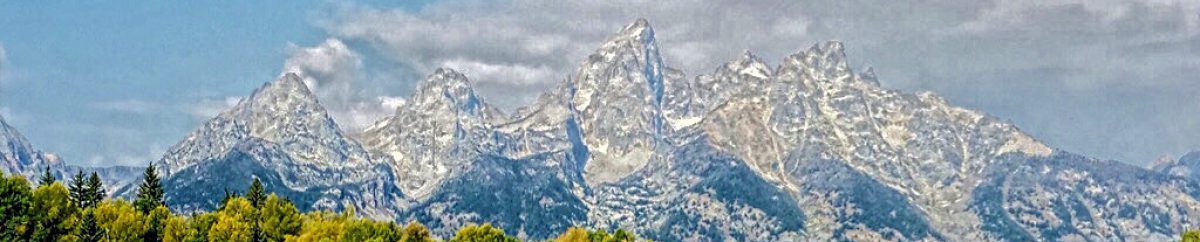
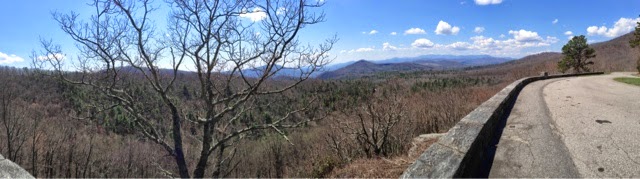
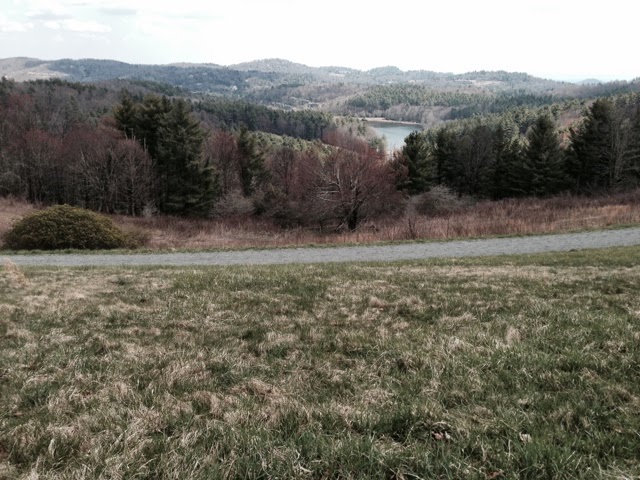
Every turn opens up amazing vistas. The dogwoods and many other flowering trees were blooming. While we were only in the 3-4,000 ft elevation range it still feels like you are in the mounntain, because you are.

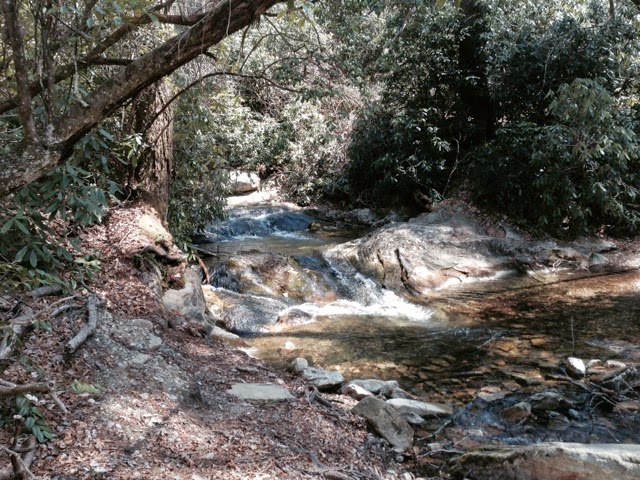
The navigator did a wonderful job. We stoped for a short hike to a small falls. More like rapids.

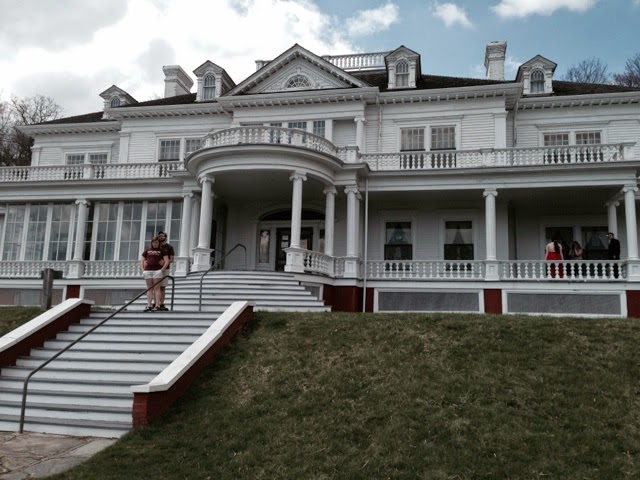
At the end of this day’s northerly driver we arrived at an old estate which was given to the National Park Service.  The fellow that owned it (Mr. Moses) made his money making denim fabric.  His hobby was building roads so there are more than 25 mles of carriage roads on his estate.  Today they are used for hiking, biking and horseback riding.

Nice view from the porch.

And we stopped for our picnic, of course.

It was a very nice day.  A bit of a long drive but surprisingly comfortable in the Jeep.
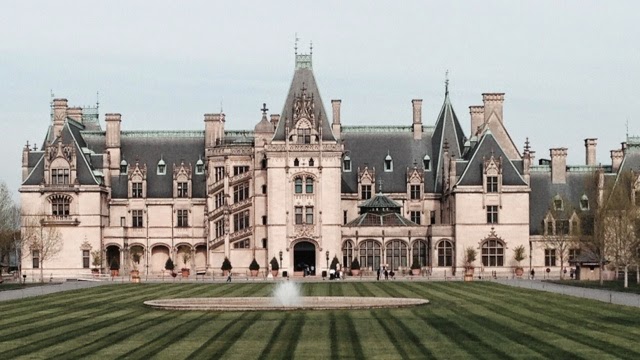
Tomorrow we are heading for the Biltmore Estate.  Some house time and garden time.  Spring is in full bloom.
More tomorrow.
Roger and Susan

Twin Lakes, Near Clemson, SC

Thursday, April 10, 2014
Yesterday we departed Carleston, SC headed for Asheville, NC.  We wanted to find something not in the city for a couple days to relax.  We found it!  
The Army Corps of Engineers manages the Hartwell Lake and Dam near Clemson, SC. The lake covers almost 90 square miles and has nearly 1000 miles of shoreline. And there are 32 square miles of land in the district. There are 9 campgrouds, 50 recreation areas and 5 marinas in this COE site.
We are at Twin Lakes campground near Clemson, SC home of the Tigers.  We found a nice site.
Most of the more than 100 sites are right on the lake.

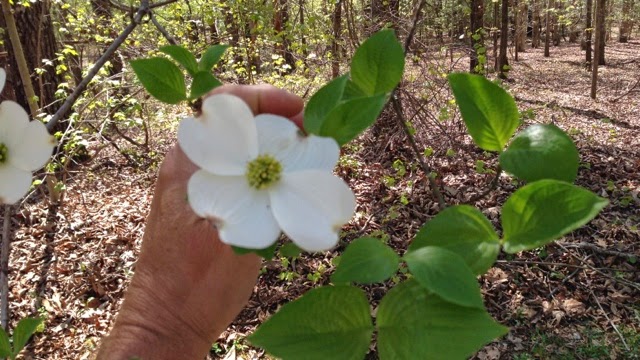
We walked around the park today through all of the loops. 12,462 steps!  Along the way we found the Dogwoods in bloom.

We looked at all of the sites with an eye towards where we would like to stay. South exposure, sun, shade, privacy, interesting … a whole bunch of intangibles. There were lots to choose from. All have water and 50 amp electric (very desirable), fire pit, picnic table and a grill. Very nice.

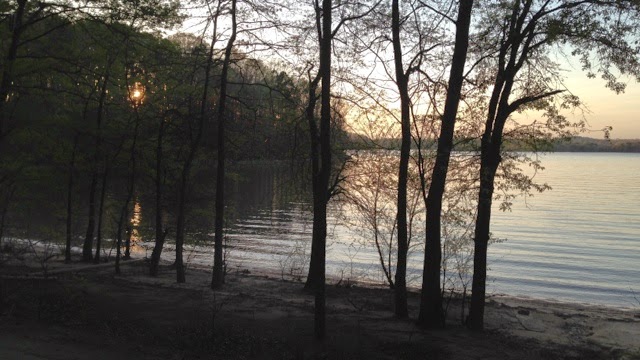
Quiet, calm, relaxing. A nice change from the busy city.

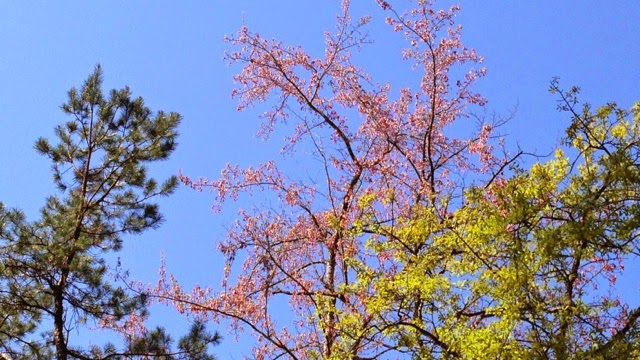
75 degrees warm today.  It is spring here. The trees are early in the leaf stage. Some are blooming pink. The pine trees are all mixed in all over. They were removing a big pine today. The smell of cut pine was very intense.

Just like “On Golden Pond”. A small campfire tonight. Toasted a few marshmallows. Relaxed. We added some piñon pine. Amazing smell. Reminds us of Santa Fe.

Roger and Susan

Charleston, SC

Monday, April 7, 2014

If you have never visited Charleston then do yourself a favor and put it on your list of places to see. I don’t think I would come in the summer, probably hot and humid, outside of most of our experience. This time of the year is pretty nice, the flowers are blooming, the annual home and gardens tours are on and the temps are pretty comfortable.

We normally would rather be not in the city but they are fun to visit for a few days.

We took pretty much all back roads from Savannah to Charleston.  We went by the giant four lane expressway into Hilton Head Island, didn’t even think about going there.  Highway 17 into Charleston is    a very busy and congested road.  Our campground is about 20 minutes from the historic district of downtown, not all that far but mostly city streets.  Charleston has the longest cable stayed bridge in the world, about two miles long.  We will be going over that bridge on our way to Asheville on Wednesday. Susan will have her eyes closed.

There are lots of things to see and do in Charleston. We have been to Ft Sumter on an earlier trip so we didn’t do that. The USS Yorktown aircarft carrier is now a museum one can visit. Probably going to miss that too. Seen one aircraft carrier, you’ve seen them all, right?

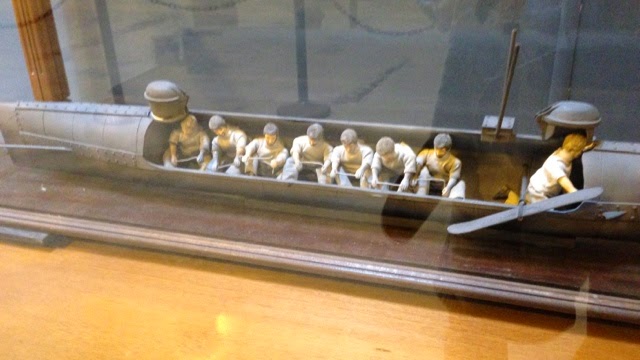
The Civil War submarine H.L.Hunley was discoverd in 1995 and recovered in 2000. It was the first submarine successfully used in combat operations when it sank the Union blockade ship the USS Housatanic, in February, 1864. The Hunley placed a 135 lb black power charge near the stern of the target ship and backed off several hundred feet to detonate the charge equivalent to a single stick of today’s dynamite. The charge was right under the Housatanic’s powder magazine which burned fiercely. The Housatanic sank in a matter if minutes. 

The Hunley disappeared itself under a cloud of mystery. No one really knows what hopened. The author, Clive Cussler and his NUMA foundation found the Hunley about 1000 ft from where the Housatanic was sunk.  The Hunley was recovered after extensive archeological investigation and brought to a University of South Carolina facility for conservation and study.  It now rests in a 90,000 gallon pool of water. Ther water is drained to work on the study and conservation effort and the refilled. They use a special water that helps remove the encrustation on the cast iron ship.  Several hull plates were removed to recover the 8 man crew still inside at their stations alongside the hand crank which turned the propeller. They were remarkably preserved including clothing and other personal artifacts.  The crews remains were buried in a nearly cemetary.  About 50,000 attended the services.

This is a model showing the crew in the Hunley. It was 48″x42″ inside.  Not for me!

They are soon going to replace the current water solution with one that contains the same chemicals as Drain-O. This will speed up the removal of deposited crust.  Then they are going to another solution that will speed up the removal of salt from the cast iron.  Surprisingly, cast iron is porus and when under water it is infused with salt.  Taking a cast iron item out of the ocean and drying it out leaves the salt embedded in the iron and it rusts very quickly from the inside out.


So now we have seen two turning points in miltary history related to the Civil War.  Th first use of rifled cannon and the end of msonary fortifictions and the first use of a submarine in combat.  It will not be until WWI when a submarine sinks a ship again in combat.

Charleston is a very old city first settled in 1670.  The first decisive victory of the Revolutionary War was  fought here at Fort Sullivan.  The worst defeat of the Americans happened here during the Seige of Carleston.  The Civil War got under way at Fort Sumter. The Union bombarded Charleston for 584 days during the Civil War. It has suffered from several mjor hurricanes and even a major earthquake. And for all of that there are beautiful parts of the historic disrict to explore. The streets are narrow and congested and parking is not easy. There are many historic homes some turned into museums and many still lived in.  There are walking tour maps that lead you around the maze of streets and alleys.  Most take two to three hours.

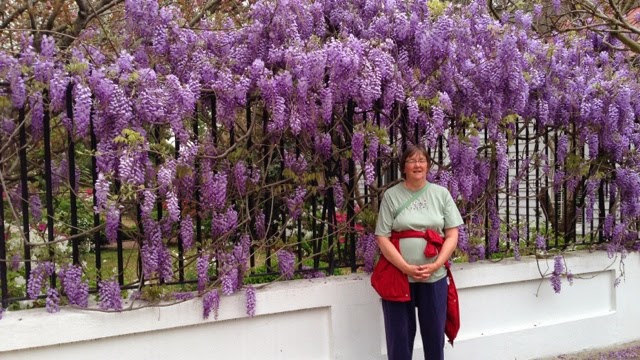
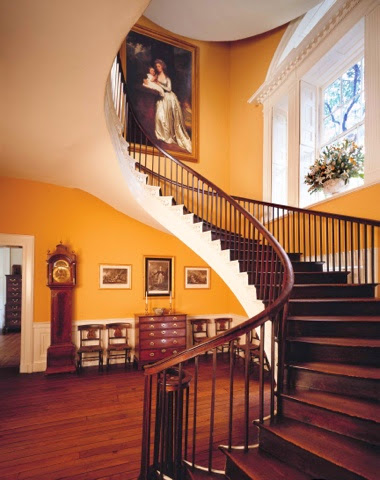
The Wisteria are blooming. We visited the Nathanial Russell house. It is a three story brick mansion with three rooms on each level, one of which was oval. An oval dining room on the first floor and a very formal family parlor.  One bedroom on the second floor, more on the third.  There were kitchens, work shops, carrige houses, stables and quarters for the 18 slaves who tended to the gardens, the house and the family.

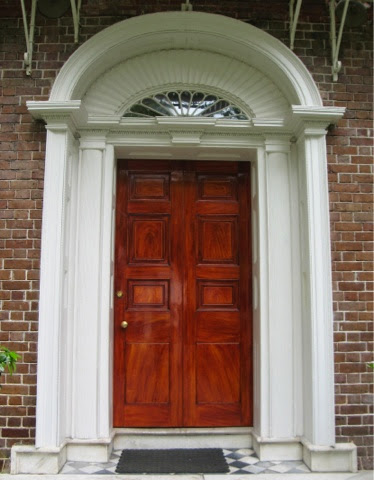
The front door looked like mahogany and inlays. In fact it was painted in the French trompe l’oeil method (fool the eye) to simulate wood. There were many other examples of this in the house from differnt types of wood to marble even to plaster details.

The elliptical stairway is probably the home’s biggest claim to fame. It winds up to ll three floors.  The medallion in the ceiling at the top is painted in two dimensions but looks very three dimensional.

From the top the shape is quite evident. 
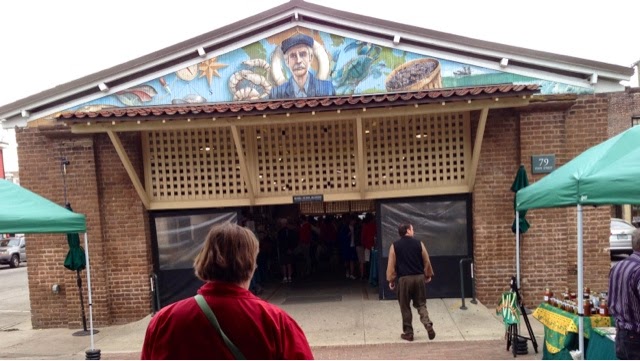
Then off to the City Market. It is a four block long set of buildings filled with art and crafts and of course food and the typical tourist stuff. Beautiful art, baskets and pottery.

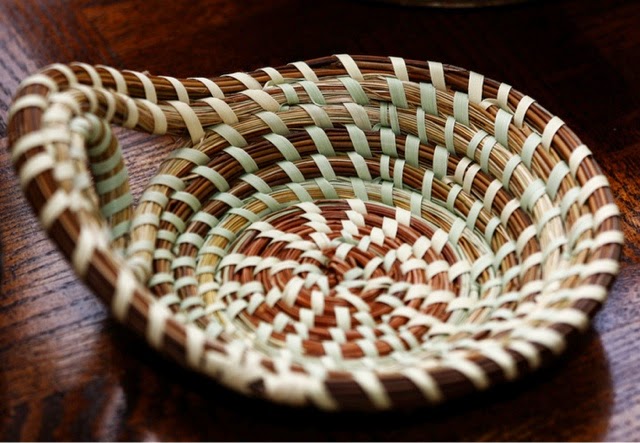
We managed to buy nothing but may go back for a sweet grass basket.these are like pottery. Some good, some great, some done by well known artists that are signed and dated and prices that can range from $50 to $1000 for what looks to the casual shopper as if they were identical.
They are very attractive and surprisingly heavy.
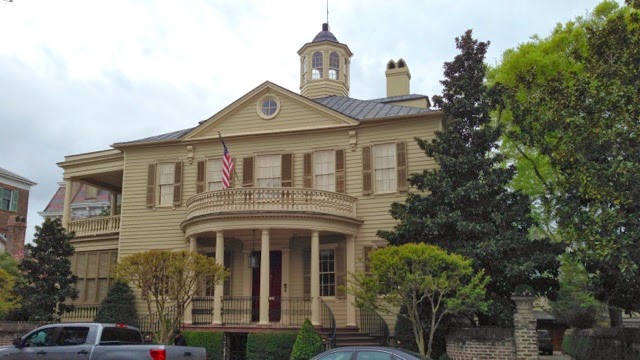
More walking. More houses. Some so big it is hard to believe one family lives there.

The typical Chrleston home in the historic district is built on a narrow lot with the side of the house facing the street and the front going down the depth of the lot with porches on each level and gardens in every spare space.

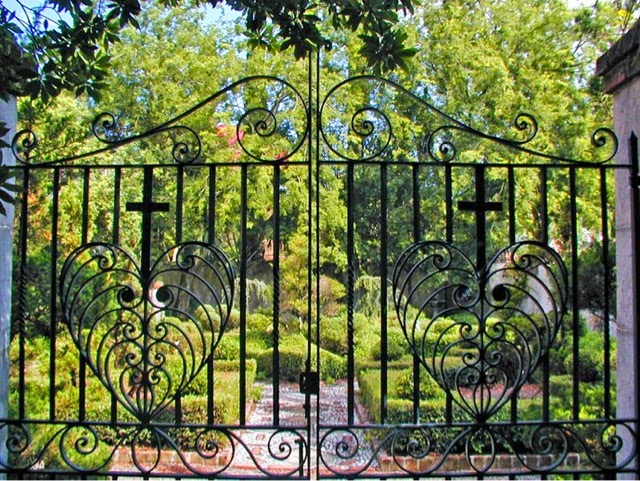
The front faces toward the harbor to catch any breeze.  Iron gates are prominent in Charleston.  Many were built by Master Blacksmith Phillip Simmons whose work was featured on the PBS series Craft in America.

Almost every home has gardens.

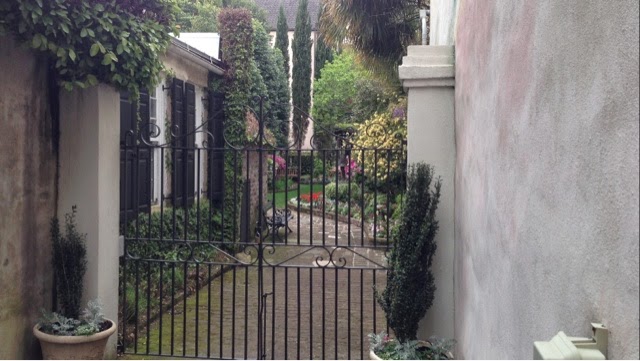
Down little alleys between homes were beautiful interior spaces.

Thre streets were mostly very old granite cobblestone.  Art in its own right.

 And of course we sampled some local grub at Magnolia’s. Wonderful.

Crab cakes on rice cooked with shrimp (pirloo), spinich and a tomato butter sauce was Susan’s choice.  I had a grilled sandwich with fried green tomatoes, bacon, lettuce and pimento cheese on a whole wheat corn bread.  We skipped dinner except for the four oatmeal raisin cookies we baked when we got home.
It rained over night (Monday) and most of this morning (Tuesday). Good time to get this posted, do some laundry and maybe head down to the Market again.
We had two dining experiences we wanted to try on this trip. One was a Waffle House, did that. The other is a Chick-Fill-A something. I assume they serve chicken. We have seen only a couple and they were not convenient. We saw on yesterday that we might try, or not.
Tomorrow we head for Asheville, NC about 220 miles away.  Should take about three days to get there at the rate we are going.
Roger and Susan
PS: Please send Susan an email and encourage her to post something. 
Hunting Island, SC

Friday, April 4, 2014

Yesterday we made the 75 mile drive from Tybee Island, Ga to Hunting Island, SC. It is east of Beaufort, SC near Paris Island. This area is called the Sea Islands. We crossed over three or four islands to get to the end of the road atHunting Island Stste Park. And the 5,000 acre park is right on the Atlantic Ocean and includes a large campground, a light house, nature areas and lots of trails.
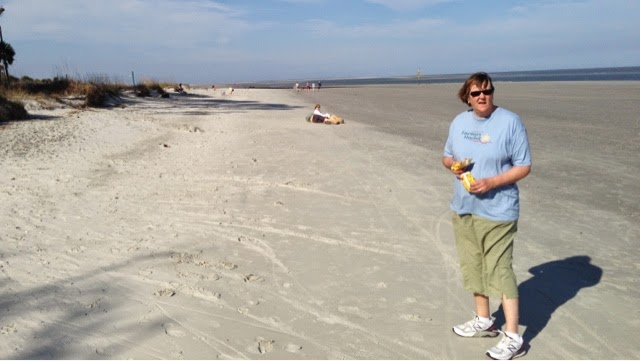
And the beach, a vary shallow sloped beach with sand bars just off shore. When the tide goes out a very wide, flat beach is left.
Looking south

And north. The beach is very easy to walk on, damp hard sand and also easy to bike on, lots of fun.

The campground is quite nice, huge pine trees, live oaks and palm trees. Most of the spaces are fairly generous. They have a 30 nights for half price deal hear for snow birds. Looks very nice. We checked out several sites. The one we are in is pretty nice. Some sun, some shade.

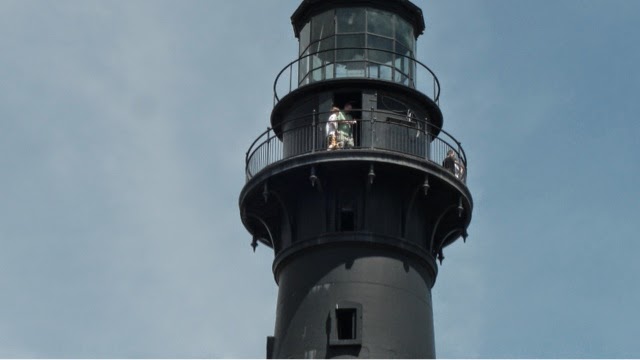
We rode our bikes to the light house about a mile and a half away.  We rode on the paved road, sort of busy and no shoulder.  The light house is made of cast iron sections bolted together. Twenty four years after it was erected it was disassembled and moved forther inland since the beach was eroding. Since the light house was originally built more than 1000′ of beach has been eroded.
For $2 you could climb to the top. Some did. About 135’ up.

The beach at this part of the islnd shows the effects of erosion.

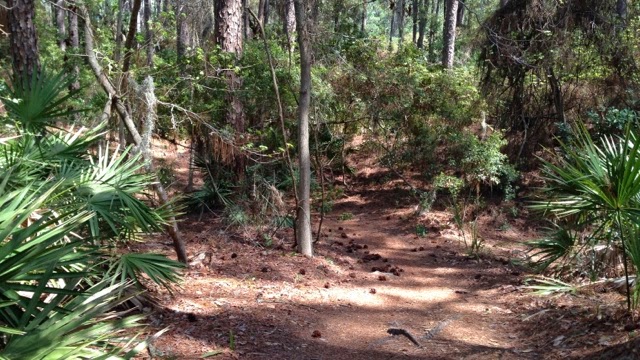
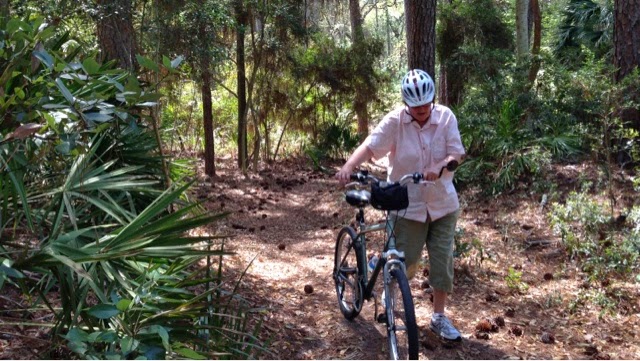
We rode back on a forest trail. Long pine needles, pine cones and palm fronds covered the path which was hilly and had a lot of big roots.

We walked our bikes on some parts of the trail.

After our ride we spent a few hours in the afternoon sun on the beach. I got on my bike and rode on the beach south towards the light house. The damp sand was very firm, easy to ride on and the beach goes on for miles. There are whole trees tipped over where the erosion has moved the beach into the forest.

Very dramatic.

A selfie right on the beach riding my bike.  

Saturday we depart for Charleston. We really wish we had more time here but it is very hard to get into on short notice.  Most people we talked to make reservations at least 6 months in advance. The campground host told me if we want a specific site for next winter then we should make reservations now.  Maybe we will.
We are looking forward to our visit to Charleston.
Roger and Susan

Tybee Island and Savannah, End of March, 2014

Tybee Island

Tybee Island is actually an island. It is about 20 miles east of Savannah at the opening of the Savannah River into the Atlantic Ocean. Our campground is called the River’s End Campground.  It was family owned for about 40 years until the city of Tybee Island bought it several years ago and now runs it. It has over150 site plus a pretty big area for tents.  It seems to have been pretty close to full while we have been here.

The town on Tybee Island is only a mile or so long.  There is a beach on the river side, the north side and the ocean side.  The ocean side beach seem to be where all of the vacationers congregate.  There is a big pier down there and shops all over selling everything for the beach.  Sort of ugly.

The old light house is now a museum. The north end is dominated by an old military battery from around 1900. We enjoyed the north beach. Not too many folks. Upper 70’s.

We were entertained by this little girl in her colorful outfit.  Skipping, dancing, twirling, splashing.  A perfect day at the beach.

We spent a day in Savannah. What a lovely city. There are 24 squares throughout the city. Some are about one block square, one is several blocks wide and a half mile long. The streets run into the squares and then around the squares. This makes everything slow down. The streets are lined with moss covered Spanish Moss. Some are divided with trees right down the middle.

It turns out that Spanish Moss is neither Spanish nor moss. It is an air plant that feeds on dust and moisture in the air.  It is also the home of chiggers, bugs that bite and burrow into your skin. Henry Ford stuffed the seat cushions of early Model Ts with this bug infested plant. His marketing slogan about “Itching to get a Ford” backfired.
The squares have everything from statues to fountains.

There were giant Live Oaks.  Some had people living in them. Kind of sad.

sad

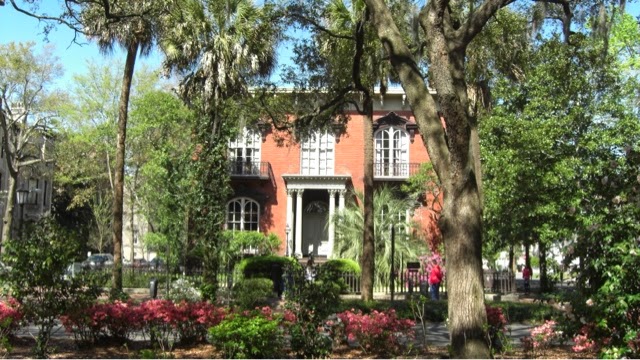
There were some pretty amazing homes. Think of Midnight in the Garden of Good and Evil.

This is it! There are lots more homes to see but I’ll save room for other stuff.

Savannah is the #4 port on the eastern seaboard.  It is a major container and car carrier port as well as LNG (liquid natural gas).  They have a pretty neat stayed cable bridge.

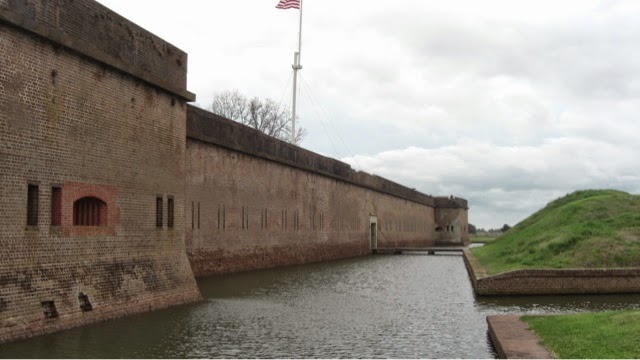
Back at Tybee we checked out Fort Pulaski, a masonry fort built after the War of 1812 to protect ports along the US coast. The walls are 5-8 ft thick mortar and bricks, several million of them and was considered impervious to artillery. It was built over three years under the command of Robert E Lee, right out of West Point. When Georgia seceded from the Union they took over the fort. Union troops set up artillery on Tybee Island more than a mile away. They had conventional round ball cannon and 15“ mortars. They also had new, untried rifled cannon that shot bullet shaped shells.  

The Confederates had hundreds of cannon that shot through openings in the walls and up on the ramparts. The battle commenced early one morning with the conventional cannon and mortars.  There was little damage to the fort.  The following morning three batteries of the new rifled cannon oppened fire concentrating on one corner of the fort. The walls were breeched within hours and when the powder magazine was hit (without exploding) the Confederates surrendured.  There are still rifled shells embedded in the wall.

The days of the round ball cannon and the brick and mortar forts were over after a 30 hour battle. Amazingly only one Union soldier was killed and two Confederates were wounded.

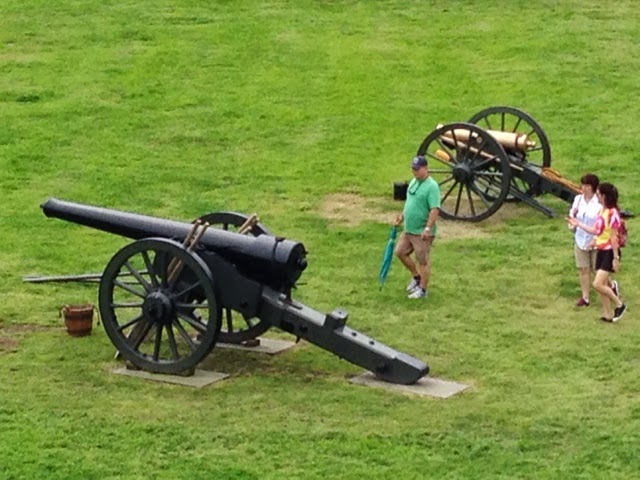
They had cannons on display and at noon they fired a rifled cannon of the type used in the battle (1/2 powder charge, no shell). The big black one.

I used the Burst Mode App on my iPhone to take these pictures about 1/20 second apart, 2 of 100 taken in less than 5 seconds. Aim, get ready …

Fire…

Today we went to the “Mighty 8th Airforce” Museum.  The Mighty 8th started in Savannah as WWII began. It was the main Army Airforce stationed in England flying into western Europe.  There were the Memphis Belle flyers, more than 350,000 in all, air crews and ground crews.  They flew missions for three years.  About 75,000 air crew members were killed or missing in action, taken prisoner or injured.   25 missions was a tour of duty.  Only 1 of three air crew lived to complete a tour of duty.  This museum looked small from the outside but was huge with detailed information, films, dioramas and displays.

A geniune cast iron british phone box. A trainer, a P 51 fighter escort and a B 17 being restored.

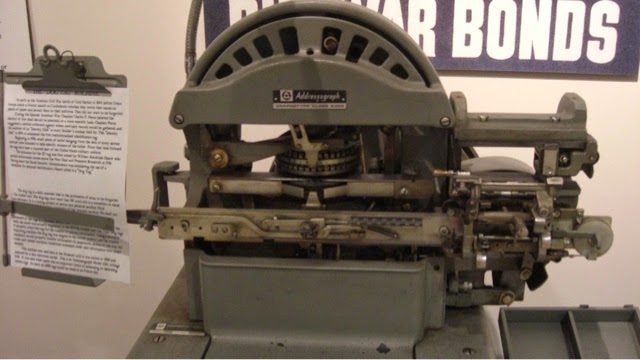
There were displays about the Girl Scouts contibution to the war effort, the sacrifices made by the folks at home, the role of women pilots (WASPs) who ferried aircraft all over the country and machines and equipment used in the war effort.  I liked this one for making up to 1000 sets of dog tags in an 8 hour shift.

That’s a lot for one post, I need to do them more often.
We are leaving in the morning on another hard day of driving, 75 miles, up the coast to South Carolina to Hunting Island State Park for a couple days then on to Charleston.  We want to see what Hunting Island looks like.  They have 1/2 price camping, full hook ups, 50 amps for Dec, Jan and Feb.  You can stay for a month.  Feb 2014 high temps averaged mid 60s with average lows in the upper 40s. 
Check back for more.
Roger and Susan.

Interesting Stuff, Thanks for your Feedback.

Google tracks all sorts of things.  

There have been 383 visits to our blog so far. This does not include the posts being emailed to folks who signed up for emails of the posts.
Visits have come from the US, Russia, Germany, Vietnam, Malaysia and Venezuala. Go figure.
Thanks for following along.  The feedback we get is encouraging and helpful. The blog makes it easy for us to share with those who are interested.
Let us know what you think.
Roger and Susan

Jacksonville, Florida

Wednesday,  March 26. 2014

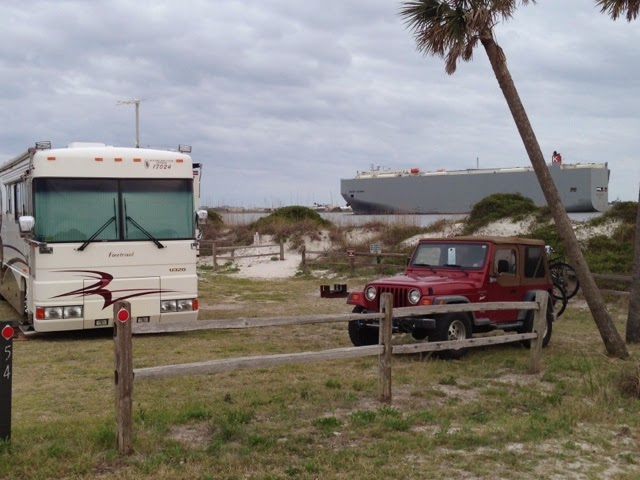
It was about an hour from St Augustine to Huguenot Memorial Park East of Jacksonville. These were French folk during the time when the Spanish were at St Augustine. The Spanish came up to Fort Caroline (near here) and massacred the French. Thus the Memorial Park. We are right on the St Johns river and there be ships!
They are maybe 200 yards away. These are big ocean going ships. The ugly gray thing in the background is a car carrier.
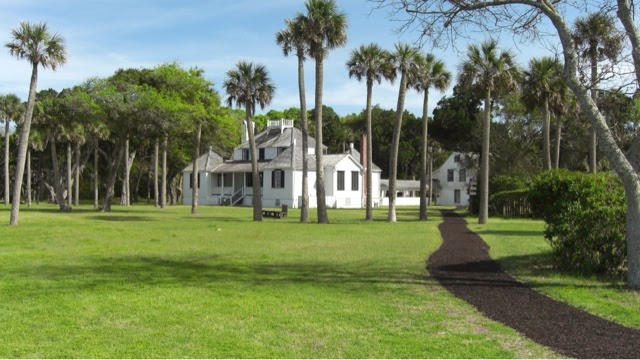
Nearby is a National Park site. The Kingsley Plantation was about 1000 acres of Sea Island cotton.  Established in 1814, Zephaniah Kingsley brought his wife and three children to this remote Fort George Island area. His wife was African, a slave he bought in 1806 in Cuba. He freed her and their children in 1811. She was his business partner and managed the plantation. She became a plantation owner herself as well as a slave owner. Some 60 slaves worked on this Kingsley plantation. When Spain lost control of Florida to the US in 1821 the laws quickly changed the status of free blacks from the Spanish system to a repressive system under the US. By 1837 Kingsley had moved his wife and sons as well as 50 freed slaves to Haiti, a free republic. Their two daughters remained in Jacksonville and married wealthy white men. Kingsley was a very wealthy man. He owned 8 plantations and over 32,000 acres of land and 200 slaves  He moved to New York City and died in 1843 knowing his family was secure.
He built an interesting home on the Fort George River complete with a basement and a widows walk. It was designed to take advantage of the ocean breezes. It is very hot and humid and buggy in these coastal Florida island during much of the year. From the widows walk he could see out to the open ocean and out over his plantation. This is the oldest plantation house still standing in Florida.  
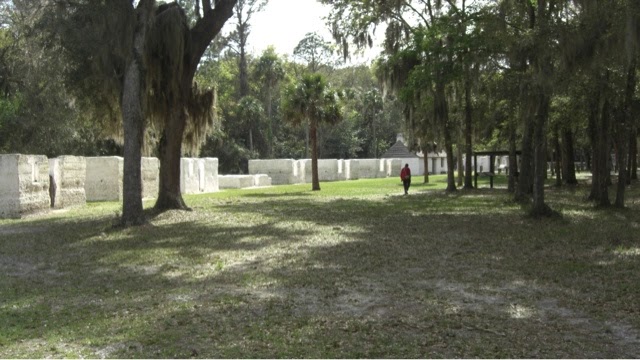
There were barns and other kitchen buildings. Slaves did all the work and lived in small houses they had to build for themselves.

These are mostly in ruins now but stabilized. The information provided told about the harsh and difficult work life the slaves were subjected to and how the community they had outside of work sustained them.  

After Kingsley’s death the Fort george Island plantation was sold to his nephews. They and their descendants continued to operate it until about 1900 when the island began to revert to forest.

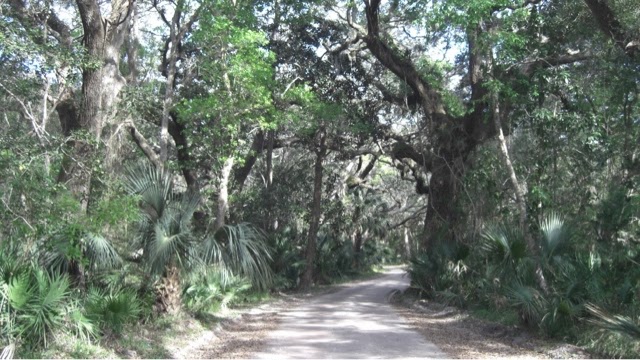
The roads into the plantation are bumpy dirt roads overhumg with Live Oak trees and Spanish moss.
We got back in time to see a parade of giant ocean ships going out and coming in. The Mayport Naval Base is just across the river. There are several big Navy ships there.  The helicopters were flying continuously practicing something. Tha Navy base has a very nice RV park for active duty, reserves and retired military folks.
Thursday, March 27, 2014
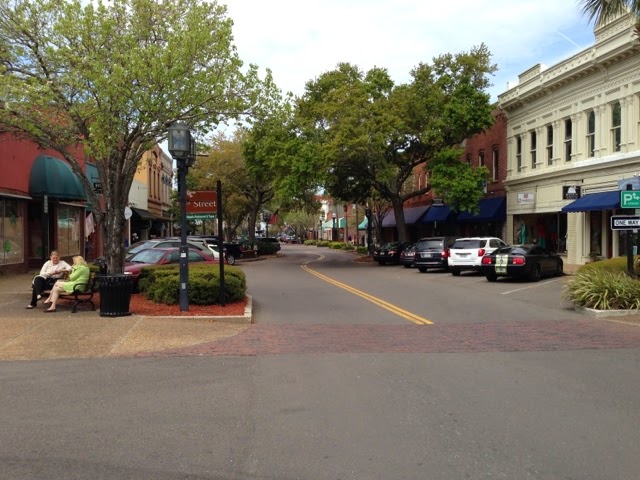
Today we drove a short way to Amelia Island. The southern half of the island is dominated by golf courses, luxury resorts and extrodinary estates. We drove by them. The northern end of the island is the town of Fernandina. Now this is what we were expecting an old historic Southern town was going to look like.
Of course there are beach homes and resorts but not like the other end of the island. Most of these looked like they have been in families for generations like cabins “Up North.” The historic district was maybe a mile square. The main street (Center) was several blocks long and had the majority of the small local businesses.

The post office, the court house, one of the oldest churches in Florida, a really cool bar that looked like it came right out of the 1800’s all were right on Center St.  At one end was the train station and the harbor on Front Street.  So at Front and Center we had a nice lunch.

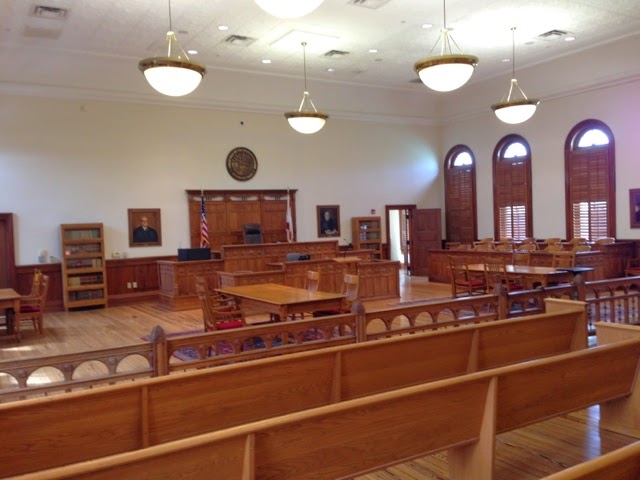
The court house was pretty neat.

We went in and visited the court room.  Right out of “To Kill a Mockingbird”

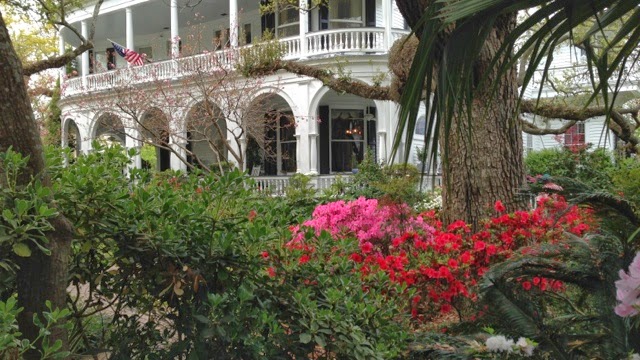
There were a stunning collection of beautiful old homes as well.
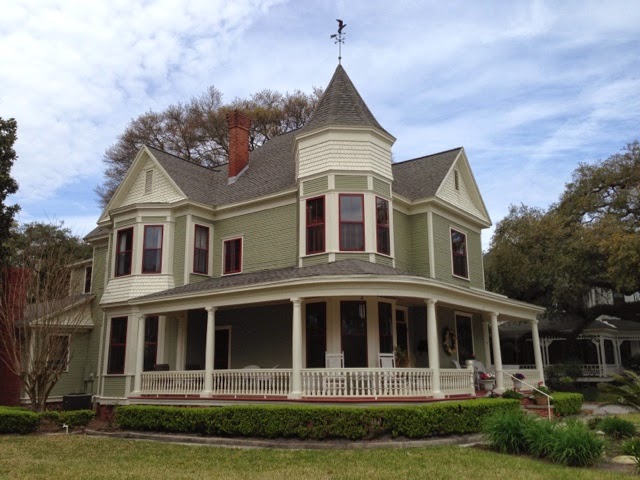
We liked this one.  Pretty much matched the colors on our St Paul home.
We got back to our campsite in the late afternoon just in time to see a monster cruise ship come by.

It is amazing to watch them come down the winding river getting bigger by the minute and the go out to sea.

A car carrier going up stream and the party boat coming down, tooting at one and other.

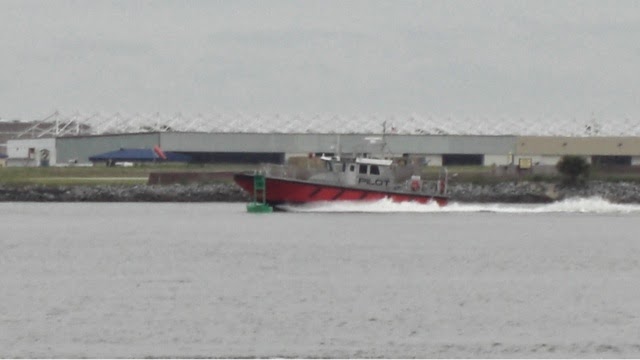
Every boat coming into or leaving the port is handled by a Port Pilot.  A small boat takes them out to the incoming ships and goes out to pick them up as the shipes head out to sea.
This is one of the really interesting things about traveking the way we do. This park would never come up on any normal travel plan and yet here we were seeing the traffic in and out of a major seaport, a charming old historical city on what anyone else would just consider a major resort island and witnessing a complicated and disturbing part of our history as it was 200 years ago.  
We may be driving right by some of the guide books must-see things on our way to see what we discover for ourselves. That is fine with us. Those following the crowds aren’t seeing any if this.
Tomorrow we head for Tybee Island and Savannah, GA. Should be nice.
OBTW.  Checking miles traveled and days gone on this trip.  We are averaging just under 70 miles per day, right on our target.  Susan and I traveled for about 10 months in 1980 and our average over that entire time was about the same.  Gas was very expensive then.  Our average daily fuel expense today is less than it was in 1980 making adjustments for inflation.  Our coach and Jeep weigh 5 times what our van did and we have much more room and comforts.  
More soon.
Roger and Susan

St Augustine, Florida

Monday, March 24, 2014 (somebody’s birthday)

Sorry for the delay, Google Blogger has been misbehaving for several days. Stay away from Google Plus, what a nightmare.

The drive from our Titusville campgound to St Augustine was only an hour and a half. We figured if we got going by mid-morning we would have time for an afternoon visit. We were headed for the Indian Forest Campground just a few minutes west of St Augustine. The folks across the way from us in Titusville were headed there as well and we heard from another Foretravel owner that they were also there.
We arrived shortly after noon and got everything set up. It only takes about 20 minutes and then we were off to see St Augustine. It claims to be the oldest city in the US. Santa Fe might argue with that. They have been a capital city since 1608. We were there in 2008 and they were celebrating their 400th anniversary being a capital city.
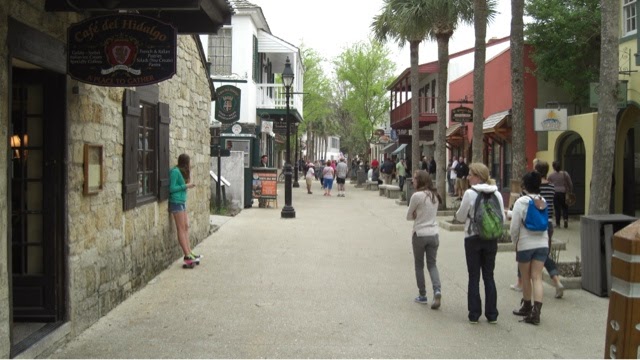
Somehow we were expecting a smaller, sleepy, historic town. Not! It is old all right with narrow, cobbleston streets not much bigger than an alley with lots of old buildings. Allmost all were privately owned and turned into anything that could make money. The oldest, woodem, one-room school house in America was there for you to “tour” for only $40. There were very few free places. Even Parking in the city owned public lot was $10 and a walking tour guide at the visitor’s center was $3.00.
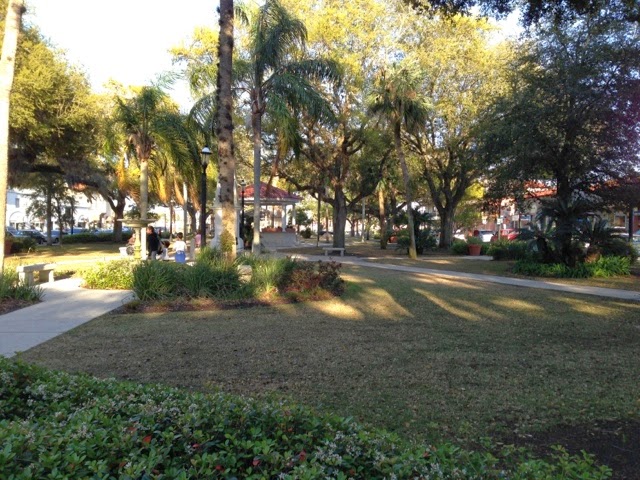
Off we went to see and do. Lots of people, lots of traffic. The city has Spanish origins and had a nice central plaza.

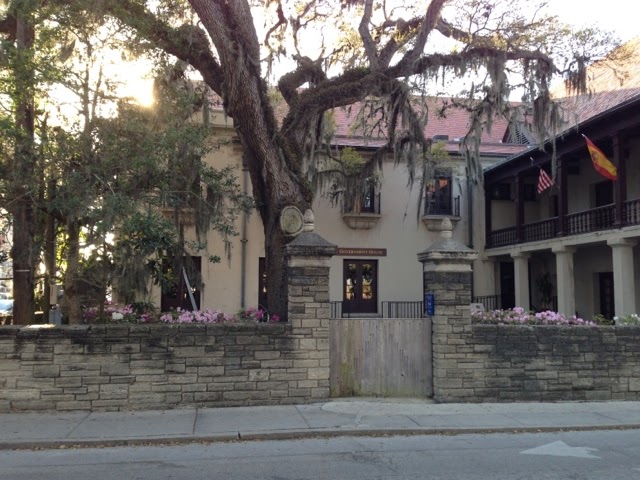
At one end is the Government Center. A Catholic curch on one side and an Episcopal church on the opposite side and at the other end, the market. All the bases covered. No Lutherans anywhere to be seen.

This is not the original Government Center but a rebuilt one. Almost nothing survived the Spanish then the French then the Seven Years War then the Spanish again then the British then the Americans and then the tourists. Mexico had something goimg on in there for a while as well. The city was nearly burned to the ground and most of the inhabitants were killed or fled at every change of control. Nice.  There are only a couple original buildings at all and the tourists are doing their best on those.
The “old” main street is a narrow track filled with tourists, people selling stuff to the tourists and people selling things for the tourista to do.

It really was more crowded than this. It was in the low 60’s with a stiff breeze and not much sun.  Everyone in shorts was secretly suffering. I had my jeans on and was secretly wishing for a jacket.

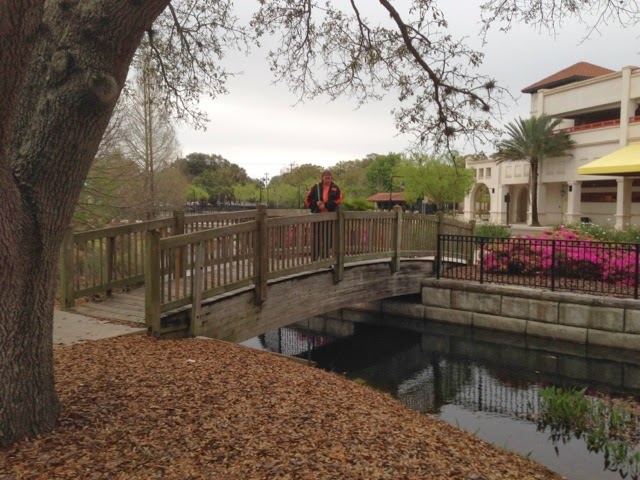
At one end of the historic district was a really nice Visitor Center and a parking ramp half surrounded by a moat and some nice wooden bridges.

The leaves are falling everywhere. It is just like Fall and at the same time everything is covered by a layer of green Sringtime pollen. We had an early dinner at Barnacle Bill’s, shrimp. It was sort of like eating with Forrest Gumps shrimp cooking buddy, shrimp every conceivable way. We had the shrimp. I had some cheesy grits as well. Pretty tasty.

St Augustine is the home of Flagler College. Now we know where our friend Bob Flagler is spending his winters.

Beautiful woodwork inside and stunning murals.

No idea what they teach here but the buildings were pretty amazing!
Back at the campground after a grocery stop I visited Forrest and Mary Clark, Foretravel full timers originally from Green Bay, WI. They were very nice. It is always nice to meet folks and swap stories about things we have in common.
Tuesday, March 25, 2014
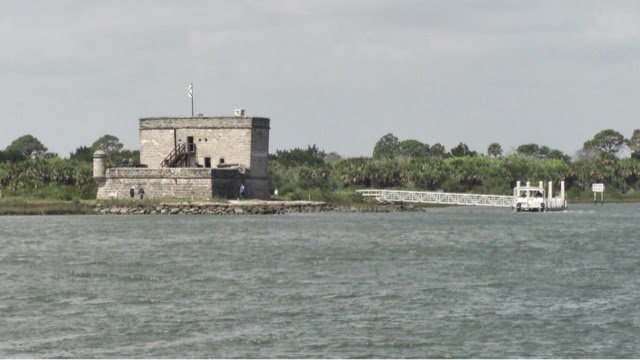
Today we drove over the bridge to Anastasia Island and then to the southern end where the Matanzas River empties into the Atlantic Ocean. The Spanish built a fort there in 1740 made of shells, sand and ground up shells burned in a fire to get lime ash to make cement. This small fort (Fort Matanzas) was about 50’x50′ and 30′ high. It had six cannon, a watch tower and was manned by 6-8 soldiers for a month at a time from the bigger fort at St Augustine. It is a National Park site and you have to take a free ferry to get to it.
It took three years to build.  After long since falling into disrepair (ruin) it has been restored. Their cannon could reach the inlet a mile away to deter invaders or unwanted visitors (French). Can you imagine a month out here almost 300 years ago in the summer heat, humidity and mosquitos? In your Spanish Army duds?

We followed the Atlantic coast line back to the far northern end of the island to Anastasia State Park. A friendly ranger gave a short term visitor pass so we could check out the campground.  We were going to stay here but it was full. No wonder. It is a nice park, nice campsites and right near the ocean beaches. Across the road from the park is the St Augustine Light Station. We went on the walking tour (for a small fee, of course).

The keepers scraped and painted the tower twice a year. It would sort of make me dizzy.
The keepers house (a duplex) was beautiful, surrounded by huge Live Oak trees. It is the most grand light keepers quarters that I have ever seen. The Live Oak trees were prized by shipbuilders because of all the crooked branches that happened to be the shape of the ship parts they needed. 

The interior was deluxe Southern Victorian.

There were also displays about the shrimp boat building business and the shrimping industry. St Augustine played a major role in the development of both. More displays were about hunting for ahip wreaks off the coast and recovery and the restoration of artifacts. There were classes going on about the craft of building wooden boats.  A simple sail boat and a nice looking row boat were in progress.  Very nice. As a woodworker it has always been something I would like to do.

Then it was off in search of another seafood experience.  The day before we had picked up a menu for Harry’s New Orleans Style seafood place.  It looked very good. Off the island, one way, over the draw bridge. Pretty easy going into St Augustine. Three directions of traffic converged on the bridge from the mainland side and cars were backed uo for several block in every direction. We found a parking spot just a half block from Harrys. It was a very pleasant outdoor, early evening dinner.
Sorry, no dinner pictures, we ate it all before taking any. We shared crab cakes, blackend red fish, red beans and rice, grilled andouille sausage, cole slaw and key lime pie. No leftovers. Why is it called cole slaw?
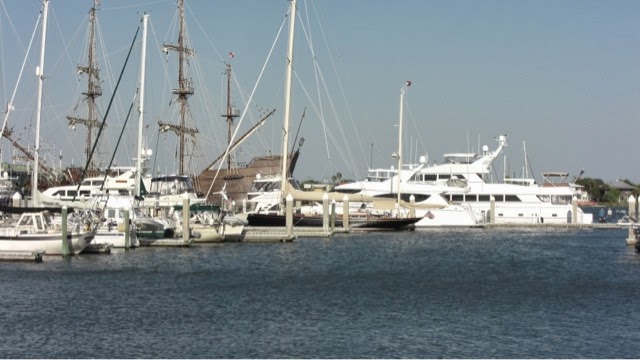
After dinner we walked to the city’s public marina. There was a tall ship there that calls St Augustine one of it’s home ports around the world.

A few other tubs floating around as well.

The beautiful balck sail boat was 78′ long.  The next white boat out was close to a hundred. The monster at the end was about 160′ long.  I walked out there and the bottom row of rectangular windows just above the dock were about head high on me.  A guy there said it had a crew of 20 and was available for lease by the month.
Where is my row boat? Actually we would like to get a couple of kayaks to haul with us if we are going where we might be able to use them.
Back to the Indian Forest Campground where it is dropping into the 40’s overnight.  We are off to a Jacksonville city campground on the St Johns river where it empties into the Atlantic. The Mayport (I thought it was the Mayhem) Naval Air Station is right across the river. The river is the main seaway access to the port of Jacksonville. Maybe some big ships?
More as soon as I can.  And Google willing.
Roger and Susan

Kennedy Space Center, Lakeland, Cape Canaveral National Seashore

Thursday, 3/20/2014

We have been waking up early, we switched to Daylight Savings time and then into Eastern time. It is wierd, we wake up when we feel like we are supposed to and it is still dark. It gets light here about 7:20. It just feels odd. KSC opens at 9 so we got going in plenty of time. We got in, parked (for $10) and then got to the main gate where you get tickets. That took a short while and we were in.
There was a Rocket Garden that had most of the rockets launched from the KSC since the early 1960s. There were lots of different kinds of exhibits covering everything from explorer robots to the  Cape Canaveral Wildlife Refuge. A two hour bus tour of the launch complex was part of the admission.  We went by the Vehicle Assembly Building. In a picture it doesn’t look that big since there is no reference. Each of thoste vertical doors is almost 40 stories tall. The doors at the bottom of each vertical door open up to more than 120′ wide. Four Empire State buildings would fit inside. 9 NFL football fields would fit on the roof. It is the largest building by volume on the planet..

Two giant mobile transporter platforms moved the Saturn V rockets and the Moon Mission vehicles to the launch pad. Only a few years later they carried the space shuttles out to the same launch pads. 

There are two launch pads like this that were used for the Space Shuttles. There were more than 30 launch pads all up and down the Cape. As the Space Age unfolded and the Space Race heated up there ware launches from the Cape every 10-14 days. When the shuttles were launched more than 1/2 million gallons of water was flooded through the flame diverters in just a few seconds to keep them from melting. It was mostly steam from this water that you saw during a launch billowing out from the launch pad. This launch pad is being rebuilt for the new Space Launch System, a rocket bigger than anything before. The second launch pad is being rebuilt as well.

 
The bus tour stopped at a big “going to the moon” exhibit. There was on the three remaining Saturn V rockets, a Lunar Command Module, a Lunar Lander, a Lunar Rover, space suits that had been to the moon and back complete with moon dust still clinging to them and the actual launch command center.

Susan met a friend there.

The Space Shuttle Atlantis is the main attraction now. After it landed ending the final shuttle mission and the end of the shuttle program after more than 30 years it was towed to the partially completed display building, raised into position and then the building was finished around it.

There were some very well done videos going in and then the doors opened and Atlantis was right there, tipped at an angle (43.21 degrees like a countdown) to give you sort of an astronaut’s view from space.  It is something to behold.  Something I worked on before it ever flew and now 40 years later its mission is complete.  I always hoped to see a launch but that never worked out. To see this in person, so close was pretty stunning for me.  

Atlantis is just as it was on its return, scorch and burn marks included.

The payload bay is 15′ in diameter and 50′ long.

My dad led the program at Honeywell in the 70’s to develop the shuttle main engine controls. Lots of meaning here for me. Pretty amazing!  

Lunch then an IMax movie on the Hubble Telescope. It was a very full day.
Friday, 3/21/2014
We went to Lakeland about 70 miles west of here to visit a couple (Larry and Nancy) we met last winter in Texas. They are Foretravel owners and live in an RV community in Florida during most of the winter and travel in the summer. We went for a pontoon boat ride on the lake in their community and had a nice lunch. Later we had carrot cake and a visit. They were fun to see.

Owners could have just an RV pad with water, electricity and sewer connection. Some of these may have storage sheds. More common is a house ( of various sizes) with garages. This one had an RV port, a two car garage and a golf cart garage. Most have two or more bedrooms.

A very nice day.

Saturday, 3/22/2013
Today we went grocery shopping. We were going to a farmers’s market in Titusville but they had closed it down. So we went to the Waffle House for breakfast. Actually, pretty good. Then a Super Target for groceries. Home by 10 and then off to the Cape Canaveral National Seashore. It is the north end of the Cape, north of the 300 ft x 3 mile long shuttle landing facility (SLF). Actually a runway. Everything at the KSC and all of the systems were assigned an acronym. Some were funny.
Out in the National Seashore there was a place where manatees are frequently seen.
They were right there by the shoreline.  Pretty big, up to 12 ft long. There were six in the shade. They eat underwater sea grass. They are distantly related to elephants and evolved from land animals. They like the water to be warmer than 70°. The water thermometer there said it was 76° 

Then we went to the beach. There were 12 beach access points with parking. They averaged about a half mile apart. These were the access points to the beach on the south 1/4 end of the shore. About 1/2 was accessible from the north. There was a big section with no access by car in the middle, just walking on the beach.

This beach literally goes on for miles. We were only about a mile from one of the shuttle launch pads. Lots of folks fishing.

Susan got to wear her “blind glasses” and her new sun hat.
We walked way down the beach and back. More than 10,000 steps. Wore down the bottom of our bare feet. Mid 80’s today, strong southerly breeze. It was very nice.

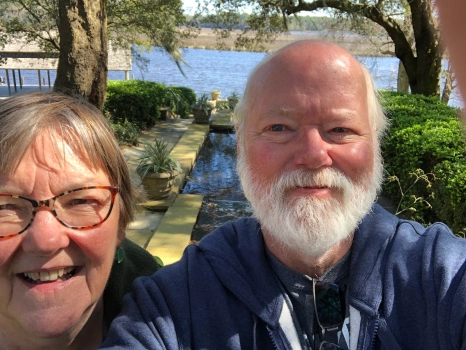
A selfie.
Another fine day. Tomorrow we will try for a farmer’s market in Cocoa. Maybe a quiet day. Maybe a book day. Maybe some more beach time. That’s all tomorrow. Moving up to St Augustine on Monday.

Roger and Susan

East Coast of Florida

Tuesday, 3/18/2014. 

We had one last thing to do in the Apopka area before we left. The Charles Hosmer Morse Museum of American Art in downtown Winter Park was one place we did not want to miss. It houses the largest collection of Louis Comfort Tifanny art work in the world. There are paintings, drawings, glass work, windows, parts from his Laurelton Hall home’s dining room, living room and other rooms and the Chapel originally created for the 1893 Columbian Exposition in Chicago and later restored and installed at Laurelton Hall. There are also extensive collections of art pottery and furniture in the Arts and Crafts style and from the Art Nouveau period.
No pictures were allowed inside. This is from the Museum website. It is hard to describe how amazing all of the different things were. And then there was a pretty stunning gift shop.
Winter Park was very nice.
Right downtown there was a beautiful park (the land came from Charles Morse). There was a train station right in the center of the park on the other side. And just then the orange and white Amtrack train came into town. Maybe it was the Orange. Blossom Special. The orange trees are in bloom and the air is filled with an refreshing aroma.

The streets are all cobblestone and tree lined. Mostly small shops and eateries. A Panera Bread was on this corner. The museum a half block down the street on the left. A nice looking church where Susan’s cousin attends was a block down on the right.  

So a nice stroll around the park and downtown and then back to the coach and off towards Titusville.

We are staying at a county park campground just south of the causeway leading over to the Kennedy Space Center. It is an older park right on the water with campsites complete with water, power and sewer connections and pretty good wifi. The sites are wooded, some pretty large, some big enough.
Ours was easy enough to get into and while not the biggest in the park just fine for our 6 day stay.  We discovered a couple from Cottage Grove in the campground today. They have been here since December and have been here every year for the last seven.  You can stay here for up to 180 days each year.  There is a fishing pier at the park. It doesn’t look like it is more than four feet deep at the end.  Across the “river” (the intercoastal waterway) is the Kennedy Space Center.  Between the trees is the Vehicle Assembly Building where the moon rockets and space shuttles were prepared for launch before they were moved to the launch sites. 
Zoom, zoom…

And right across from us is the KSC Visitor’s Center that wee will visit on Thursday. The Space Shuttle Atlantis the on display there.  A two hour bus ride through the entire launch complex, iMax movies, the Astronaut Hall of Fame and more is all part of the rather pricey admission price (although it is about 1/2 the cost of goint to Disney World).  The big orange and white thing is the space shuttle main fuel tank and the solid rocket boosters standing next to the Visitor’s Center.  It is at least five miles away.

Tha park has a large grassy area right on the water.  A great place to watch a launch.
Last night we created two home made small Evil Jungle Pizzas.  A spicy peanut sauce, barbeque chicken, carrots, onions, red pepper, snap peas and cheese.  Very tasty.
Perfect.
Today we drove down the coast to Melbourne Beach and over the causway to Cape Canaveral and the back up along the ocean side through Cocoa Beach and on to the Kennedy Space Center and back to our comfy home on wheel.
Plugging along ..
Roger and Susan